
Guide to Optimism Bias in Marketing: Description, Psychology, and Examples
What Is Optimism Bias?
Optimism Bias is the tendency for people to systematically overestimate the likelihood of positive events and underestimate the likelihood of negative events happening to them personally, believing they’re more likely to experience good outcomes than others. This powerful cognitive bias explains why consumers continue to purchase lottery tickets despite astronomical odds, sign up for gym memberships they rarely use, and invest in products with the conviction that “this time will be different.”
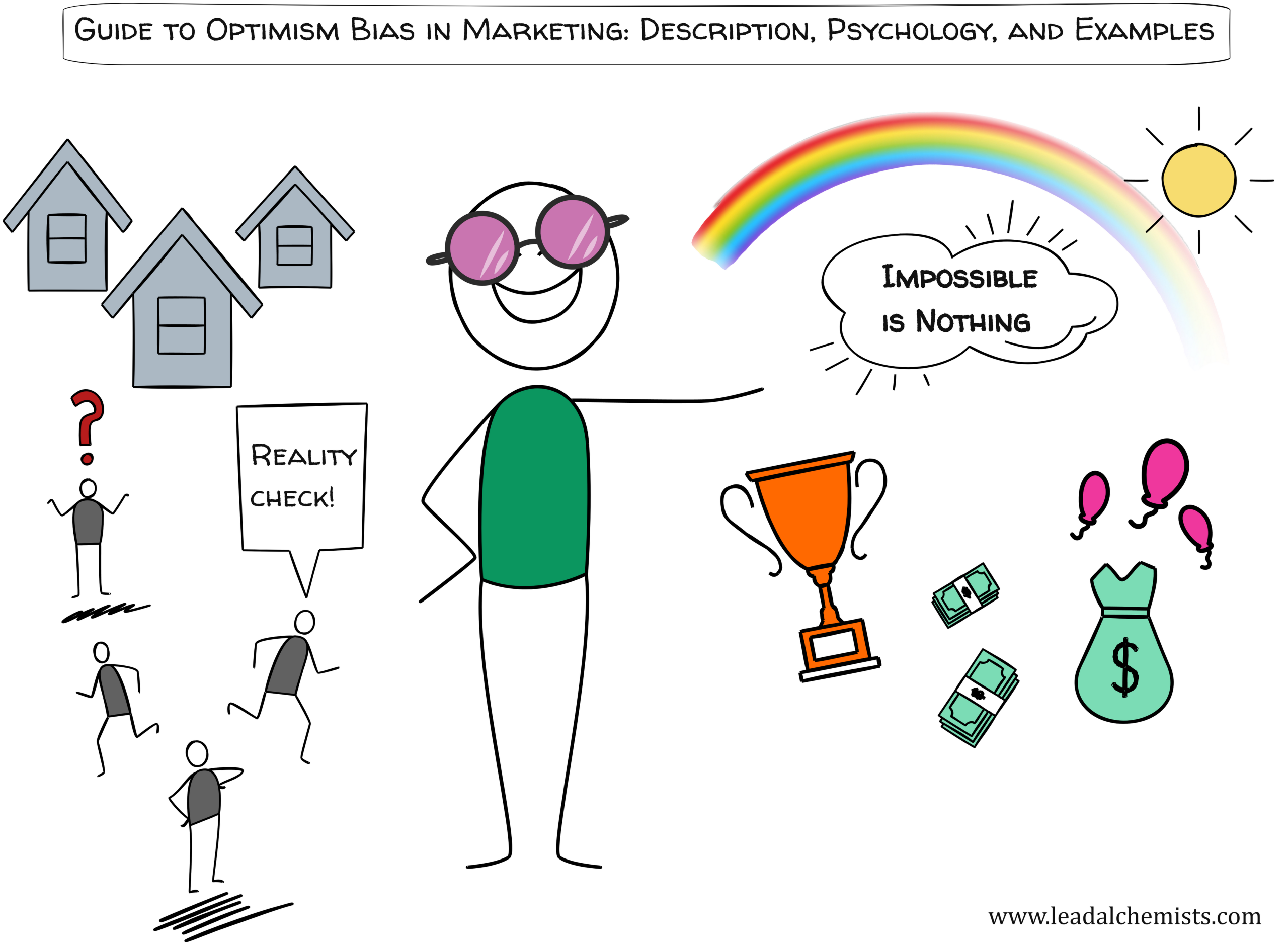
At its psychological core, Optimism Bias works because humans are cognitive misers – we instinctively protect our self-image and emotional wellbeing by believing we’re special exceptions to negative statistics. When evaluating risks and opportunities, our brains automatically inflate the probability of positive outcomes for ourselves while deflating negative ones, making it far more likely that we’ll pursue aspirational purchases and goals rather than confronting the uncomfortable reality that we face similar odds as everyone else.
For marketers and advertisers, understanding this bias gives a real competitive edge. By purposefully and strategically framing products and services in ways that align with customers’ optimistic self-perception while delivering genuine solutions to their needs, you can inspire action and engagement in ways that other persuasion techniques simply cannot match.
How Optimism Bias Actually Works
The Brain Science of Optimism
Optimism bias isn’t just a quirk of human nature – it’s hardwired into our neural circuitry. Neuroimaging studies by Dr. Tali Sharot and colleagues have revealed that optimism bias is linked to specific brain activity patterns:
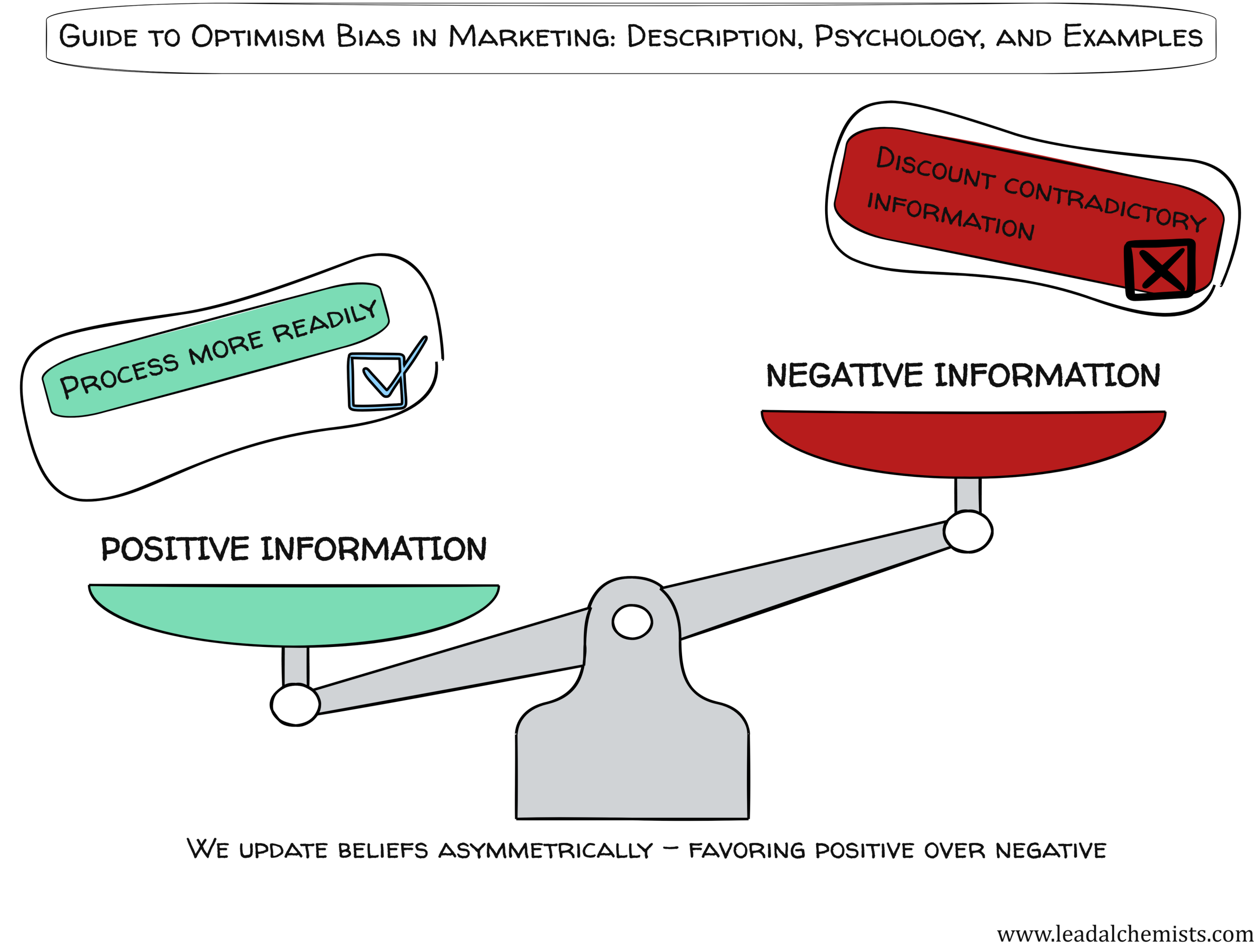
Selective Information Processing: Our brains process positive information about the future more readily than negative information. When we receive good news that confirms our optimistic outlook, we integrate it quickly. When we receive contradictory negative information, we tend to discount it.
Neural Mechanisms: The anterior cingulate cortex and amygdala play crucial roles in processing prediction errors related to optimism bias. These brain regions respond differently to information that confirms versus challenges our optimistic expectations.
Belief Updating Asymmetry: Research shows we’re more likely to update our beliefs when presented with positive information than negative information. This creates a self-reinforcing cycle that maintains our optimistic outlook despite contradictory evidence.
Interestingly, this bias appears to be absent or diminished in people with depression, suggesting it may serve an adaptive function for mental health and motivation.
The Evolutionary Advantage
Why would our brains evolve to distort reality? Researchers suggest optimism bias offers several evolutionary advantages:
- Increased Persistence: Optimistic individuals are more likely to persevere through challenges
- Reduced Stress: Believing positive outcomes are more likely reduces anxiety
- Enhanced Motivation: Optimism about future rewards drives goal-directed behaviour
However, this same bias can lead to poor decision-making when it causes people to underestimate genuine risks or overcommit to unlikely outcomes.
Real-World Examples of Optimism Bias
Optimism bias influences decision-making across numerous domains:
In Health Decisions
People consistently underestimate their personal risk of developing health conditions. Studies show smokers acknowledge smoking causes cancer but believe they’re personally less likely to develop it than other smokers.
In Financial Planning
Investors routinely overestimate their ability to pick winning stocks and time the market. This overconfidence contributes to excessive trading and risk-taking behaviours.
In Project Management
The “planning fallacy” – a manifestation of optimism bias – leads project managers to consistently underestimate completion times and budgets. This explains why large projects are notoriously late and over budget.
In Marketing and Advertising
Brands leverage optimism bias through aspirational messaging that encourages consumers to envision positive future states. For example:
Adidas “Impossible is Nothing” Campaign: This campaign directly tapped into optimism bias by encouraging consumers to believe they could overcome seemingly impossible obstacles. The results were impressive: an 11% increase in sales and doubled U.S. market share within a year of launch.
Old Spice “The Man Your Man Could Smell Like” Campaign: These adverts created improbable, aspirational scenarios that invited viewers to project themselves into a better future. The campaign led to a 38% increase in sales and a 300% increase in website traffic.
Liberty Mutual “Responsibility” Campaign: This campaign leveraged optimism bias by encouraging viewers to see themselves as “more responsible than others.” Research showed 90% of surveyed respondents believed they were more responsible than others after exposure to the campaign.
How Optimism Bias Affects Consumer Behaviour
Optimism bias influences consumer behaviour in several key ways:
Purchase Decisions
Consumers routinely overestimate how much they’ll use products or services they purchase. This explains the “aspirational purchase” – buying exercise equipment, productivity tools, or educational materials based on an optimistic view of future behaviour.
Risk Assessment
When evaluating products or services, consumers tend to discount potential downsides or limitations whilst amplifying potential benefits. This skewed risk assessment makes certain marketing approaches particularly effective.
Brand Loyalty
Optimism bias contributes to brand loyalty by creating positive associations between brands and desired future states. When consumers associate a brand with their optimistic vision of the future, they develop stronger emotional connections.
Psychological Triggers
Several factors can amplify optimism bias in marketing contexts:
Temporal Distance: The further in the future an outcome is, the more optimistically it’s viewed
Vivid Imagery: Detailed, concrete visualisations of positive outcomes strengthen optimistic expectations
Testimonials: Success stories trigger optimistic self-comparisons (“If they can do it, so can I”)
Case Studies: How Marketers Use Optimism Bias in Advertising
Let’s examine how real companies have successfully leveraged optimism bias in their marketing strategies:
Adidas “Impossible is Nothing” Campaign
Optimism Bias Mechanism: The campaign encouraged consumers to believe they could overcome seemingly impossible obstacles – a direct application of optimism bias.
Implementation: Adidas invited athletes and consumers to share stories of achieving the “impossible,” creating a narrative that reinforced the belief that with Adidas products, extraordinary achievements were within reach.
Results: The campaign generated an 11% increase in sales and doubled Adidas’s U.S. market share within a year of launch. Industry recognition included a Gold Lion at Cannes and Marketer of the Year from Footwear News.
Key Takeaway: By aligning their brand with consumers’ optimistic self-perception, Adidas created powerful emotional connections that drove measurable business results.
Subscription Box Services
Optimism Bias Mechanism: Subscription boxes tap into optimism bias by promising future enjoyment and convenience. Consumers sign up based on optimistic expectations about the value and delight they’ll receive.
Implementation: Subscription box websites feature aspirational imagery and testimonials focusing on positive experiences, reinforcing potential customers’ optimistic outlook.
Results: Whilst not solely attributable to optimism bias, the subscription e-commerce market grew by more than 100% annually over a five-year period, according to McKinsey & Company.
Key Takeaway: Services that leverage future anticipation can benefit from optimism bias, but must deliver on promises to maintain customer retention.
Practical Applications for Google Ads and Lead Generation
Here’s how businesses can apply optimism bias principles to improve lead generation:
Google Ads Copywriting and Ad Design
Frame Ad Copy Around Positive Outcomes: Instead of describing what your service does, focus on what the customer will achieve. For example:
- Weak: “Professional Tax Preparation Services”
- Strong: “Maximise Your Tax Refund This Year”
This approach is supported by behavioural economics research on framing effects (Tversky & Kahneman, 1981).
Use Future-Focused Language: Incorporate language that helps prospects envision positive future states:
- “Imagine never worrying about…”
- “Picture yourself enjoying…”
- “Start your journey towards…”
A/B Test Optimistic vs. Feature-Focused Messaging: Run a controlled experiment with two advert variations:
- Version A (Control): “Affordable Plumbing Repairs”
- Version B (Optimism Bias): “Enjoy Peace of Mind with Reliable Plumbing”
Track click-through rates and conversion rates to measure the impact of optimism-focused messaging.
Landing Page Structuring for Lead Generation
Visual Anchors of Ideal Future States: Use imagery that represents the positive outcome after using your service. For example, a career coaching service could show images of clients celebrating new job offers or achieving career milestones.
Benefit-Oriented Form Labels and CTAs: Replace generic form buttons with benefit-focused language:
- Instead of “Submit,” use “Get Your Free Consultation”
- Instead of “Download,” use “Start Your Journey to Financial Freedom”
Future-Self Focused Lead Magnets: Frame lead magnets as tools to help clients achieve their desired future:
- Instead of “Guide to Investing,” offer “5 Steps to Secure Your Retirement Future”
- Instead of “Fitness Tips,” offer “Your Personalised Plan to a Healthier, More Energetic You”
Website UX and Form Optimisation
Testimonials and Success Stories: Group testimonials strategically to leverage both social proof and optimism bias. A local law firm could feature multiple client success stories on their contact page to boost enquiries.
Before-and-After Demonstrations: Show visual evidence of transformation. A home renovation company could showcase before-and-after photos of completed projects, allowing prospects to envision similar positive changes.
Low-Risk Entry Points: Offer free consultations or assessments that allow potential clients to experience your service with minimal risk. This increases optimism about potential outcomes whilst reducing perceived barriers to engagement.
Why Marketers Should Care About Optimism Bias
Optimism bias offers marketers a powerful tool for ethical persuasion for several reasons:
Enhanced Conversion Potential
When marketing messages align with consumers’ naturally optimistic outlook, they become more persuasive. By framing offerings in terms of positive future outcomes, marketers can significantly increase conversion rates.
Emotional Connection
Optimism bias creates opportunities for deeper emotional connections with consumers. When brands become associated with positive future states, they benefit from stronger loyalty and engagement.
Differentiation Strategy
In crowded markets, leveraging optimism bias can help brands stand out by focusing on aspirational outcomes rather than features or specifications that competitors might match.
Ethical Considerations
Whilst optimism bias offers powerful marketing opportunities, ethical application is essential:
Avoid Unrealistic Claims: Never promise outcomes that your product or service cannot reasonably deliver.
Provide Balanced Information: Whilst emphasising positive outcomes, also provide realistic expectations about effort, time, or limitations.
Consider Vulnerable Audiences: Be especially careful when marketing to groups who may be particularly susceptible to optimistic messaging, such as those in financial distress or with health concerns.
Transparency Matters: Be transparent about potential challenges or limitations associated with your product or service.
How to Implement Optimism Bias in Your Marketing Strategy
Follow these steps to ethically and effectively incorporate optimism bias into your marketing:
Step 1: Identify Your Customers’ Desired Future States
- What positive outcomes do your customers hope to achieve?
- What problems do they optimistically believe can be solved?
- What aspirational identities do they hold for themselves?
Step 2: Connect Your Offering to Those Desired States
- Reframe your product/service descriptions to emphasise outcomes over features
- Use imagery that depicts the positive future state
- Create messaging that bridges the gap between current reality and desired future
Step 3: Reinforce Optimistic Expectations Throughout the Customer Journey
- Align advert copy, landing pages, and follow-up communications around consistent positive outcomes
- Use testimonials and case studies that demonstrate achieved positive outcomes
- Provide tools that help customers visualise their progress towards desired states
Step 4: Test and Refine Your Approach
- A/B test optimism-focused messaging against feature-focused alternatives
- Measure not just conversion rates but also customer satisfaction and retention
- Refine messaging based on which specific positive outcomes resonate most strongly
Best Practices and Common Pitfalls
Best Practices:
- Focus on realistic, achievable positive outcomes
- Use concrete, specific language rather than vague promises
- Balance optimistic messaging with transparent information
- Segment audiences to tailor optimistic messaging to specific desires
Common Pitfalls:
Failing to deliver on the optimistic vision you’ve created
Overpromising results that create unrealistic expectations
Using generic “positive” language without specific outcomes
Ignoring potential obstacles or challenges entirely
Related Psychological Biases and Effects
Optimism bias works alongside several related psychological phenomena:
Confirmation Bias: People tend to seek information that confirms their existing beliefs, including their optimistic outlook. This can amplify optimism bias by filtering out contradictory evidence.
Availability Heuristic: People judge probabilities based on how easily examples come to mind. Marketers can leverage this by making positive outcomes more mentally available through vivid examples and testimonials.
Halo Effect: Whilst optimism bias focuses on future expectations, the halo effect involves generalising positive impressions from one area to another. These biases often work together in brand perception.
Social Proof: When combined with optimism bias, social proof becomes particularly powerful. Seeing others achieve positive outcomes reinforces the belief that “I can do it too.”
Frequently Asked Questions
What is the Optimism Bias and how does it affect our thinking?
Optimism bias is a cognitive bias where people systematically overestimate the likelihood of positive events and underestimate the likelihood of negative events in their own lives. This mental tendency leads us to believe that we’re more likely to experience good outcomes and less likely to experience bad ones compared to others. The bias affects our thinking by creating an unrealistically positive view of our future, which can influence decision-making across many areas of life.
Research shows this bias is linked to selective information processing in the brain, particularly in the prefrontal cortex, where we tend to incorporate positive information more readily than negative information about our future.
How does Optimism Bias influence our daily decision-making process?
Optimism bias influences daily decision-making by causing us to underestimate risks and overestimate potential benefits. This affects decisions in several key ways:
Health choices: People often underestimate their personal risk of developing health conditions, leading to less preventive behaviour
Financial decisions: Investors may take excessive risks, believing they’re more likely to succeed than statistics suggest
Project planning: We consistently underestimate how long tasks will take to complete (the “planning fallacy”)
Relationship expectations: Many enter relationships with unrealistic expectations about future happiness
This bias can be both beneficial (increasing motivation and resilience) and harmful (leading to poor risk assessment and inadequate preparation for challenges).
What’s the difference between Optimism Bias and positive thinking?
Optimism bias is fundamentally different from positive thinking in several important ways:
Measurable vs. intentional: Optimism bias is a measurable cognitive bias that occurs automatically, whilst positive thinking is a deliberate mental approach
Accuracy vs. attitude: Optimism bias involves inaccurate probability assessments about future events, whereas positive thinking is an intentional attitude or mindset
Unconscious vs. conscious: Optimism bias operates largely unconsciously, whilst positive thinking is a conscious choice
Statistical error vs. coping strategy: Optimism bias represents a statistical error in judgement, whilst positive thinking is a psychological coping strategy
Research shows optimism bias has specific neural correlates and can be measured through experimental tasks, unlike general positive thinking which is more subjective and intentional.
Who first discovered the Optimism Bias and when was it studied?
Neil D. Weinstein first formally documented optimism bias in his groundbreaking 1980 study published in the Journal of Personality and Social Psychology. His paper, “Unrealistic optimism about future life events,” demonstrated that people consistently believe they are less likely than their peers to experience negative events and more likely to experience positive ones.
Whilst Weinstein established the foundational research, the field expanded significantly with Tali Sharot’s neuroimaging studies in the 2000s. Sharot and colleagues used fMRI technology to identify the neural mechanisms behind optimism bias, showing how the brain processes positive and negative information differently. Her 2011 paper in Nature Neuroscience, “How unrealistic optimism is maintained in the face of reality,” was particularly influential in explaining the cognitive mechanisms that maintain this bias.
What brain regions are involved in Optimism Bias according to neuroscience research?
Neuroscience research has identified several key brain regions involved in optimism bias:
Prefrontal cortex: Plays a central role in processing prediction errors related to optimism bias, particularly when updating beliefs based on new information
Anterior cingulate cortex: Involved in error detection and processing differences between expected and actual outcomes
Amygdala: Shows differential activity when processing positive versus negative information about future events
Inferior frontal gyrus: Activated during belief updating, with asymmetric responses to positive versus negative information
Sharot’s neuroimaging studies (2007, 2011) demonstrated that these regions show selective activity patterns when people process information that either confirms or challenges their optimistic expectations. The brain appears to incorporate positive information more readily than negative information, maintaining the optimistic outlook even when faced with contradictory evidence.
Are there any studies that challenge the existence of Optimism Bias?
Whilst optimism bias is well-established, several studies have challenged its universality and consistency:
Cultural variations: Research by Fischer & Chalmers (2008) found that optimism bias varies significantly across cultures, being less pronounced in collectivist societies compared to individualistic ones
Depression exception: Garrett et al. (2014) demonstrated that optimism bias is reduced or completely absent in people with depression, who often show more accurate (or even pessimistically biased) predictions
Methodological critiques: Some researchers have questioned whether the standard measurement approaches truly capture bias rather than rational responses to ambiguous questions
Context dependency: Studies show the bias fluctuates based on context, mood, and specific domains being evaluated
These challenges don’t disprove optimism bias but suggest it’s not universal across all populations, situations, or mental states. The research indicates optimism bias is a complex phenomenon with important boundary conditions and exceptions.
What role did Tali Sharot play in Optimism Bias research?
Tali Sharot made groundbreaking contributions to optimism bias research by uncovering its neurological basis and mechanisms. Her key contributions include:
Neural mechanisms: Her 2007 study in Nature identified specific brain regions activated during optimistic thinking, providing the first neuroimaging evidence of optimism bias
Belief updating model: In her influential 2011 paper, Sharot demonstrated that people update their beliefs asymmetrically – incorporating positive information more readily than negative information
Computational framework: She developed computational models showing how optimism bias functions as a domain-general prior for positive outcomes
Popular science communication: Her 2012 book “The Optimism Bias” and TED talk brought this research to wider public awareness
Sharot’s work transformed our understanding of optimism bias from a purely psychological phenomenon to one with identifiable neural correlates and computational principles. Her research helped establish that this bias has deep roots in how our brains process information about the future.
What are some famous real-world examples of Optimism Bias in action?
Optimism bias manifests in numerous real-world contexts with significant consequences:
The 2008 financial crisis: Lenders, investors, and homebuyers systematically underestimated the risks of subprime mortgages and complex financial instruments
Major infrastructure projects: The Sydney Opera House was originally estimated to cost $7 million and take 4 years to build – it ultimately cost $102 million and took 14 years
Start-up entrepreneurs: Studies show founders consistently overestimate their chances of success, with 80% believing their business has a 70%+ chance of success despite 70% of start-ups failing within 10 years
Health behaviour: Smokers typically believe they’re less likely than other smokers to develop lung cancer or heart disease
In marketing, campaigns like Adidas’ “Impossible is Nothing” (which increased sales by 11%) and Old Spice’s “The Man Your Man Could Smell Like” (which boosted sales by 38%) successfully leveraged optimism bias by creating aspirational messaging that consumers projected onto themselves.
How does Optimism Bias affect investment decisions and financial planning?
Optimism bias significantly impacts investment decisions and financial planning in several ways:
Risk assessment: Investors consistently underestimate the probability of negative market events affecting their portfolios
Return expectations: Individual investors typically expect their investments to outperform the market average, a statistical impossibility for the majority
Retirement planning: People underestimate how much money they’ll need for retirement whilst overestimating expected returns
Trading behaviour: Optimism bias contributes to excessive trading and portfolio turnover, which typically reduces returns
Research shows this bias is particularly strong in financial contexts because:
- Feedback is often delayed (investments take years to mature)
- Outcomes are partially probabilistic (some luck is involved)
- There’s significant ambiguity in interpreting market signals
Financial advisers can help counteract this bias by using concrete data, historical performance metrics, and structured planning tools to create more realistic financial projections.
Can businesses use Optimism Bias ethically in their marketing strategies?
Businesses can use optimism bias ethically in marketing by following these principles:
Truthfulness: Ensure all claims about products or services are factually accurate and can be substantiated
Realistic expectations: Present optimistic outcomes that are genuinely achievable for most customers
Transparency: Disclose potential challenges, limitations, or effort required to achieve promised results
Balanced messaging: Include both benefits and realistic assessments of what customers can expect
Vulnerable audience protection: Take extra care when marketing to groups particularly susceptible to optimism bias (e.g., those with financial insecurity)
Ethical applications include:
- Framing advert copy to highlight positive but realistic outcomes (e.g., “Maximise Your Tax Refund” rather than “Get Rich Quick”)
- Using before-and-after examples that represent typical rather than exceptional results
- Providing testimonials that reflect the average customer experience
The key distinction is between leveraging natural optimism versus creating unrealistic expectations that lead to disappointment or harm.
How can you overcome or reduce the effects of Optimism Bias?
You can reduce the effects of optimism bias through several evidence-based strategies:
Consider the base rate: Research the statistical likelihood of outcomes for people in similar situations before making predictions about your own future
Use the “pre-mortem” technique: Imagine your plan has failed, then work backward to identify what could have gone wrong
Seek outside perspectives: Ask for feedback from people who aren’t emotionally invested in your decisions
Track your predictions: Keep a record of your forecasts and check them against actual outcomes to calibrate your judgement
Use structured decision tools: Implement checklists, decision matrices, or formal risk assessments
For businesses making important decisions:
- Assign a “devil’s advocate” role in planning meetings
- Examine case studies of similar failed projects
- Break large projects into smaller milestones with clear success metrics
- Build in contingency time and resources for unexpected challenges
These approaches don’t eliminate optimism bias but can significantly reduce its impact on important decisions.
Does Optimism Bias affect some people more than others?
Optimism bias varies significantly across individuals and groups based on several factors:
Mental health: People with depression show reduced or absent optimism bias, often making more accurate predictions about negative events
Cultural background: Research shows optimism bias is typically stronger in individualistic Western cultures than in collectivist Eastern cultures
Age: The bias appears to follow an inverted U-shape across the lifespan – increasing from childhood to young adulthood, then gradually declining with age
Personality traits: People high in dispositional optimism and self-efficacy tend to show stronger optimism bias
Expertise: In some domains, greater expertise can reduce optimism bias, though experts remain susceptible in their areas of knowledge
Interestingly, awareness of optimism bias doesn’t necessarily reduce it. Studies show that even when people are informed about this bias, they often acknowledge its existence in others whilst maintaining they personally are less affected – a “bias blind spot” that reinforces the original bias.
How does Optimism Bias relate to mental health and wellbeing?
Optimism bias has a complex relationship with mental health and wellbeing:
Positive Associations:
- Resilience: Moderate optimism bias correlates with better recovery from setbacks and traumatic events
- Reduced anxiety: Underestimating negative future events can reduce anticipatory anxiety
- Motivation: Optimistic expectations encourage goal pursuit and persistence
- Physical health: Studies link optimistic outlooks to better immune function and cardiovascular health
Negative Associations:
- Depression link: The absence of optimism bias is a marker of depression, with depressed individuals showing more accurate (but more negative) predictions
- Risk behaviours: Excessive optimism can lead to inadequate health precautions or dangerous behaviours
- Disappointment cycles: Consistently unrealised optimistic expectations can lead to disillusionment
Recent research from 2024 confirms that individuals with depression and social anxiety lack the optimistic bias during social evaluation learning, which reflects and perpetuates reduced positive self-beliefs. However, these two conditions maintain negative self-beliefs through distinct mechanisms.
The relationship appears to be bidirectional – lack of optimism bias may contribute to depression and anxiety, whilst these conditions simultaneously reduce optimism bias. Some therapeutic approaches aim to restore a “healthy” level of optimism bias, recognising that some degree of positive illusion may be beneficial for mental wellbeing. Research suggests an “optimal margin of illusion” – a moderate level of optimism bias that promotes wellbeing without leading to serious misjudgements.
What’s the difference between Optimism Bias and Confirmation Bias?
Optimism bias and confirmation bias are distinct cognitive biases that affect our thinking in different ways:
Optimism Bias:
- Focuses on future expectations and predictions
- Involves overestimating positive outcomes and underestimating negative ones
- Operates primarily when making forecasts about personal future events
- Is driven by asymmetric updating of beliefs (incorporating positive information more readily)
Confirmation Bias:
- Focuses on information processing and interpretation
- Involves seeking, favouring, and remembering information that confirms existing beliefs
- Operates when evaluating any information, not just future predictions
- Is driven by motivated reasoning and cognitive consistency needs
Whilst distinct, these biases can work together: optimism bias creates positive expectations about the future, and confirmation bias helps maintain those expectations by filtering incoming information to support the optimistic outlook.
How does Optimism Bias compare to the Planning Fallacy?
The planning fallacy and optimism bias are closely related but distinct cognitive phenomena:
Planning Fallacy:
- Scope: Specifically relates to task completion time and resource estimates
- Focus: Primarily affects project planning and deadline predictions
- Mechanism: Involves focusing on best-case scenarios and discounting past experiences
- Application: Most evident in project management, scheduling, and budgeting
Optimism Bias:
- Scope: Broader phenomenon affecting predictions about many future events
- Focus: Influences expectations about both positive and negative outcomes
- Mechanism: Involves asymmetric updating of beliefs based on new information
- Application: Affects decisions across health, finance, relationships, and more
The planning fallacy can be considered a specific manifestation of optimism bias in the domain of project planning. Both biases lead people to make unrealistically positive predictions, but the planning fallacy is more narrowly focused on task completion estimates.
Kahneman and Tversky first identified the planning fallacy in 1979, showing that people consistently underestimate how long tasks will take, even when they have experience with similar tasks taking longer than expected.
How does Optimism Bias manifest differently across cultures?
Research shows significant cultural variations in optimism bias:
Individualistic vs. Collectivist Cultures: Fischer & Chalmers’ (2008) meta-analysis found optimism bias is typically stronger in individualistic Western cultures (like the US and UK) than in collectivist Eastern cultures (like Japan and China)
Self-enhancement differences: Western cultures tend to show stronger unrealistic optimism about personal attributes and abilities compared to East Asian cultures
Relative vs. Absolute judgements: Some cultures show stronger bias when making comparative judgements (relative to others) than when making absolute judgements about future events
Cultural values influence: Cultures that emphasise modesty and social harmony may show less pronounced optimism bias in certain domains
These differences suggest optimism bias isn’t purely biological but is shaped by cultural norms, values, and social expectations. However, some degree of optimism bias appears across all studied cultures, suggesting it may have universal elements despite cultural variations in its expression and magnitude.
Marketing strategies should be adapted accordingly, with more aspirational messaging potentially resonating better in cultures with stronger optimism bias tendencies.
How do you test for Optimism Bias in psychological experiments?
Researchers use several established methods to measure optimism bias in experimental settings:
Comparative risk assessments: Participants estimate their likelihood of experiencing various events (e.g., heart attack, winning a prize) compared to their peers. Systematic underestimation of negative events and overestimation of positive events indicates optimism bias.
Belief updating tasks: Participants estimate their risk for negative events, receive the actual statistical risk, then re-estimate their personal risk. Optimism bias is indicated when people update their beliefs more in response to positive than negative information.
Future event predictions: Subjects list and rate the likelihood of positive and negative future events in their lives, with biased probability estimates suggesting optimism bias.
Life expectancy estimates: People predict their own lifespan compared to population averages, with optimism bias shown by expectations of living longer than statistical norms would predict.
Neuroimaging studies: fMRI scans measure brain activity whilst participants process positive versus negative information about future events, revealing the neural correlates of optimism bias.
These methods have consistently demonstrated optimism bias across diverse populations, though the magnitude varies based on individual differences and cultural factors.
What’s the relationship between Optimism Bias and depression or anxiety?
The relationship between optimism bias and depression/anxiety is significant and well-documented:
Depression: Multiple studies show that optimism bias is reduced or absent in people with depression. Depressed individuals tend to make more accurate (or even pessimistically biased) predictions about future negative events. Garrett et al. (2014) demonstrated that this occurs because depressed people update their beliefs more equally in response to both positive and negative information, unlike non-depressed people who preferentially incorporate positive information.
Recent 2024 research confirms that individuals with depression lack optimistic bias during social evaluation learning, which reflects and perpetuates reduced positive self-beliefs. This absence of optimistic social biases likely maintains maladaptive negative self-beliefs that are central to depression.
Anxiety: Anxiety disorders are associated with reduced optimism bias, particularly regarding threat-relevant future events. People with anxiety tend to overestimate the likelihood of negative outcomes, especially those related to their specific fears. However, the mechanisms differ from depression – social anxiety maintains negative self-beliefs through distinct learning patterns.
Bidirectional relationship: The relationship appears bidirectional – lack of optimism bias may contribute to depression and anxiety, whilst these conditions simultaneously reduce optimism bias.
Treatment implications: Some therapeutic approaches aim to restore a “healthy” level of optimism bias, recognising that some degree of positive illusion may be beneficial for mental wellbeing. Meta-analyses show that interventions improving optimism also significantly reduce depressive symptoms, with these outcomes closely linked.
This relationship suggests optimism bias may serve a protective function for mental health, with its absence being both a symptom and potentially a maintaining factor in mood and anxiety disorders.