Guide to The Halo Effect & Horn Effect in Marketing: Description, Psychology, and Examples
What Is The Halo Effect & Horn Effect?
The Halo Effect is the tendency for people to allow a positive impression in one area to influence their opinions in completely unrelated areas, creating a psychological “glow” that colors perceptions of an entire brand. The Horn Effect works in reverse – a negative impression in one domain creates a generalized negative perception across all other areas, explaining why a single positive review can transform customer perceptions while one negative experience can poison a brand’s reputation for months.
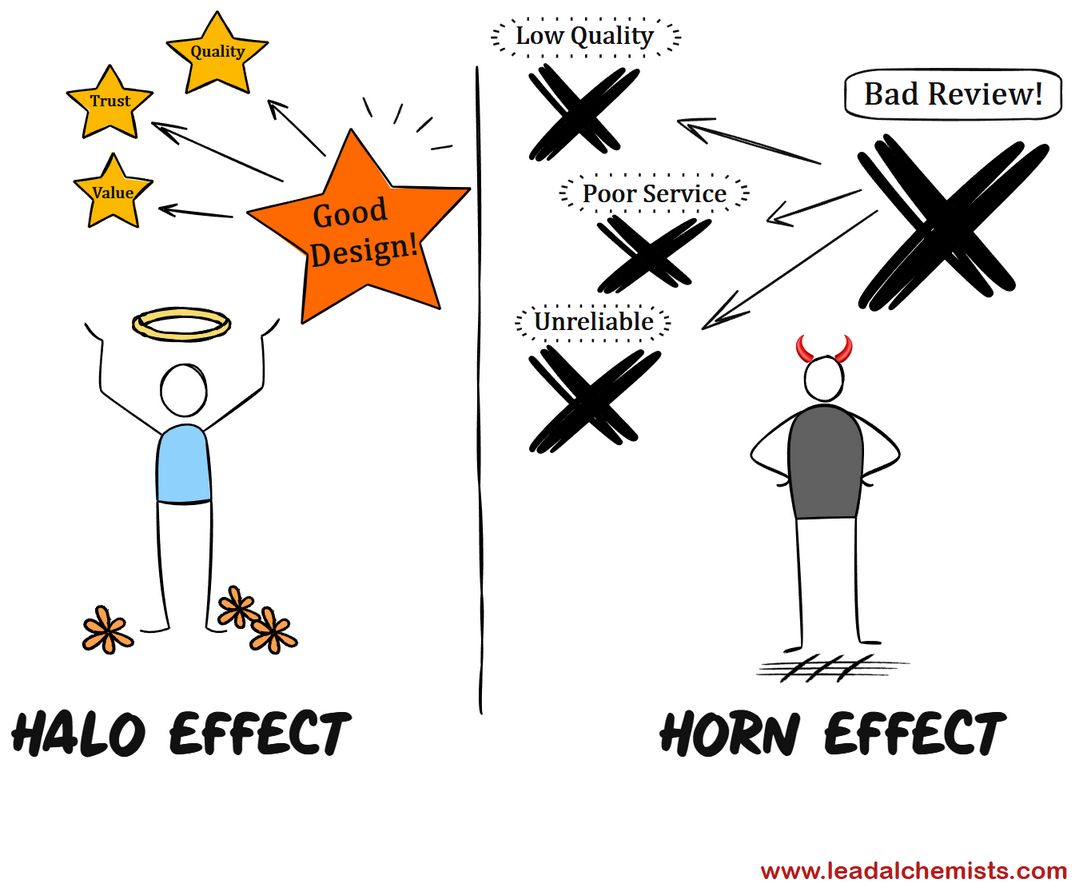
At its psychological core, the Halo Effect and Horn Effect work because humans instinctively seek cognitive consistency – we automatically interpret new information through the lens of our initial impressions to maintain a coherent perception. When we form a positive or negative first impression, our brains take the mental shortcut of generalizing that impression across unrelated attributes, making it far more likely that we’ll perceive everything about a brand through that same filter rather than expending the mental energy to evaluate each characteristic independently.
For marketers and advertisers, understanding these biases gives a real competitive edge. By purposefully and strategically managing the most visible touchpoints that create first impressions while consistently delivering genuine quality across all customer interactions, you can leverage the Halo Effect to enhance overall brand perception and mitigate the Horn Effect when problems arise in ways that other persuasion techniques simply cannot match.
How The Halo Effect & Horn Effect Works (The Psychology Behind It)
The Cognitive Mechanisms
When the Halo or Horn Effect activates, several psychological processes work together:
Cognitive Consistency Theory explains why our brains resist contradictory information. If we perceive a brand as “premium” based on sleek design, we’re more likely to assume their customer service, reliability, and value are also superior.
Attribution Theory shows how we assign qualities based on limited observations. A single positive interaction with your sales team can lead prospects to assume your entire company operates at that same level of excellence.
Impression Formation Heuristics reveal how quickly these judgments form. Research shows that first impressions can solidify within milliseconds, and once established, they’re remarkably resistant to change.
Key Research Findings
Nisbett & Wilson (1977) demonstrated this effect in a landmark study. Participants rated a lecturer more positively on appearance, mannerisms, and accent after seeing him act warm and friendly, compared to when he acted cold and distant. The participants were completely unaware that their judgments of unrelated traits had been influenced.
Recent systematic reviews (2021) confirm that both effects persist across various domains, including education, healthcare, and organisational settings. However, newer research also shows these effects can be mitigated when people receive contradictory information or become aware of the bias.
Landry et al. (2016) found that the attractiveness of political candidates influenced voter perceptions of their competence and trustworthiness – traits completely unrelated to physical appearance.
Real-World Examples of The Halo Effect & Horn Effect
Beyond Marketing Applications
Education: Teachers’ initial impressions of students based on appearance or early performance can bias grading and expectations throughout the academic year.
Healthcare: Patients rate clinicians more favourably when they have good bedside manner, even rating their medical competence higher based on interpersonal skills alone.
Economics: The perceived trustworthiness of a CEO influences investor confidence and stock prices, even when financial performance doesn’t justify the sentiment.
Social Interactions: Physical attractiveness leads to assumptions about intelligence, competence, and moral character – the classic “what is beautiful is good” effect.
Marketing Success Stories
Apple’s Brand Halo: The iPhone’s success created a powerful halo effect that benefited subsequent products like the iPad and Apple Watch. Consumers trusted new Apple products based on positive experiences with previous devices, allowing Apple to command premium pricing across their entire product line.
Nike’s Celebrity Endorsements: Nike’s partnership with Michael Jordan demonstrates the Halo Effect in action. Jordan’s athletic prowess, charisma, and winning image transferred to the Air Jordan line, creating one of the most successful celebrity endorsement campaigns in history.
Tesla’s Innovation Halo: Tesla’s Model S reputation for luxury and cutting-edge technology extends to their more affordable models and energy products. The positive perception of flagship models increases trust in the entire product portfolio.
Horn Effect Examples
Negative Review Impact: Research consistently shows that a single negative review can deter a significant percentage of potential customers, even when dozens of positive reviews exist.
Brand Crisis Spillover: When United Airlines faced public relations crises, the negative perception affected customer ratings of unrelated services like punctuality and seat comfort.
How The Halo Effect & Horn Effect Affects Consumer Behaviour
Neurological Response
Neuromarketing studies using fMRI technology reveal that positive brand associations activate reward centres in the brain, making consumers more receptive to marketing messages. When the Halo Effect triggers, the brain literally experiences pleasure, creating a positive feedback loop that reinforces the initial impression.
Purchasing Psychology Impact
The effects influence every stage of the customer journey:
Awareness Stage: A single positive touchpoint (like an award or certification) can elevate perception of your entire brand.
Consideration Stage: Prospects evaluate your services through the lens of their initial impression, often overlooking negative information that contradicts their halo-influenced view.
Decision Stage: The effects can override rational analysis, leading customers to choose based on overall impression rather than objective comparison.
Post-Purchase: Satisfied customers often rate unrelated aspects of your service more highly, while dissatisfied customers do the opposite.
Case Studies: How Marketers Use The Halo Effect & Horn Effect in Advertising
Apple’s Strategic Brand Building
Apple’s success demonstrates masterful Halo Effect application. Their reputation for innovative design creates a positive impression that extends to user-friendliness, reliability, and status. While direct attribution is complex due to multiple factors, Apple consistently ranks among the highest in brand equity and customer loyalty metrics.
Key Strategy: Apple focuses intensely on design excellence in flagship products, knowing this positive impression will transfer to their entire ecosystem.
Nike’s Endorsement Strategy
Nike’s Air Jordan partnership showcases celebrity endorsement halo effects. Academic research confirms that athlete endorsements increase brand perception and sales, with measurable impacts on both revenue and stock performance following major athlete achievements.
Measurable Impact: Harvard Business School research found that celebrity athlete endorsements can lead to significant sales and stock return increases for brands.
Small Business Application: Local Service Providers
A local accounting firm emphasising “Award-Winning Service” in their marketing creates a halo effect. This single positive attribute makes potential clients perceive the firm as more trustworthy and competent overall, even though the award might be for a specific service area.
Practical Implementation: Display industry awards, certifications, and positive ratings prominently in all marketing materials to trigger the Halo Effect.
Practical Applications for Google Ads & Lead Generation
Google Ads Optimisation
Halo Effect in Ad Copy: Highlight single, highly positive attributes to create favourable overall impressions. For example, “5-Star Rated Plumbing Service” leverages positive ratings to increase perceived trustworthiness across all service areas.
Horn Effect Avoidance: Avoid negative language that could create negative overall impressions. Instead of “We fix accounting errors,” use “Ensure Accurate Financials.”
A/B Test Scenario: Test two ad variations for a local service provider:
- Ad A (Halo): “Voted Best Plumber in [City] – 5-Star Rated”
- Ad B (Control): “Experienced Local Plumbers – Affordable Rates”
Track click-through rates and conversion rates to measure the halo effect’s impact.
Lead Generation Website Optimisation
Testimonial Strategy: Feature prominent client testimonials with photos and specific outcome details. This creates a positive overall impression that increases form submissions and consultation bookings.
Form Optimisation: Simplify lead capture forms to avoid creating negative impressions. Lengthy or intrusive forms trigger the Horn Effect, making potential clients hesitant to submit information.
Lead Magnet Enhancement: Offer high-value, free resources that demonstrate expertise. A financial advisor offering “5 Smart Tax Reduction Strategies” creates a halo effect, making them appear more competent and trustworthy overall.
Small Business Implementation
Award Display: Prominently feature industry awards, certifications, and recognitions. A local bakery displaying “Best Bakery” awards creates a halo effect that attracts customers and justifies premium pricing.
Social Proof Integration: Showcase video testimonials from satisfied clients. The positive impression from one success story often transfers to overall service perception.
Professional Presentation: Invest in high-quality website design and marketing materials. Professional appearance creates a halo effect that influences perceptions of service quality and reliability.
Why Marketers Should Care About The Halo Effect & Horn Effect
Competitive Advantage
Understanding these effects provides significant competitive advantages:
Amplified Marketing ROI: A single positive impression can influence multiple purchasing decisions, maximising the impact of your marketing investments.
Reputation Management: Knowing how negative impressions spread helps you prioritise crisis management and customer service excellence.
Strategic Positioning: You can strategically choose which positive attributes to emphasise, knowing they’ll create broader positive perceptions.
Ethical Considerations
Responsible Application: Use these effects to highlight genuine strengths rather than manipulate perceptions. Authentic positive attributes create sustainable halo effects, while manufactured ones eventually backfire.
Transparency Importance: Industry guidelines emphasise honesty in advertising. The most effective halo effects come from real achievements and genuine customer satisfaction.
Long-term Thinking: While these effects can provide short-term marketing boosts, sustainable success requires delivering on the positive impressions you create.
Risk Management
Horn Effect Prevention: Monitor online reviews, customer feedback, and brand mentions vigilantly. A single negative incident can create disproportionate damage if not addressed quickly.
Expectation Management: Ensure your service delivery matches the positive impressions your marketing creates. Disappointed customers often rate everything more negatively due to the Horn Effect.
How to Implement The Halo Effect & Horn Effect in Your Marketing Strategy

Step-by-Step Implementation
1. Identify Your Strongest Attributes Audit your business to identify genuinely impressive qualities – awards, certifications, exceptional customer satisfaction scores, or unique expertise areas.
2. Strategic Emphasis Feature these strong attributes prominently in all marketing materials, knowing positive impressions will transfer to other areas of your business.
3. Consistency Across Touchpoints Ensure every customer interaction reinforces positive impressions. From your website design to customer service interactions, maintain the quality that supports your halo effect.
4. Monitor and Measure Track how emphasising different attributes affects overall brand perception and conversion rates. Use A/B testing to optimise your approach.
Best Practices
Quality Over Quantity: Focus on one or two genuinely impressive attributes rather than making multiple weak claims.
Authenticity Matters: Base your halo effect strategy on real strengths. Customers quickly detect and punish inauthentic positioning.
Proactive Management: Address potential negative impressions before they can create horn effects. Excellent customer service and rapid problem resolution are essential.
Common Pitfalls
Over-Promising: Creating unrealistic expectations that your service can’t meet will trigger the Horn Effect when customers are disappointed.
Ignoring Negative Feedback: Failing to address legitimate complaints allows horn effects to spread and damage your overall reputation.
Inconsistent Messaging: Mixed messages confuse customers and prevent clear halo effects from forming.
A/B Testing Ideas
Email Subject Lines: Test subject lines emphasising awards versus general service descriptions to measure halo effect impact on open rates.
Landing Page Headlines: Compare headlines featuring certifications against generic benefit statements to assess conversion rate differences.
Social Media Content: Test posts highlighting achievements versus standard service posts to measure engagement and lead generation differences.
Related Psychological Biases & Effects
The Halo and Horn Effects work alongside several related psychological principles:
Confirmation Bias: Once the halo effect creates a positive impression, customers actively seek information that confirms their positive view while ignoring contradictory evidence.
Cialdini’s Liking Principle: The Liking Principle says that people are more likely to be influenced and persuaded to say “yes” by people they know and like.
Understanding these interconnected biases helps create more sophisticated and effective marketing strategies that work with natural psychological tendencies rather than against them.
Ready to Transform Your Marketing with Psychological Insights?
Understanding the Halo Effect and Horn Effect is just the beginning. These powerful psychological principles can dramatically improve your lead generation, increase conversion rates, and build stronger customer relationships when applied strategically and ethically.
The key lies in identifying your genuine strengths, presenting them strategically, and ensuring your service delivery consistently reinforces the positive impressions you create. Remember: authentic excellence creates sustainable halo effects, while manufactured impressions eventually backfire.
Whether you’re optimising Google Ads campaigns, redesigning your website, or developing your overall brand strategy, these psychological insights provide a competitive advantage that can transform your marketing effectiveness.
FAQs About Halo Effect & Horn Effect
What is the Halo Effect & Horn Effect and how do they work?
The Halo Effect occurs when a positive impression in one area influences our perception of unrelated qualities, whilst the Horn Effect is its opposite – where a negative impression colours our overall judgment. Both are cognitive biases first documented by psychologist Edward Thorndike in 1920, who observed that supervisors’ ratings of subordinates were highly correlated due to general impressions rather than independent evaluations.
These effects work through our brain’s tendency to seek cognitive consistency – if we perceive someone or something positively in one domain, we automatically assume they’re positive in others. For instance, if you think a brand has excellent customer service, you’re more likely to assume their products are high-quality too, even without evidence.
What’s the difference between the Halo Effect & Horn Effect?
The key difference lies in the direction of bias: the Halo Effect creates positive generalizations from a single positive trait, whilst the Horn Effect (sometimes called the “devil effect”) creates negative generalizations from a single negative trait.
Halo Effect example: Apple’s reputation for innovative design makes consumers assume all their products are premium quality, even new releases they haven’t tested.
Horn Effect example: A restaurant receiving one poor health inspection score may see customers avoid it entirely, even after the issue is resolved. Research shows negative impressions often have a stronger impact than positive ones due to negativity bias.
How does the Halo Effect & Horn Effect influence our daily decision-making?
These biases significantly shape everyday choices, often without our awareness. In hiring decisions, attractive candidates are frequently perceived as more competent. In healthcare, a doctor’s bedside manner can influence how patients rate their medical expertise. In education, teachers’ initial impressions of students can affect grading throughout the term.
Consumer behaviour is particularly susceptible – we might choose a restaurant based on its attractive exterior, assuming the food quality matches. Online, a single five-star review can make us trust an entire business, whilst one negative review might deter us completely. The effects are so pervasive that awareness alone doesn’t eliminate them; they require conscious effort to counteract.
Who first discovered the Halo Effect & Horn Effect in psychology research?
Edward Thorndike first documented the Halo Effect in his 1920 paper “A Constant Error in Psychological Ratings.” He discovered this whilst studying military officers who were rating their subordinates on various traits like leadership, intelligence, and character. Thorndike found that ratings were suspiciously correlated – if an officer rated someone highly on one trait, they tended to rate them highly on all others.
The Horn Effect was conceptualised later as the inverse phenomenon. Thorndike’s work laid the foundation for understanding how first impressions and general evaluations can systematically bias our judgments across unrelated domains, influencing decades of research in social psychology and behavioural economics.
What are the most famous real-world examples of the Halo Effect & Horn Effect?
Apple’s brand halo is perhaps the most cited example – the iPhone’s success created positive associations that benefited subsequent products like the iPad and Apple Watch, allowing premium pricing across their entire range.
Nike’s partnership with Michael Jordan demonstrates celebrity halo effects, where Jordan’s athletic prowess and winning image enhanced the perceived value of Air Jordan products. Harvard Business School research confirms that celebrity athlete endorsements can significantly boost both sales and stock returns.
Horn Effect examples include how negative online reviews disproportionately impact businesses – studies show a single negative review can deter a significant percentage of potential customers, even when outweighed by positive feedback. United Airlines’ passenger removal incident in 2017 damaged trust across their entire service offering, not just their customer service policies.
How do companies use the Halo Effect & Horn Effect in their marketing strategies?
Companies strategically leverage these effects through celebrity endorsements, brand extensions, and testimonial placement. When a successful product creates positive brand associations, companies extend that “halo” to new products – Tesla’s Model S reputation for luxury and innovation now benefits their entire product portfolio, including solar panels and energy storage.
In digital marketing, businesses highlight awards, certifications, or five-star ratings in Google Ads to create positive first impressions. Landing pages feature prominent testimonials and recognisable client logos near contact forms to build trust through association.
Companies also work to avoid the Horn Effect by carefully managing negative associations – avoiding problem-focused language in advertising (saying “ensure accurate finances” rather than “fix accounting errors”) and maintaining consistent quality across all customer touchpoints.
What’s the neurological basis behind the Halo Effect & Horn Effect?
These effects stem from our brain’s cognitive efficiency mechanisms – mental shortcuts that help us make quick decisions with limited information. Neurologically, they’re linked to pattern recognition and associative memory systems that automatically connect related concepts.
The brain seeks cognitive consistency to reduce mental effort. When we form a positive impression, neural pathways associated with reward and trust become activated, influencing how we process subsequent information about that person or brand. fMRI studies show that positive brand associations activate reward centres in the brain, making us more receptive to related marketing messages.
This automatic processing happens faster than conscious reasoning, which is why these biases persist even when we’re aware of them. The effects are particularly strong because they tap into System 1 thinking – the fast, intuitive mental processes described by behavioural economist Daniel Kahneman.
How does the Halo Effect & Horn Effect compare to confirmation bias?
Whilst both are cognitive biases, they operate differently. Confirmation bias involves actively seeking information that confirms existing beliefs, whilst the Halo and Horn Effects involve generalising from limited information to form new impressions.
However, they often reinforce each other. Once the Halo Effect creates a positive impression, confirmation bias makes us more likely to notice and remember information that supports that view whilst ignoring contradictory evidence.
Key difference: Confirmation bias is about information processing after forming beliefs, whilst Halo and Horn Effects are about initial impression formation. The Halo Effect might make you think a brand is trustworthy based on good design, then confirmation bias makes you focus on positive reviews whilst dismissing negative ones.
Can you overcome the Halo Effect & Horn Effect in your thinking?
Yes, but it requires conscious effort and systematic approaches. Research shows these biases can be mitigated through structured decision-making processes and awareness training.
Practical strategies include:
- Separating evaluations: Rate different attributes independently before forming overall impressions
- Seeking contradictory evidence: Actively look for information that challenges initial impressions
- Using checklists: Systematic evaluation criteria reduce the influence of general impressions
- Delayed judgment: Allow time between first impressions and final decisions
Studies indicate that when people receive dissonant information that contradicts initial impressions, the effects can be reduced or even reversed. However, complete elimination is difficult because these biases serve useful functions in rapid decision-making scenarios.
What are the ethical concerns surrounding the Halo Effect & Horn Effect?
The primary ethical concern is manipulation – using these biases to mislead consumers or mask product deficiencies. When companies create false halo effects through exaggerated claims or misleading celebrity endorsements, it constitutes deceptive advertising.
Social harm is another concern, as these effects can reinforce stereotypes and discrimination. In hiring, the Halo Effect might favour attractive candidates regardless of competence, whilst the Horn Effect could unfairly penalise qualified individuals based on irrelevant negative traits.
Industry guidelines from organisations like the American Marketing Association emphasise transparency and honesty, discouraging manipulative use of cognitive biases. Ethical application involves highlighting genuine positive attributes whilst avoiding false associations or exploiting vulnerable populations.
How does the Halo Effect & Horn Effect impact hiring and workplace decisions?
These biases significantly influence recruitment and performance evaluations. Attractive candidates often receive higher ratings on competence and leadership potential – a phenomenon documented across numerous studies. Similarly, employees who excel in one visible area may receive inflated ratings across all performance metrics.
Interview processes are particularly susceptible. A candidate’s confident handshake or professional appearance can create a halo that influences how interviewers interpret their answers. Conversely, a single awkward moment might trigger the Horn Effect, unfairly colouring the entire evaluation.
Mitigation strategies include structured interviews with standardised questions, multiple interviewers, and blind resume reviews. Some companies use skills-based assessments before face-to-face meetings to reduce appearance-based biases. Performance reviews benefit from specific, measurable criteria rather than general impressions.
What role does the Halo Effect & Horn Effect play in brand perception?
These effects are fundamental to brand building. A single positive brand experience can create a halo that enhances perception of all company offerings, whilst one negative incident can damage the entire brand through the Horn Effect.
Brand extensions rely heavily on the Halo Effect – when Virgin successfully operates airlines, the positive association helps launch Virgin Mobile or Virgin Media. Consumers transfer trust and quality expectations from familiar products to new ones within the same brand family.
Digital reputation management has become crucial because online reviews create immediate halo or horn effects. A business with predominantly five-star reviews benefits from a positive halo, whilst even a few negative reviews can trigger the Horn Effect, deterring potential customers disproportionately to their actual frequency.
Are there any studies that challenge the validity of the Halo Effect & Horn Effect?
Whilst the effects are well-established, some research suggests their magnitude can be overstated. Studies show that people can make independent judgments about different attributes when explicitly prompted to do so, and that the effects can be moderated by incongruent information.
Recent research (2020-2021) confirms these biases persist across various domains but emphasises that they’re not absolute – first impressions can be updated when new, contradictory information is presented. The strength of the effects varies by context, individual differences, and the relevance of the initial impression to subsequent judgments.
Methodological debates focus on distinguishing between genuine trait correlations and bias-driven correlations. Some researchers argue that certain “halo effects” might reflect real underlying relationships rather than pure cognitive bias, requiring more nuanced experimental designs to isolate the bias component.
How does the Halo Effect & Horn Effect affect online reviews and ratings?
Online reviews create powerful halo and horn effects that disproportionately influence consumer behaviour. Positive reviews generate a halo that makes potential customers more likely to trust the business across all service areas, whilst negative reviews create horn effects that can deter customers even when vastly outnumbered by positive feedback.
Research findings show that negative reviews have a stronger impact than positive ones due to negativity bias – people weight negative information more heavily in decision-making. A single one-star review among dozens of five-star ratings can significantly reduce purchase intent.
Star ratings create immediate halo or horn effects before customers even read review content. Businesses with 4.5+ star averages benefit from positive assumptions about quality, service, and reliability, whilst those below 4.0 stars face the Horn Effect regardless of the actual review content quality.
What’s the relationship between the Halo Effect & Horn Effect and first impressions?
First impressions are the primary trigger for both effects. Within seconds of encountering a person, product, or brand, we form general evaluations that then influence all subsequent judgments through halo or horn effects.
Speed of formation is crucial – these impressions form faster than conscious reasoning, making them particularly resistant to change. Research shows that first impressions based on appearance, voice, or initial interactions can persist even when contradicted by later evidence.
Marketing implications are significant: the first touchpoint with a brand – whether a website, advertisement, or customer service interaction – disproportionately influences overall brand perception. This is why companies invest heavily in first-impression management across all customer journey touchpoints.
How do celebrities and influencers leverage the Halo Effect & Horn Effect?
Celebrities and influencers strategically use their positive attributes to create halo effects for endorsed products. Their attractiveness, success, or expertise in one domain transfers to unrelated products through association.
Influencer marketing relies on this principle – followers who admire an influencer’s lifestyle or expertise assume their product recommendations are trustworthy. The influencer’s positive qualities create a halo that enhances product perception without direct experience.
Risk management is crucial because the Horn Effect works equally powerfully. Celebrity scandals can damage all associated brands – Tiger Woods’ personal issues temporarily impacted his sponsors, demonstrating how negative associations transfer across unrelated domains. This is why brands include morality clauses in endorsement contracts.
What are some common mistakes people make due to the Halo Effect & Horn Effect?
Hiring decisions are frequently compromised when attractive or charismatic candidates receive inflated competency ratings. Similarly, investment choices can be skewed when a company’s strong performance in one area creates false confidence in unrelated business segments.
Consumer purchases often reflect these biases – choosing restaurants based on attractive exteriors, assuming expensive products are higher quality, or avoiding entire brands due to single negative experiences. Online shopping is particularly susceptible, with product ratings and seller reputations creating immediate halo or horn effects.
Relationship judgments are also affected – initial physical attraction or single positive traits can create halos that mask incompatibility issues, whilst minor early conflicts can trigger horn effects that prevent recognition of genuine compatibility.
How does the Halo Effect & Horn Effect impact investment and financial decisions?
These biases significantly influence stock market behaviour and investment choices. Companies with charismatic CEOs often receive inflated valuations regardless of underlying business fundamentals – the CEO’s positive qualities create a halo that enhances investor confidence across all company metrics.
Brand reputation affects stock prices through halo and horn effects. Apple’s innovation reputation allows premium valuations even for products that haven’t yet proven market success. Conversely, companies experiencing scandals see stock prices fall across all business units, not just those directly involved.
Fund management decisions are also susceptible – a fund manager’s past success in one market sector can create a halo that influences investor confidence in their performance across different sectors, even when the skills may not transfer.
What’s the difference between the Halo Effect & Horn Effect and the primacy effect?
The primacy effect refers to better recall of information presented first in a sequence, whilst the Halo and Horn Effects involve generalising impressions across different attributes or domains.
Key distinction: Primacy effect is about memory and information processing order, whilst Halo and Horn Effects are about impression generalisation. However, they often work together – first impressions (primacy) create halo or horn effects that influence subsequent evaluations.
Practical example: In job interviews, the primacy effect makes first information more memorable, whilst the Halo Effect makes positive first impressions influence ratings on unrelated competencies. Both contribute to the disproportionate importance of early interactions in forming lasting judgments.
How can teachers and educators be aware of the Halo Effect & Horn Effect?
Teachers must recognise how initial student impressions can bias ongoing evaluations. A student’s early performance, appearance, or behaviour can create halo or horn effects that influence grading throughout the term, potentially creating self-fulfilling prophecies.
Practical strategies include:
- Anonymous grading where possible to reduce name-based biases
- Structured rubrics that evaluate specific criteria independently
- Multiple assessment methods to avoid over-relying on single performance indicators
- Regular bias awareness training to maintain conscious vigilance
Research shows that teacher expectations significantly influence student performance – positive halos can boost achievement whilst horn effects can hinder progress. Blind marking and standardised assessment criteria help ensure fair evaluation regardless of initial impressions.
What are the most effective ways to minimize the Halo Effect & Horn Effect?
Systematic decision-making processes are most effective. Use structured evaluation criteria that assess different attributes independently before forming overall judgments. Checklists and rubrics prevent general impressions from overwhelming specific assessments.
Seek contradictory evidence actively – when forming positive impressions, deliberately look for potential negatives, and vice versa. Delayed judgment allows time for multiple impressions to form before making final decisions.
Multiple perspectives help counteract individual biases – involve different evaluators or seek diverse opinions before important decisions. Awareness training increases recognition of when these biases might be operating, though awareness alone doesn’t eliminate them.
How does social media amplify the Halo Effect & Horn Effect?
Social media accelerates and amplifies these effects through rapid information sharing and visual-first platforms. Profile photos and curated content create immediate halo or horn effects that influence how all subsequent posts are perceived.
Viral content demonstrates extreme amplification – a single positive or negative incident can create massive halo or horn effects across entire personal or brand reputations. Cancel culture often reflects the Horn Effect, where one negative action colours perception of someone’s entire character.
Algorithm bias compounds these effects by showing users content that confirms their existing impressions, creating echo chambers that reinforce initial halo or horn effects rather than providing balanced perspectives.