
Guide to Selective Perception in Marketing: Description, Psychology, and Examples
What Is Selective Perception?
Selective Perception is the tendency for people to filter, interpret, and remember information based on their existing beliefs, expectations, and emotional comfort zones, often ignoring information that contradicts their worldview. This powerful cognitive bias explains why different people can witness the same event or advertisement yet walk away with completely different interpretations based on what aligns with their pre-existing mental framework.
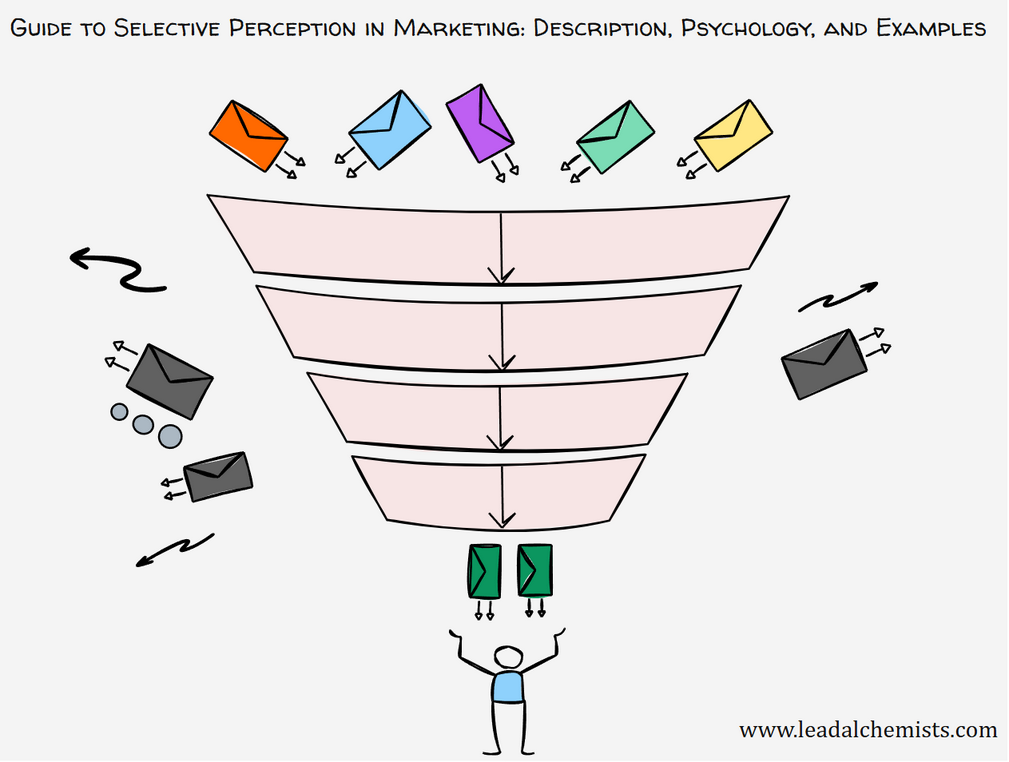
At its psychological core, Selective Perception works because humans are cognitive misers – we instinctively filter the overwhelming amount of stimuli we encounter daily to conserve mental energy. When faced with information that challenges our existing beliefs, our brains automatically screen it out or reinterpret it to fit our worldview, making it far more likely that we’ll notice and remember messages that confirm what we already think rather than expending mental energy processing contradictory information.
For marketers and advertisers, understanding this bias gives a real competitive edge. By purposefully and strategically crafting messages that align with your target audience’s existing beliefs and values while delivering genuine solutions to their needs, you can break through the noise and capture attention in ways that other persuasion techniques simply cannot match.
How Selective Perception Actually Works
The Cognitive Mechanisms
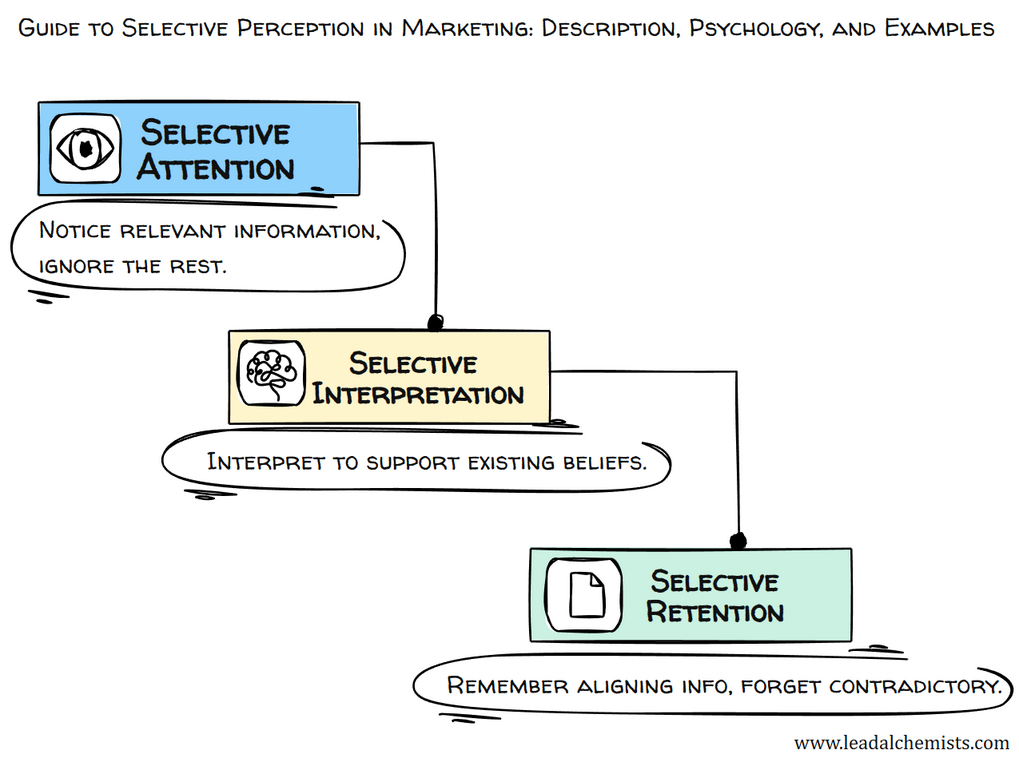
Selective perception works through three primary filtering mechanisms:
Selective Attention: We notice information that’s relevant to our needs, values, and interests whilst ignoring the rest. This is why a pregnant woman suddenly notices every other pregnant woman around her, or why after researching a specific car model, you start seeing it everywhere.
Selective Interpretation: We interpret ambiguous information in ways that support our existing beliefs. This is closely linked to confirmation bias, where we accept information that confirms our preconceptions and scrutinise or reject information that challenges them.
Selective Retention: We remember information that aligns with our beliefs and values whilst forgetting contradictory information.
The Neurological Basis
Neurologically, selective perception stems from the brain’s need to manage the overwhelming amount of sensory input it receives. The reticular activating system (RAS) in our brain stem acts as a gatekeeper, filtering out irrelevant stimuli and allowing through only what it deems important based on our existing beliefs, needs, and experiences.
This filtering happens before information even reaches our conscious awareness, which is why selective perception is so powerful and often operates without our knowledge.
Key Research Supporting Selective Perception
The foundational study on selective perception comes from Hastorf and Cantril (1954), who examined how students from rival universities perceived the same football game. Despite watching identical footage, students from each university “saw” more fouls committed by the opposing team and believed the referees were biased against their team.
More recent research confirms that selective perception affects everything from political opinions to consumer choices. Studies show that people are more likely to notice, engage with, and remember advertisements that align with their existing beliefs and values.
Real-World Examples of Selective Perception
In Everyday Life
Selective perception shapes our daily experiences in countless ways:
Politics: Voters tend to notice and remember information that supports their political views whilst dismissing contradictory evidence. This contributes to political polarisation and “echo chambers.”
Healthcare: Patients often selectively perceive information about their health conditions, sometimes ignoring medical advice that conflicts with their beliefs or preferences.
Education: Teachers may unconsciously form expectations about students based on limited information, then selectively perceive student behaviour that confirms these expectations.
In Marketing and Advertising
The Coca-Cola vs. Pepsi “Pepsi Challenge” offers a classic example of selective perception in marketing. In blind taste tests, consumers often preferred Pepsi, but when brand identities were revealed, many reverted to preferring Coca-Cola. Their perception of taste was influenced by brand loyalty and prior beliefs about which product was superior.
This demonstrates how powerful selective perception can be – it can literally change how we experience physical sensations like taste.
Another notable example is Dove’s “Real Beauty” campaign. By challenging conventional beauty standards, Dove created messaging that resonated strongly with women who felt underrepresented in traditional advertising. Those who valued authenticity and body positivity were more likely to notice, engage with, and remember Dove’s messaging, filtering out competing messages that didn’t align with these values.
Whilst Dove reported increased brand sentiment and sales, it’s worth noting that the campaign’s success wasn’t solely due to selective perception but also involved other factors like brand positioning and broader cultural shifts.
How Selective Perception Affects Consumer Behaviour
The Decision-Making Process
Selective perception influences every stage of the consumer journey:
Problem Recognition: Consumers are more likely to recognise problems that align with their existing concerns.
Information Search: They seek information from sources they already trust and that confirm their existing beliefs.
Evaluation of Alternatives: They give more weight to product features that match their priorities and less weight to those that don’t.
Purchase Decision: They’re more likely to notice and be influenced by marketing messages that align with their values and beliefs.
Post-Purchase Evaluation: They tend to notice aspects of the product that confirm they made the right choice, reinforcing their decision.
Psychological Triggers That Amplify Selective Perception
Several factors can strengthen selective perception in consumers:
Personal Relevance: The more personally relevant a message is, the more likely it will break through perceptual filters.
Emotional Resonance: Emotionally charged messages are more likely to be noticed and remembered.
Consistency with Self-Image: People pay more attention to messages that align with how they see themselves.
Cognitive Dissonance: When faced with information that contradicts their beliefs, people often experience discomfort (cognitive dissonance) and may selectively perceive information to reduce this discomfort.
Case Studies: How Marketers Use Selective Perception in Advertising
Case Study 1: Google Ads Personalisation
Google Ads leverages selective perception by showing users adverts based on their search history, browsing behaviour, and demographic information. This personalisation ensures that adverts align with users’ existing interests and needs, making them more likely to notice and engage with the adverts.
Mechanism: Users are more likely to notice adverts that match their current interests or needs, filtering out irrelevant adverts.
Impact: Whilst specific conversion rates vary by industry and campaign, Google’s own research shows that personalised adverts consistently achieve higher click-through rates than non-personalised adverts. Academic studies confirm that perceived relevance positively impacts purchase intention and engagement.
Application for Small Businesses: Even with limited budgets, small businesses can implement audience targeting in Google Ads to show their adverts to users who have demonstrated interest in related topics or services.
Case Study 2: A/B Testing Environmental Messaging
Whilst not a specific brand case study, research supports the effectiveness of tailoring messaging to audience values. For example, an online retailer selling eco-friendly products could run an A/B test with:
- Ad Group A (Control): Generic messaging like “High-quality cleaning products”
- Ad Group B (Test): Value-aligned messaging like “Reduces plastic waste by 80%”
When targeted at environmentally conscious consumers (based on search history and interests), Ad Group B would likely achieve higher click-through and conversion rates because it aligns with the audience’s existing values and concerns.
This approach is supported by academic models of consumer perception and purchase intention, though marketers should note that results will vary based on audience, industry, and execution.
Practical Applications for Google Ads and Lead Generation
Google Ads Copywriting and Ad Design
Ad Copy Tailoring: Craft advert copy that directly addresses the specific needs or pain points of your target audience. For example, a local plumbing service targeting homeowners searching for “emergency plumbing repair” could use advert copy like “Leaky Pipe Emergency? Fast, Reliable Plumbing Repair – Call Now!” This focuses on the immediate need, increasing relevance.
Keyword Targeting and Ad Group Segmentation: Create tightly focused ad groups based on specific keywords and user intent. A marketing agency could create separate ad groups for “SEO services,” “PPC management,” and “social media marketing,” each with tailored advert copy and landing pages.
A/B Test Idea: Test different advert headlines that appeal to different values or priorities:
- Version A: Generic advert copy: “Plumbing Services – Experienced Professionals”
- Version B: Urgent, need-focused copy: “Stop Water Damage Now! Emergency Plumbing Experts – 24/7 Service”
- Metrics to Track: Click-through rate (CTR) and conversion rate
Landing Page Structuring for Lead Generation
Visual Attention Guidance: Use visual cues (arrows, contrasting colours, directional elements) on landing pages to guide visitors’ attention to your call-to-action. Eye-tracking studies confirm this increases form submissions and conversions.
Relevant Testimonials: Feature testimonials that specifically address the concerns or aspirations of your target audience. A local law firm could categorise client success stories by practice area (family law, personal injury, etc.) to boost enquiries from potential clients with similar needs.
Personalised Landing Page Content: Tailor landing page content based on the traffic source. A cleaning service could display different headlines and images based on whether the visitor clicked on an advert for “house cleaning” or “office cleaning.”
Website UX and Form Optimisation
Framing Lead Magnets: Position lead magnets (ebooks, checklists, templates) as solutions to specific problems your audience is actively seeking to solve. Instead of offering a generic “Guide to Digital Marketing,” a marketing consultant could offer “The Ultimate Checklist for Generating Leads with LinkedIn” to attract business owners specifically interested in LinkedIn lead generation.
Form Field Relevance: Only ask for information that seems relevant to the service being offered. For high-consideration services like financial planning, longer forms may actually increase conversion by signalling thoroughness and professionalism.
A/B Test Idea: Test different CTA button designs:
Metrics to Track: Form submissions or consultation bookings
Version A: Standard CTA button
Version B: Larger, more visually prominent CTA button with an arrow pointing to it
Why Marketers Should Care About Selective Perception
The Power of Targeted Messaging
Selective perception explains why generic, one-size-fits-all marketing often fails whilst targeted, relevant messaging succeeds. When your marketing speaks directly to your audience’s existing beliefs, values, and needs, it breaks through perceptual filters and captures attention in a crowded marketplace.
This is particularly valuable for lead generation, where the goal is to convert interest into action. By understanding what your potential leads already believe and value, you can craft messages they’re naturally predisposed to notice and respond to.
Ethical Considerations
Whilst selective perception is a powerful tool, it comes with ethical responsibilities:
Transparency: Be honest about your products or services. Using selective perception to highlight benefits is ethical; using it to hide drawbacks is not.
Respect for Diversity: Recognise that different audience segments have different values and beliefs. Avoid reinforcing harmful stereotypes or exploiting biases.
Avoiding Manipulation: There’s a fine line between leveraging selective perception to communicate effectively and manipulating consumers through misinformation. Ethical marketers stay on the right side of this line.
Risks of Overuse or Manipulation
Overreliance on selective perception can lead to several pitfalls:
Echo Chambers: If you only ever tell customers what they already believe, you may reinforce narrow thinking and miss opportunities for innovation.
Audience Limitation: Focusing exclusively on existing beliefs may prevent you from expanding your audience to new segments.
Backlash: Consumers are increasingly savvy about marketing tactics. If they perceive your use of selective perception as manipulative, it can damage trust and brand reputation.
How to Implement Selective Perception in Your Marketing Strategy
Step-by-Step Implementation Guide
1. Research Your Audience’s Existing Beliefs and Values:
- Conduct surveys or interviews with current customers
- Analyse social media conversations and reviews
- Use tools like Google Analytics to understand what content resonates
2. Segment Your Audience Based on Shared Beliefs and Values:
- Create detailed buyer personas that include psychographic information
- Develop different messaging for different segments
3. Craft Messages That Align With These Beliefs and Values:
- Highlight product features or benefits that match audience priorities
- Use language and imagery that resonates with their worldview
- Frame your offering as a solution to problems they already recognise
4. Test and Refine Your Approach:
- Run A/B tests with different messaging to see what performs best
- Monitor engagement metrics to gauge effectiveness
- Gather feedback and adjust accordingly
Best Practices
Be Authentic: Ensure that your messaging aligns with your actual product or service. Selective perception works best when it highlights genuine strengths.
Focus on Relevance: Make your marketing messages highly relevant to your target audience’s needs and interests. This is more effective than trying to be everything to everyone.
Use Multiple Channels: Reinforce your message across different touchpoints to increase the likelihood of breaking through perceptual filters.
Balance Confirmation and Challenge: Whilst it’s important to align with existing beliefs, occasionally challenging assumptions in a respectful way can create memorable marketing that stands out.
A/B Testing Ideas
Email Subject Lines: Test subject lines that appeal to different values or priorities within your audience.
Landing Page Headlines: Compare generic headlines with ones tailored to specific audience segments or traffic sources.
Advert Visuals: Test different images that might resonate with different segments of your audience.
Call-to-Action Phrasing: Compare different CTA phrasings that appeal to different motivations (e.g., “Save Money Now” vs. “Upgrade Your Experience”).
Related Psychological Biases and Effects
Selective perception works alongside several other cognitive biases that influence consumer behaviour:
Confirmation Bias: The tendency to search for, interpret, and remember information that confirms existing beliefs. Whilst closely related to selective perception, confirmation bias specifically involves actively seeking confirming evidence.
Halo Effect: When a positive impression in one area influences perceptions in other areas. For example, if a brand is perceived as innovative, consumers might assume its products are also high-quality.
Framing Effect: How information is presented (framed) influences how it’s perceived and the decisions made based on it.
Cognitive Dissonance: The mental discomfort that occurs when holding contradictory beliefs or when new information conflicts with existing beliefs.
Anchoring Bias: The tendency to rely too heavily on the first piece of information encountered (the “anchor”) when making decisions.
Understanding these related biases can help marketers develop more comprehensive strategies that account for the full complexity of consumer psychology.
Frequently Asked Questions
What is Selective Perception and how does it work?
Selective perception is a cognitive process where individuals attend to, interpret, and remember information that aligns with their existing beliefs and expectations, whilst ignoring or forgetting contradictory information. It works through both conscious and unconscious filtering mechanisms in the brain that prioritise information relevant to personal needs, values, and prior experiences.
The brain uses selective perception as a natural filtering system to prevent cognitive overload from the constant stream of sensory information we encounter daily. This filtering happens through:
- Attention filtering: Noticing information that confirms existing beliefs
- Interpretation bias: Understanding ambiguous information in ways that support current views
- Memory selectivity: Better recall of belief-confirming information
This cognitive mechanism helps us navigate a complex world but can also reinforce existing biases and limit our perspective.
How does Selective Perception affect our daily decision-making?
Selective perception significantly influences daily decision-making by creating invisible filters through which we process information. It affects our choices in several key ways:
Information consumption: We tend to seek out news sources and opinions that align with our existing views
Product preferences: We notice features that confirm our initial impressions of products
Relationship dynamics: We interpret others’ behaviours in ways that confirm our expectations
Problem-solving: We may overlook important information that contradicts our preferred solution
For example, when house-hunting, someone who values modern design might immediately notice and remember the updated kitchen in a property whilst overlooking structural issues that don’t align with their desire to find the perfect home.
To make better decisions, actively seek diverse perspectives and consciously challenge your initial impressions before reaching conclusions.
What causes Selective Perception in the human brain?
Selective perception is caused by several interconnected cognitive and neurological mechanisms in the human brain:
Cognitive efficiency: The brain filters information to prevent overload, as we can only process a fraction of available sensory input.
Neural pathways: Existing neural connections make it easier to process familiar information that aligns with established beliefs.
Emotional regulation: The brain naturally avoids information that causes discomfort or threatens self-concept, activating defence mechanisms.
Confirmation bias: We have an inherent tendency to seek information that validates existing beliefs.
Prior experiences: Past experiences create mental frameworks that influence how we interpret new information.
These mechanisms serve an evolutionary purpose by helping us quickly process information and maintain psychological comfort, but they can also limit our perspective and reinforce biases.
Who first discovered Selective Perception and when?
Selective perception was first formally documented by psychologists Albert Hastorf and Hadley Cantril in their landmark 1954 study “They Saw a Game.” This pioneering research demonstrated how students from rival universities (Dartmouth and Princeton) perceived the same football game differently based on their school affiliations.
The study showed that students from each university saw more rule infractions committed by the opposing team and interpreted ambiguous plays in favour of their own team. This demonstrated how pre-existing loyalties shaped what people literally “saw” when watching the same event.
Whilst Hastorf and Cantril provided the first empirical evidence, the concept built upon earlier work by psychologist Gordon Allport (1955), who explored how attitudes and values influence perception. Later, Ulric Neisser’s work in cognitive psychology (1967) further developed our understanding of how the brain selectively processes information.
What are the key characteristics of Selective Perception?
The key characteristics of selective perception include:
Filtering mechanism: Automatically screens out information that contradicts existing beliefs or causes discomfort
Dual processing: Operates both consciously (active filtering) and unconsciously (automatic bias)
Belief reinforcement: Strengthens existing views by prioritising confirming information
Contextual sensitivity: Varies based on emotional state, personal relevance, and situational factors
Perceptual distortion: Can lead to misinterpretation of neutral or ambiguous information
Self-protection: Often serves to maintain self-concept and reduce cognitive dissonance
Universality: Present in everyone, though the degree varies by individual and situation
These characteristics help explain why two people can witness the same event yet come away with completely different perceptions of what occurred, as demonstrated in the classic Hastorf and Cantril football game study.
How is Selective Perception different from confirmation bias?
Selective perception and confirmation bias are closely related but distinct cognitive processes:
Selective Perception:
- Occurs at the initial information processing stage
- Involves what we notice, interpret, and remember
- Functions as a perceptual filter for incoming sensory information
- Operates largely unconsciously as an automatic filtering mechanism
- Example: A sports fan may literally not see a foul committed by their favourite team
Confirmation Bias:
- Occurs primarily during information seeking and evaluation
- Involves actively searching for evidence that supports existing beliefs
- Functions as a deliberate research and evaluation strategy
- Often involves more conscious reasoning and judgement
- Example: A sports fan may seek out statistics that prove their team is superior
The key difference is that selective perception happens during initial perception and interpretation of information, whilst confirmation bias involves the active seeking and evaluation of information. Selective perception can be thought of as the “input filter,” whilst confirmation bias influences how we search for and evaluate evidence.
What are some famous examples of Selective Perception in history?
Several famous examples demonstrate selective perception’s powerful influence throughout history:
The Hastorf and Cantril Football Study (1954): Students from rival universities perceived the same game differently, seeing more fouls committed by the opposing team – the foundational study that established selective perception.
Coca-Cola vs. Pepsi “Pepsi Challenge”: When consumers knew they were drinking Coca-Cola, brand loyalty influenced their taste perception. In blind tests, preferences often differed, showing how brand knowledge shapes sensory experience.
Political Media Consumption: Studies by Iyengar and Hahn (2009) demonstrated how voters selectively consume news that aligns with their political views, reinforcing polarisation.
Dearborn and Simon’s Executive Study (1958): Business executives from different departments interpreted the same organisational problems through the lens of their departmental roles and responsibilities.
Dove “Real Beauty” Campaign: This marketing campaign succeeded by aligning with consumers’ values around authentic representation, demonstrating how messages that match existing beliefs gain more attention.
These examples show how selective perception operates across domains from sports and politics to business and marketing.
How does Selective Perception influence consumer behaviour?
Selective perception significantly influences consumer behaviour through several key mechanisms:
Brand recognition: Consumers are more likely to notice advertisements and products from brands they already know and trust.
Product evaluation: People tend to focus on product features that confirm their initial impressions whilst overlooking contradictory information.
Information filtering: Consumers pay more attention to marketing messages that align with their existing beliefs, values, and needs.
Review interpretation: Shoppers interpret ambiguous product reviews in ways that support their pre-existing opinions.
Post-purchase justification: After making a purchase, consumers often selectively notice information that validates their choice.
This is why personalised advertising is effective – Google Ads and social media platforms leverage selective perception by showing users content aligned with their browsing history and preferences, increasing engagement and conversion rates. For example, someone researching fitness equipment will notice fitness-related adverts more readily than other consumers would.
Can Selective Perception be overcome or controlled?
Yes, selective perception can be managed and partially overcome through deliberate strategies and awareness, though it can never be completely eliminated as it’s a fundamental cognitive process. Here are effective approaches:
Develop awareness: Recognise that selective perception exists and actively look for it in your thinking.
Seek diverse perspectives: Intentionally expose yourself to viewpoints that challenge your existing beliefs.
Practise mindful observation: Slow down your information processing to notice details you might otherwise filter out.
Use structured decision frameworks: Implement formal processes that require consideration of contradictory evidence.
Invite feedback: Ask others what they perceive in situations where you might have blind spots.
Implement devil’s advocate thinking: Deliberately argue against your initial perceptions to test their validity.
Delay judgement: Allow time for reflection before forming conclusions about complex information.
Whilst these strategies won’t eliminate selective perception entirely, they can significantly reduce its unintended negative effects on decision-making and interpersonal understanding.
What role does Selective Perception play in marketing strategies?
Selective perception plays a crucial role in marketing strategies by influencing how consumers notice, interpret, and remember brand messages. Savvy marketers leverage this cognitive process in several ways:
Targeted messaging: Crafting content that resonates with consumers’ existing beliefs and values, making it more likely to be noticed and remembered.
Audience segmentation: Dividing markets into specific groups to deliver messages that align with each segment’s preferences and interests.
Brand positioning: Highlighting product features that appeal to specific consumer segments, knowing they’ll selectively attend to benefits relevant to them.
Visual attention guidance: Using design elements like colour contrast and directional cues to draw attention to key messages and calls-to-action.
Testimonial targeting: Featuring customer stories that reflect the experiences and aspirations of target audiences.
For example, the Coca-Cola vs. Pepsi blind taste tests demonstrated how brand perception influences taste experience, whilst Dove’s “Real Beauty” campaign succeeded by aligning with consumers’ desire for authentic representation in advertising.
How do marketers use Selective Perception to influence customers?
Marketers use selective perception to influence customers through several strategic approaches:
Advert copy tailoring: Creating messages that directly address specific customer pain points or desires, making them more likely to be noticed. For example, a plumbing service might use “Stop Water Damage Now!” rather than generic “Plumbing Services” messaging.
Keyword targeting: Segmenting advert campaigns into tightly focused groups based on specific search terms, ensuring adverts match what customers are actively seeking.
Visual cues on landing pages: Using directional elements, contrasting colours, and strategic placement to guide attention to calls-to-action.
Relevant testimonials: Featuring customer stories that match the visitor’s specific situation or concern, increasing perceived relevance and trust.
Personalised content: Tailoring landing pages based on traffic source or user behaviour, as seen when a cleaning service displays different headlines for “house cleaning” versus “office cleaning” searches.
Problem-specific lead magnets: Offering downloadable resources that address particular challenges, like a real estate agent’s guide on “5 Mistakes to Avoid When Selling Your Home.”
These techniques work by aligning marketing elements with what customers are already primed to notice and value, increasing engagement and conversion rates.
What are the negative effects of Selective Perception?
Selective perception can have several negative effects on individuals and society:
Reinforced biases: It strengthens existing prejudices by filtering out contradictory information, creating a self-reinforcing cycle.
Polarisation: In politics and social issues, selective perception contributes to echo chambers where people only consume information that confirms their views.
Missed opportunities: In business and personal life, it can cause people to overlook valuable information that doesn’t fit their expectations.
Relationship conflicts: Selective perception can lead to misunderstandings when people interpret the same interaction differently based on their expectations.
Poor decision-making: By filtering out important contradictory evidence, selective perception can lead to flawed judgements and choices.
Resistance to change: It makes people less receptive to new ideas that challenge their established beliefs.
Stereotyping: Selective perception can reinforce stereotypes by causing people to notice behaviours that confirm their preconceptions about groups.
These negative effects highlight why developing awareness of selective perception and actively seeking diverse perspectives is important for balanced thinking and decision-making.
How does Selective Perception impact workplace relationships?
Selective perception significantly impacts workplace relationships in several important ways:
Performance evaluations: Managers’ pre-existing attitudes towards employees influence how they perceive performance. Research by Wayne and Ferris (1990) showed that managers interpret the same work differently based on their prior opinions of employees.
First impression persistence: Initial judgements about colleagues become self-reinforcing as we notice behaviours that confirm our first impressions.
Communication barriers: Team members may interpret the same message differently based on their expectations and prior experiences.
Feedback filtering: Employees often selectively hear positive feedback whilst discounting constructive criticism.
Conflict escalation: During disagreements, parties tend to notice actions that confirm their negative perceptions of the other person.
Departmental silos: As demonstrated in Dearborn and Simon’s classic study (1958), professionals from different departments interpret organisational problems through their specialised lens.
To mitigate these effects, organisations can implement structured feedback processes, diverse team composition, and training on cognitive biases to help employees recognise and manage selective perception in workplace interactions.
What’s the difference between Selective Perception and selective attention?
Selective perception and selective attention are related but distinct cognitive processes:
Selective Attention:
- Focuses on what information we choose to process from our environment
- Operates primarily at the sensory input level
- Involves directing focus to specific stimuli whilst ignoring others
- Is about filtering immediate sensory information
- Example: Focusing on a conversation in a noisy restaurant whilst tuning out background noise
Selective Perception:
- Concerns how we interpret information once we’ve attended to it
- Operates at the interpretation and meaning-making level
- Involves biased processing based on existing beliefs and expectations
- Is about filtering through the lens of prior beliefs
- Example: Two people watching the same political debate but interpreting the candidates’ statements differently based on their political affiliations
In simple terms, selective attention determines what information we process, whilst selective perception influences how we interpret that information. Selective attention is the first filter (what we notice), and selective perception is the second filter (how we make sense of what we notice).
How does Selective Perception affect social media usage?
Selective perception significantly shapes social media usage and experiences in several key ways:
Content filtering: Users naturally pay more attention to posts that align with their existing beliefs and interests, often scrolling past contradictory content.
Algorithm reinforcement: Platform algorithms detect this selective engagement and show more similar content, creating personalised “filter bubbles.”
Interpretation bias: The same post or news article is often interpreted differently by users with opposing viewpoints, each seeing confirmation of their beliefs.
Selective sharing: People tend to share content that supports their worldview, further reinforcing their social media echo chambers.
Polarisation acceleration: These combined effects can accelerate political and social polarisation as users are increasingly exposed only to viewpoints that match their own.
Confirmation seeking: Users often follow accounts and join groups that reinforce their existing perspectives rather than challenging them.
This explains why two people with different political views can have completely different social media experiences, even when connected to similar networks. The combination of selective perception and algorithmic curation creates highly personalised information environments that often reinforce rather than challenge existing beliefs.
What are real-world examples of Selective Perception in advertising?
Real-world examples of selective perception in advertising demonstrate how brands leverage this cognitive bias:
Coca-Cola vs. Pepsi “Pepsi Challenge”: This famous campaign revealed how brand loyalty influences taste perception. When consumers knew they were drinking Coca-Cola, their perception of taste was influenced by their brand associations, but in blind tests, preferences often differed.
Dove “Real Beauty” Campaign: By challenging conventional beauty standards, Dove created messaging that resonated with consumers who valued authenticity. Those who already felt underrepresented in advertising were more likely to notice and respond positively to these adverts.
Targeted Google Ads: When businesses create adverts highlighting specific benefits (like a plumbing service using “Stop Water Damage Now!” versus generic “Plumbing Services”), they leverage selective perception by addressing immediate concerns that potential customers are primed to notice.
Segmented Testimonials: Law firms that categorise client success stories by practice area (family law, personal injury, etc.) use selective perception by ensuring visitors see testimonials most relevant to their specific situation.
Political Campaign Messaging: Political adverts often contain carefully chosen language that supporters interpret positively whilst opponents may interpret negatively – the same advert content is perceived differently based on existing beliefs.
These examples show how effective advertising often works not by changing minds but by aligning with what target audiences are already predisposed to notice and value.
How does Selective Perception influence political opinions?
Selective perception powerfully influences political opinions through several key mechanisms:
Media consumption: Studies confirm that voters selectively attend to news sources that align with their political views. Conservatives and liberals often prefer different news outlets that reinforce their existing beliefs.
Information interpretation: The same political event or speech is often interpreted differently by supporters and opponents. Each group notices details that confirm their pre-existing views about a candidate or policy.
Fact filtering: Voters tend to accept facts that support their political position whilst scrutinising or dismissing contradictory information, even when presented with identical evidence.
Echo chambers: Social media algorithms and selective perception work together to create information environments where people are primarily exposed to viewpoints similar to their own.
Polarisation reinforcement: These effects contribute to increasing political polarisation as people’s views become more entrenched through selective exposure to confirming information.
Perception gap: Research shows that politically active individuals tend to have deeply distorted perceptions of the other side, with the most partisan groups showing the widest “perception gaps” about what their opponents actually believe.
This explains why political debates rarely change minds – viewers selectively perceive the same debate differently, each side believing their candidate performed better and provided stronger arguments. Recent studies have shown that 86% of voters believe that supporters of opposing candidates “can’t agree on basic facts,” highlighting how selective perception contributes to the breakdown of shared reality in political discourse.