
Guide to The Illusory Truth Effect in Marketing: Description, Psychology, and Examples
What Is The Illusory Truth Effect?
The Illusory Truth Effect is the tendency for people to believe information is true after repeated exposure, even when that information is objectively false or was initially recognized as questionable. This powerful cognitive bias explains why repetition is such an effective persuasion tool in marketing and why the same message gains credibility simply by being heard multiple times.
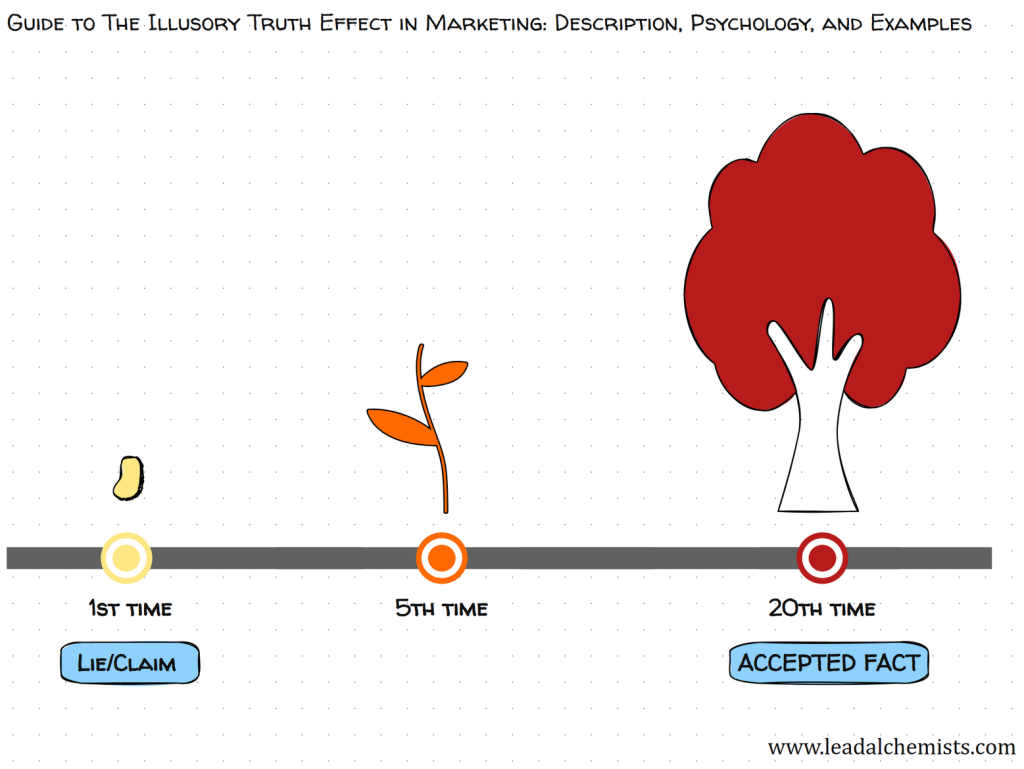
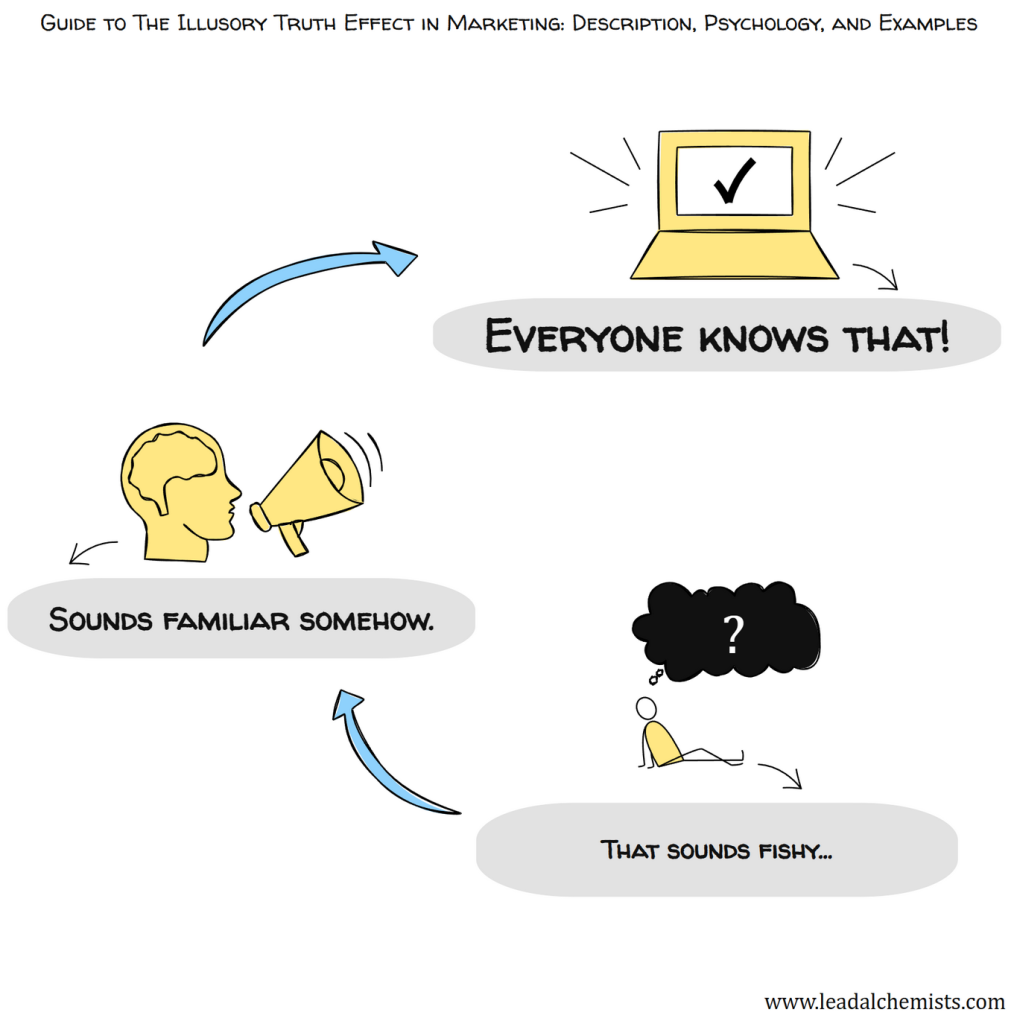
At its psychological core, the Illusory Truth Effect works because humans process familiar information more fluently – our brains instinctively interpret processing ease as truthfulness. When we encounter information repeatedly, it feels more comfortable and accessible to our minds, making it far more likely that we’ll accept it as true rather than expending the mental energy to verify or critically evaluate its accuracy.
For marketers and advertisers, understanding this bias gives a real competitive edge. By purposefully and strategically repeating key messages across multiple channels and touchpoints while providing genuine value to customers, you can build brand familiarity and trust in ways that other persuasion techniques simply cannot match.
How The Illusory Truth Effect Actually Works
The Cognitive Mechanisms
The Illusory Truth Effect operates through three primary psychological mechanisms:
Processing Fluency: When we encounter information repeatedly, our brains process it more easily and quickly. This processing ease creates a feeling of familiarity that we unconsciously misattribute to truthfulness rather than recognising it as simply the result of previous exposure.
Familiarity as a Truth Cue: Our brains use mental shortcuts (heuristics) to make quick judgements. Familiarity serves as one such shortcut – if something feels familiar, we’re more likely to accept it as true without deeper scrutiny.
Source Amnesia: Over time, we often remember the content of a message but forget where we heard it. This means that even if the original source was unreliable or explicitly labelled as false, the repeated exposure still increases our belief in the statement.
Key Research Findings
Multiple peer-reviewed studies have validated this effect:
Hasher et al. (1977) showed that participants rated repeated statements as more truthful than new statements, regardless of actual validity.
Begg, Anas, and Farinacci (1992) demonstrated that repetition increases perceived truth even when the source is known to be unreliable.
Dechêne et al. (2010) conducted a meta-analysis confirming the robustness of the effect across various conditions and types of statements.
Recent research by Pennycook et al. (2018) found the effect persists for fake news headlines even when participants have relevant knowledge to identify the falsehood.
Interestingly, whilst strong prior knowledge can reduce the effect, it doesn’t eliminate it entirely. Even experts can be influenced by repeated exposure to claims in their field of expertise, though to a lesser degree than non-experts.
Real-World Examples of The Illusory Truth Effect
Non-Marketing Examples
The Illusory Truth Effect influences decision-making across numerous domains:
Politics: Repeated political messages, even if demonstrably false, can shift public opinion and voting behaviour. During elections, candidates who consistently repeat the same slogans and talking points often see those messages gain credibility over time.
Healthcare: Medical myths persist partly because of repetition. For example, the repeatedly debunked claim linking vaccines to autism continues to influence healthcare decisions despite overwhelming scientific evidence to the contrary.
Education: Students may adopt misconceptions if exposed repeatedly to incorrect information, even after initial correction. This is why educators must be careful about how they present information, especially when addressing common misconceptions.
Marketing Applications
In marketing, the Illusory Truth Effect manifests in several ways:
Brand Slogans: Think of McDonald’s “I’m Lovin’ It” or Nike’s “Just Do It.” These phrases gain power through consistent repetition across all marketing channels.
Advertising Claims: When brands repeatedly state they’re “Number 1” or “The Best,” consumers begin to accept these claims, even without supporting evidence.
Political Campaigns: Political advertisers use consistent messaging across multiple channels to reinforce key points, knowing that repetition increases believability.
How The Illusory Truth Effect Affects Consumer Behaviour
When the Illusory Truth Effect is triggered, several things happen in the consumer’s brain:
Reduced Cognitive Resistance: Repeated exposure to a claim reduces our natural scepticism. The familiar feels safe, and our brains expend less energy questioning information we’ve encountered before.
Increased Confidence in Decisions: Consumers feel more confident purchasing products with messaging they’ve heard repeatedly, as the familiarity creates a sense of trust.
Confirmation Bias Amplification: The effect becomes even stronger when the repeated message aligns with what consumers already believe or want to believe.
The psychological triggers that amplify this effect include:
Cognitive Load: When people are busy, distracted, or under pressure, they’re more susceptible to the Illusory Truth Effect because they have fewer mental resources available for critical evaluation.
Emotional Resonance: Messages with emotional content tend to benefit more from repetition than purely factual claims.
Source Credibility: Whilst the effect works regardless of source, it’s amplified when the repeated message comes from a perceived authority or multiple different sources.
Case Studies: How Marketers Use The Illusory Truth Effect in Advertising
Whilst direct, quantifiable business case studies with measured impact are limited in peer-reviewed literature, we can examine evidence-based applications of the Illusory Truth Effect in marketing:
A/B Testing in Google Ads
Hypothesis-Based Approach: A local plumbing service could test the Illusory Truth Effect by creating two ad groups:
- Control Group: Standard ad copy with varied messaging about services
- Test Group: Consistent repetition of “24/7 Emergency Service” across all ads and the landing page
This approach is grounded in cognitive psychology research showing that repeated exposure to claims increases their perceived truthfulness. The plumbing service would measure CTR and lead form submissions to determine if the repetition strategy outperforms the control.
Landing Page Optimisation for Service Businesses
Evidence-Based Strategy: A financial advisory firm could implement the Illusory Truth Effect on their lead generation landing page by:
- Repeating their core value proposition (“Secure Your Retirement”) in the headline, subheadings, testimonials, and call-to-action button
- Using consistent visual cues (like retirement imagery) to reinforce the message
- Featuring multiple client testimonials that all emphasise the same key benefit
This approach is supported by academic research showing that repetition from multiple sources further enhances the truth effect.
Form Optimisation for Lead Generation
Practical Application: A law firm specialising in personal injury cases could optimise their consultation request form by:
- Repeating their key claim (“No Win, No Fee”) throughout the landing page
- Placing this same message directly above the form submission button
- Including it in the form’s headline and call-to-action button text
This strategy leverages the Illusory Truth Effect at the critical conversion point, potentially increasing form submissions by reinforcing the key benefit at the moment of decision.
Practical Applications for Google Ads and Lead Generation
Google Ads Copywriting and Ad Design
Consistent Messaging Across Ad Groups:
- Use the same core benefit or USP across multiple ad groups targeting different keywords
- Example: A dental practice might consistently emphasise “Painless Procedures” across ads for various dental services
Headline Repetition Strategy:
- Repeat your key claim in both headlines and descriptions
- Example: “Free Consultation” appearing in Headline 1 and again in the description
Ad Extension Reinforcement:
- Use callout extensions and structured snippets to repeat key benefits from your main ad copy
- Example: If your main ad emphasises “Same-Day Service,” include this again in a callout extension
Landing Page Structuring for Lead Generation
Value Proposition Repetition:
- Feature your core value proposition in the hero section, subheadings, body copy, and testimonials
- Example: A marketing agency repeatedly emphasising “Increase Leads by 30%” throughout their landing page
Benefit Clustering:
- Group testimonials that highlight the same benefit together to create repetition from multiple sources
- Example: A business coach featuring three client testimonials that all mention “doubled revenue” in the same section
Visual Reinforcement:
- Use consistent visual elements (icons, colours, imagery) to reinforce your key message
- Example: A cybersecurity firm using shield icons throughout their landing page to reinforce their “protection” message
Website UX and Form Optimisation
Form Headline Alignment:
- Ensure your form headline reiterates the main benefit promised in your ads and landing page
- Example: “Get Your Free Home Valuation” appearing in both the page headline and form headline
Button Text Reinforcement:
- Use CTA button text that repeats the key benefit rather than generic text like “Submit”
- Example: “Start My Free Consultation” instead of “Submit”
Post-Form Messaging:
Example: “Your Free Website Audit is being prepared” on the thank-you page after a form submission
Continue the repetition in thank-you pages and follow-up emails
Why Marketers Should Care About The Illusory Truth Effect
The Illusory Truth Effect offers marketers a powerful tool for influencing consumer choices without resorting to manipulation or deception. By strategically repeating truthful, valuable messages, you can:
Increase Message Retention: Repeated messages are more likely to be remembered and recalled when consumers are making purchasing decisions.
Build Brand Recognition: Consistent repetition of key brand attributes helps solidify your position in consumers’ minds.
Overcome Scepticism: In industries where consumers are naturally sceptical (financial services, legal services, etc.), repetition can help overcome initial resistance.
Ethical Considerations
Whilst powerful, the Illusory Truth Effect must be used responsibly:
Stick to Truth: Only repeat claims that are factually accurate and can be substantiated. Using this effect to spread misinformation may provide short-term gains but will damage brand trust in the long run.
Avoid Manipulation: There’s a fine line between persuasion and manipulation. Ethical marketers use repetition to emphasise genuine value, not to create false impressions.
Consider Context: Be mindful of how your repeated messages might affect vulnerable populations or reinforce harmful stereotypes.
Risks of Overuse
Overusing the Illusory Truth Effect can backfire in several ways:
Message Fatigue: Excessive repetition can lead to consumer annoyance and tune-out.
Scepticism Triggers: Too much repetition of the same claim may actually trigger scepticism in savvy consumers who begin to question why you’re pushing a particular message so hard.
Brand Perception: Brands that rely too heavily on repetition without substance may be perceived as lacking in genuine value or innovation.
How to Implement The Illusory Truth Effect in Your Marketing Strategy
Step-by-Step Implementation Guide
1. Identify Your Core Truth:
- Determine the single most important, truthful benefit your product or service provides
- Ensure this claim is specific, meaningful, and provable
2. Create Consistent Messaging:
- Develop variations of this core message that maintain the same fundamental claim
- Example: “Save 3 hours every week” → “Save 15+ hours monthly” → “Reduce workload by 20%”
3. Map Touchpoints:
- Identify all customer touchpoints where your message can appear
- Include ads, landing pages, email sequences, social media, and sales conversations
4. Implement Repetition Strategy:
- Place your core message at each touchpoint, using appropriate variations
- Ensure visual elements reinforce the verbal/written message
5. Measure and Refine:
- Track metrics like message recall, brand perception, and conversion rates
- A/B test different repetition frequencies to find the optimal balance
Best Practices
Balance Repetition with Variety: Repeat your core message whilst varying the presentation to prevent fatigue.
Use Multiple Channels: Repetition across different channels (social media, email, ads) is more effective than repetition within a single channel.
Leverage Social Proof: Having others repeat your message (through testimonials, reviews, etc.) amplifies the Illusory Truth Effect.
Be Patient: The Illusory Truth Effect builds over time – don’t expect immediate results from your repetition strategy.
A/B Testing Ideas
Frequency Test:
- Version A: Standard frequency of your key message
- Version B: Increased frequency (2-3x more repetition)
- Measure: Message recall, brand perception, and conversion rates
Consistency Test:
- Version A: Varied messaging highlighting different benefits
- Version B: Consistent messaging focusing on one key benefit
- Measure: Lead quality, conversion rates, and customer acquisition cost
Source Variation Test:
- Version A: Same message repeated by your brand only
- Version B: Same message repeated by your brand, customers, and industry experts
- Measure: Trust metrics, conversion rates, and time to conversion
Related Psychological Biases and Effects
The Illusory Truth Effect works in conjunction with several other cognitive biases that marketers should understand:
Mere Exposure Effect: People tend to develop preferences for things simply because they are familiar with them. Whilst similar to the Illusory Truth Effect, this focuses on liking rather than believing.
Confirmation Bias: People tend to search for, interpret, and recall information that confirms their pre-existing beliefs. The Illusory Truth Effect can be amplified when the repeated message aligns with what someone already believes.
Availability Heuristic: People judge the likelihood of events based on how easily examples come to mind. Repeated messages become more mentally available, making them seem more common or important.
Processing Fluency: The ease with which information is processed affects how it’s evaluated. The Illusory Truth Effect is one manifestation of how processing fluency influences judgement.
Social Proof: When people follow the actions of others, assuming they reflect correct behaviour. When combined with repetition, social proof can significantly amplify message believability.
Understanding these related biases can help you create more effective marketing strategies that leverage multiple psychological principles simultaneously.
Frequently Asked Questions
What is the Illusory Truth Effect and how does it work?
The Illusory Truth Effect is the tendency to believe information is true after repeated exposure, even if it is objectively false or initially recognised as false. It works through processing fluency – repetition makes information easier to process, and this ease is misattributed to truthfulness. When we encounter something multiple times, our brains process it more quickly, creating a sense of familiarity that we mistake for validity.
This effect is robust across various types of content including trivia, opinions, health claims, and news headlines, making it a powerful psychological mechanism in how we form beliefs.
How does the Illusory Truth Effect influence our decision-making process?
The Illusory Truth Effect significantly impacts decision-making by causing us to give more weight to repeated information, regardless of its accuracy. When making choices, we often rely on what feels familiar rather than critically evaluating information.
This influence operates in several ways:
- Automatic processing: Repeated claims bypass critical thinking
- Confidence building: Familiarity increases confidence in decisions
- Risk assessment: Familiar claims seem less risky
- Choice justification: We use repeated information to justify our decisions
In marketing contexts, this effect can influence purchasing decisions when product claims are consistently repeated across multiple touchpoints.
What causes the Illusory Truth Effect in the human brain?
The Illusory Truth Effect stems from two primary cognitive mechanisms in the brain:
Processing fluency: When information is repeated, neural pathways become more efficient at processing it. This increased processing ease is misinterpreted as a signal of truth rather than mere familiarity.
Source amnesia: Over time, we remember the content of information but forget where we learned it. This means we may recall a claim but forget that it came from an unreliable source.
These mechanisms are related to how memory consolidation works in the brain – repeated exposure strengthens neural connections associated with the information, making it more accessible and creating an illusion of credibility.
Who first discovered the Illusory Truth Effect and when?
The Illusory Truth Effect was first documented by Lynn Hasher, David Goldstein, and Thomas Toppino in 1977. Their groundbreaking study, published in the Journal of Verbal Learning and Verbal Behaviour, demonstrated that participants rated repeated statements as more truthful than new statements, regardless of their actual validity.
In their experiment, participants rated the truthfulness of trivia statements over multiple sessions. The researchers found that statements seen in earlier sessions were rated as more true in later sessions, establishing the fundamental principle that repetition enhances perceived truthfulness.
What are the key research studies that prove the Illusory Truth Effect exists?
Several pivotal studies have established the robustness of the Illusory Truth Effect:
Hasher, Goldstein, and Toppino (1977): The original study showing repeated statements were rated as more truthful, regardless of actual validity.
Begg, Anas, and Farinacci (1992): Demonstrated that repetition increases perceived truth even when the source is known to be unreliable.
Dechêne et al. (2010): A meta-analysis confirming the effect’s robustness across various conditions and types of statements.
Pennycook et al. (2018): Found the effect persists for fake news headlines and even when participants have relevant knowledge to identify falsehoods.
Recent research (2023): Shows the effect is present even for implausible claims and can be reduced (but not eliminated) by warnings or secondary tasks.
How do neuroscientists explain the Illusory Truth Effect?
Neuroscientists explain the Illusory Truth Effect through the brain’s processing mechanisms and memory systems. When we encounter information repeatedly, several neural processes occur:
Reduced cognitive load: Repeated information requires less neural activation to process, creating a sense of ease that the brain misinterprets as truthfulness.
Memory consolidation: Repeated exposure strengthens neural pathways, making the information more accessible in memory.
Familiarity signals: The brain’s familiarity detection systems (primarily in the medial temporal lobe) activate more strongly for repeated information.
Dissociation of memory systems: Our explicit memory for content becomes separated from the source memory, leading to recognition without recalling where we learned the information.
Whilst direct neuroimaging studies specifically on the Illusory Truth Effect are limited, the effect aligns with established neuroscientific understanding of how memory and familiarity processing work.
Are there any studies that challenge the validity of the Illusory Truth Effect?
Whilst the Illusory Truth Effect is robustly established, some research has identified important limitations and moderating factors:
Knowledge effects: Studies show the effect is weaker (though still present) when people have strong prior knowledge about a topic.
Accuracy motivation: When people are explicitly instructed to focus on accuracy, the effect can be diminished, suggesting it’s not inevitable in all contexts.
Methodological considerations: Some researchers have questioned whether certain experimental designs might amplify the effect beyond what occurs naturally.
Individual differences: The strength of the effect varies across individuals, with some people being more susceptible than others.
These challenges don’t invalidate the effect but help define its boundaries and the conditions under which it operates most strongly.
What are some famous real-world examples of the Illusory Truth Effect?
The Illusory Truth Effect can be observed in several real-world contexts, though specific documented cases are often difficult to isolate from other psychological influences:
Political messaging: Repeated campaign slogans and talking points gain perceived credibility through repetition. Research by Pennycook et al. (2018) documented how repeated political claims, even when initially identified as false, gained believability.
Health misinformation: Studies show that repeated health myths (like “we only use 10% of our brain”) persist despite debunking efforts.
Advertising claims: Product claims like “9 out of 10 dentists recommend” gain credibility through consistent repetition across marketing channels.
News media cycles: The continuous repetition of news stories, regardless of their accuracy, can increase public belief in those narratives.
Educational misconceptions: Commonly repeated but incorrect “facts” in educational settings can become widely accepted through repetition.
How has the Illusory Truth Effect been used in political campaigns?
The Illusory Truth Effect has been utilised in political campaigns through several strategic approaches:
Message consistency: Political campaigns maintain strict message discipline, repeating key slogans and policy points across all communications. Research by Pennycook et al. (2018) showed that repeated political claims gain credibility regardless of their factual basis.
Simple, repeatable phrases: Successful campaigns create memorable phrases that are easy to repeat (“Yes We Can,” “Make America Great Again”), leveraging the effect to build perceived truthfulness.
Cross-channel repetition: The same messages appear in speeches, advertisements, social media, and campaign literature, maximising exposure frequency.
Opponent characterisation: Repeated characterisations of opponents can shape public perception, even when those characterisations lack evidence.
Whilst specific campaign effectiveness metrics are rarely published in peer-reviewed research, the widespread use of repetition in political messaging aligns with the psychological principles of the Illusory Truth Effect.
What’s the difference between the Illusory Truth Effect and confirmation bias?
The Illusory Truth Effect and confirmation bias are distinct but related cognitive biases:
Illusory Truth Effect:
- Operates through repetition of information
- Affects perception of truth regardless of prior beliefs
- Works primarily through processing fluency
- Can influence beliefs about new or unfamiliar topics
- Is primarily about how repetition creates perceived truth
Confirmation Bias:
- Operates through selective attention to information
- Involves seeking or favouring information that confirms existing beliefs
- Works through motivated reasoning and selective information processing
- Primarily affects topics where we already hold opinions
- Is about how existing beliefs shape information processing
Whilst distinct, these biases can work together – repeated exposure to information that aligns with existing beliefs (confirmation bias) can make that information seem even more truthful (Illusory Truth Effect).
How is the Illusory Truth Effect different from the mere exposure effect?
The Illusory Truth Effect and mere exposure effect are related but distinct psychological phenomena:
Illusory Truth Effect:
- Increases the perceived truthfulness of repeated statements
- Applies specifically to factual claims or assertions
- Operates through processing fluency being misattributed to truthfulness
- Directly influences belief formation and decision-making
- Primarily studied in the context of information processing
Mere Exposure Effect:
- Increases liking or preference for familiar stimuli
- Applies to a wider range of stimuli (images, sounds, people, etc.)
- Operates through reduced uncertainty and increased processing ease
- Influences affective responses and preferences
- Primarily studied in the context of attitudes and preferences
Whilst both effects involve repetition and processing fluency, they affect different aspects of cognition – truth judgements versus preference judgements.
Is the Illusory Truth Effect the same as the availability heuristic?
No, the Illusory Truth Effect and the availability heuristic are distinct cognitive processes:
Illusory Truth Effect:
- Causes repeated information to seem more truthful
- Operates through processing fluency
- Directly affects truth judgements
- Is specifically about how repetition influences perceived truth
- Works even with information we know is from unreliable sources
Availability Heuristic:
- Causes easily recalled information to seem more important or common
- Operates through ease of memory retrieval
- Affects frequency and probability judgements
- Is about how mental availability influences risk perception
- Often works with vivid or emotionally charged memories
Whilst both involve cognitive shortcuts, they serve different functions in our thinking. The availability heuristic helps us estimate frequency or probability, whilst the Illusory Truth Effect influences our truth assessments.
What’s the opposite of the Illusory Truth Effect called?
There isn’t a formally recognised direct “opposite” of the Illusory Truth Effect in psychological literature. However, several related phenomena represent contrasting cognitive processes:
Truth Decay Effect: A term sometimes used to describe how repeated exposure to contradictory information can decrease certainty about what is true.
Continued Influence Effect: Describes how initial information continues to influence beliefs even after being corrected or retracted.
Novelty Bias: The tendency to give more attention and weight to new information rather than familiar information.
Scepticism Effect: When explicit warnings about misinformation lead people to become more critical of repeated claims.
The most direct conceptual opposite would be a hypothetical effect where repetition decreases perceived truthfulness, but this isn’t typically observed except in specific contexts where people are explicitly warned about manipulation attempts.
How do marketers use the Illusory Truth Effect in advertising?
Marketers apply the Illusory Truth Effect in advertising through several evidence-based strategies:
Consistent messaging: Repeating core brand claims across multiple channels and touchpoints. Research shows repetition increases the perceived truth of product claims, regardless of their objective accuracy.
Tagline repetition: Using consistent slogans and taglines across campaigns to build familiarity and perceived truthfulness.
Multiple testimonials: Featuring several customers making similar claims about a product, creating repetition from different sources.
Claim reinforcement: Repeating key product benefits in different ways throughout marketing materials.
Frequency-based media buying: Ensuring target audiences see advertisements multiple times to leverage the effect.
Whilst direct business case studies with measured results are limited in peer-reviewed literature, these applications are grounded in established cognitive psychology research on the Illusory Truth Effect.
Can the Illusory Truth Effect help improve brand recognition?
Yes, the Illusory Truth Effect can help improve brand recognition, though it works alongside other psychological mechanisms. When brand messages are consistently repeated:
Increased familiarity: Repeated exposure makes brand elements more easily recognised, creating a sense of familiarity that can be misattributed to trustworthiness.
Processing fluency: Brand information becomes easier to process mentally, which creates positive associations.
Memory consolidation: Key brand claims are more likely to be remembered when repeated across multiple touchpoints.
Perceived credibility: Consistent repetition of brand positioning statements increases their perceived truthfulness.
For practical application, marketers should maintain consistent messaging across all customer touchpoints whilst ensuring claims are factually accurate. Whilst specific brand recognition metrics from controlled studies are limited, the psychological mechanism is well-established in cognitive research.
How does the Illusory Truth Effect impact consumer purchasing decisions?
The Illusory Truth Effect influences consumer purchasing decisions in several research-supported ways:
Perceived product quality: Repeatedly encountered product claims (“strongest on the market,” “longest-lasting”) are more likely to be believed, affecting quality perceptions.
Risk reduction: Familiar claims reduce perceived purchase risk, as the repeated information feels more trustworthy.
Consideration set formation: Products with repeatedly encountered benefits are more likely to enter a consumer’s consideration set.
Value perception: Repeated price-value claims (like “best value” or specific savings amounts) can increase perceived deal attractiveness.
Post-purchase rationalisation: Consumers may use familiar claims to justify purchases and reduce cognitive dissonance.
Whilst direct conversion metrics from business case studies are limited in peer-reviewed literature, cognitive psychology research confirms that repetition increases belief in product claims, which can influence purchase decisions.
Do social media algorithms exploit the Illusory Truth Effect?
Social media algorithms potentially amplify the Illusory Truth Effect, though the relationship is complex and not always deliberate exploitation:
Content repetition: Algorithms often show similar content repeatedly, increasing exposure frequency to certain claims or perspectives.
Echo chambers: By showing content similar to what users have previously engaged with, algorithms can create environments where the same viewpoints are repeatedly reinforced.
Engagement optimisation: Content that generates strong reactions (including misinformation) may be amplified, increasing exposure to potentially false claims.
Cross-platform repetition: Similar content appearing across multiple platforms increases total exposure frequency.
Research by Pennycook et al. (2018) demonstrated that repeated exposure to false headlines on social media increased their perceived accuracy, suggesting these algorithmic patterns could indeed leverage the Illusory Truth Effect. However, direct studies specifically examining algorithm design and the Illusory Truth Effect are limited in peer-reviewed literature.
Is it ethical to use the Illusory Truth Effect in marketing campaigns?
The ethics of using the Illusory Truth Effect in marketing depends largely on how it’s applied:
Ethical considerations include:
Truthfulness of claims: Using repetition to reinforce factually accurate claims is generally considered ethical, whilst repeating misleading or false claims is problematic.
Transparency: Being open about persuasion techniques rather than attempting to manipulate consumers covertly.
Consumer autonomy: Whether the technique respects consumers’ ability to make informed decisions.
Potential harm: Whether repeated claims could lead to harmful decisions if believed.
Most marketing ethics guidelines don’t specifically address the Illusory Truth Effect but do emphasise truthfulness and avoiding deception. The consensus among marketing ethicists is that leveraging cognitive biases becomes unethical when combined with deceptive content or when targeting vulnerable populations.
A responsible approach is to use repetition to reinforce truthful, valuable information rather than to manufacture false perceptions.
What are the dangers of the Illusory Truth Effect in spreading misinformation?
The Illusory Truth Effect poses several significant dangers in the spread of misinformation:
Persistence of falsehoods: Research by Pennycook et al. (2018) shows that repeated exposure to false news headlines increases their perceived accuracy, even when people initially recognise them as false.
Resistance to correction: Once false beliefs form through repetition, they become difficult to correct, as the familiarity persists even after debunking.
Amplification through sharing: Social media enables rapid repetition of false claims across networks, accelerating the effect. Studies show that people are more likely to share statements they’ve been exposed to previously, and this relationship is mediated by perceived accuracy.
Exploitation by bad actors: Those seeking to deliberately spread misinformation can strategically repeat false claims across multiple channels, knowing that repetition will increase believability.
Undermining of expertise: Repeated falsehoods can sometimes override factual information from credible sources, especially when the falsehoods are simpler and more frequently encountered than complex truths.
Domain-agnostic impact: Research demonstrates the effect works across different domains, from health information to general knowledge, making it a universal concern for information quality.
Cross-platform amplification: When misinformation appears across multiple platforms or sources, the cumulative repetition effect becomes even stronger, making false claims seem more credible.
These dangers are particularly acute in health information, politics, and science communication, where believing misinformation can lead to tangible harm – from refusing vaccines to making poor financial decisions or supporting harmful policies.