
Guide to Self-Serving Bias in Marketing: Description, Psychology, and Examples
What Is Self-Serving Bias?
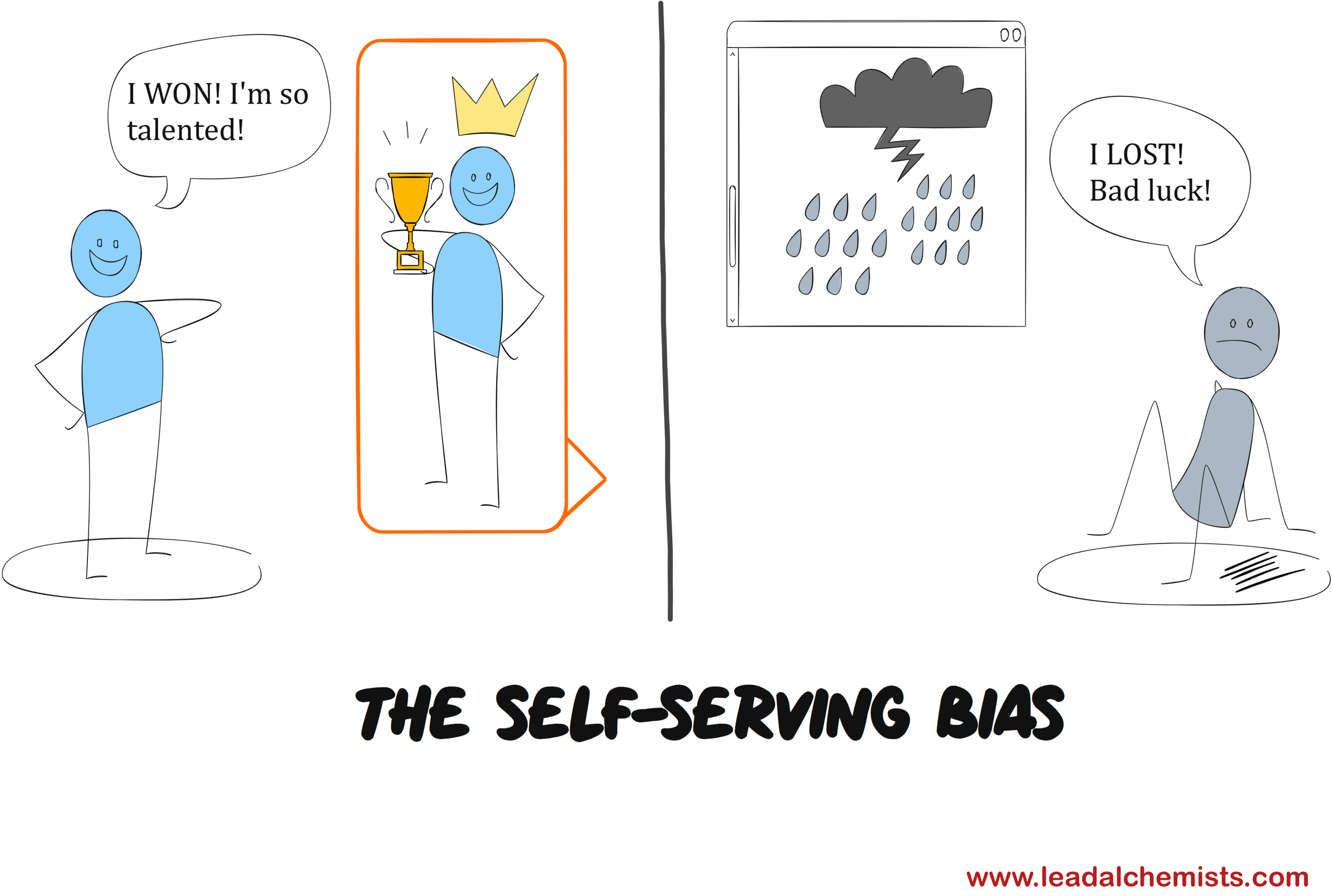
Self-serving bias is the tendency for people to systematically attribute their successes to internal, personal factors (like ability and effort) whilst attributing failures to external, situational factors (such as bad luck or task difficulty). This powerful cognitive bias explains why consumers take credit for their wins but blame circumstances for their losses, believing they’re more skilled and capable than outcomes might suggest.
More customers will engage with your offers if you tap into their natural optimism about positive outcomes. Used thoughtfully, self-serving bias can be a great way to drive purchase decisions. It’s used a lot by fitness companies and financial services providers.
At its psychological core, self-serving bias works because humans are cognitive misers – we instinctively protect our self-image and emotional wellbeing by taking ownership of successes whilst deflating our responsibility for failures, making it far more likely that we’ll pursue aspirational purchases that we face similar odds as everyone else.
For marketers and advertisers, understanding this bias gives a real competitive edge. By purposefully and strategically framing products and services in ways that allow customers to take credit for positive outcomes whilst providing a safety net for potential disappointments, you can inspire action and engagement in ways that other persuasion tactics simply cannot match.
How Self-Serving Bias Actually Works
The Cognitive Mechanisms
The self-serving bias operates through two primary mechanisms:
Motivational Factors: We’re naturally motivated to maintain positive self-views, so we distort attributions in self-favouring directions to protect our ego and self-esteem.
Cognitive Processing: Our brains selectively attend to, interpret, and remember information that supports positive self-perceptions, creating a filter through which we process experiences.
Research from Mezulis et al. (2004) found this bias to be robust across various contexts in their meta-analysis of 266 studies, though its strength varies across cultures. Interestingly, the bias tends to be less pronounced in collectivist cultures and may even reverse in some East Asian populations.
The Neurological Basis
When we engage in self-serving attributions, brain regions associated with self-referential processing become active. Whilst neurological research in this area is still emerging, studies suggest that the medial prefrontal cortex – an area involved in self-reflection – plays a key role in maintaining these biased attributions. Research using fMRI has also identified that the dorsal striatum, involved in motor activities with cognitive aspects, plays a role in controlling self-serving bias.
Individual Differences
Not everyone exhibits the self-serving bias to the same degree:
Narcissistic individuals demonstrate particularly strong self-serving biases, especially when their self-image is threateneddecision-making when it causes people to underestimate genuine risks or overcommit to unlikely outcomes.
People with high self-esteem typically show stronger self-serving attributions
Those with depression or low self-esteem may display a reverse pattern, blaming themselves for failures and attributing successes to external factors
Real-World Examples of Self-Serving Bias
The self-serving bias influences decision-making across numerous contexts:
Beyond Marketing
Education: Students attribute good grades to their intelligence and hard work but blame poor grades on unfair tests or inadequate teaching.
Finance: Investors take credit for successful investments whilst blaming market conditions for losses.
Workplace: Employees attribute team successes to their contributions but blame failures on colleagues or circumstances.
Healthcare: Patients credit their recovery to personal health habits but blame lack of improvement on medical care quality.
Politics: Politicians claim credit for positive economic outcomes but blame predecessors or global factors for negative results.
In Marketing and Advertising
Whilst direct case studies specifically attributing marketing success to the self-serving bias are rare, the principle is widely applied in theoretical frameworks:
Service Marketing: Research published in the Renascence Journal shows that customers are more likely to credit themselves for successful service outcomes whilst blaming providers for failures. Smart brands leverage this by framing post-service communications to highlight the customer’s role in achieving positive results.
Corporate Decision-Making: According to research from INSEAD and the Academy of Management Journal, companies often attribute strategic successes to internal capabilities whilst blaming failures on external market conditions. This same pattern affects marketing campaign reviews, where teams take credit for high ROI but blame poor results on external factors.
Premium Pricing Strategies: Brands create tiered pricing models that allow customers to attribute their success to making the “smart choice” of selecting premium options. Whilst no direct case studies quantify this effect specifically for self-serving bias, it aligns with established marketing principles of price discrimination and product differentiation.
How Self-Serving Bias Affects Consumer Behaviour
Understanding how this bias influences purchasing decisions can transform your marketing approach:
Psychological Triggers
The self-serving bias becomes particularly powerful when:
Self-image is at stake: When purchases reflect on identity or status, consumers are more likely to engage in self-serving attributions.
Decision complexity increases: For complex products or services, consumers are more likely to attribute positive outcomes to their wise choice and negative outcomes to product limitations.
Social visibility is high: Publicly consumed products or services trigger stronger self-serving attributions than private purchases.
Impact on Purchase Decisions
This bias affects the entire customer journey:
Pre-purchase: Consumers may overestimate their ability to use products effectively or achieve desired results.
During use: Users attribute early successes to their skills and initial difficulties to product design.
Post-purchase: Satisfied customers credit their smart decision-making; dissatisfied customers blame product quality or service delivery.
Case Studies: How Marketers Use Self-Serving Bias in Advertising
Whilst direct case studies with measurable impacts are limited, theoretical applications and test scenarios provide valuable insights:
Strategic Attribution in Service Marketing
Context: Service-based businesses face a unique challenge – customers often credit themselves for positive outcomes whilst blaming the provider for negative ones.
Application: Financial advisers strategically position their services to reinforce clients’ belief in their financial acumen. Rather than saying, “We’ll fix your poor investment choices,” they say, “Let’s refine your already solid portfolio to achieve even greater returns.”
Theoretical Basis: This approach builds on self-affirmation and positive reinforcement principles, acknowledging clients’ existing efforts and perceived competence to increase the likelihood of accepting recommendations.
Google Ads A/B Test Scenario
Whilst no published case study directly links self-serving bias framing in Google Ads to conversion uplift, this represents a testable hypothesis:
Test Setup:
- Control Ad: “Get Results with Our Marketing Services”
- Test Ad: “Smart Businesses Choose Us for Growth. See How”
- Metrics to Track: Click-through rate (CTR) and conversion rate
Theoretical Basis: The test advert appeals to the user’s self-perception as intelligent and forward-thinking, potentially increasing engagement by tapping into the self-serving bias.
Practical Applications for Google Ads and Lead Generation
Here are actionable strategies for implementing the self-serving bias in your marketing efforts:
Google Ads Copywriting and Ad Design
Frame advert copy to attribute potential success to the user’s smart choice:
- Instead of: “Our CRM Software Increases Sales”
- Try: “Smart Sales Teams Choose Our CRM to Boost Their Performance”
Highlight the user’s role in achieving results:
- Instead of: “Our Marketing Course Will Teach You Everything”
- Try: “Unlock Your Marketing Genius with Our Advanced Course”
A/B Test Idea for Local Service Business:
- Control: “Professional Plumbing Services – Fast & Reliable”
- Test: “Smart Homeowners Choose Our Plumbing Services – See Why”
- Measure CTR and lead form submissions to determine effectiveness
Landing Page Structuring for Lead Generation
Use language that acknowledges the visitor’s proactive decision-making:
- “You’re already taking the first step towards [desired outcome] by exploring our solutions”
- “Your search for the right [service] shows you’re serious about results”
Structure testimonials to highlight the client’s role in success:
- Include quotes like: “We chose [Company] for our project, and our decision paid off with a 30% increase in leads”
- Feature before/after scenarios that emphasise how the client’s choice led to positive outcomes
Position lead magnets as tools for enhancing existing abilities:
- Instead of: “Download Our Guide to Fix Your Marketing”
- Try: “Enhance Your Marketing Strategy: Download Our Expert Guide”
Website UX and Form Optimisation
Reframe form submissions as commitment to personal goals:
- Replace generic “Submit” buttons with action-oriented text like “Start My Journey” or “Secure My Consultation”
Use progress indicators that affirm the user’s initiative:
- “Step 1 of 3: You’re making a smart choice by exploring your options”
A/B Test for Form Conversion:
- Control: Standard form with “Submit” button
- Test: Form with “Claim My Strategy Session” button and affirming microcopy
- Measure form completion rates to validate effectiveness
Why Marketers Should Care About Self-Serving Bias
The self-serving bias offers powerful advantages for marketers who understand how to apply it ethically:
Benefits for Marketing Effectiveness
Increased engagement: When consumers feel your marketing acknowledges their intelligence and agency, they’re more likely to engage with your content.
Higher conversion rates: Framing that allows prospects to take credit for making smart choices can boost conversion rates for lead generation forms.
Improved customer satisfaction: When customers can attribute positive outcomes partly to their own choices, overall satisfaction tends to increase.
Ethical Considerations
Whilst the self-serving bias can be powerful, ethical application is crucial:
Avoid manipulation: Don’t exploit this bias to make unrealistic promises or create false expectations.
Maintain honesty: Frame your messaging to acknowledge the customer’s role in success without diminishing your product’s actual capabilities.
Consider diverse audiences: Remember that this bias varies across cultures and individuals – what works for one audience segment may not work for another.
Risks of Overuse
Overreliance on this bias can backfire:
Unrealistic expectations: If customers overestimate their ability to achieve results with your product, disappointment may follow.
Reduced accountability: Excessive focus on customer agency might diminish your brand’s perceived responsibility for delivering quality.
Credibility concerns: Sophisticated audiences may recognise and resist obvious attempts to leverage this bias.
How to Implement Self-Serving Bias in Your Marketing Strategy
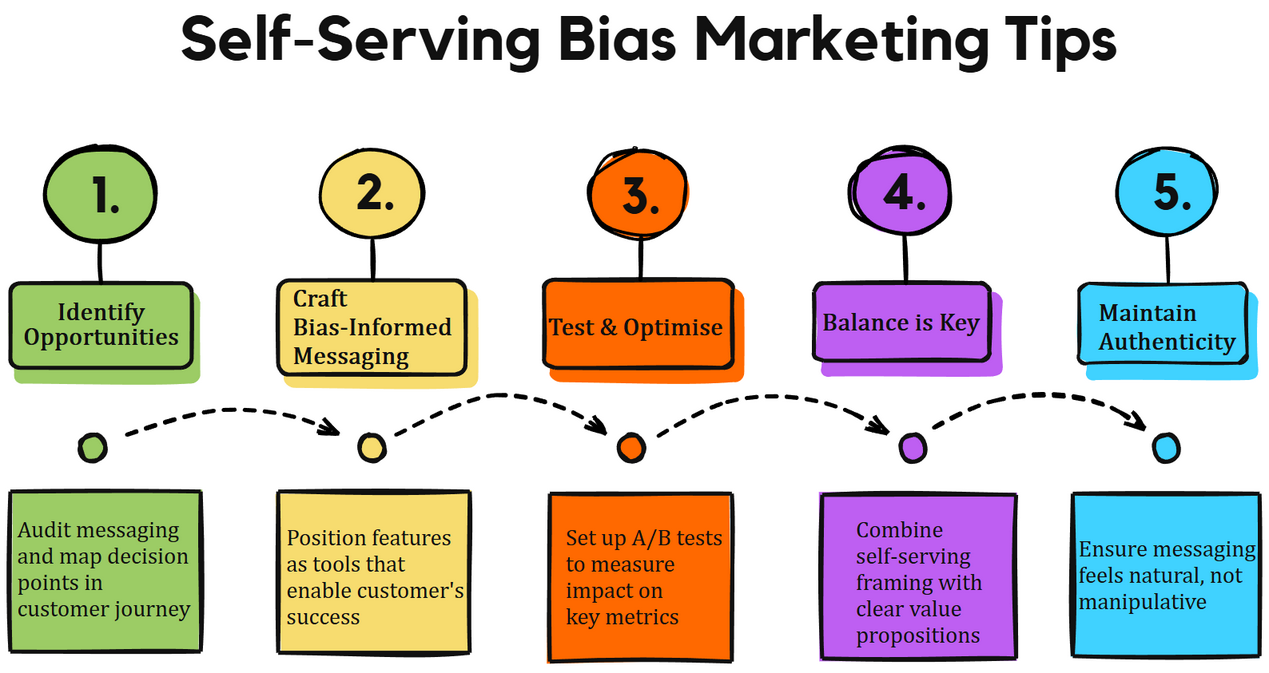
Follow these steps to effectively incorporate the self-serving bias into your marketing:
Step 1: Identify Opportunities in Your Customer Journey
- Audit your current messaging: Look for places where you could shift attribution from your product to the customer’s smart choice.
- Map decision points: Identify key moments where customers might experience doubt or need reassurance about their decision-making.
- Review customer feedback: Look for patterns in how customers already attribute successes and failures with your product.
Step 2: Craft Bias-Informed Messaging
- Reframe product benefits: Position features as tools that enable the customer’s success rather than doing all the work for them.
- Develop affirming microcopy: Create small text elements throughout your website that reinforce the customer’s agency and good judgement.
- Design testimonials strategically: Select and structure customer stories that highlight both your solution and the customer’s role in achieving results.
Step 3: Test and Optimise
- Set up A/B tests: Create controlled experiments to measure the impact of self-serving bias framing on key metrics.
- Start small: Begin with limited tests on specific ad groups or landing pages before broader implementation.
- Measure multiple metrics: Track not just conversions but also engagement, customer satisfaction, and long-term retention.
Best Practices
- Balance is key: Combine self-serving framing with clear value propositions about what your product actually delivers.
- Segment your approach: Different audience segments may respond differently to self-serving framing – tailor your approach accordingly.
- Maintain authenticity: Ensure your messaging feels natural and aligned with your brand voice, not manipulative.
Common Pitfalls
- Overpromising: Avoid suggesting that success is guaranteed just because the customer made a “smart choice.”
- Neglecting product quality: Don’t use self-serving framing to mask actual product limitations.
- Ignoring cultural differences: Remember that this bias varies across cultures – what works in individualistic societies may not work in collectivist ones.
Related Psychological Biases and Effects
The self-serving bias operates alongside several related psychological phenomena:
Actor-Observer Bias: We tend to attribute our own actions to situational factors but others’ actions to their personal characteristics. This complements the self-serving bias in how we interpret behaviour.
Optimism Bias: Our tendency to overestimate the likelihood of positive outcomes and underestimate negative ones. This works with the self-serving bias to create unrealistic expectations about future performance.
Confirmation Bias: We seek information that confirms our existing beliefs. This reinforces the self-serving bias by helping us find evidence that supports our positive self-attributions.
Halo Effect: A positive impression in one area influences our opinion in other areas. This can amplify the self-serving bias by generalising positive self-attributions across different domains.
Understanding these related biases can help you create more sophisticated, psychologically informed marketing strategies that address multiple aspects of human decision-making.
Frequently Asked Questions
What is the Self-Serving Bias and how does it work?
Self-serving bias is a cognitive and attributional bias where people attribute their successes to internal factors (like ability or effort) and their failures to external factors (like bad luck or task difficulty). This psychological mechanism serves to protect and enhance our self-esteem by creating a more favourable self-perception.
The bias operates through two main mechanisms:
- Motivational: We’re driven to maintain positive self-image and protect our ego
- Cognitive: Our attention, memory, and information processing naturally favour self-enhancing explanations
This tendency occurs largely automatically and unconsciously, helping us maintain a positive self-concept whilst navigating life’s successes and failures.
How does Self-Serving Bias affect our daily decision-making?
Self-serving bias influences daily decision-making by creating blind spots in how we evaluate our actions and outcomes. In everyday life, this bias manifests when we:
- Take full credit for successful projects at work whilst attributing team failures to external circumstances
- Blame traffic for being late but credit our time management when arriving early
- Attribute good grades to our intelligence and poor grades to unfair testing
- Credit ourselves for investment gains but blame market conditions for losses
- Overestimate our contributions to household chores whilst underestimating others’
This bias can impair objective self-assessment, making it harder to learn from mistakes and improve decision-making over time. Recognising when we’re engaging in self-serving attributions is the first step towards more balanced evaluations.
What are the main characteristics of Self-Serving Bias in psychology?
The main characteristics of self-serving bias in psychology include:
Asymmetrical attribution: Success is attributed to internal factors (ability, effort), whilst failure is attributed to external factors (luck, task difficulty)
Self-esteem protection: Functions as a psychological defence mechanism to maintain positive self-image
Automaticity: Operates largely unconsciously without deliberate intent
Cultural variation: Stronger in individualistic Western cultures than in collectivist Eastern cultures
Contextual sensitivity: More pronounced when self-esteem is threatened or outcomes are important
Individual differences: Stronger in people with narcissistic traits and weaker in those with depression
Reverse pattern: Can manifest in reverse for people with low self-esteem, who may blame themselves for failures and attribute successes to external factors
Research shows this bias is robust but moderate in strength and influenced by both motivational and cognitive factors.
How is Self-Serving Bias different from confirmation bias?
Self-serving bias and confirmation bias are distinct cognitive biases that affect different aspects of information processing:
Self-Serving Bias:
- Focuses on attribution of outcomes (success vs. failure)
- Attributes successes to internal factors and failures to external factors
- Primarily serves to protect self-esteem
- Occurs after events have happened (retrospective)
- Example: “I got the promotion because I’m talented” vs. “I was passed over because the boss is playing favourites”
Confirmation Bias:
- Focuses on information selection and interpretation
- Involves seeking, favouring, and remembering information that confirms existing beliefs
- Primarily serves to maintain cognitive consistency
- Occurs during information gathering and processing (ongoing)
- Example: Only reading news sources that align with your political views
Whilst both biases can work together to maintain a positive self-image, they operate through different psychological mechanisms and at different stages of information processing.
Who first discovered the Self-Serving Bias and when?
The self-serving bias wasn’t discovered by a single researcher but emerged gradually through attribution theory research. Fritz Heider laid the groundwork in 1958 with his book “The Psychology of Interpersonal Relations,” introducing fundamental attribution concepts.
The term “self-serving bias” gained prominence in the 1970s through researchers like:
- Robert Arkin and Gail Maruyama (1979), who studied attribution patterns in college exam performance
- Daryl Bem (1972), who explored self-perception theory
- Miller and Ross (1975), who published an influential paper questioning whether the bias was motivational or cognitive
The concept was further developed through studies by:
- Zuckerman (1979), who confirmed motivational factors in attribution
- Campbell and Sedikides (1999), who linked the bias to self-threat and narcissism
- Mezulis et al. (2004), whose meta-analysis of 266 studies established the bias as robust across contexts
Rather than a single discovery, self-serving bias represents the culmination of decades of research in attribution theory and social psychology.
What brain mechanisms are responsible for Self-Serving Bias?
The neurological basis of self-serving bias is still being researched, but recent studies using fMRI technology have identified several brain mechanisms likely involved:
Medial prefrontal cortex (mPFC): Active during self-referential processing and self-evaluation, showing increased activation when processing self-relevant positive information
Anterior cingulate cortex (ACC): Involved in error detection and emotional regulation, may help manage negative emotions when processing failure
Ventral striatum: Part of the brain’s reward system, shows increased activity when processing self-enhancing information
Dorsal striatum: Research from 2003 using fMRI identified this region as controlling self-serving bias, particularly in activities that share cognitive and motor aspects
Amygdala: Processes emotional responses, with differential activation patterns when attributing success versus failure
Neural studies suggest the bias involves an interplay between:
- Regions responsible for self-concept maintenance
- Emotional processing areas
- Cognitive control networks that regulate how we interpret events
However, neurological research on self-serving bias is still emerging, with some inconsistent findings across studies. The complete neural circuitry remains to be fully mapped.
Are there any studies that challenge the validity of Self-Serving Bias?
Yes, several studies have challenged aspects of self-serving bias, raising important questions about its universality and mechanisms:
Cultural variations: Brown & Kobayashi (2003) found that in Japanese and other East Asian populations, the bias is significantly weaker and sometimes reversed, suggesting it’s not a universal human tendency.
Methodological critiques: Some researchers argue that experimental demand characteristics may artificially produce the bias in laboratory settings.
Alternative explanations: Miller & Ross (1975) proposed that what appears to be self-serving bias might actually reflect rational information processing – people expect success, so they attribute expected outcomes (success) to themselves.
Depression research: Studies show people with depression often exhibit a reverse pattern, challenging the idea that self-serving attribution is automatic or inevitable.
Contextual factors: Research by Shepperd et al. (2008) demonstrated that the bias varies significantly based on context, audience, and stakes, suggesting it’s not a fixed cognitive tendency.
Whilst the existence of self-serving attributional patterns is well-established, these studies highlight that the bias is more nuanced, context-dependent, and culturally variable than initially thought.
What neurological research exists on Self-Serving Bias?
Neurological research on self-serving bias is still developing, with most studies conducted in the past two decades using functional magnetic resonance imaging (fMRI). Key findings include:
Self-referential processing: Studies show increased activation in the medial prefrontal cortex (mPFC) when people make self-serving attributions, suggesting engagement of self-concept maintenance systems.
Reward processing: The ventral striatum, part of the brain’s reward system, shows heightened activity when people attribute success to themselves, similar to patterns seen during reward anticipation.
Dorsal striatum control: A 2003 fMRI study specifically identified the dorsal striatum as controlling self-serving bias, representing an important breakthrough in understanding the neural mechanisms.
Emotional regulation: The anterior cingulate cortex (ACC) and lateral prefrontal regions show differential activation patterns during self-serving attributions, suggesting cognitive control processes may help regulate negative emotions when processing failure.
Individual differences: Neuroimaging studies reveal different activation patterns in people with high versus low self-esteem, with stronger neural responses in self-enhancement regions for those with higher self-esteem.
Limitations of current research include:
- Small sample sizes in most neuroimaging studies
- Inconsistent experimental paradigms across studies
- Difficulty isolating self-serving bias from other cognitive processes
Researchers continue to explore how these neural mechanisms interact with personality traits, cultural factors, and clinical conditions like depression and narcissism.
What are some famous real-world examples of Self-Serving Bias?
Self-serving bias appears regularly in high-profile contexts, though most examples represent general patterns rather than documented case studies:
Politics and Leadership:
- Politicians routinely take credit for economic improvements during their tenure whilst blaming predecessors or external factors for downturns
- Corporate executives attributing company success to their leadership but blaming market conditions for failures
Sports:
- Athletes crediting victories to their skill and preparation whilst attributing losses to referee decisions, playing conditions, or injuries
- Coaches taking credit for team wins but blaming player execution for losses
- Newspaper accounts of baseball and football games show about 75% of attributions from winning teams were internal whilst only about 55% of attributions from losing teams were internal
Business:
- Investment managers highlighting their strategy for successful investments whilst blaming market volatility for poor performance
- Corporate annual reports that attribute positive results to management strategy but negative results to “challenging market conditions”
Education:
- Students attributing good grades to their intelligence and hard work, but poor grades to unfair testing or inadequate teaching
- Teachers crediting student success to their teaching methods but blaming poor performance on student motivation
These patterns are consistently observed across domains, though specific individuals may vary in how strongly they exhibit the bias.
How does Self-Serving Bias appear in movies and popular culture?
Self-serving bias frequently appears in movies and popular culture as a character trait or plot device that creates both comedy and conflict:
Film Examples:
- In “The Social Network,” Mark Zuckerberg attributes Facebook’s success to his own genius whilst dismissing others’ contributions
- “The Wolf of Wall Street” shows Jordan Belfort taking credit for his firm’s success whilst blaming others when legal troubles arise
- Characters in “The Office” consistently take credit for successful projects whilst deflecting blame for failures
Television:
- In “Succession,” the Roy family members constantly jockey for credit whilst avoiding responsibility for mistakes
- “Arrested Development” features characters like GOB Bluth who never acknowledge their own failures
- Reality competition shows like “The Apprentice” showcase contestants taking credit for team successes whilst blaming teammates for failures
Literature:
- Jane Austen’s characters often display self-serving attributions about their social successes and failures
- In “The Great Gatsby,” characters attribute their social position to their own merit rather than privilege
These portrayals serve as mirrors to our own cognitive tendencies, often exaggerated for dramatic or comedic effect. Writers use this bias to create relatable but flawed characters whose lack of self-awareness drives narrative tension.
What historical events demonstrate Self-Serving Bias in action?
Historical events frequently demonstrate self-serving bias in how they’re interpreted and recorded by different parties:
Military Conflicts:
- After World War I, German leaders promoted the “stab-in-the-back” myth, attributing their defeat to internal betrayal rather than military failure
- Various military leaders throughout history have taken credit for victories whilst blaming defeats on weather, supplies, or subordinates
Economic Events:
- Following the 2008 financial crisis, many banking executives attributed previous successes to their business acumen but blamed the collapse on unforeseeable market conditions
- Political parties consistently take credit for economic booms during their administration whilst blaming recessions on previous administrations or global factors
Scientific Discoveries:
- The history of science contains numerous priority disputes where multiple scientists claimed personal credit for discoveries whilst minimising others’ contributions
Political Movements:
- Revolutionary leaders often attribute successful uprisings to their leadership and vision whilst blaming setbacks on external opposition
- Political memoirs typically emphasise the author’s positive contributions whilst contextualising failures as due to circumstances beyond their control
These examples demonstrate how self-serving bias shapes not just individual perceptions but collective historical narratives, with different groups constructing attributions that protect their identity and reputation.
Can you give examples of Self-Serving Bias in sports and competition?
Self-serving bias is particularly evident in sports and competition, where outcomes are clear and stakes are high:
Individual Athletes:
- Tennis players attributing wins to their skill and strategy but losses to external factors like court conditions, equipment issues, or referee calls
- Golfers crediting good rounds to their technique whilst blaming poor performance on weather conditions or course setup
- Boxers explaining victories through superior training but defeats through injuries or biased judging
Team Sports:
- Football coaches taking credit for wins (“our game plan worked perfectly”) but attributing losses to player execution or officiating
- Basketball players claiming credit for game-winning shots but blaming teammates for missed opportunities in losses
- Cricket captains attributing successful matches to their leadership but unsuccessful ones to pitch conditions
Research Evidence:
- Studies of post-game interviews show consistent patterns where athletes make more internal attributions (skill, preparation) for victories and external attributions (luck, officiating) for defeats
- Research on sports fans shows they exhibit similar biases, attributing their team’s wins to player skill but losses to bad luck or poor officiating
- A 1980 study coding newspaper accounts found that lone performers made more self-serving attributions than team performers because individual performance outcomes have greater effects on personal esteem
This bias can impede athletic development by preventing honest assessment of performance. However, some sports psychologists suggest a moderate self-serving bias may protect athlete confidence and motivation following defeats.
How is Self-Serving Bias different from the halo effect?
Self-serving bias and the halo effect are distinct cognitive biases that influence different aspects of perception:
Self-Serving Bias:
- Focuses on attribution of personal outcomes (success vs. failure)
- Involves attributing one’s successes to internal factors and failures to external factors
- Primarily serves to protect self-esteem
- Operates in self-perception and self-evaluation
- Example: “I got promoted because of my skills” vs. “I was overlooked because the timing wasn’t right”
Halo Effect:
- Focuses on impression formation of others or products
- Involves generalising one positive trait or impression to other unrelated characteristics
- Primarily serves to simplify social perception
- Operates in perception of others or brands
- Example: “This person is attractive, so they must also be intelligent and kind”
Whilst both biases involve cognitive shortcuts in evaluation, self-serving bias specifically concerns causal attributions about personal outcomes, whereas the halo effect involves generalising impressions across different traits or qualities. The self-serving bias is self-directed, whilst the halo effect typically applies to our perception of others.
What’s the difference between Self-Serving Bias and attribution bias?
Self-serving bias is actually a specific type of attribution bias, not a separate phenomenon. Here’s how they relate:
Attribution Bias (Broader Category):
- Encompasses all systematic errors in how people determine the causes of events or behaviours
- Includes multiple specific biases in how we attribute causes
- Applies to attributions about ourselves, others, and general events
- Based on Fritz Heider’s attribution theory about how people explain causality
Self-Serving Bias (Specific Type):
- A particular pattern of attribution bias specifically about personal outcomes
- Involves attributing successes to internal factors (ability, effort) and failures to external factors (luck, task difficulty)
- Primarily focused on protecting and enhancing self-esteem
- Only applies to attributions about one’s own outcomes
Other types of attribution biases include:
- Fundamental Attribution Error: Overemphasising personality and underemphasising situational factors when explaining others’ behaviour
- Actor-Observer Bias: Attributing our own actions to situations but others’ actions to their personality
- Hostile Attribution Bias: Perceiving hostile intent in others’ ambiguous actions
Self-serving bias is best understood as a specific manifestation of attribution bias that follows a particular pattern related to self-esteem maintenance.
How does Self-Serving Bias compare to the Dunning-Kruger effect?
Self-serving bias and the Dunning-Kruger effect are related but distinct cognitive phenomena that affect self-perception in different ways:
Self-Serving Bias:
- Focuses on attribution of outcomes (success vs. failure)
- Involves attributing successes to internal factors and failures to external factors
- Primarily serves to protect self-esteem after events occur
- Applies to people at all skill levels
- Example: “I succeeded because I’m skilled; I failed because the test was unfair”
Dunning-Kruger Effect:
- Focuses on metacognitive ability (ability to assess one’s own competence)
- Involves low-skilled individuals overestimating their abilities and high-skilled individuals slightly underestimating theirs
- Results from lack of self-awareness about one’s competence level
- Primarily affects those with lower skill levels
- Example: “I’m excellent at this task” (despite poor performance)
Whilst both biases involve self-enhancement, self-serving bias relates to how we explain outcomes, whereas the Dunning-Kruger effect concerns our ability to accurately assess our skills before performance. They can work together – someone might overestimate their ability (Dunning-Kruger) and then attribute failure to external factors (self-serving bias).
Is there an opposite effect to Self-Serving Bias?
Yes, there is an opposite pattern to self-serving bias, sometimes called “self-effacing bias” or “reverse self-serving bias.” This occurs when people attribute failures to internal factors and successes to external factors.
This reverse pattern is observed in several contexts:
Clinical Depression: Research consistently shows people with depression often exhibit a reverse attributional style, blaming themselves for negative outcomes whilst attributing positive events to external factors or luck. Recent 2024 research confirms that individuals with depression show an attenuated self-serving bias, with low self-esteem and high depression levels predicting this reverse pattern.
Cultural Differences: Studies by Brown & Kobayashi (2003) found that in collectivist cultures, particularly East Asian societies, people often demonstrate a more self-effacing attributional style compared to Western individualistic cultures. This reflects cultural values that emphasise modesty and group harmony over individual self-enhancement.
Low Self-Esteem: Individuals with chronically low self-esteem may show a reverse pattern, consistent with their negative self-concept. Research shows that self-esteem is positively correlated with self-serving bias, meaning those with lower self-esteem exhibit weaker or reversed bias patterns.
Self-Blaming Bias: This specific term refers to the tendency to blame oneself for failures whilst attributing successes to luck or external help. This pattern can contribute to a cycle of reduced confidence and may exacerbate mental health issues like depression and anxiety.
Therapeutic Implications: Recent studies suggest that self-affirmation interventions can help individuals with attenuated self-serving bias (such as those with depression) to increase self-esteem, reduce depressive symptoms, and restore more balanced attributional patterns.
Understanding this reverse pattern is crucial for both clinical psychology and marketing, as it highlights that self-serving bias is not universal and varies significantly based on individual mental health, cultural background, and personal experiences.