
Guide to Hindsight Bias in Marketing: Description, Psychology, and Examples
What Is Hindsight Bias?
Hindsight Bias is the tendency for people to believe they could have predicted an outcome after it has already occurred, even when they had no basis for that prediction beforehand. This powerful cognitive bias explains why customers often reconstruct their memories to feel they “knew it all along,” making them more confident about their purchase decisions and more receptive to messaging that reinforces this feeling of prescience.
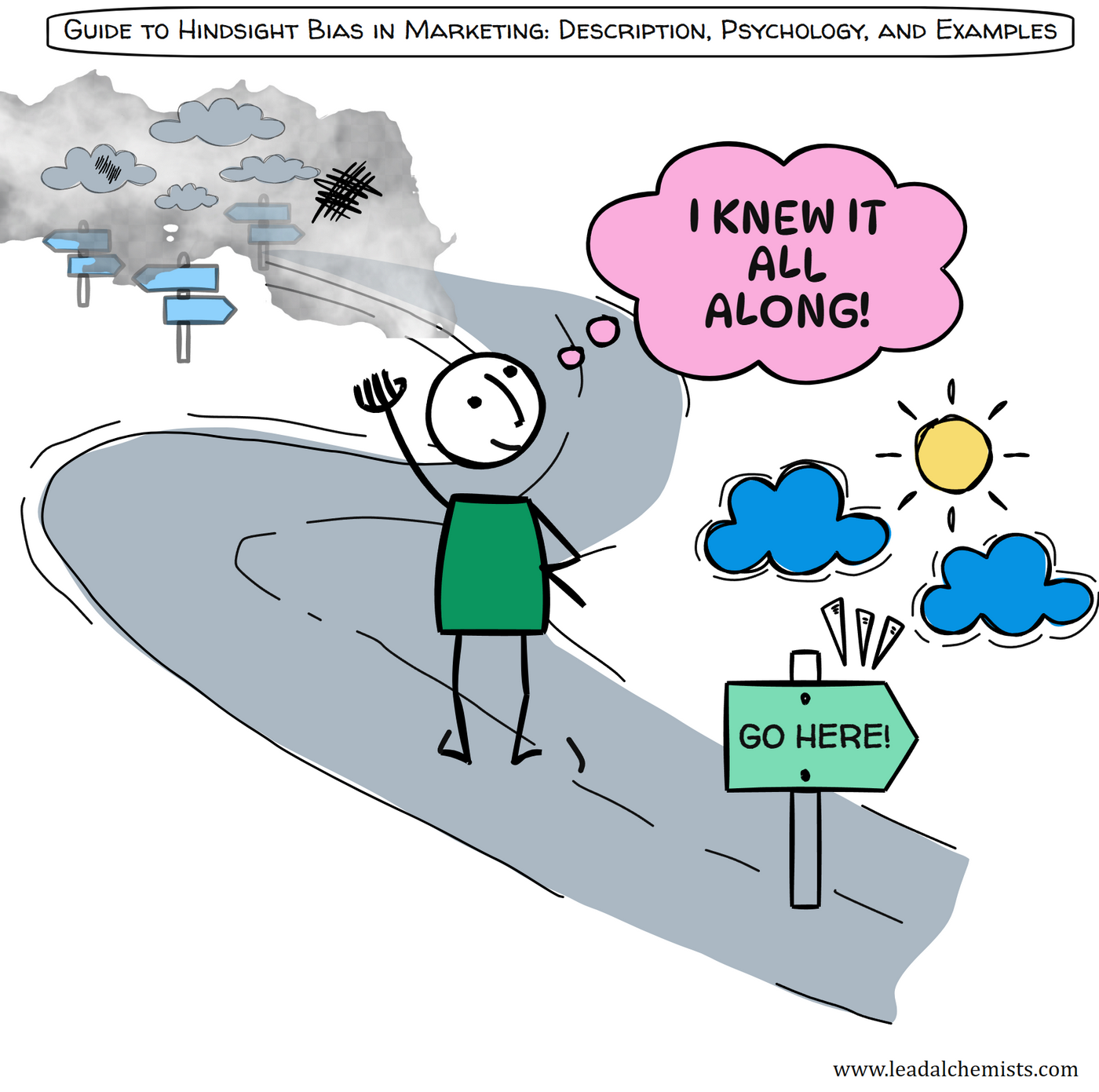
At its psychological core, Hindsight Bias works because humans are cognitive misers – we instinctively reconstruct our memories to create a coherent narrative that makes sense of past events. When an outcome occurs, our brains automatically rewrite our previous uncertainty into a feeling of certainty, making it far more likely that we’ll feel we “saw it coming” rather than admitting we were genuinely uncertain, which would challenge our self-perception as competent decision-makers.
For marketers and advertisers, understanding this bias gives a real competitive edge. By purposefully and strategically framing product benefits and customer success stories in ways that help buyers feel their choice was obvious and predictable while delivering genuine value, you can reinforce purchase satisfaction and reduce cognitive dissonance in ways that other persuasion techniques simply cannot match.
How Hindsight Bias Actually Works
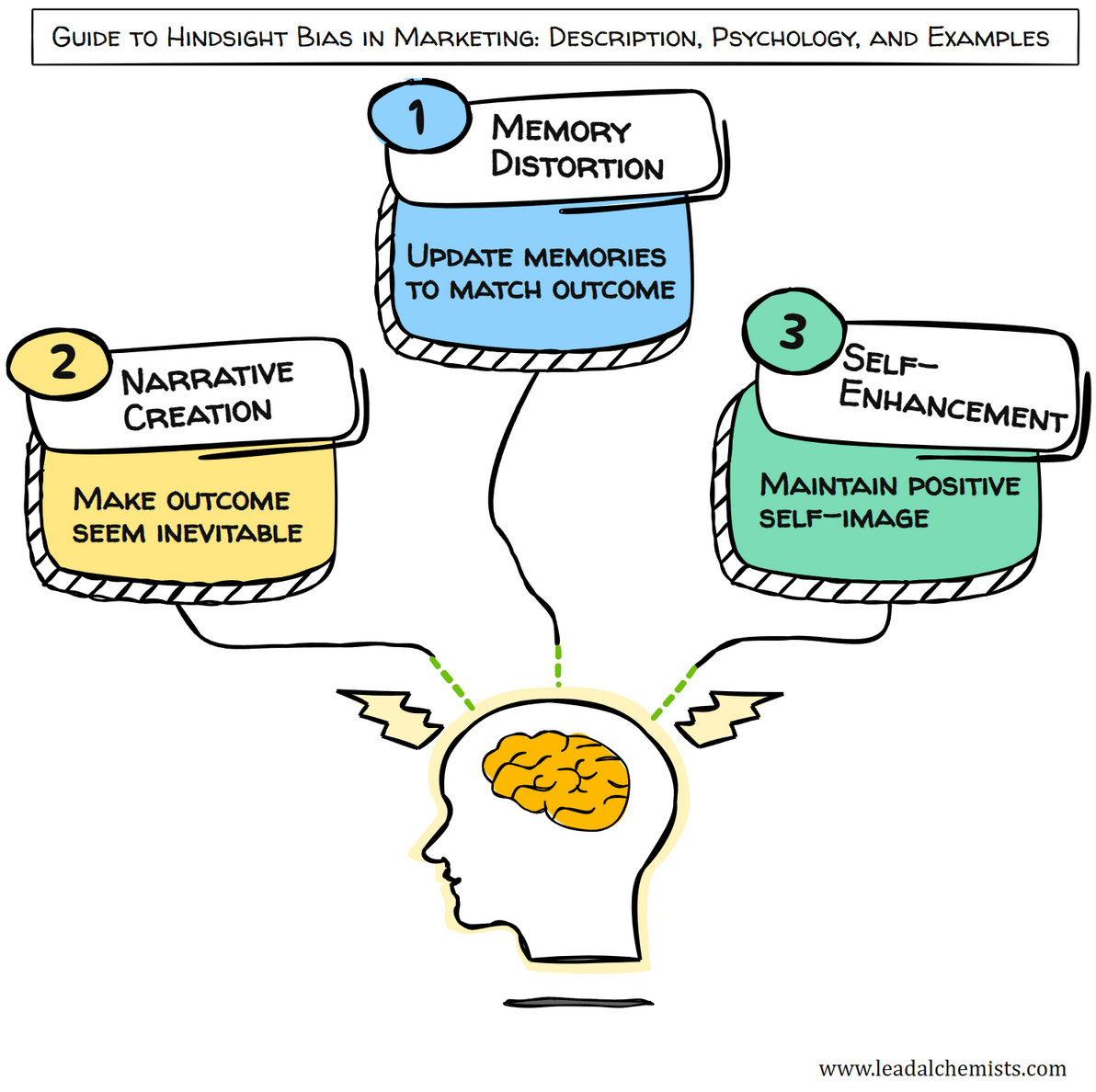
The hindsight bias operates through three primary cognitive mechanisms:
Memory Distortion
When we learn an outcome, our brains automatically update our memories of what we previously thought. This isn’t deliberate deception – it’s how our memory systems work. We literally cannot remember our previous state of ignorance once we know something.
Sense-Making and Narrative Creation
Humans are natural storytellers. Our brains constantly seek order and coherence, filtering information to create narratives that make outcomes seem inevitable. After learning what happened, we construct a causal chain that makes the result appear obvious and predictable.
Self-Enhancement and Ego Protection
Believing we “knew it all along” helps us maintain a positive self-image as competent, knowledgeable individuals. This motivational factor is particularly strong when outcomes are moderately surprising – not so obvious that everyone predicted them, but not so shocking that they seem completely unpredictable.
Research by Roese and Vohs (2012) confirmed these mechanisms, demonstrating that hindsight bias is a robust psychological phenomenon that affects decision-making across various contexts. Their study showed that the bias is particularly strong when:
- The outcome aligns with our expectations
- We’re evaluating others’ decisions rather than our own
- We’re emotionally invested in the outcome
Recent neuroimaging studies suggest that hindsight bias involves brain regions associated with memory updating and self-referential processing, though this research is still emerging.
Real-World Examples of Hindsight Bias
Non-Marketing Examples
Hindsight bias appears in numerous contexts beyond marketing:
Financial Markets: After market crashes, many investors claim they “saw it coming,” despite few actually acting on such predictions beforehand. This overconfidence can lead to risky future investments.
Medical Diagnoses: Physicians often overestimate their ability to have predicted patient outcomes after learning the actual results, affecting clinical judgement and potentially leading to overconfidence in future diagnoses.
Legal Judgements: Jurors tend to assign more blame when they know a negative outcome occurred, believing the outcome was more foreseeable than it actually was.
Political Analysis: After elections or major political events, commentators often reframe their previous analyses to suggest they predicted the outcome, even when their pre-event predictions were quite different.
Marketing Applications
Whilst direct, data-driven case studies explicitly using hindsight bias in marketing are limited, the psychological principles can be applied in several ways:
Testimonial Framing: Customer testimonials that emphasise the “I wish I’d done this sooner” sentiment tap into hindsight bias. When potential customers read these testimonials, they’re primed to imagine themselves having the same realisation after using the product or service.
Post-Purchase Reinforcement: Email campaigns that validate a customer’s purchase decision by highlighting how “obvious” the benefits were can reduce buyer’s remorse and increase satisfaction. This approach frames the purchase as inevitable and wise in retrospect.
Before-and-After Demonstrations: Visual representations showing transformation (like before-and-after photos) implicitly trigger hindsight bias by making the outcome seem obvious and attainable once it’s been demonstrated.
How Hindsight Bias Affects Consumer Behaviour
Hindsight bias significantly impacts how consumers make decisions and evaluate their purchases:
Pre-Purchase Influence
When consumers are considering a purchase, hindsight bias can make them more receptive to messaging that frames the decision as one they’ll later see as “obvious.” This works particularly well when:
- The messaging highlights how others initially hesitated but later realised the benefits were clear
- The product solves a problem the consumer has struggled with for some time
- The solution seems simple in retrospect
Post-Purchase Justification
After making a purchase, consumers naturally want to feel they made the right choice. Hindsight bias helps them justify their decisions by making the benefits seem more predictable and obvious than they might have appeared before the purchase.
Psychological Triggers That Amplify The Effect
Several factors can strengthen hindsight bias in consumer contexts:
Surprise followed by explanation: When consumers are surprised by information but then given a simple explanation, hindsight bias tends to be stronger
Group-based judgements: When decisions are framed as ones that “most people” eventually recognise as correct
High-involvement products: The bias is stronger for products that require significant consideration or investment
Research by Geissmar, Niemand, and Kraus (2023) found that when consumers were surprised by sustainability information about products, hindsight bias increased purchase intention and word-of-mouth, particularly for high-involvement products.
Case Studies: How Marketers Use Hindsight Bias in Advertising
Whilst direct case studies explicitly labelled as hindsight bias applications are rare, academic research provides evidence for how this psychological principle can be applied in marketing contexts.
Academic Evidence: Consumer Evaluation Study
A 2023 study by Geissmar, Niemand, and Kraus experimentally demonstrated how hindsight bias affects consumer evaluations. The researchers found that when consumers were presented with surprising information about products, followed by explanations that made the information seem obvious in retrospect, their purchase intentions increased significantly.
Key Finding: The effect was strongest when the information was moderately surprising (not completely obvious nor entirely unexpected) and when consumers were evaluating high-involvement products.
Marketing Application: This suggests that revealing unexpected benefits or features of a product, then framing them as “obvious in retrospect,” can be an effective persuasion technique.
Practical A/B Test Example for Google Ads
Whilst not a historical case study, here’s a research-backed A/B test that marketers could implement:
- Control Ad: “Get Fast Relief from Headaches”
- Test Ad (Hindsight Framing): “The Solution Was Always Here – Don’t Wait to Feel Better”
The test advert leverages hindsight bias by suggesting that the solution will seem obvious in retrospect, potentially increasing curiosity and engagement. Metrics to track would include click-through rates and conversion rates on the landing page.
Practical Applications for Google Ads and Lead Generation
Google Ads Copywriting and Ad Design
Headline Framing: Instead of “Book Your Financial Consultation,” try “Discover the Financial Strategy You’ll Wish You’d Known Sooner”
Ad Description: Rather than “Our accounting services save businesses time,” use “Clients consistently tell us: ‘I can’t believe I waited so long to get proper accounting help'”
Call-to-Action: Replace standard CTAs like “Learn More” with hindsight-framed alternatives like “See What You’ve Been Missing”
A/B Test Idea:
- Control: “Get Expert Legal Advice for Your Business”
- Test: “The Legal Solution You’ll Wonder How You Managed Without”
- Metrics: Compare click-through rates and conversion rates
Landing Page Structuring for Lead Generation
Testimonial Selection: Prioritise testimonials that express the “I should have done this sooner” sentiment. For example, a financial adviser’s landing page could feature: “I knew I should have started investing earlier, and [Adviser’s Name] made it so easy.”
Form Headline Framing: Instead of “Request Information,” use “Take the Step You’ll Wish You’d Taken Sooner”
Benefit Presentation: Frame benefits as revelations that will seem obvious after using the service: “You’ll wonder how you ever managed without our project management system”
Visual Elements: Use before-and-after visuals that make the transformation seem inevitable in retrospect
Website UX and Form Optimisation
Form Button Text: Replace “Submit” with “Begin the Solution You’ll Wonder How You Lived Without”
Lead Magnet Framing: Title resources to leverage hindsight bias, such as “The 5 Fixes You’ll Wish You’d Known Last Year”
Progress Indicators: Use language that reinforces the inevitability of completing the form: “You’re on your way to the solution that will seem obvious in hindsight”
Confirmation Messages: After form submission, reinforce the wisdom of their decision: “You’ve just taken a step that our clients consistently say they wish they’d taken sooner”
Why Marketers Should Care About Hindsight Bias
Hindsight bias offers several powerful advantages for marketers when ethically applied:
Conversion Optimisation
By framing decisions as ones that will seem obvious in retrospect, you can reduce hesitation and friction in the conversion process. This works particularly well for services with delayed benefits or products that solve persistent problems.
Customer Satisfaction Enhancement
Post-purchase communications that reinforce the wisdom of a customer’s decision can reduce cognitive dissonance and increase satisfaction, potentially improving retention and referrals.
Trust Building
When customers feel they’ve made a wise decision that seems obvious in retrospect, they’re more likely to trust your brand for future recommendations and purchases.
Ethical Considerations and Responsible Use
Whilst hindsight bias can be a powerful marketing tool, ethical application is essential:
Avoid False Claims: Never fabricate testimonials or create artificial regret narratives
Use Authentic Experiences: Base hindsight-framed messaging on genuine customer experiences
Don’t Exaggerate Inevitability: Avoid suggesting that outcomes are guaranteed or completely predictable
Respect Consumer Agency: Frame messages to empower consumers rather than manipulate them
The risks of misusing hindsight bias include damaging brand credibility, eroding consumer trust, and potentially violating advertising standards around truthfulness and substantiation.
How to Implement Hindsight Bias in Your Marketing Strategy
Step-by-Step Implementation Guide
1. Audit Current Messaging
- Review your existing marketing materials for opportunities to incorporate hindsight framing
- Identify points where customers typically experience “I should have done this sooner” moments
2. Collect Authentic Testimonials
- Ask satisfied customers specifically about their “hindsight moments”
- Look for patterns in when customers realise the value of your product/service
3. Develop Hindsight-Framed Messaging
- Create advert copy and landing page content that leverages the “knew it all along” effect
- Focus on how obvious the benefits will seem after using your product/service
4. Test and Measure
- Implement A/B tests comparing standard messaging against hindsight-framed alternatives
- Track key metrics including click-through rates, conversion rates, and customer satisfaction
5. Refine Based on Results
- Analyse which hindsight-framed messages perform best
- Iterate and improve based on data-driven insights
Best Practices and Common Pitfalls
Best Practices:
- Use authentic customer language rather than marketing jargon
- Balance hindsight framing with clear present benefits
- Apply the bias most heavily at decision points and post-purchase communications
- Ensure all claims are truthful and substantiated
Common Pitfalls:
- Overusing the technique, which can make messaging seem manipulative
- Creating artificial urgency or regret that doesn’t align with actual customer experiences
- Failing to test different variations of hindsight-framed messaging
- Ignoring industry or audience differences in receptiveness to this approach
A/B Testing Ideas
Google Ads Headline Test:
- Control: “Professional Tax Services for Small Businesses”
- Test: “The Tax Solution You’ll Wish You’d Discovered Years Ago”
- Metric: Click-through rate and conversion rate
Landing Page Form Button Test:
- Control: “Submit Request”
- Test: “Take the Step You’ll Be Glad You Took”
- Metric: Form completion rate
Email Subject Line Test:
Metric: Open rate and click-through rate
Control: “Introducing Our New Consulting Package”
Test: “The Consulting Approach You’ll Wonder How You Managed Without”
Related Psychological Biases and Effects
Understanding hindsight bias works best when considered alongside related psychological phenomena:
Confirmation Bias: Whilst hindsight bias involves reconstructing memories after learning outcomes, confirmation bias involves seeking information that confirms existing beliefs. These biases often work together, as people may use hindsight bias to confirm their pre-existing views.
Outcome Bias: Closely related to hindsight bias, outcome bias involves judging a decision based on its outcome rather than the quality of the decision-making process. Marketers can address both biases by focusing on the process and journey, not just the end result.
Availability Heuristic: This bias causes people to overestimate the likelihood of events that are easily recalled. It can amplify hindsight bias when memorable outcomes seem more predictable in retrospect.
Anchoring Effect: The tendency to rely too heavily on the first piece of information encountered. Hindsight bias can be strengthened when initial information serves as an anchor for later judgements.
Frequently Asked Questions
What is Hindsight Bias and how does it affect our thinking?
Hindsight bias is the tendency to believe we “knew it all along” after learning the outcome of an event, perceiving past events as more predictable than they actually were. This cognitive bias affects our thinking by distorting our memory of past judgements to align with current knowledge, creating a false sense that we could have predicted outcomes that were actually uncertain.
The bias operates through three key mechanisms:
- Memory distortion – Misremembering our original predictions
- Sense-making – Creating narratives that make outcomes seem inevitable
- Self-enhancement – Bolstering our self-image as knowledgeable and competent
This mental shortcut can lead to overconfidence in future predictions and hinder our ability to learn from genuine surprises or mistakes.
Why is Hindsight Bias also called the ‘I-knew-it-all-along’ effect?
Hindsight bias is called the “I-knew-it-all-along” effect because it perfectly captures the essence of the phenomenon: people’s tendency to claim they anticipated an outcome after it has occurred, even when they had no basis for predicting it beforehand. This nickname highlights how we often revise our memory of predictions to align with known results.
The term reflects the common phrases people use when exhibiting the bias:
- “I knew that would happen”
- “It was obvious all along”
- “I could have told you that”
This colloquial name makes the concept more accessible and relatable, as most people can recognise instances when they or others have made such claims after sporting events, elections, or market movements.
How does Hindsight Bias distort our memory of past events?
Hindsight bias distorts our memory through a process of unconscious reconstruction, where we selectively recall and reinterpret information to make it consistent with known outcomes. This memory distortion happens automatically and without awareness.
The process works in several ways:
- We selectively recall information that aligns with the known outcome
- We reinterpret ambiguous information to fit with what eventually happened
- We forget our original predictions and replace them with new ones
- We minimise the uncertainty we actually experienced before knowing the outcome
Research by Fischhoff (1975) demonstrated this effect when participants, after learning historical event outcomes, misremembered their original probability estimates to be closer to what actually happened. This memory reconstruction creates a false sense of predictability and can prevent us from recognising genuine surprises.
What’s the difference between Hindsight Bias and confirmation bias?
Hindsight bias and confirmation bias are distinct cognitive errors that affect our thinking in different ways. Hindsight bias occurs after an outcome is known, causing us to believe we predicted it all along, whilst confirmation bias happens during information processing, leading us to favour evidence that supports our existing beliefs.
Key differences:
| Hindsight Bias | Confirmation Bias |
| Occurs after outcomes are known | Occurs during information gathering |
| Involves memory reconstruction | Involves selective attention to evidence |
| Makes past events seem inevitable | Makes current beliefs seem validated |
| Example: “I knew that team would win” (after the game) | Example: Only reading news sources that support your political views |
Whilst distinct, these biases can work together – confirmation bias might lead you to seek information supporting your view, and hindsight bias might later convince you that you were right all along, reinforcing overconfidence in future judgements.
Who first discovered Hindsight Bias, and when was it studied?
Baruch Fischhoff first systematically studied and documented hindsight bias in the 1970s. His groundbreaking 1975 paper, “Hindsight ≠ Foresight: The Effect of Outcome Knowledge on Judgement Under Uncertainty,” published in the Journal of Experimental Psychology, established the foundation for research on this cognitive phenomenon.
Fischhoff conducted experiments where participants:
- Read descriptions of historical events
- Were asked to assess the probability of different possible outcomes
- Were then told the actual outcome
- Were asked to recall their original probability estimates
The results showed that participants who knew the outcome consistently misremembered their original predictions, believing they had assigned higher probabilities to what actually happened than they actually did.
Whilst Fischhoff is credited with formally identifying and naming the bias, philosophers and thinkers had noted similar effects throughout history. His work, however, provided the empirical evidence and theoretical framework that launched decades of subsequent research.
What did Baruch Fischhoff’s research reveal about Hindsight Bias?
Baruch Fischhoff’s pioneering research revealed that hindsight bias is a robust and pervasive cognitive phenomenon that significantly distorts our judgement. His 1975 experiments demonstrated that once people learn an outcome, they cannot accurately recall their previous predictions and consistently overestimate how predictable the outcome was.
Key findings from Fischhoff’s research:
- Participants who knew the outcome of historical events claimed they would have assigned significantly higher probabilities to those outcomes than participants who made predictions without knowing results
- The bias persisted even when participants were explicitly warned about it and asked to avoid it
- People were unaware of the influence that outcome knowledge had on their judgements
- The effect was consistent across various scenarios and contexts
Fischhoff concluded that hindsight bias creates an illusion of predictability that can lead to unwarranted confidence in future predictions and unfair assessments of decision-makers who lacked the benefit of outcome knowledge. His work established that this bias is not just a curiosity but a fundamental limitation in human judgement with significant implications for fields like medicine, law, and business.
How does the brain create Hindsight Bias at a neurological level?
At a neurological level, hindsight bias appears to involve multiple brain regions associated with memory reconstruction and self-referential processing, though research is still emerging. Whilst no definitive neural model exists, several mechanisms have been identified through neuroimaging studies.
The brain creates hindsight bias through:
- Memory updating processes in the hippocampus and prefrontal cortex that overwrite original memories with new information
- Causal reasoning networks that automatically create coherent narratives linking past events to known outcomes
- Self-referential processing in medial prefrontal regions that motivate us to maintain a positive self-image as knowledgeable
- Confirmation mechanisms that strengthen neural pathways supporting the known outcome whilst weakening competing pathways
Recent neuroimaging studies using fMRI suggest that when people exhibit hindsight bias, there’s increased activity in brain regions associated with memory reconstruction rather than memory retrieval, indicating that people aren’t simply recalling their previous judgements but actively reconstructing them to align with current knowledge.
However, it’s important to note that neurological research on hindsight bias is still developing, and a comprehensive neural model has not yet been established.
Are there any studies that challenge the existence of Hindsight Bias?
Whilst hindsight bias is widely accepted as a robust psychological phenomenon, some researchers have challenged aspects of its interpretation and universality. These challenges don’t deny the effect itself but question how we understand it.
Key challenges include:
Memory updating perspective: Some researchers, like Pezzo (2011), argue that what we call hindsight bias may sometimes represent rational memory updating rather than a cognitive error – the brain appropriately integrating new information.
Methodological concerns: Critics have questioned whether laboratory scenarios fully capture real-world complexity, suggesting that artificial experimental settings might exaggerate the bias.
Individual and cultural differences: Studies have found significant variations in hindsight bias across individuals and cultures, challenging the notion that it’s a universal cognitive tendency.
Contextual factors: Research shows the bias can be reduced or eliminated under certain conditions, such as when people are held accountable for their judgements or when they have expertise in the relevant domain.
Despite these challenges, the fundamental effect – that outcome knowledge influences our perception of past predictability – has been replicated across hundreds of studies in diverse contexts, confirming that hindsight bias is a genuine psychological phenomenon, even if its interpretation and boundaries remain subjects of ongoing research.
What role does memory reconstruction play in Hindsight Bias?
Memory reconstruction plays a central role in hindsight bias, serving as the primary cognitive mechanism through which the bias operates. Rather than simply retrieving memories, our brains actively rebuild them each time we recall information, making them vulnerable to post-event influences.
This reconstruction process works in several ways:
Selective retrieval: We unconsciously prioritise recalling information consistent with known outcomes whilst forgetting details that suggested alternative possibilities.
Reinterpretation: Ambiguous information from the past is reinterpreted to align with what eventually happened, creating a coherent narrative.
Memory integration: New knowledge becomes seamlessly integrated with original memories, making it impossible to distinguish between what we knew then versus now.
Filling gaps: When memory is incomplete, the brain fills gaps with plausible information that fits the known outcome.
Research by Hoffrage, Hertwig, and Gigerenzer (2000) demonstrated that this reconstruction isn’t deliberate deception but an automatic cognitive process. The brain prioritises creating coherent, causally sensible narratives over preserving accurate records of our previous states of knowledge, leading to the persistent feeling that “we knew it all along” even when we clearly didn’t.
What are some famous historical examples of Hindsight Bias?
Historical events often become subject to hindsight bias, with people claiming predictability after the fact. Several notable examples demonstrate how this bias shapes our collective understanding of major events:
The 2008 Financial Crisis: After the housing market collapsed, numerous analysts claimed they had foreseen the crisis, despite few having taken concrete actions beforehand. Post-crisis books and articles presented warning signs as if they had been obvious, though most financial experts failed to predict the severity and timing of the downturn.
Pearl Harbor Attack (1941): After the Japanese attack, investigations revealed that intelligence reports contained warning signs. With hindsight, these scattered pieces of information seemed to form an obvious pattern, leading to accusations that officials “should have known” despite the ambiguity of the intelligence at the time.
Fall of the Soviet Union: Though few experts predicted the Soviet Union’s collapse, after it happened in 1991, many political analysts retroactively identified “clear signs” of its inevitable downfall, reinterpreting decades of history through the lens of the known outcome.
COVID-19 Pandemic: Early public health decisions were heavily criticised in hindsight, with many claiming the severity should have been obvious from the start, despite the genuine uncertainty that existed when decisions were being made with limited information.
These examples illustrate how hindsight bias can lead to unfair judgements of decision-makers who acted without the benefit of outcome knowledge, and how it creates an illusion that historical events were more predictable than they actually were.
How did Hindsight Bias affect perceptions of the 2008 financial crisis?
Hindsight bias profoundly shaped perceptions of the 2008 financial crisis, creating an illusion that the collapse was more predictable than it actually was at the time. After the crisis unfolded, a narrative emerged that warning signs had been obvious and ignored.
Key manifestations of hindsight bias included:
Selective memory of warnings: The few economists who predicted the crisis (like Nouriel Roubini and Robert Shiller) received disproportionate attention afterward, whilst the vast majority of experts who failed to predict it were overlooked.
Reinterpretation of data: Economic indicators that seemed ambiguous before the crisis were retrospectively viewed as clear warning signs. Rising housing prices, increasing debt levels, and complex financial instruments were reframed as obviously unsustainable.
“I knew it all along” claims: Many investors, analysts, and ordinary people claimed they had anticipated the crash, despite having taken no protective actions beforehand.
Blame allocation: Regulators and financial institutions were harshly criticised for missing “obvious” signs, with less acknowledgement of the genuine uncertainty that existed.
Research by Biais and Weber (2009) documented this effect among financial professionals, finding that after learning outcomes, they significantly overestimated their ability to have predicted market movements. This bias complicated efforts to learn appropriate lessons from the crisis, as it created a false sense that preventing future crises simply requires paying attention to “obvious” warning signs, rather than acknowledging the inherent unpredictability of complex financial systems.
Can you see Hindsight Bias in movies and TV shows?
Hindsight bias is frequently portrayed in movies and TV shows, both as a narrative device and as a behaviour exhibited by characters. These fictional representations help illustrate how the bias works in everyday life.
As a narrative device:
- Mystery/thriller plots often include clues that seem obvious in retrospect but were deliberately obscured during the story (like in “The Sixth Sense” or “Fight Club”)
- Foreshadowing creates a sense that outcomes were inevitable once revealed
- Character flashbacks that recontextualise earlier scenes, making previous events seem more predictable than they initially appeared
Character behaviours:
- “I told you so” moments where characters claim they predicted outcomes they didn’t actually anticipate
- Monday morning quarterbacking by characters who criticise others’ decisions after knowing results
- Revisionist history where characters rewrite their own predictions to align with known outcomes
A classic example is in sports films like “Moneyball,” where characters initially reject new approaches but later act as if they always supported them once success is achieved. Similarly, in political dramas like “House of Cards,” characters often claim to have anticipated plot twists that genuinely surprised them.
These fictional portrayals help audiences recognise the bias in their own thinking, though ironically, viewers themselves often experience hindsight bias when rewatching shows, feeling they “knew all along” how plots would unfold simply because they’ve seen them before.
How does Hindsight Bias appear in sports commentary and analysis?
Hindsight bias is particularly prevalent in sports commentary and analysis, where it’s often called “Monday morning quarterbacking” after the tendency to criticise NFL decisions after Sunday games. This bias manifests in several distinctive ways in sports contexts:
- Post-game analysis that treats close calls as obvious mistakes or brilliant decisions based solely on their outcomes
- Coach and player criticism that ignores the limited information available during the game
- Draft pick evaluations that claim certain selections were clearly good or bad, ignoring the genuine uncertainty at draft time
- Strategy second-guessing where commentators claim plays were obviously wrong after seeing results
For example, a coach’s decision to attempt a fourth-down conversion might be called “obviously reckless” if it fails, but “bold and strategic” if it succeeds – despite being the same decision made with the same information.
Research has shown that even experienced sports analysts exhibit this bias. A study of basketball experts found they significantly overestimated their ability to have predicted game outcomes after learning results, demonstrating that expertise doesn’t eliminate the bias.
This sports-related hindsight bias affects fans’ perceptions of team quality, influences coaching decisions (as coaches may make conservative choices to avoid retrospective criticism), and creates unrealistic expectations about the predictability of sporting events, despite their inherently uncertain nature.
What’s a real-world example of Hindsight Bias in medical diagnosis?
A classic real-world example of hindsight bias in medical diagnosis occurs with missed or delayed diagnoses, particularly for conditions with subtle initial presentations. Consider this documented scenario from medical error research:
A 45-year-old patient presents to the emergency department with chest discomfort, mild shortness of breath, and fatigue. Initial ECG shows minor abnormalities, but nothing definitively indicating a heart attack. Troponin levels are borderline. The physician diagnoses anxiety and acid reflux, sending the patient home with appropriate medications.
Two days later, the patient returns with a massive heart attack. In the subsequent morbidity and mortality review:
- Colleagues reviewing the case claim the initial ECG changes were “obviously concerning”
- The patient’s family insists symptoms were “clearly cardiac” from the beginning
- Medical students learning from the case perceive the diagnosis as an obvious error
- Even the treating physician begins to question how they missed such “clear signs”
Research by Christensen-Szalanski and Willham (1991) documented this phenomenon, showing that physicians consistently overestimate their ability to have diagnosed conditions correctly when reviewing cases where the final diagnosis is known.
This medical hindsight bias has serious implications:
- It creates unrealistic expectations about diagnostic accuracy
- It contributes to unfair malpractice judgements
- It impedes genuine learning from medical errors by oversimplifying complex diagnostic situations
- It increases defensive medicine practices
Medical education now specifically addresses hindsight bias, teaching physicians to recognise how outcome knowledge influences their perception of past clinical decisions.
How is Hindsight Bias different from the availability heuristic?
Hindsight bias and the availability heuristic are distinct cognitive phenomena that affect judgement in different ways, though they can sometimes work together to influence our thinking.
Key differences:
| Hindsight Bias | Availability Heuristic |
| Occurs after outcomes are known | Occurs during probability estimation |
| Involves memory distortion of past predictions | Involves ease of recall affecting current judgements |
| Makes past events seem more predictable than they were | Makes events seem more frequent or likely if easily recalled |
| Example: “I knew the stock would crash” (after it crashed) | Example: Overestimating plane crash likelihood after seeing news coverage |
How they interact: The availability heuristic can sometimes feed into hindsight bias. When an outcome occurs that matches easily recalled examples (availability heuristic), we may be more likely to believe we predicted it (hindsight bias). For instance, if you’ve seen several news stories about housing market crashes, when a crash actually occurs, the availability of those examples might make you feel you “knew it would happen,” even if you made no such prediction beforehand.
The availability heuristic operates during the decision-making process itself, affecting what information comes to mind when we’re forming judgements. Hindsight bias, by contrast, distorts our memory of what we thought before we knew the outcome. Together, these biases can create a powerful illusion of foresight and predictive ability that doesn’t match reality.