Guide to The Tribal Marketing & In-Group Favoritism in Marketing: Description, Psychology, and Examples
What Is The Tribal Marketing & In-Group Favoritism?
Tribal Marketing leverages in-group favoritism (the tendency for people to show preference, trust, and positive attitudes toward members of their own group over outsiders) to build powerful brand communities by creating a sense of shared identity and belonging. This powerful psychological strategy explains why brands like Harley-Davidson inspire cult-like devotion with lifelong communities, why Apple customers queue for hours for new releases, and why local businesses outcompete national chains by fostering genuine tribal connections.
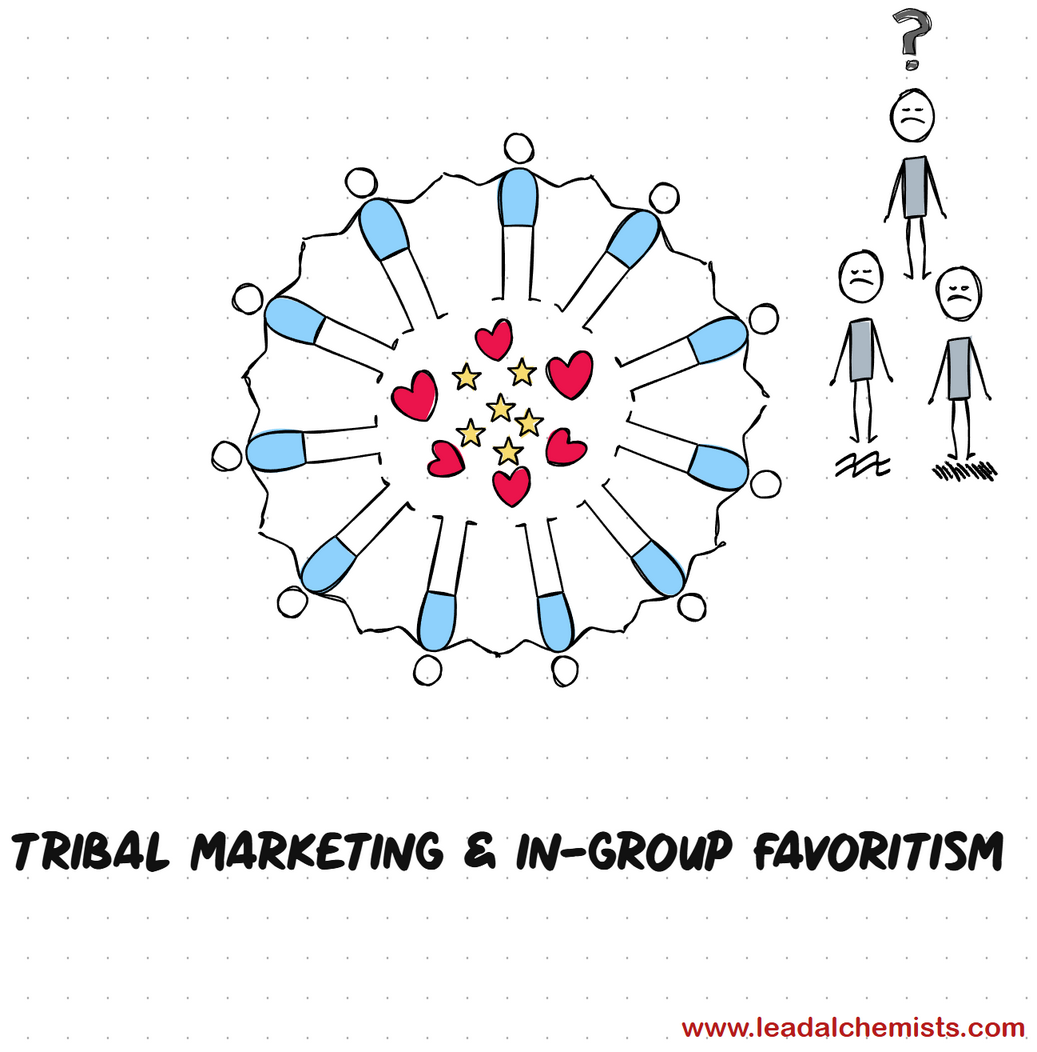
At its psychological core, Tribal Marketing works because humans derive part of their self-concept from group memberships and instinctively favor their in-groups to maintain positive social identity and self-esteem. When customers feel they belong to a brand’s “tribe,” they automatically transfer these powerful group loyalty mechanisms to the brand itself, making it far more likely that they’ll remain loyal, spend more, and actively promote to others rather than simply being transactional customers without emotional connection to the brand community.
For marketers and advertisers, understanding this bias gives a real competitive edge. By purposefully and strategically creating brand communities that foster genuine belonging, shared identity, and meaningful connections between members while delivering real value that justifies tribal membership, you can transform ordinary customers into passionate advocates in ways that other persuasion techniques simply cannot match.
How The Tribal Marketing & In-Group Favoritism Works (The Psychology Behind It)
The psychological mechanisms behind tribal marketing are deeply rooted in human evolution and social psychology. Understanding these mechanisms helps marketers apply the strategy ethically and effectively.
Social Identity Theory
Henri Tajfel’s groundbreaking research in the 1970s demonstrated that even arbitrary group assignments could trigger in-group favoritism. His “minimal group paradigm” experiments showed that people would favour their randomly assigned group members over others, even when there was no logical reason to do so.
This occurs because individuals derive part of their self-esteem and identity from group membership. When a brand successfully positions itself as representing a particular group’s values or lifestyle, customers begin to see the brand as part of their identity.
Neurological Basis
Recent neuroscience research has revealed the biological foundations of in-group favoritism. fMRI studies show that brain regions associated with reward processing (such as the ventral striatum) become more active when people make decisions that benefit their in-group members. This suggests that supporting our “tribe” literally feels rewarding at a neurological level.
Cognitive Mechanisms
Several cognitive biases reinforce tribal marketing effects:
- Social categorization: The tendency to classify people as “us” (in-group) versus “them” (out-group)
- Emotional attachment: Stronger empathy and emotional bonds within the in-group
- Confirmation bias: Seeking information that confirms existing beliefs about the in-group
- Out-group homogeneity effect: Perceiving out-group members as more similar to each other than in-group members
Conflicting Viewpoints
Research shows that in-group favoritism isn’t always detrimental. Some studies suggest it can promote cooperation and social cohesion within groups. However, other research emphasises the potential for discrimination and conflict when in-group favoritism becomes excessive. The key for marketers is finding the balance between fostering community and avoiding exclusion.
Real-World Examples of The Tribal Marketing & In-Group Favoritism
Tribal marketing extends far beyond commercial applications, influencing decisions across multiple contexts:
Political Polarisation
In-group favoritism plays a significant role in political behaviour, with individuals showing strong preference for their own political party and negative attitudes toward opposing parties. This demonstrates the power (and potential dangers) of tribal thinking.
Educational Settings
Teachers may unconsciously favour students from their own ethnic or social background, leading to disparities in academic outcomes. This highlights the importance of awareness when applying tribal marketing principles.
Healthcare Decisions
Studies show that healthcare providers may exhibit in-group favoritism, leading to differences in treatment quality based on race, ethnicity, or social class. This underscores the ethical considerations marketers must consider.
Brand Communities in Action
Harley-Davidson has cultivated one of the strongest brand communities in business history. The company organises events, rallies, and riding clubs that reinforce community bonds. They encourage bike personalisation, further strengthening individual and group identity. Harley-Davidson’s brand community is widely recognised as a driver of exceptional loyalty and advocacy, as documented in Harvard Business School case studies and marketing research. However, direct attribution to specific conversion or revenue metrics isn’t available in published academic sources.
Apple has successfully created a brand that inspires strong loyalty and advocacy through product design, user experience, and marketing that fosters belonging to an “Apple tribe.” The “Think Different” campaign exemplified this approach by appealing to specific group identity. Apple’s marketing and product ecosystem foster a strong sense of in-group belonging, leading to high customer retention and advocacy. While Apple’s loyalty rates are among the highest in the industry, peer-reviewed sources don’t isolate the impact of tribal marketing on specific conversion metrics.
How The Tribal Marketing & In-Group Favoritism Affects Consumer Behaviour
When tribal marketing triggers in-group favoritism, several predictable behavioural changes occur:
Enhanced Brand Loyalty
Customers who identify with a brand’s tribe show significantly higher retention rates and lifetime value. This loyalty often extends beyond rational product comparisons – tribal members will choose their brand even when competitors offer better features or prices.
Increased Word-of-Mouth Marketing
Tribal members become natural brand advocates, sharing their positive experiences with others. However, research shows this loyalty may be to the tribe rather than the brand itself, and not all tribal members are equally vocal advocates.
Premium Price Tolerance
Members of brand tribes often willingly pay premium prices, viewing the extra cost as an investment in their identity and group membership. This explains why luxury brands and lifestyle companies often command higher margins.
Neurological Reward Response
Brain imaging studies reveal that supporting in-group brands activates reward centres in the brain, creating positive associations that reinforce purchasing behaviour.
Case Studies: How Marketers Use The Tribal Marketing & In-Group Favoritism in Advertising
Amazon Prime: Membership as In-Group Status
Amazon Prime leverages in-group favoritism by creating a sense of exclusivity and belonging for its members. Prime members receive benefits such as free shipping, streaming services, and exclusive deals, creating perceived higher status compared to non-members.
Amazon Prime’s exclusive benefits foster a sense of in-group belonging, which is associated with higher loyalty and increased spending, as documented in industry and academic research. However, direct causal attribution to tribal marketing, as opposed to program benefits, isn’t isolated in peer-reviewed studies.
Local Business Success Story
A Manchester-based accounting firm implemented tribal marketing by targeting their Google Ads specifically to local small businesses. Instead of generic messaging like “Accounting Services for Your Business,” they used location-specific copy: “Accounting for Manchester Small Businesses” and “Proudly Serving Manchester Entrepreneurs for 15 Years.”
Their landing page reinforced this local connection with images of recognisable Manchester landmarks, testimonials from local business owners, and mentions of their involvement in Manchester business associations. While specific conversion data isn’t available, this approach demonstrates how small businesses can apply tribal marketing principles cost-effectively.
Practical Applications for Google Ads & Lead Generation
Google Ads Copywriting Strategies
Professional Group Targeting: Tailor ad copy to resonate with specific professional groups. A financial advisor targeting doctors might use: “Protect Your Practice & Plan Your Future. Financial Planning for Physicians.” This leverages in-group identity to increase relevance and click-through rates.
Geographic Tribal Marketing: Local businesses can use location-specific messaging in Google Ads. A local restaurant might use “Your [Neighbourhood Name] Pizza Place” rather than generic “Best Pizza in Town” messaging.
A/B Testing Recommendation: Compare generic versus in-group messaging in ads and landing pages. Track conversion rates (lead form submissions) to validate effectiveness. Personalised ad copy and landing pages that reflect in-group identity are supported by behavioural psychology and advertising research as effective for increasing relevance and conversions.
Lead Generation Website Optimization
Service-Based Landing Pages: Showcase expertise within specific industries or niches. A web design agency specialising in restaurant websites could create dedicated landing pages featuring case studies from restaurant clients, testimonials from restaurant owners, and industry-specific insights.
Targeted Lead Magnets: Offer resources tailored to specific in-groups. A marketing consultant might provide “The Ultimate Marketing Checklist for Healthcare Practices” rather than generic business advice.
Social Proof Through In-Group Testimonials: Instead of generic testimonials, feature detailed success stories from clients who represent your target in-group. A local law firm might highlight “Successfully defended a Manchester business owner in a contract dispute” rather than anonymous praise.
Low-Cost Implementation Strategies
Authentic Community Involvement: Participate in local business associations, professional networking events, or online forums relevant to your target audience. Showcase this involvement on your website and marketing materials.
Niche-Specific Content Creation: Develop blog posts, articles, or videos addressing specific challenges of your target in-group. Share this content in relevant online communities and optimise for search terms your target audience uses.
Grouped Testimonials: Collect detailed testimonials from satisfied clients who represent your target in-group, encouraging them to mention specific benefits and how your service addressed their unique needs.
Why Marketers Should Care About The Tribal Marketing & In-Group Favoritism
Tribal marketing offers several compelling advantages for businesses willing to invest in community building:
Competitive Differentiation
In crowded markets, tribal marketing creates emotional connections that transcend product features and pricing. Customers choose brands that align with their identity, not just their immediate needs.
Reduced Customer Acquisition Costs
Tribal members become natural advocates, reducing reliance on paid advertising. Word-of-mouth from trusted in-group members carries more weight than traditional marketing messages.
Higher Customer Lifetime Value
Tribal loyalty extends beyond single transactions, creating customers who purchase repeatedly and upgrade to premium offerings.
Ethical Considerations and Responsible Use
However, tribal marketing must be applied ethically. Potential risks include:
Exclusion and Polarisation: Tribal marketing can create strong in-group/out-group divisions, potentially alienating non-members. Brands perceived as too exclusive may face negative publicity.
Manipulation Concerns: There’s risk of exploiting psychological biases to drive behaviour, raising concerns about authenticity and manipulation.
Best Practices: Ethical marketing guidelines recommend transparency, inclusivity, and respect for diverse audiences. Focus on building genuine connections and providing value rather than exploiting biases.
How to Implement The Tribal Marketing & In-Group Favoritism in Your Marketing Strategy
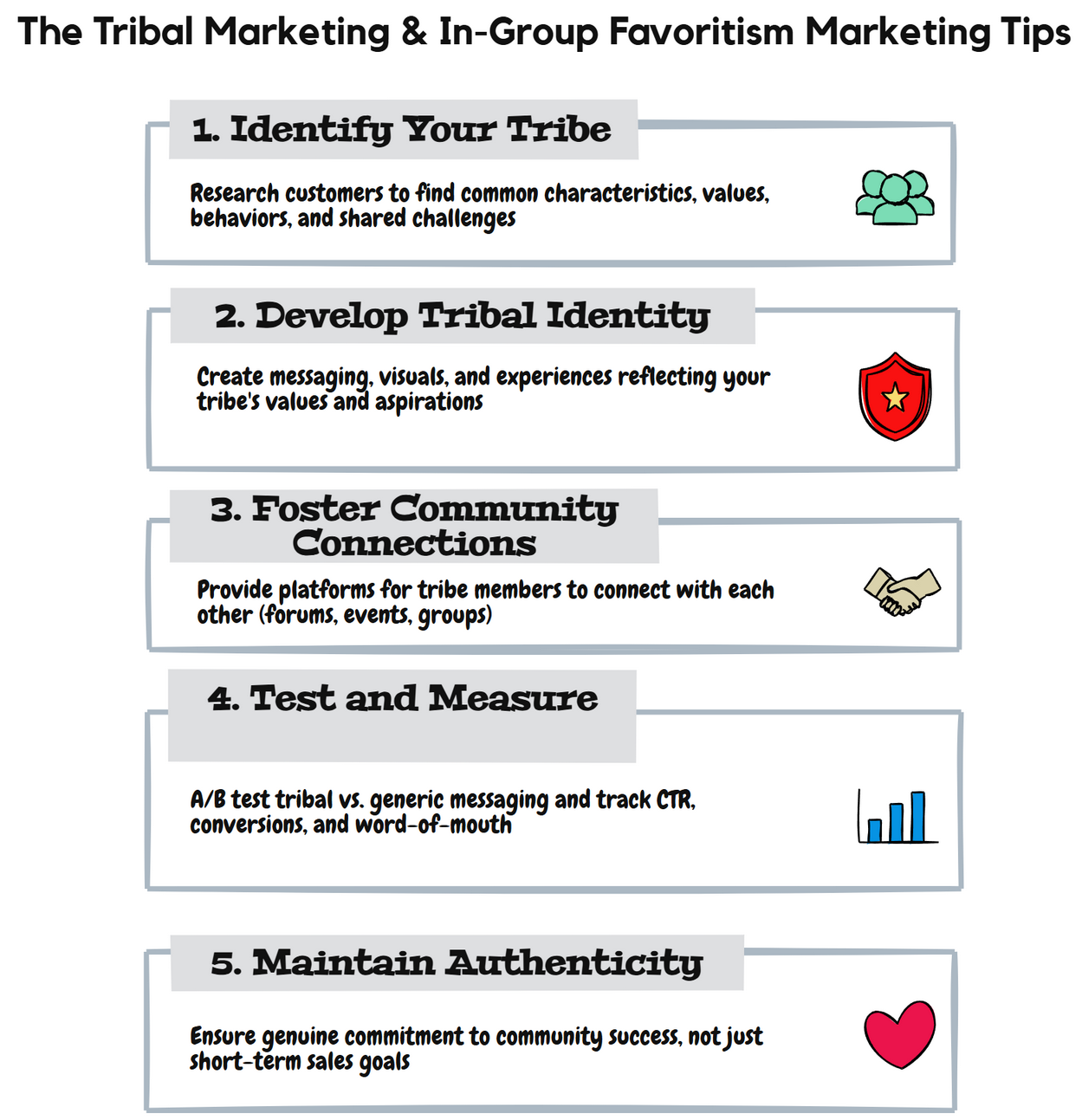
Step 1: Identify Your Tribe
Research your existing customers to identify common characteristics, values, and behaviours. Look for natural groupings based on profession, location, lifestyle, or shared challenges.
Step 2: Develop Tribal Identity
Create messaging, visuals, and experiences that reflect your tribe’s values and aspirations. This isn’t about creating artificial divisions but recognising and celebrating existing communities.
Step 3: Foster Community Connections
Provide platforms and opportunities for tribe members to connect with each other, not just with your brand. This might include online forums, local events, or exclusive member groups.
Step 4: Test and Measure
Implement A/B tests comparing tribal messaging with generic approaches. Track metrics including click-through rates, conversion rates, customer lifetime value, and word-of-mouth referrals.
Step 5: Maintain Authenticity
Ensure your tribal marketing efforts reflect genuine commitment to your community’s success, not just short-term sales goals. Authenticity is crucial for long-term tribal loyalty.
Common Pitfalls to Avoid
- Neglecting community needs: Focusing on sales rather than genuine community value
- Surface-level tribalism: Simply using group-specific language without understanding deeper values and needs
- Exclusionary messaging: Creating “us versus them” dynamics that alienate potential customers
- Inconsistent application: Mixing tribal and generic messaging in ways that confuse your audience
Related Psychological Biases & Effects
Understanding related biases helps marketers apply tribal marketing more effectively:
Social Proof
Tribal marketing leverages social proof by highlighting experiences of others within the same in-group. When potential customers see people like themselves using and endorsing a product, they’re more likely to follow suit.
Confirmation Bias
People pay more attention to information that confirms their existing beliefs and values. Tribal marketing works by aligning brand messaging with the target group’s existing worldview.
Halo Effect
Positive feelings toward a brand or group can influence perceptions of its products or services. Strong tribal identity creates a halo effect that benefits all brand touchpoints.
Bandwagon Effect
The desire to belong to a group can lead individuals to adopt behaviours and preferences of that group, even when they might not otherwise choose those options.
Tribal marketing differs from these related biases by focusing specifically on group identity and belonging rather than general social influence or cognitive shortcuts.
Understanding The Tribal Marketing & In-Group Favoritism can significantly improve your marketing effectiveness by creating genuine emotional connections with your target audience. When applied ethically and authentically, this approach transforms customers into passionate advocates who drive sustainable business growth.
The key lies in recognising that people don’t just buy products – they buy into identities and communities. By fostering genuine tribal connections, businesses can build lasting relationships that transcend traditional transactional marketing.
If you’re ready to apply tribal marketing principles to your lead generation strategy, remember that success requires patience, authenticity, and genuine commitment to your community’s success. Start small, test thoroughly, and always prioritise providing real value to your tribe members.
FAQs About Tribal Marketing & In-Group Favoritism
What is Tribal Marketing & In-Group Favoritism and how does it work?
Tribal Marketing & In-Group Favoritism is a psychological phenomenon where people show preference and loyalty to members of their own group over outsiders. In marketing, this translates to creating brand communities that foster a sense of belonging and shared identity among customers.
The effect works through social identity theory – people derive self-esteem from group membership and naturally favour those who share their values, interests, or characteristics. Brands leverage this by:
• Creating exclusive communities around shared passions or lifestyles • Using in-group language that resonates with specific audiences • Fostering “us vs. them” dynamics that strengthen group bonds • Offering exclusive benefits to community members
Neurologically, studies show increased activity in reward-processing brain regions when people interact with in-group members, making tribal marketing particularly powerful for building emotional connections.
How does Tribal Marketing & In-Group Favoritism influence consumer behavior?
In-group favoritism significantly impacts purchasing decisions by creating emotional bonds that transcend rational product comparisons. When consumers identify with a brand’s “tribe,” they become more likely to:
• Choose the brand over competitors even at higher prices • Recommend products to others within their perceived group • Remain loyal during competitive challenges • Engage more actively with brand content and communities
Research shows that loyalty often extends more to the tribe than the brand itself. For example, Apple users don’t just buy products – they identify as “Apple people” and defend the brand against criticism. This emotional investment makes tribal marketing particularly effective for:
- Premium positioning strategies
- Customer retention programmes
- Word-of-mouth marketing campaigns
- Community-driven growth
The key is authenticity – consumers quickly detect and reject artificial attempts at tribe-building.
What are the key characteristics of Tribal Marketing & In-Group Favoritism?
Effective tribal marketing exhibits several distinct characteristics that differentiate it from traditional demographic targeting:
Core Elements: • Shared values and beliefs rather than just demographics • Exclusive language and symbols that create insider identity • Community rituals and experiences that strengthen bonds • Clear differentiation from out-groups or competitors
Behavioural Patterns: • Automatic preference for in-group members and products • Defensive responses when the group is criticised • Active participation in community activities and discussions • Willingness to pay premiums for group-associated products
Marketing Applications: • Harley-Davidson’s HOG community creates motorcycle owner tribes • Nike’s athlete-focused messaging appeals to fitness enthusiasts • Local business targeting specific neighbourhoods or professions
The most successful tribal marketing feels organic and authentic, building on existing communities rather than creating artificial divisions.
Who first studied Tribal Marketing & In-Group Favoritism in psychology research?
Henri Tajfel pioneered the foundational research on in-group favoritism through his groundbreaking “minimal group experiments” in the 1970s. His work demonstrated that even arbitrary group assignments could trigger preferential treatment of in-group members.
Key Researchers and Contributions: • Henri Tajfel & John Turner – Developed Social Identity Theory (1979) • Muzafer Sherif – Conducted the famous Robbers Cave experiment (1961) • Bernard Cova – Applied tribal concepts to marketing theory (2002)
Modern Research: Recent studies by Ruane (2015) found that tribal loyalty often supersedes brand loyalty, while Sierra et al. (2016) showed consumers frequently demonstrate more allegiance to their community than to specific brands.
Academic Evolution: The concept evolved from pure psychology into marketing applications, with researchers like Coffin & Cova (2023) examining how tribal marketing adapted during the post-pandemic era, emphasising digital communities and shared identity formation.
This research foundation provides the scientific backing for modern tribal marketing strategies used by brands worldwide.
What brain mechanisms are involved in Tribal Marketing & In-Group Favoritism?
Neurological research reveals specific brain regions that activate during in-group favoritism, explaining why tribal marketing creates such powerful emotional responses.
Key Brain Areas: • Ventromedial prefrontal cortex (vmPFC) – Processes reward and positive emotions when viewing in-group members • Amygdala – Manages emotional responses and threat detection from out-groups • Social cognition networks – Handle group identity and belonging sensations
Neurochemical Processes: Research by Van Bavel et al. (2008) using fMRI scans showed that exposure to in-group symbols triggers the brain’s reward system, similar to other pleasurable experiences. This creates:
- Dopamine release when engaging with tribal brands
- Oxytocin production during community interactions
- Reduced stress responses within familiar groups
Marketing Implications: These neurological responses explain why tribal marketing can be more effective than traditional advertising. The brain literally rewards in-group identification, making tribal brands feel more satisfying and memorable.
However, the same mechanisms can create out-group bias, potentially alienating non-members if not managed carefully.
Are there any studies that challenge the validity of Tribal Marketing & In-Group Favoritism?
Yes, several studies question the universality and application of tribal marketing principles, providing important nuances for marketers.
Key Challenges: • Brewer (1999) argued that in-group bias isn’t always automatic and can be overridden by empathy and egalitarian values • Ruane (2015) found that loyalty often flows to the tribe rather than the brand itself, limiting direct marketing benefits • Sierra et al. (2016) showed tribal affiliation can actually supersede brand loyalty, creating challenges for brand managers
Methodological Limitations:
- Many studies focus on specific demographics (e.g., Generation Y in Ireland), limiting generalisability
- Transient nature of tribes makes long-term effects difficult to measure
- Cultural variations affect how tribal marketing resonates across different markets
Practical Concerns: Research indicates that inauthentic tribal marketing attempts often backfire, with consumers quickly detecting and rejecting artificial community-building efforts. Additionally, some studies suggest the effects may be context-dependent rather than universally applicable.
These findings emphasise the importance of authentic, carefully implemented tribal marketing strategies rather than blanket applications of the concept.
What neurological research supports Tribal Marketing & In-Group Favoritism theory?
Extensive neurological research validates the biological basis of tribal marketing, using advanced brain imaging to understand how group identity affects decision-making.
Landmark Studies: • Van Bavel et al. (2008) – Used fMRI to show increased vmPFC activity when viewing in-group members positively • Kinzler et al. (2009) – Demonstrated that even infants show preferences for native language speakers, indicating early in-group bias development • Plassmann et al. (2012) – Found that brands associated with in-group identity trigger positive emotional responses and increase purchase intentions
Brain Imaging Findings: Modern EEG and fMRI studies reveal that tribal marketing activates:
- Reward processing centres when consumers encounter “their” brands
- Social cognition networks during community interactions
- Memory consolidation areas that make tribal brands more memorable
Neuromarketing Applications: Research shows that emotional content with group identity cues generates significantly stronger brain responses than neutral advertising. This explains why tribal marketing campaigns often outperform traditional demographic targeting.
Clinical Validation: Studies demonstrate these neurological responses are consistent across cultures and age groups, providing robust scientific support for tribal marketing strategies when implemented authentically.
What are some famous examples of Tribal Marketing & In-Group Favoritism in action?
Several iconic brands have successfully leveraged tribal marketing to build devoted communities and drive exceptional loyalty.
Harley-Davidson: The motorcycle manufacturer created one of the most successful brand tribes through: • HOG (Harley Owners Group) exclusive membership • Rally events and riding groups that foster community • Customer storytelling in marketing materials • Industry-leading loyalty rates documented in Harvard Business School case studies
Apple: Apple’s tribal marketing creates strong “us vs. them” dynamics: • “Think Different” campaign positioning users as creative innovators • Ecosystem exclusivity that reinforces belonging • Consistently highest brand loyalty among smartphone users in the U.S.
Nike: The athletic brand builds tribes around fitness and achievement: • “Just Do It” messaging that empowers athletes • Nike Run Club app creating running communities • Athlete endorsements that inspire group identification
Fortnite (Epic Games): The gaming platform leverages tribal mechanics through: • Team-based gameplay fostering group identity • Exclusive skins and content for community members • High user engagement and industry-leading spend per user
These examples demonstrate how authentic tribal marketing creates emotional connections that transcend traditional product benefits.
How do Apple and Nike use Tribal Marketing & In-Group Favoritism in their strategies?
Apple and Nike represent masterclasses in tribal marketing, each creating distinct approaches to foster community and loyalty.
Apple’s Tribal Strategy: • Ecosystem Integration – Products work seamlessly together, creating switching costs and reinforcing membership • Design Philosophy – Minimalist aesthetics become tribal symbols that users display proudly • “Us vs. Them” Messaging – Positioning against “complex” competitors strengthens group identity • Retail Experience – Apple Stores function as community gathering spaces
Nike’s Community Building: • Athlete Inspiration – “Just Do It” creates a tribe of achievers and strivers • Digital Communities – Nike Run Club and Training Club apps foster ongoing engagement • Local Activation – Sponsoring local events and athletes builds grassroots communities • Performance Focus – Products become symbols of athletic dedication and achievement
Shared Success Factors: Both brands succeed by:
- Authentic value alignment with their communities’ aspirations
- Consistent messaging across all touchpoints
- Premium positioning that makes membership feel exclusive
- Community investment through events, apps, and experiences
Their approaches demonstrate how tribal marketing works best when brands genuinely embody the values their communities care about.
Can you see Tribal Marketing & In-Group Favoritism in movies and TV shows?
Entertainment media frequently showcases tribal marketing principles, both as plot devices and through product placement strategies.
On-Screen Examples: • Sports team loyalty in films like “Remember the Titans” demonstrates in-group favoritism • Brand placement in shows often targets specific tribal audiences (luxury cars in executive dramas) • Fandom communities around franchises like Marvel or Star Wars exhibit classic tribal behaviour
Marketing Through Media: • Product integration that aligns with character tribes (tech brands in Silicon Valley shows) • Lifestyle positioning where brands become tribal symbols within storylines • Audience targeting based on show demographics and tribal affiliations
Real-World Applications: Entertainment partnerships work because they:
- Reinforce existing tribal identities rather than creating new ones
- Provide authentic context for brand usage
- Leverage emotional storytelling to strengthen brand-tribe connections
Viewer Psychology: Audiences often adopt brands featured by characters they identify with, demonstrating how tribal marketing extends beyond traditional advertising into cultural storytelling. This explains why entertainment partnerships can be more effective than direct advertising for tribal brands.
What historical events demonstrate Tribal Marketing & In-Group Favoritism?
Historical examples reveal how in-group favoritism has shaped human behaviour long before modern marketing, providing insights for contemporary brand strategies.
Political Movements: • Brand boycotts and support during civil rights movements showed economic tribal behaviour • Wartime propaganda leveraged in-group/out-group psychology for national unity • Political party loyalty demonstrates tribal thinking in democratic societies
Cultural Phenomena: • Fashion trends historically created tribal identities (mods vs. rockers in 1960s Britain) • Music subcultures (punk, hip-hop, country) built communities around shared values • Regional pride in products (champagne from Champagne, scotch from Scotland)
Commercial Evolution: • Guild systems in medieval times created professional tribes • Company towns fostered employee tribal loyalty • Brand heritage stories connect modern products to historical tribal identities
Modern Lessons: These historical patterns show that successful tribal marketing:
- Builds on existing social divisions rather than creating artificial ones
- Provides genuine value to community members
- Evolves with changing social dynamics
- Respects cultural sensitivities and historical context
Understanding these patterns helps marketers create authentic tribal strategies that resonate with deep human psychological needs.
How is Tribal Marketing & In-Group Favoritism different from the halo effect?
Tribal Marketing and the Halo Effect operate through distinct psychological mechanisms, though both influence consumer perceptions.
Key Differences:
Tribal Marketing: • Group-based identity – Focuses on community membership and belonging • Emotional connection – Creates deep, personal relationships with brands • Exclusive benefits – Rewards in-group members with special treatment • Long-term loyalty – Builds sustained commitment through shared values
Halo Effect: • Individual perception – One positive trait influences overall brand evaluation • Cognitive shortcut – Quick judgments based on limited information • Broad application – Affects all brand attributes simultaneously • Context-dependent – Can change based on new information
Practical Applications: • Tribal marketing works best for lifestyle brands and communities (Harley-Davidson, Apple) • Halo effect benefits from celebrity endorsements and awards (luxury goods, professional services)
Combined Strategies: Smart marketers often use both approaches:
- Tribal elements create community and belonging
- Halo effects enhance overall brand perception
- Authentic integration prevents consumer scepticism
The most effective campaigns leverage tribal psychology for deep engagement while using halo effects for broader market appeal.
What’s the difference between Tribal Marketing & In-Group Favoritism and confirmation bias?
Tribal Marketing and Confirmation Bias are related but distinct psychological phenomena that affect consumer behaviour differently.
Tribal Marketing & In-Group Favoritism: • Social identity focus – Based on group membership and belonging • Emotional attachment – Creates deep connections to communities • Active participation – Encourages engagement with brand tribes • Preference formation – Shapes what people like based on group identity
Confirmation Bias: • Information processing – Seeks evidence that supports existing beliefs • Cognitive filter – Ignores contradictory information • Individual psychology – Personal rather than group-based • Belief reinforcement – Strengthens existing opinions
Marketing Implications:
For Tribal Strategies:
- Build communities around shared values and interests
- Create exclusive experiences for tribe members
- Foster peer-to-peer advocacy within groups
For Confirmation Bias:
- Provide supporting evidence for purchase decisions
- Use testimonials that match customer beliefs
- Frame messages to align with existing attitudes
Interaction Effects: These biases often work together – tribal members seek information that confirms their group’s superiority while filtering out criticism. Successful marketers understand both dynamics to create more effective campaigns that resonate with target audiences’ psychological needs.
How does Tribal Marketing & In-Group Favoritism compare to social proof theory?
Tribal Marketing and Social Proof are closely related concepts that often work together in marketing strategies, but they operate through different psychological mechanisms.
Social Proof Theory: • Behavioural mimicry – People follow what others do • Uncertainty reduction – Provides guidance in ambiguous situations • Broad application – Works across diverse groups and contexts • Evidence-based – Relies on visible actions and testimonials
Tribal Marketing: • Identity formation – Creates sense of belonging and group membership • Emotional bonding – Builds deep connections with community • Selective application – Works best with specific, aligned audiences • Value-based – Focuses on shared beliefs and aspirations
Complementary Strategies: Effective campaigns often combine both approaches:
- Social proof demonstrates that “people like you” use the product
- Tribal elements make customers feel part of an exclusive community
- Testimonials from tribe members carry extra weight
- Community size provides social proof while maintaining exclusivity
Cialdini’s Principles: Tribal marketing leverages multiple Cialdini principles:
- Social Proof (others in the tribe use it)
- Liking (connection to tribe members)
- Commitment (public tribal membership)
The most successful brands use social proof to demonstrate tribal membership benefits while creating authentic communities that provide genuine value to members.
Curious about other psychological biases that influence customer behavior? Explore our comprehensive guide to cognitive biases in marketing here.