
Guide to The Expectation Effect (Placebo & Branding) in Marketing: Description, Psychology, and Examples
What Is The Expectation Effect (Placebo & Branding)?
The Expectation Effect is the tendency for people’s prior beliefs, expectations, and contextual cues to influence their perception, behavior, and even physiological responses, literally altering how they experience reality. This powerful psychological phenomenon explains why customers pay £5 for premium café coffee over £1 alternatives, why branded painkillers feel more effective than identical generic versions, and why strategic expectation-setting can enhance perceived value without changing the underlying product.
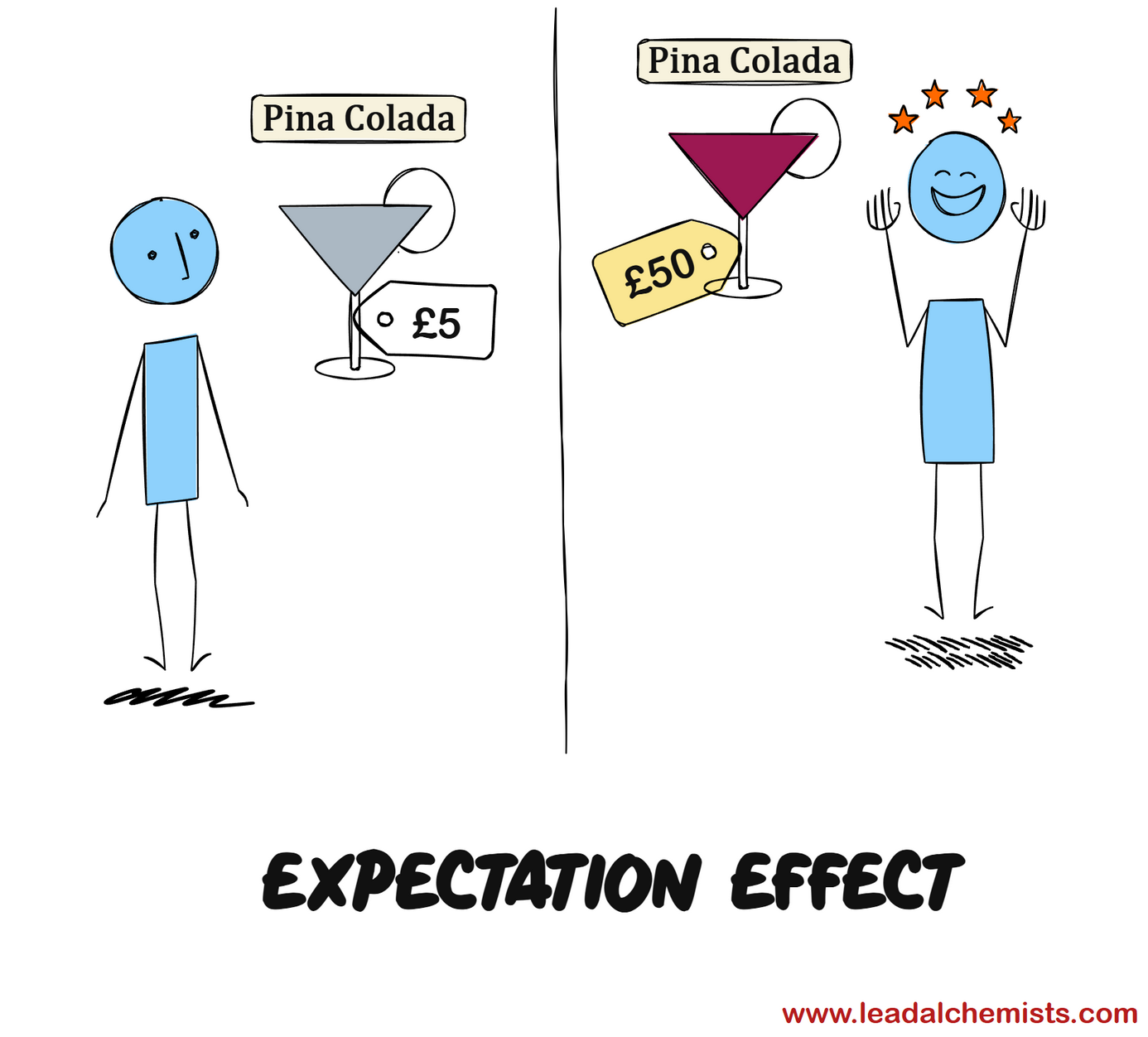
At its psychological core, the Expectation Effect works because humans use top-down processing – our brains actively predict what we should experience based on context, branding, and prior beliefs rather than simply receiving objective sensory data. When customers expect something to be high-quality, effective, or valuable, their brains process the experience differently through these pre-existing expectations, making it far more likely that they’ll genuinely perceive and feel higher quality, effectiveness, or value rather than experiencing the product objectively.
For marketers and advertisers, understanding this bias gives a real competitive edge. By purposefully and strategically setting positive expectations through premium branding, authoritative positioning, and carefully crafted contextual cues while delivering genuine quality that meets or exceeds those expectations, you can enhance customer satisfaction and justify premium pricing in ways that other persuasion techniques simply cannot match.
How The Expectation Effect (Placebo & Branding) Works (The Psychology Behind It)
The Expectation Effect operates through sophisticated cognitive and neurological mechanisms that demonstrate just how powerful our minds are in shaping reality.
The Brain’s Predictive System
The effect is rooted in predictive coding theory, which explains that our brains constantly generate predictions about incoming stimuli and update internal models based on prediction errors. When you see a premium brand logo or hear about a product’s superior quality, your brain creates specific expectations about the experience you’re about to have.
Research using fMRI brain imaging has shown that expectations can alter activity in brain regions associated with:
- Reward processing (nucleus accumbens)
- Sensory interpretation (various cortical areas)
- Emotion regulation (prefrontal cortex)
Neurological Evidence
A groundbreaking 2008 study by Plassmann and colleagues demonstrated this effect in action. Participants tasted identical wines but were told they came from bottles of different prices. Brain imaging revealed that the pleasure centres in participants’ brains were genuinely more active when they believed they were drinking expensive wine. This wasn’t just reporting bias – their brains were literally experiencing more pleasure.
The Conditioning Component
The Expectation Effect also operates through classical conditioning. When customers repeatedly encounter high-quality branding paired with positive experiences, neutral brand elements (logos, colours, messaging) become associated with positive outcomes. This creates automatic expectation responses that influence future experiences.
Recent Research Insights
A 2022 study published in Scientific Reports found that positive treatment expectations (induced through verbal instructions and contextual cues) lowered participants’ threshold for identifying positive emotions while reducing sensitivity to negative ones. This suggests that expectations don’t just influence what we experience – they influence what we’re capable of perceiving.
Real-World Examples of The Expectation Effect (Placebo & Branding)
The Expectation Effect operates across numerous contexts, demonstrating its fundamental role in human psychology and decision-making.
Healthcare and Medicine
The placebo effect represents the most studied application of expectation influence. Patients often experience genuine symptom relief when given inactive treatments, provided they believe the treatment will help. This effect is so powerful that clinical trials must account for it when testing new medications.
Interestingly, branding influences medical outcomes too. Studies show that patients often report greater relief from branded medications compared to generic versions with identical active ingredients, even in controlled conditions.
Education: The Pygmalion Effect
Teachers’ expectations significantly influence student performance. When teachers expect certain students to excel, those students often do perform better – not because of different teaching methods, but because expectations create subtle behavioural changes that become self-fulfilling prophecies.
Economics and Finance
Market expectations can create self-fulfilling prophecies in economic contexts. When consumers expect economic growth, they spend more, which contributes to actual growth. Similarly, expectations about a company’s performance can influence stock prices before any fundamental changes occur.
Verified Marketing Case Study: Wine and Price Perception
The most robust marketing demonstration comes from Plassmann et al.’s wine study. Participants rated identical wines as tasting significantly better when told they were more expensive. Brain imaging confirmed this wasn’t just polite reporting – participants’ pleasure centres showed increased activity when they believed they were drinking premium wine.
Marketing Application: Wine brands leverage this by investing heavily in premium packaging, sophisticated labelling, and marketing narratives that create expectations of superior quality, thereby enhancing the actual tasting experience.
Business Phenomenon: Premium Athletic Wear
While not academically studied as a controlled experiment, Lululemon’s success demonstrates expectation effects in action. By emphasising research and development, technical fabric properties, and aspirational lifestyle associations, the brand creates expectations of superior performance that justify premium pricing and enhance customer satisfaction.
How The Expectation Effect (Placebo & Branding) Affects Consumer Behaviour
Understanding the neurological and psychological mechanisms behind expectation effects reveals why they’re so powerful in marketing contexts.
Brain Processing Changes
When customers encounter expectation-setting cues (premium branding, high prices, expert endorsements), their brains begin processing subsequent experiences differently. The anterior cingulate cortex and prefrontal cortex—areas associated with attention and expectation – become more active, literally changing how sensory information is interpreted.
Purchasing Psychology Impact
Expectations influence purchasing decisions through several pathways:
Value Perception: Higher expectations increase perceived value, making customers more willing to pay premium prices.
Satisfaction Enhancement: When products meet or exceed expectations, customer satisfaction increases disproportionately compared to objective quality improvements.
Attention Bias: Customers selectively attend to information that confirms their expectations while downplaying contradictory evidence.
Psychological Triggers That Amplify the Effect
Several factors strengthen expectation effects:
Personal Relevance: Expectations are stronger when outcomes matter personally to the individual.
Source Credibility: Expectations set by trusted sources (experts, established brands, peer recommendations) carry more weight.
Contextual Cues: Environmental factors (premium locations, professional presentation, high-quality materials) reinforce expectations.
Social Proof: When others share similar expectations, individual expectation effects are amplified.
Case Studies: How Marketers Use The Expectation Effect (Placebo & Branding) in Advertising
Verified Case Study: Experiential Marketing at Trade Shows
A comprehensive study of the Taipei International Sports Cycle Show demonstrated measurable expectation effects in marketing. Researchers found that experiential marketing – which creates immersive, expectation-driven experiences – significantly increased customer purchase intention. Regression analysis showed that experiential marketing elements explained 47.7% of the variance in purchase intention, providing robust evidence for expectation effects in commercial settings.
Key Takeaway: Creating experiences that set and fulfil high expectations can drive measurable increases in customer intent and sales.
Healthcare Brand Perception Campaign
A documented brand perception campaign targeting healthcare services used expectation-setting messaging and visual storytelling to improve perceptions of physician expertise and innovation. The campaign resulted in measurable improvements in consumer perception and brand equity, demonstrating how strategic expectation management can shift market positioning.
Application: Service-based businesses can use professional presentation, expert positioning, and outcome-focused messaging to create expectations that enhance perceived value.
Recommended A/B Test: Google Ads for Service Businesses
Test Scenario: Compare ad copy that sets different expectation levels:
- Control: “Reliable Plumbing Services”
- Variation: “Expert Plumbers Delivering Guaranteed Results”
Metrics to Track: Click-through rate, conversion rate, and average order value.
Expected Outcome: The expectation-enhanced ad copy should generate higher engagement and potentially higher transaction values due to increased perceived expertise and value.
Practical Applications for Google Ads & Lead Generation
Google Ads Copywriting Strategies
Expectation-Setting Headlines: Instead of generic service descriptions, use copy that creates specific quality expectations:
- Replace “Affordable Web Design” with “Transform Your Online Presence with Expert Web Design”
- Change “Legal Advice Available” to “Get the Expert Legal Guidance You Deserve”
Landing Page Consistency: Ensure your landing pages reinforce the expectations set in your ad copy. If your ad promises “guaranteed results,” your landing page should prominently feature testimonials, case studies, and guarantees that support this claim.
Visual Expectation Cues: Use high-quality images that represent desired outcomes. For landscaping services, show stunning before-and-after transformations. For business consultants, use professional imagery that conveys expertise and success.
Lead Generation Website Optimization
Service-Based Landing Page Enhancement:
- Before: “Contact Us for Legal Advice”
- After: “Schedule Your Free Consultation with Award-Winning Legal Experts”
The revised headline sets higher expectations for expertise and value while positioning the consultation as valuable rather than routine.
Form Optimization with Expectation Setting: Add brief statements above lead forms that create expectations of personalised, high-quality service: “Tell us about your project, and we’ll provide a tailored solution within 24 hours.”
Lead Magnet Title Enhancement:
- Generic: “Free Guide to SEO”
- Enhanced: “Unlock Your Website’s Potential: The Ultimate SEO Blueprint for Explosive Growth”
The enhanced title sets higher expectations for the guide’s value and potential impact.
Low-Cost Implementation Strategies
Testimonial Strategy: Actively gather and prominently display client testimonials that highlight specific, impressive outcomes. This creates expectations that your service delivers similar results.
Expert Positioning: Position free consultations as “expert assessments” or “personalised strategy sessions” to increase their perceived value without changing the actual service.
Social Proof Integration: Display client logos, case study summaries, and success metrics to create expectations of professional competence and proven results.
Why Marketers Should Care About The Expectation Effect (Placebo & Branding)
The Expectation Effect represents one of the most powerful tools in marketing psychology because it doesn’t just influence what customers think – it influences what they actually experience.
Competitive Advantage Through Perception
In markets where products or services are functionally similar, expectation management becomes a key differentiator. Companies that successfully create and fulfil high expectations can command premium pricing, achieve higher customer satisfaction, and build stronger brand loyalty.
Measurable Business Impact
Research demonstrates that expectation effects produce measurable outcomes:
- Enhanced perceived value and willingness to pay premium prices
- Increased customer satisfaction scores
- Higher retention rates and customer lifetime value
- Improved word-of-mouth marketing and referral rates
Ethical Considerations and Responsible Use
The power of expectation effects comes with ethical responsibilities. Marketers should use this principle to highlight genuine value rather than deceive customers. Key ethical guidelines include:
Truthful Enhancement: Use expectation-setting to highlight real benefits and quality, not to mask deficiencies.
Deliverable Promises: Ensure your products or services can meet the expectations you create through marketing.
Transparent Communication: Be clear about pricing, service terms, and realistic outcomes.
Risks of Overuse or Manipulation
Misusing expectation effects can backfire spectacularly:
Legal Consequences: False or misleading claims can result in regulatory action and legal liability
Expectation Gaps: If reality doesn’t match inflated expectations, customer dissatisfaction increases dramatically
Brand Damage: Deceptive expectation-setting can lead to public backlash and long-term reputation damage
How to Implement The Expectation Effect (Placebo & Branding) in Your Marketing Strategy
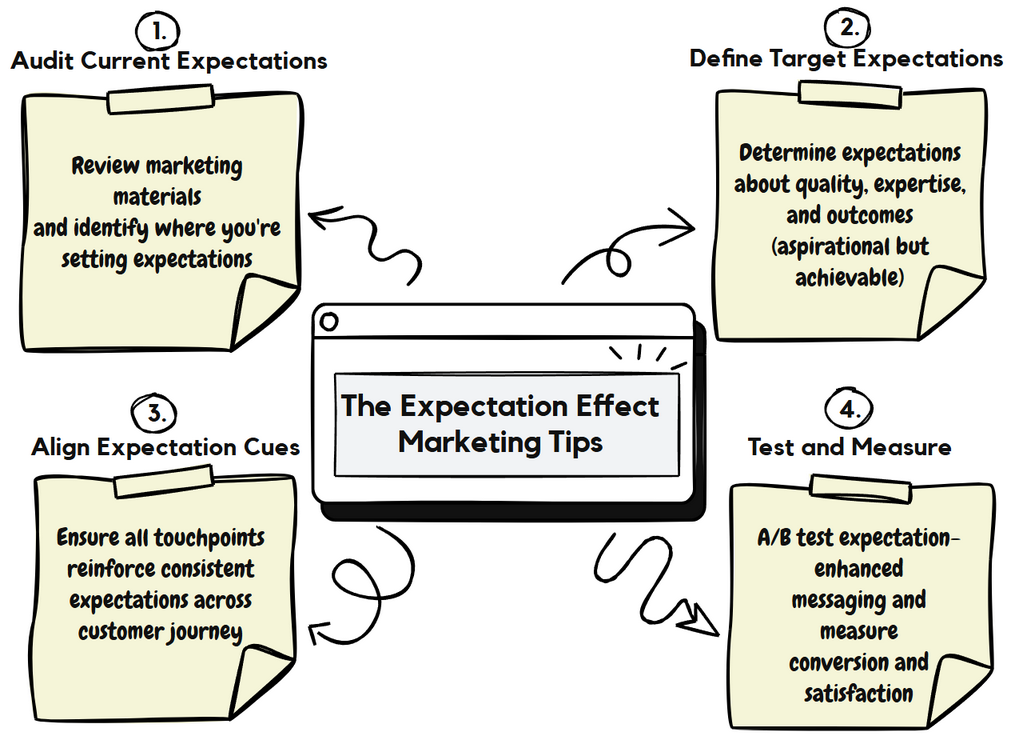
Step-by-Step Implementation Guide
1. Audit Current Expectations Review your current marketing materials, website copy, and customer touchpoints. Identify where you’re setting expectations and whether they align with your desired positioning.
2. Define Target Expectations Determine what expectations you want to create about your service quality, expertise, outcomes, and customer experience. Ensure these expectations are both aspirational and achievable.
3. Align Expectation Cues Ensure all customer touchpoints reinforce consistent expectations:
- Ad copy and headlines
- Website design and imagery
- Sales presentations and proposals
- Service delivery and follow-up
4. Test and Measure Implement A/B tests to measure the impact of expectation-enhanced messaging:
- Compare generic vs. expectation-setting ad copy
- Test different landing page headlines
- Measure conversion rates, engagement metrics, and customer satisfaction
Best Practices and Common Pitfalls
Best Practices:
- Start with authentic strengths and genuine value propositions
- Use specific, credible language rather than vague superlatives
- Reinforce expectations throughout the customer journey
- Gather and display social proof that supports your positioning
Common Pitfalls:
- Creating unrealistic expectations that can’t be met
- Inconsistent messaging across different touchpoints
- Focusing on features rather than benefits and outcomes
- Neglecting to measure and adjust based on customer feedback
A/B Testing Ideas
Google Ads Test:
- Control: “Professional Marketing Services”
- Variation: “Transform Your Business with Award-Winning Marketing Strategies”
- Measure: CTR, conversion rate, cost per lead
Landing Page Test:
- Control: Standard service description
- Variation: Outcome-focused description with expectation-setting language
- Measure: Time on page, form completion rate, consultation booking rate
Email Subject Line Test:
Measure: Open rate, click-through rate, engagement metrics
Control: “Monthly Newsletter”
Variation: “Exclusive Insights to Accelerate Your Growth”
Related Psychological Biases & Effects
Understanding related biases helps marketers create more comprehensive and effective strategies:
Social Proof: While expectation effects are based on individual beliefs, social proof leverages others’ behaviour to influence expectations. Combining testimonials (social proof) with outcome-focused messaging (expectation setting) creates powerful synergy.
Anchoring Bias: Initial price points or value references can set expectations for subsequent evaluations. Premium pricing can actually enhance perceived value through expectation effects.
Halo Effect: Positive impressions in one area influence perceptions in others. Strong branding creates positive expectations that extend across all customer interactions.
Framing Effect: How information is presented influences perception and decision-making. Expectation-setting language frames experiences in ways that enhance perceived value.
Confirmation Bias: Customers seek information that confirms their expectations. Once positive expectations are established, customers become more likely to notice and remember confirming evidence.
Understanding and ethically applying the Expectation Effect can transform your marketing effectiveness by enhancing how customers actually experience your products and services. The key lies in creating authentic, achievable expectations that highlight genuine value while delivering consistently excellent experiences.
FAQs About Expectation Effect (Placebo & Branding)
What is the Expectation Effect (Placebo & Branding) and how does it work?
The Expectation Effect (Placebo & Branding) is a psychological phenomenon where prior beliefs and expectations influence perception, behaviour, and even physiological responses. It works through top-down processing, where your brain uses existing expectations to interpret incoming sensory information.
The effect operates via predictive coding theory – your brain generates predictions about what you’ll experience and compares these against reality. When you expect a premium wine to taste better or a branded painkiller to work more effectively, your brain actually processes these experiences differently, often making them align with your expectations.
Neurologically, expectations can activate reward centres (like the nucleus accumbens) and alter activity in sensory processing regions, creating measurable changes in how you perceive quality, taste, or effectiveness.
How does the Expectation Effect (Placebo & Branding) influence consumer behavior?
The Expectation Effect shapes consumer behaviour by altering perceived value before, during, and after purchase. When brands create high expectations through premium pricing, sophisticated packaging, or aspirational messaging, consumers genuinely experience products as higher quality.
Key behavioural impacts include:
- Price-quality perception: Higher prices create expectations of superior quality
- Brand loyalty: Positive expectations lead to repeat purchases even when alternatives exist
- Satisfaction levels: Products that meet pre-set expectations receive higher satisfaction ratings
- Word-of-mouth: Consumers share experiences that align with their initial expectations
This effect is particularly powerful in service industries, where the intangible nature of offerings makes expectations crucial for perceived value.
What’s the difference between the Expectation Effect (Placebo & Branding) and the placebo effect?
The placebo effect is primarily a medical phenomenon where inactive treatments produce real physiological improvements due to patient expectations. The Expectation Effect in branding applies the same psychological principles to consumer products and services.
Key differences:
- Context: Placebo effects occur in healthcare settings; branding effects happen in commercial contexts
- Outcomes: Placebo effects can produce measurable health improvements; branding effects influence perceived quality and satisfaction
- Mechanisms: Both use expectation-driven neural changes, but placebo effects often involve endogenous opioid and dopamine systems
Similarities: Both demonstrate that expectations can create genuine changes in subjective experience, not just “imagined” improvements.
Who first discovered the Expectation Effect (Placebo & Branding) in psychology research?
The placebo effect was scientifically documented by Henry Beecher in his influential 1955 paper “The Powerful Placebo” in the Journal of the American Medical Association. However, the application to branding emerged later through consumer psychology research.
Key milestones:
- 1960s: Early studies on brand names affecting taste perception
- 2008: Plassmann et al.’s groundbreaking PNAS study showed identical wines were rated as tasting better when participants believed they were more expensive, with fMRI confirming neural changes
- 2005: Shiv et al. demonstrated that marketing actions could affect neural representations of product value
The field continues evolving, with recent research (2022) showing that positive treatment expectations can even influence emotion recognition and mood enhancement.
What are the neurological mechanisms behind the Expectation Effect (Placebo & Branding)?
The Expectation Effect operates through several neurological pathways that create genuine changes in brain activity and subjective experience.
Primary mechanisms:
- Predictive coding: The brain generates predictions about incoming stimuli and updates its internal model based on prediction errors
- Reward system activation: Expectations trigger activity in the nucleus accumbens and other reward-related regions
- Sensory modulation: Expectations can alter activity in sensory processing areas, changing how stimuli are perceived
- Neurotransmitter release: Positive expectations can activate endogenous opioid and dopamine systems
Brain regions involved:
- Prefrontal cortex: Manages expectations and cognitive control
- Anterior cingulate cortex: Processes expectation-reality mismatches
- Insula: Integrates sensory information with emotional context
These changes are measurable through fMRI and other neuroimaging techniques, proving the effect isn’t simply “psychological” but involves real neural alterations.
Can the Expectation Effect (Placebo & Branding) actually change physical sensations?
Yes, the Expectation Effect can produce genuine changes in physical sensations and physiological responses, not just subjective impressions.
Documented physical changes:
- Pain perception: Expectations of pain relief can reduce activity in pain-processing brain regions
- Taste enhancement: Higher price expectations genuinely improve taste perception, as shown in wine studies
- Sensory detection: Placebo expectations enhance detection of relevant sensations, leading people to notice signs of improvement
- Physiological responses: Can influence heart rate, blood pressure, and immune system markers
Important distinction: While the physical sensations are real, they’re mediated by neural changes rather than direct product effects. For example, an expensive wine doesn’t chemically taste better, but your brain processes its taste more positively due to price expectations.
This demonstrates that the boundary between “psychological” and “physical” effects is less clear-cut than commonly assumed.
What are some famous real-world examples of the Expectation Effect (Placebo & Branding)?
Several well-documented examples demonstrate the Expectation Effect across different industries:
Academic research examples:
- Wine pricing study (Plassmann et al., 2008): Identical wines rated as tasting significantly better when participants believed they cost more, with brain scans confirming increased pleasure centre activity
- Pharmaceutical branding: Patients often report greater relief from branded medications versus generics, despite identical active ingredients
Business applications:
- Premium positioning: Luxury brands create expectations of superior quality through pricing, packaging, and marketing narratives
- Service framing: Positioning consultations as “expert assessments” rather than “free advice” increases perceived value
- Visual cues: Before-and-after photos in advertising set expectations that influence customer satisfaction
Note: While some business examples are widely discussed, the wine pricing study remains the gold standard for demonstrating measurable expectation effects in consumer contexts.
How do luxury brands use the Expectation Effect (Placebo & Branding) in their marketing?
Luxury brands systematically leverage the Expectation Effect through multiple touchpoints that create and reinforce premium expectations:
Pricing strategies:
- Premium pricing: Higher prices signal superior quality and exclusivity
- Price anchoring: Displaying expensive options first makes mid-range products seem reasonable
Brand positioning:
- Heritage storytelling: Emphasising craftsmanship, tradition, and expertise
- Scarcity messaging: Limited editions and exclusive access create expectation of special value
- Aspirational imagery: Associating products with desired lifestyles and social status
Sensory design:
- Packaging: High-quality materials and sophisticated design reinforce premium expectations
- Retail environments: Luxurious store atmospheres prime customers for premium experiences
- Product presentation: Careful staging and display enhance perceived value
These strategies work because they create genuine expectation-driven changes in how customers perceive and experience the products, not just superficial impressions.
Is the Expectation Effect (Placebo & Branding) the same as the halo effect?
No, while related, the Expectation Effect and halo effect are distinct psychological phenomena with different mechanisms and applications.
Expectation Effect:
- Mechanism: Prior beliefs shape perception of specific experiences
- Timing: Operates before and during product/service consumption
- Focus: Influences actual sensory and emotional experience
- Example: Expecting expensive wine to taste better actually makes it taste better
Halo Effect:
- Mechanism: One positive impression influences judgements in unrelated areas
- Timing: Typically occurs after initial impression formation
- Focus: Affects overall judgements and evaluations
- Example: Attractive packaging making people assume better product quality
Key difference: The Expectation Effect changes the actual experience, while the halo effect changes judgements about the experience. Both can work together in branding, but they operate through different cognitive pathways.
How does the Expectation Effect (Placebo & Branding) differ from confirmation bias?
The Expectation Effect and confirmation bias are related but operate differently in consumer contexts:
Expectation Effect:
- Changes perception: Actually alters how you experience products or services
- Sensory impact: Influences taste, comfort, satisfaction at a neurological level
- Timing: Operates during the experience itself
- Reversibility: Can be influenced by changing expectations
Confirmation bias:
- Filters information: Selectively notices evidence that supports existing beliefs
- Cognitive impact: Affects interpretation and memory of experiences
- Timing: Operates after experiences, during evaluation
- Persistence: Tends to reinforce existing beliefs regardless of actual experience
In marketing: The Expectation Effect makes customers genuinely experience higher quality, while confirmation bias makes them remember and interpret experiences in ways that support their initial beliefs. Effective branding often leverages both simultaneously.
What role does price play in the Expectation Effect (Placebo & Branding)?
Price serves as a powerful expectation cue that can significantly influence perceived quality and actual experience, backed by robust research evidence.
Price-quality expectations:
- Neural impact: Higher prices activate brain regions associated with increased pleasure and value
- Taste perception: The famous wine study showed identical wines rated as tasting better when priced higher
- Service expectations: Premium pricing creates expectations of superior service quality
Marketing applications:
- Strategic pricing: Setting prices above competitors can enhance perceived value
- Price anchoring: Displaying high-priced options first makes other prices seem reasonable
- Value communication: Explaining why prices are higher (quality, craftsmanship, exclusivity) reinforces positive expectations
Important caveat: This effect works best when products can deliver on the expectations created by premium pricing. Overpricing without substance can lead to disappointment and negative reviews.
Can you overcome the Expectation Effect (Placebo & Branding) with awareness?
Awareness can reduce but not eliminate the Expectation Effect, as it operates partly through unconscious neurological processes.
What awareness can do:
- Reduce magnitude: Knowing about the effect can diminish its strength
- Improve decision-making: Helps you evaluate products more objectively
- Resist manipulation: Makes you less susceptible to expectation-based marketing tactics
Why it persists despite awareness:
- Automatic processing: Many expectation effects occur below conscious awareness
- Neural pathways: Brain changes happen regardless of conscious knowledge
- Evolutionary advantage: Expectations help us navigate complex environments efficiently
Practical implications: Even marketing professionals who understand these effects can still be influenced by them. The key is using awareness to make more informed decisions while recognising that complete immunity isn’t realistic or necessarily desirable.
How do restaurants use the Expectation Effect (Placebo & Branding) to enhance dining experiences?
Restaurants systematically use the Expectation Effect through environmental design, service protocols, and presentation techniques that prime diners for enhanced experiences.
Atmospheric cues:
- Lighting and music: Dim lighting and classical music create expectations of fine dining
- Table settings: Quality linens, glassware, and cutlery signal premium experiences
- Décor and layout: Sophisticated design elements reinforce quality expectations
Service strategies:
- Staff presentation: Professional uniforms and knowledgeable servers enhance credibility
- Menu descriptions: Detailed ingredient lists and preparation methods increase perceived value
- Timing and pacing: Controlled service timing creates anticipation and satisfaction
Food presentation:
- Plating techniques: Artistic presentation increases perceived taste quality
- Portion psychology: Smaller portions on larger plates can seem more elegant
- Ingredient highlighting: Emphasising premium ingredients (truffle oil, aged cheese) enhances expectations
These techniques work because they create genuine expectation-driven improvements in how diners perceive taste, service quality, and overall satisfaction.
What are the ethical concerns surrounding the Expectation Effect (Placebo & Branding) in marketing?
The Expectation Effect raises significant ethical questions about manipulation, transparency, and consumer protection in marketing practices.
Primary ethical concerns:
- Deceptive expectations: Creating false expectations about product capabilities or benefits
- Vulnerable populations: Exploiting psychological vulnerabilities, particularly in health or financial products
- Price manipulation: Using expectation effects to justify unjustifiable price premiums
- Transparency: Failing to disclose when marketing relies heavily on psychological effects rather than product superiority
Industry guidelines:
- American Marketing Association: Emphasises honesty, fairness, and transparency in marketing communications
- Truth in advertising: Legal requirements to substantiate claims and avoid misleading consumers
- Responsible application: Using expectation effects to highlight genuine value rather than deceive
Best practices: Ethical marketers use expectation effects to enhance genuine product benefits rather than create false impressions, ensuring that customer experiences can meet or exceed the expectations created.
How does the Expectation Effect (Placebo & Branding) impact wine tasting and perception?
Wine provides the most scientifically documented example of the Expectation Effect in consumer products, with rigorous research demonstrating genuine perceptual changes.
Landmark research (Plassmann et al., 2008):
- Method: Participants tasted identical wines while believing they cost different amounts
- Results: Higher-priced wines were rated as tasting significantly better
- Neural evidence: fMRI scans showed increased activity in brain pleasure centres for “expensive” wines
- Implication: The effect wasn’t just reported preference but actual neurological changes
Wine industry applications:
- Label design: Sophisticated packaging creates quality expectations
- Price positioning: Strategic pricing influences perceived taste quality
- Tasting notes: Detailed descriptions prime specific flavour expectations
- Brand storytelling: Heritage and craftsmanship narratives enhance perceived value
Broader implications: This research demonstrates that expectation effects aren’t just “psychological” but involve measurable changes in sensory processing, validating the phenomenon across consumer categories.
What studies have challenged the validity of the Expectation Effect (Placebo & Branding)?
While the Expectation Effect is well-established, several methodological concerns and conflicting findings have emerged in research literature.
Main criticisms:
- Reporting bias: Some researchers argue effects reflect biased reporting rather than genuine experience changes
- Natural fluctuation: Critics suggest apparent improvements might reflect normal variation rather than expectation effects
- Blinding difficulties: Challenges in creating truly blind conditions in consumer research
- Publication bias: Tendency to publish positive results while negative findings remain unpublished
Methodological challenges:
- Expectation induction: Difficulty in standardising how expectations are created across studies
- Measurement issues: Distinguishing between genuine perceptual changes and response bias
- Individual differences: Significant variation in susceptibility to expectation effects
Research response: Recent studies have addressed these concerns through improved methodology, including neuroimaging evidence and more sophisticated experimental designs. The consensus remains that expectation effects are genuine, though their magnitude and mechanisms continue to be refined through ongoing research.
How do tech companies leverage the Expectation Effect (Placebo & Branding) in product launches?
Tech companies masterfully use the Expectation Effect through strategic anticipation-building and experience design that primes users for enhanced product perception.
Pre-launch strategies:
- Teaser campaigns: Gradual revelation of features builds anticipation and expectations
- Keynote presentations: Theatrical product reveals create excitement and high expectations
- Beta programs: Exclusive early access makes users feel special and primes positive experiences
- Media coverage: Strategic leaks and reviews shape public expectations
Design psychology:
- Unboxing experience: Premium packaging creates ceremony and reinforces quality expectations
- Interface design: Sleek, intuitive interfaces meet expectations of technological sophistication
- Performance framing: Emphasising speed, efficiency, or innovation capabilities
Brand ecosystem:
- Ecosystem integration: Products that work seamlessly together exceed expectations of convenience
- Customer support: Premium support experiences reinforce brand quality perceptions
- Community building: User communities create shared positive expectations
These strategies work because they create genuine expectation-driven improvements in user satisfaction and perceived product performance.
Does the Expectation Effect (Placebo & Branding) work differently across cultures?
Cultural differences significantly influence how the Expectation Effect operates, though the basic psychological mechanisms appear universal.
Cultural variations:
- Collectivist vs. individualist: Cultures emphasising group harmony may be more influenced by social expectations
- Power distance: Hierarchical cultures may show stronger responses to authority-based expectations (expert endorsements)
- Uncertainty avoidance: Risk-averse cultures may rely more heavily on brand reputation and established expectations
Research findings:
- Price-quality relationships: Vary across cultures based on economic development and consumer sophistication
- Brand loyalty: Stronger in cultures with high uncertainty avoidance
- Social proof sensitivity: More influential in collectivist cultures
Marketing implications:
- Localisation strategies: Expectation-setting tactics must be adapted to cultural contexts
- Trust building: Different cultures require different approaches to establishing credibility
- Communication styles: Direct vs. indirect messaging affects expectation formation
Universal elements: While expression varies, the fundamental neurological basis of expectation effects appears consistent across cultures.
Curious about other psychological biases that influence customer behavior? Explore our comprehensive guide to cognitive biases in marketing here.