
Guide to The Google Effect (Digital Amnesia) in Marketing: Description, Psychology, and Examples
What Is The Google Effect (Digital Amnesia)?
The Google Effect is the tendency for people to forget information that can be easily retrieved online, as our brains prioritize remembering where to find information rather than the information itself. This powerful cognitive phenomenon explains why customers can’t remember specific product details but know exactly where to find them, and why marketing success increasingly depends on being easily discoverable rather than immediately memorable.
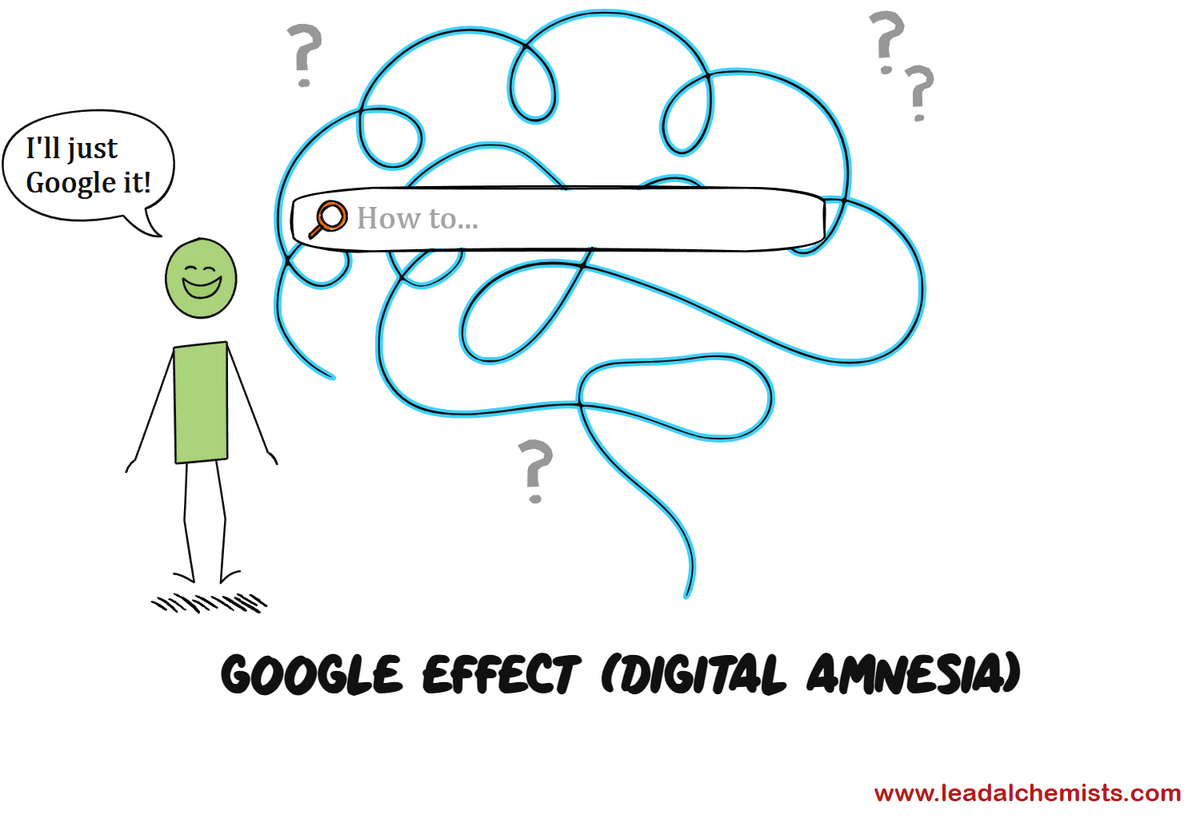
At its psychological core, the Google Effect works because humans instinctively optimize mental resources for the digital age – when information is readily available online, our brains adapt by storing the location of information rather than detailed facts themselves, essentially treating the internet as an external memory system. This transactive memory strategy means customers viewing your advertisements or website aren’t attempting to memorize every detail about your service, making it far more likely that they’ll remember your brand’s findability and trustworthiness rather than specific product features or specifications.
For marketers and advertisers, understanding this bias gives a real competitive edge. By purposefully and strategically optimizing for discoverability through strong SEO, consistent brand presence across platforms, and memorable brand positioning while delivering genuine value when customers return to find you, you can work with rather than against natural memory patterns in ways that other persuasion techniques simply cannot match.
How The Google Effect (Digital Amnesia) Works (The Psychology Behind It)
The Google Effect operates through several interconnected cognitive mechanisms that fundamentally change how we process and retain information.
Transactive Memory Systems
At its core, the Google Effect is rooted in transactive memory, a system where we rely on external sources to store information whilst our brains focus on remembering the location of that information. Originally studied in close relationships where partners divide memory tasks, this concept has expanded to include our relationship with technology.
When your customers encounter your marketing materials, they’re not trying to memorise your entire service list. Instead, they’re forming mental shortcuts: “This company does web design” or “These are the tax experts.” The detailed information gets offloaded to their expectation that they can easily retrieve it later.
Cognitive Offloading
This process involves deliberately transferring memory tasks to digital devices, reducing cognitive load and freeing mental resources for other tasks. Research from Columbia University’s landmark 2011 study by Sparrow, Liu, and Wegner demonstrated that participants were less likely to remember information if they believed it would be stored on a computer.
The marketing implication: Your customers are more likely to remember your brand’s core promise than specific details about your services. This is why positioning statements and memorable taglines often outperform detailed feature lists in advertising.
Reduced Encoding
When people expect future access to information, they’re less likely to encode it deeply into long-term memory. This isn’t laziness – it’s cognitive efficiency. Our brains have adapted to prioritise processing and pattern recognition over rote memorisation.
Recent meta-analytical reviews confirm that frequent internet search behaviour is associated with changes in cognitive load and behavioural patterns, with effects varying by age and prior internet experience. Younger users and those in North America show stronger susceptibility to the Google Effect than older adults or those in other regions.
Real-World Examples of The Google Effect (Digital Amnesia)
The Google Effect manifests across numerous contexts, offering valuable insights for marketers who understand its implications.
Educational Settings
Students increasingly rely on digital devices for reminders and information retrieval, potentially impacting deep learning and long-term retention. Research shows that over 70% of students report reliance on devices for memory tasks, with many focusing on where information is stored rather than memorising content itself.
Marketing parallel: Your potential clients aren’t trying to remember every detail from your consultation. They’re evaluating whether you’re the expert they can trust and easily contact when they need your services.
Social and Economic Contexts
The effect appears in social interactions (forgetting conversation details) and economic decision-making (investors relying on easily accessible online sources). Individuals may make decisions based on quickly accessible online information, sometimes at the expense of critical evaluation or deeper knowledge.
Professional Decision-Making
In business contexts, professionals often rely on readily available online information rather than conducting thorough research, potentially leading to decisions based on easily accessible but potentially incomplete data.
The key insight: Your marketing materials need to position your brand as the reliable, easily accessible source that customers will remember and return to when they need your expertise.
How The Google Effect (Digital Amnesia) Affects Consumer Behaviour
Understanding how the Google Effect influences your customers’ decision-making process is crucial for effective marketing strategy.
Information Processing Changes
When customers encounter your marketing materials, their brains aren’t operating like traditional filing systems. Instead, they’re creating mental bookmarks – quick references that help them categorise and relocate information when needed.
This means customers are more likely to remember:
- Your brand’s core expertise (“the SEO specialists”)
- How they felt about your company (“trustworthy,” “professional”)
- Where to find you again (“that company from the Google ad”)
They’re less likely to remember:
- Specific service details
- Pricing information
- Technical specifications
Purchasing Psychology Impact
The Google Effect influences the entire customer journey. Potential clients may see your advert, form a positive impression, then conduct additional research before making contact. This creates a multi-touchpoint journey where your brand needs to be consistently discoverable and memorable.
Critical insight: Your marketing strategy must account for the fact that customers will likely research you further after their initial exposure to your brand. This makes SEO, online reviews, and consistent messaging across platforms essential components of your marketing mix.
Psychological Triggers
Several factors amplify the Google Effect in marketing contexts:
Accessibility assurance: Customers need confidence that they can easily find you again when ready to purchase
Cognitive load reduction: Customers prefer simple, clear messaging over information-heavy content
Authority positioning: Brands that position themselves as experts are more likely to be remembered and trusted
Case Studies: How Marketers Use The Google Effect (Digital Amnesia) in Advertising
Whilst direct case studies explicitly attributing marketing success solely to the Google Effect are rare in peer-reviewed literature, several verified applications demonstrate its principles in action.
Content Marketing and “Snackable” Information
Concept: Rather than providing exhaustive information, create easily digestible content that encourages users to search for more details, reinforcing brand awareness.
Application: A project management software company creates short, engaging blog posts and infographics highlighting specific features or benefits without providing comprehensive overviews. The content is optimised for relevant keywords, ensuring the company’s website appears prominently when users search for more information.
Results: This approach aligns with content marketing best practices, leveraging users’ tendency to rely on search engines for information whilst positioning the brand as a go-to resource.
Google Ads Campaign Optimisation
Hypothetical A/B Test Scenario: A digital marketing training company tests two ad variations:
- Ad A (Control): “Learn Digital Marketing – Expert Instructors, Flexible Schedules, Affordable Prices”
- Ad B (Test): “Digital Marketing Course – Enroll Now!” (more concise, omitting details)
Expected Outcome: Ad B might achieve higher click-through rates due to its simplicity and direct call to action, with the assumption that interested users will seek further details if motivated.
Key Principle: The strategy balances providing enough information to generate interest whilst relying on the Google Effect to drive users to search for additional details.
Lead Generation Form Optimisation
Strategy: A financial advisory firm splits their “Request a Consultation” form into three simple steps: (1) Basic contact information, (2) Financial goals, (3) Preferred consultation time.
Rationale: Users are more likely to complete forms that appear simple and structured, reducing cognitive load whilst maintaining the essential information capture.
Implementation: The approach focuses on core messaging and leverages existing assets (customer testimonials, case studies) to create compelling landing pages without overwhelming visitors with excessive details.
Practical Applications for Google Ads & Lead Generation
The Google Effect offers several actionable strategies for improving your marketing effectiveness, particularly in lead generation contexts.
Google Ads Copywriting Strategy
Emphasis on Expertise Over Information: Instead of cramming detailed service descriptions into your ad copy, emphasise your business’s expertise and trustworthiness. A local accounting firm might use “Trusted Tax Experts – Get Your Maximum Refund” rather than “We offer tax preparation, bookkeeping, and payroll services.”
Landing Page Reinforcement: Ensure your landing page reinforces the key message from your ad copy. If your ad emphasises “fast service,” your landing page should prominently display statistics or testimonials related to speed.
A/B Test Suggestion: Test two ad variations for a plumbing service:
- Version A: Focuses on detailed services offered (“We repair leaks, install pipes, and unclog drains”)
- Version B: Focuses on core benefit and expertise (“Reliable Plumbing Solutions – Fast & Affordable”)
Measure click-through rates and conversion rates (lead form submissions) on the landing page. Version B will likely achieve higher performance because it focuses on memorable core benefits and expertise.
Lead Generation Website Optimisation
Simplified Forms with Progress Indicators: Break down lead capture forms into smaller, manageable steps with progress indicators. This reduces cognitive load and makes the process seem less daunting.
Strategic Visual Usage: Use visuals that reinforce your key message and create emotional connections. A landscaping company’s landing page featuring before-and-after photos of local projects showcases transformation more effectively than generic stock photos.
Information Overload Reduction: Focus on core benefits and key differentiators rather than overwhelming visitors with excessive details. A web design company should highlight expertise in creating mobile-friendly websites that generate leads rather than listing every technical aspect of their development process.
Small Business Implementation
Core Messaging Focus: Simplify your core message and make it memorable. A cleaning service using “Sparkling Clean, Guaranteed” creates stronger recall than lengthy descriptions of cleaning processes.
Existing Asset Leverage: Use customer testimonials, case studies, and project photos to create compelling landing pages and ad copy. A freelance graphic designer showcasing a portfolio of successful projects with highlighted client impact creates more powerful messaging than detailed service descriptions.
Budget-Friendly Comparison:
Small Business Equivalent: A local marketing agency features video testimonials from satisfied clients on their homepage, highlighting specific results achieved (“Increased leads by 200%”)
Big Brand Example: HubSpot uses social proof (testimonials, case studies) prominently on landing pages to build trust and encourage sign-ups
Why Marketers Should Care About The Google Effect (Digital Amnesia)
The Google Effect represents a fundamental shift in how your customers process and retain information, making it a powerful tool for influencing consumer choices when applied ethically and strategically.
Competitive Advantage Through Understanding
Marketers who understand the Google Effect can create more effective campaigns by aligning their messaging with how customers naturally process information. Rather than fighting against cognitive tendencies, you can work with them to create more memorable and actionable marketing materials.
Strategic Benefits:
- Improved ad performance: Simplified, expertise-focused messaging typically achieves higher click-through rates
- Better lead quality: Customers who find you through optimised, Google Effect-aware campaigns often have clearer expectations
- Enhanced brand recall: Positioning your brand as the easily accessible expert creates stronger mental associations
Ethical Considerations and Responsible Use
The Google Effect should be leveraged ethically, enhancing customer experience rather than manipulating decision-making processes.
Best Practices:
- Transparency: Ensure essential information remains accessible, even if not immediately visible
- Balance: Provide sufficient information to satisfy customer needs whilst leveraging natural cognitive tendencies
- Value Creation: Focus on becoming the reliable, easily accessible source customers genuinely need
Risks of Misuse:
- Information withholding: Intentionally hiding essential information to exploit the Google Effect can damage trust
- Manipulation concerns: Using the effect to deceive rather than inform violates ethical marketing principles
- Customer frustration: Failing to provide adequate information when customers need it can harm conversion rates
Long-term Brand Building
The Google Effect supports sustainable brand building by encouraging marketers to focus on core value propositions and expert positioning rather than feature-heavy messaging. This approach creates stronger brand associations and improves customer lifetime value.
How to Implement The Google Effect (Digital Amnesia) in Your Marketing Strategy
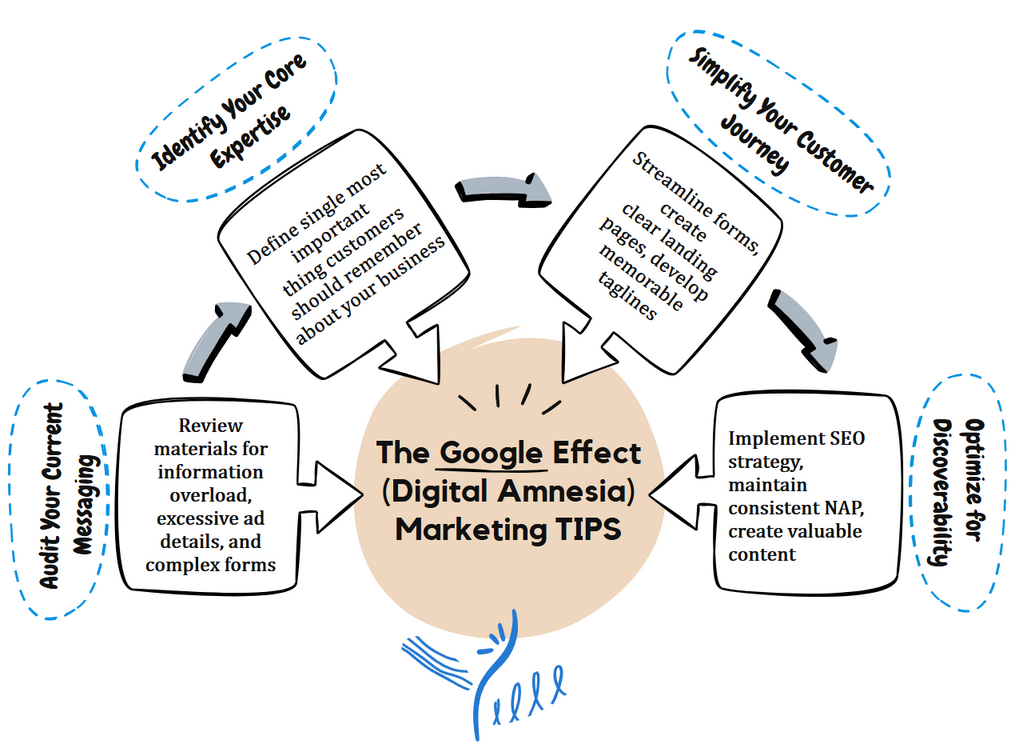
Successfully implementing Google Effect principles requires a systematic approach that balances cognitive psychology insights with practical marketing execution.
Step-by-Step Implementation Guide
1. Audit Your Current Messaging Review your existing marketing materials to identify information overload. Look for:
- Ad copy with excessive detail
- Landing pages overwhelming visitors with features
- Forms requesting unnecessary information upfront
2. Identify Your Core Expertise Define the single most important thing you want customers to remember about your business. This becomes your primary positioning statement across all marketing channels.
3. Simplify Your Customer Journey Map your customer journey and identify points where cognitive load can be reduced:
- Streamline form fields to essential information only
- Create clear, single-focus landing pages
- Develop memorable taglines that encapsulate your value proposition
4. Optimise for Discoverability Ensure customers can easily find you when they’re ready to purchase:
- Implement comprehensive SEO strategy
- Maintain consistent NAP (Name, Address, Phone) information across platforms
- Create valuable, easily discoverable content
A/B Testing Framework
Test 1: Ad Copy Simplification
- Control: Detailed service descriptions
- Variant: Simplified expertise positioning
- Measure: Click-through rates, cost per lead, conversion rates
Test 2: Landing Page Information Density
- Control: Comprehensive service information
- Variant: Core benefits with “learn more” options
- Measure: Time on page, form completion rates, bounce rates
Test 3: Form Complexity
- Control: Single comprehensive form
- Variant: Multi-step progressive form
- Measure: Form completion rates, lead quality scores
Common Pitfalls to Avoid
Over-Simplification: Removing so much information that customers cannot make informed decisions
Inconsistent Messaging: Using different core messages across platforms, confusing the mental bookmarks customers create
Neglecting Follow-Up: Failing to provide detailed information when customers actively seek it
Ignoring Context: Applying Google Effect principles inappropriately to high-consideration purchases requiring detailed information
Related Psychological Biases & Effects
Understanding the Google Effect alongside related cognitive biases creates more comprehensive marketing strategies.
Information Overload
Users become overwhelmed by excessive information, leading to decision fatigue. The Google Effect complements strategies to reduce information overload by encouraging strategic information presentation.
Availability Heuristic
People overestimate the importance of easily accessible information. The Google Effect leverages this by ensuring your brand becomes the easily accessible expert source in your field.
Cognitive Offloading
Users rely on external tools (search engines, notes) to remember information. This broader concept encompasses the Google Effect whilst extending to other digital memory aids.
Transactive Memory
Users rely on others or external sources to remember information. The Google Effect represents a specific application of transactive memory principles in digital contexts.
Strategic Integration: Successful marketers combine Google Effect principles with these related biases to create cohesive campaigns that work with natural cognitive tendencies rather than against them.
Understanding The Google Effect (Digital Amnesia) provides a significant competitive advantage in today’s information-saturated marketplace. By aligning your marketing strategy with how customers naturally process and retain information, you can create more effective campaigns that generate higher-quality leads whilst building stronger brand associations.
The key lies in becoming the easily accessible expert that customers remember and trust, the reliable source they can find when they need your services. This approach not only improves immediate marketing performance but also builds sustainable competitive advantages through enhanced brand recall and customer loyalty.
FAQs About Google Effect (Digital Amnesia)
What is the Google Effect (Digital Amnesia) and how does it work?
The Google Effect, also known as Digital Amnesia, is the tendency to forget information that can be easily retrieved online, particularly through search engines like Google. It works through transactive memory – instead of remembering facts themselves, people remember where to find the information. This cognitive phenomenon was first documented by psychologists Betsy Sparrow, Jenny Liu, and Daniel Wegner in their landmark 2011 study published in Science journal.
When we expect information to be readily accessible later, our brains engage in shallow encoding, focusing on the location of information rather than its content. This isn’t memory failure – it’s strategic memory allocation that allows us to prioritise higher-order thinking over rote memorisation.
How does the Google Effect (Digital Amnesia) change the way we remember information?
The Google Effect fundamentally shifts our memory strategy from internal storage to external access. Rather than memorising facts, we develop enhanced recall for where to find information, essentially turning the internet into an extension of our memory system.
Key changes include:
- Reduced retention of specific facts and details
- Enhanced memory for information sources and locations
- Cognitive offloading onto digital devices and search engines
- Shallow processing when we expect future access to information
Research shows this effect is particularly strong among frequent internet users and varies by age, region, and prior digital experience. It’s not about becoming less intelligent – it’s about adapting our memory strategies to an information-rich environment.
What are the main characteristics of Google Effect (Digital Amnesia) in everyday life?
Google Effect manifests in several recognisable patterns in daily life:
Common characteristics include:
- Phone number amnesia: Relying on contacts rather than memorising numbers
- Fact-checking dependency: Immediately googling information during conversations
- Navigation reliance: Using GPS instead of learning routes
- Password outsourcing: Depending on browsers to remember login details
- Information confidence: Feeling knowledgeable because information is accessible
In professional settings, people may struggle to recall specific details from meetings or presentations, knowing they can reference notes or recordings later. Students increasingly rely on digital devices for information retrieval rather than deep learning and retention.
Is Google Effect (Digital Amnesia) the same as having a bad memory?
No, Google Effect is not the same as having a bad memory – it’s a strategic adaptation to our digital environment. Unlike memory disorders or general forgetfulness, Digital Amnesia is a conscious cognitive strategy where the brain prioritises remembering access routes over content.
Key differences:
- Memory disorders affect overall cognitive function
- Google Effect specifically relates to externally accessible information
- Bad memory is often involuntary and affects various memory types
- Digital Amnesia is adaptive and allows focus on higher-level thinking
Research indicates this phenomenon can actually be beneficial, freeing up cognitive resources for analysis, creativity, and problem-solving rather than rote memorisation. However, over-reliance on external sources may reduce critical thinking skills if not balanced properly.
Who discovered the Google Effect (Digital Amnesia) and when was it first studied?
The Google Effect was first scientifically documented by Betsy Sparrow, Jenny Liu, and Daniel Wegner in their groundbreaking 2011 study published in Science journal, titled “Google Effects on Memory: Cognitive Consequences of Having Information at Our Fingertips.”
Timeline of research:
- 2011: Original study published in Science
- 2017: Follow-up research by Storm et al. confirmed the effect
- 2021-2024: Meta-analyses involving over 30,000 participants validated findings
The research built upon earlier work on transactive memory by Daniel Wegner (1986), which explored how people rely on external sources – including other people – as extensions of their memory systems. The 2011 study was revolutionary because it demonstrated this effect specifically with digital technology and search engines.
What did Betsy Sparrow’s research reveal about Google Effect (Digital Amnesia)?
Sparrow’s research revealed three crucial findings about how digital access affects memory:
Primary discoveries:
- Reduced information recall: Participants were less likely to remember information they believed would be saved on a computer
- Enhanced location memory: People showed better recall for where information was stored rather than the content itself
- Expectation dependency: The effect only occurred when participants expected future access to the information
Experimental design: Participants were asked to type statements into a computer, with some told the information would be saved and others told it would be deleted. Those expecting the information to be saved showed significantly poorer recall of the actual content but better memory for file locations.
This research demonstrated that knowing information is accessible reduces the cognitive effort we invest in memorising it, fundamentally changing how we process and store information in the digital age.
What happens in the brain when Google Effect (Digital Amnesia) occurs?
When Google Effect occurs, the brain undergoes strategic memory allocation rather than memory failure. Neurologically, this involves changes in encoding processes and cognitive load distribution.
Brain mechanisms include:
- Shallow encoding: Less deep processing when expecting future access
- Cognitive offloading: Transferring memory burden to external sources
- Attention reallocation: Focusing on access routes rather than content
- Working memory optimisation: Freeing up resources for other cognitive tasks
Recent meta-analyses suggest frequent internet search behaviour may be associated with changes in cognitive load patterns and behavioural phenotypes. Some preliminary research indicates possible alterations in brain structure, such as grey matter density, though these findings require further investigation.
Important note: These changes represent adaptation rather than deterioration, allowing the brain to optimise for an information-rich environment.
Are there any studies that challenge the validity of Google Effect (Digital Amnesia)?
While the Google Effect is well-established, some research highlights important nuances and limitations:
Methodological considerations:
- Many studies rely on self-report data, limiting causal inference
- Effects vary significantly by age, region, and internet experience
- Some research suggests benefits for cognitive stimulation, particularly in older adults
- Correlational studies make it difficult to isolate the effect from other factors
Conflicting viewpoints:
- Some researchers argue the effect is adaptive rather than detrimental
- Others suggest it may accelerate forgetting and reduce deep learning
- Cultural differences in how the effect manifests aren’t fully understood
Research gaps: There’s limited direct evidence linking the Google Effect to specific marketing applications or business outcomes. Most commercial applications are inferred from psychological research rather than controlled business experiments.
What neurological mechanisms are behind Google Effect (Digital Amnesia)?
The Google Effect operates through several interconnected neurological mechanisms:
Core mechanisms:
- Transactive memory systems: The brain treats external sources as extensions of internal memory
- Cognitive offloading: Neural resources are redirected from storage to processing
- Encoding modulation: Expectation of future access triggers shallow rather than deep encoding
- Attention allocation: Focus shifts from content retention to access route memorisation
Neuroplasticity aspects:
- Synaptic efficiency: The brain optimises neural pathways for information retrieval rather than storage
- Working memory management: Cognitive load is distributed between internal and external systems
- Prefrontal cortex activity: Changes in executive function related to information management
Recent findings: Meta-analyses suggest the effect may influence cognitive self-esteem and behavioural phenotypes, though direct neural correlates remain underexplored. The brain essentially adapts to treat digital devices as cognitive prosthetics.
What are some famous real-world examples of Google Effect (Digital Amnesia)?
Educational settings:
- Students increasingly struggle to recall lecture content, knowing they can access recordings or slides later
- Reduced note-taking quality as students expect digital access to materials
- Decreased memorisation of historical dates, formulas, and factual information
Workplace scenarios:
- Professionals relying on searchable email archives rather than remembering project details
- Meeting amnesia: Forgetting discussion points when recordings are available
- Contact dependency: Inability to recall colleagues’ phone numbers or email addresses
Daily life examples:
- Navigation dependency: Relying entirely on GPS without learning routes
- Recipe reliance: Inability to cook familiar dishes without consulting online instructions
- Cultural knowledge gaps: Reduced retention of general knowledge that’s easily googled
Important note: While these examples are commonly cited, documented case studies with measurable impacts are limited. Most evidence comes from observational research rather than controlled studies.
How does Google Effect (Digital Amnesia) show up in movies and popular culture?
Google Effect has become a recurring theme in contemporary media, often portrayed as both convenience and concern:
Film and television:
- “Her” (2013): Explores dependency on AI for information and emotional support
- “Black Mirror” episodes: Examine extreme scenarios of external memory dependence
- Documentary films: Address concerns about technology’s impact on human cognition
Cultural discussions:
- “Digital natives” debate: Questions about younger generations’ relationship with information
- “Google generation” terminology: Popular media discussions about cognitive changes
- Social media commentary: Viral posts about forgetting phone numbers or directions
Literary references:
- Academic articles in popular science magazines
- Self-help books addressing digital dependency
- Educational content about healthy technology use
Note: While culturally significant, these portrayals often dramatise or oversimplify the actual psychological research, sometimes presenting the effect as more problematic than scientific evidence suggests.
Can you give examples of Google Effect (Digital Amnesia) in workplace situations?
Professional scenarios where Google Effect commonly occurs:
Information management:
- Email dependency: Relying on search functions rather than remembering project details
- Document amnesia: Forgetting report contents when files are easily accessible
- Meeting notes reliance: Reduced attention during presentations when recordings are available
Knowledge work:
- Research shortcuts: Immediately googling information rather than drawing from expertise
- Procedure dependency: Consulting manuals for routine tasks previously memorised
- Contact list reliance: Inability to recall frequently used phone numbers or email addresses
Training and development:
- Reduced retention from workshops when materials are provided digitally
- Just-in-time learning: Preference for searching solutions rather than building knowledge base
- Skill atrophy: Decreased proficiency in tasks with readily available digital assistance
Impact on productivity: While this can increase efficiency by reducing cognitive load, it may also create vulnerability when digital resources are unavailable and reduce deep expertise development.
What are some historical cases that demonstrate Google Effect (Digital Amnesia)?
Pre-digital parallels help illustrate that external memory dependence isn’t entirely new:
Historical examples:
- Socrates’ concern about writing (Plato’s Phaedrus): Worried that written language would weaken memory
- Printing press impact: Reduced emphasis on memorising entire texts
- Calculator introduction: Decreased mental arithmetic skills in education
- Phone book dependency: Reliance on directories rather than memorising numbers
Evolutionary perspective:
- Tool use evolution: Humans have always used external aids to extend cognitive capabilities
- Cultural memory systems: Societies developed external knowledge storage (libraries, oral traditions)
- Specialisation benefits: Division of cognitive labour allows for expertise development
Key difference: The speed and ubiquity of digital access represents an unprecedented scale of external memory dependence. Unlike historical examples, modern digital amnesia affects real-time information processing rather than just long-term storage.
Research note: These historical parallels are often cited in discussions but lack the controlled experimental validation of modern Google Effect studies.
How is Google Effect (Digital Amnesia) different from confirmation bias?
Google Effect and confirmation bias are distinct cognitive phenomena with different mechanisms and outcomes:
Google Effect (Digital Amnesia):
- Memory strategy: About where to find information vs. remembering content
- Information neutral: Affects all easily accessible information equally
- Cognitive efficiency: Optimises mental resources for processing over storage
- Adaptive function: Helps manage information overload
Confirmation bias:
- Information selection: Seeking information that confirms existing beliefs
- Content-specific: Affects how we interpret and remember particular information
- Cognitive distortion: Can lead to flawed reasoning and decision-making
- Protective function: Maintains existing worldview and reduces cognitive dissonance
Potential interaction: Google Effect might amplify confirmation bias if people primarily search for information that confirms their beliefs, but the mechanisms operate independently. One affects memory strategy, the other affects information evaluation and selection.
What’s the difference between Google Effect (Digital Amnesia) and the availability heuristic?
Both involve easily accessible information but operate through different psychological mechanisms:
Google Effect (Digital Amnesia):
- Memory phenomenon: About forgetting information that’s externally accessible
- Strategic adaptation: Conscious or unconscious decision to rely on external sources
- Information storage: Affects how we encode and retain information
- Future-oriented: Based on expectation of future access
Availability heuristic:
- Judgment bias: Overestimating probability of easily recalled events
- Decision-making error: Affects how we assess likelihood and importance
- Information retrieval: Based on how easily examples come to mind
- Present-oriented: Based on current mental accessibility
Relationship: Google Effect might influence availability heuristic by changing what information is mentally accessible, but they address different cognitive processes – memory storage versus probability judgment.
Marketing relevance: Both can be leveraged in marketing, but through different mechanisms – Google Effect through information accessibility, availability heuristic through memorable examples and vivid imagery.
How does Google Effect (Digital Amnesia) compare to transactive memory?
Google Effect is actually a specific type of transactive memory applied to digital technology:
Transactive memory (broader concept):
- Social phenomenon: Originally described memory shared between people
- Relationship-based: Partners, teams, or groups specialise in different knowledge areas
- Interpersonal trust: Relies on confidence in others’ expertise and availability
- Developed over time: Builds through repeated interaction and collaboration
Google Effect (specific application):
- Technology-mediated: Extends transactive memory to digital devices and search engines
- Individual behaviour: Personal relationship with external information sources
- Instant access: Relies on immediate availability rather than social coordination
- Scalable: Can access vast information networks beyond personal relationships
Key insight: Google Effect represents the digitalisation of transactive memory, where search engines and digital devices replace human partners as external memory sources. This allows for unprecedented scale but may lack the social verification and contextual understanding that human transactive memory provides.
Is Google Effect (Digital Amnesia) related to cognitive offloading?
Yes, Google Effect is a prime example of cognitive offloading – the process of using external resources to reduce internal cognitive demands:
Cognitive offloading mechanisms:
- Memory externalization: Storing information in devices rather than minds
- Processing delegation: Using tools to perform mental calculations or analysis
- Attention management: Focusing on access rather than retention
- Resource optimisation: Freeing mental capacity for other tasks
Google Effect as offloading:
- Information storage: Offloading facts and details to search engines
- Retrieval processes: Delegating information finding to digital systems
- Cognitive burden reduction: Decreasing mental effort required for memorisation
- Strategic adaptation: Optimising brain function for available tools
Benefits and risks:
- Advantages: Increased capacity for creative and analytical thinking
- Disadvantages: Potential vulnerability when external resources are unavailable
- Balance needed: Maintaining core knowledge while leveraging external tools effectively
Research shows this offloading can be beneficial when used strategically, but may create dependencies that affect performance when digital resources aren’t accessible.
What’s the opposite of Google Effect (Digital Amnesia)?
The opposite would be “information hoarding” or “digital independence” – deliberately memorising information despite easy external access:
Characteristics of the opposite:
- Deep encoding: Intentionally memorising easily accessible information
- Internal storage preference: Choosing mental retention over external access
- Cognitive redundancy: Maintaining both internal knowledge and external access
- Independence preparation: Building knowledge base for offline situations
Real-world examples:
- Medical professionals memorising drug interactions despite database access
- Musicians learning pieces by heart despite having sheet music
- Emergency responders memorising procedures for crisis situations
- Educators maintaining broad knowledge base beyond what they can quickly search
Strategic applications:
- Core competency development: Memorising fundamental knowledge in your field
- Critical information backup: Internalising essential facts for emergencies
- Cognitive exercise: Maintaining memory skills through deliberate practice
- Cultural preservation: Memorising important cultural or historical information
Balance approach: Most effective strategy combines both – memorising core information while leveraging external sources for detailed or rarely needed facts.
Curious about other psychological biases that influence customer behavior? Explore our comprehensive guide to cognitive biases in marketing here.