
Guide to The Present Bias in Marketing: Description, Psychology, and Examples
What Is The Present Bias?
Present Bias is the tendency for people to systematically overvalue immediate rewards at the expense of larger, delayed rewards, preferring instant gratification over long-term benefits even when they know the delayed option is objectively better. This powerful cognitive bias explains why customers choose “Buy Now, Pay Later” schemes, respond strongly to “Limited Time Offer” banners, and make purchases that prioritize immediate satisfaction over superior long-term value.
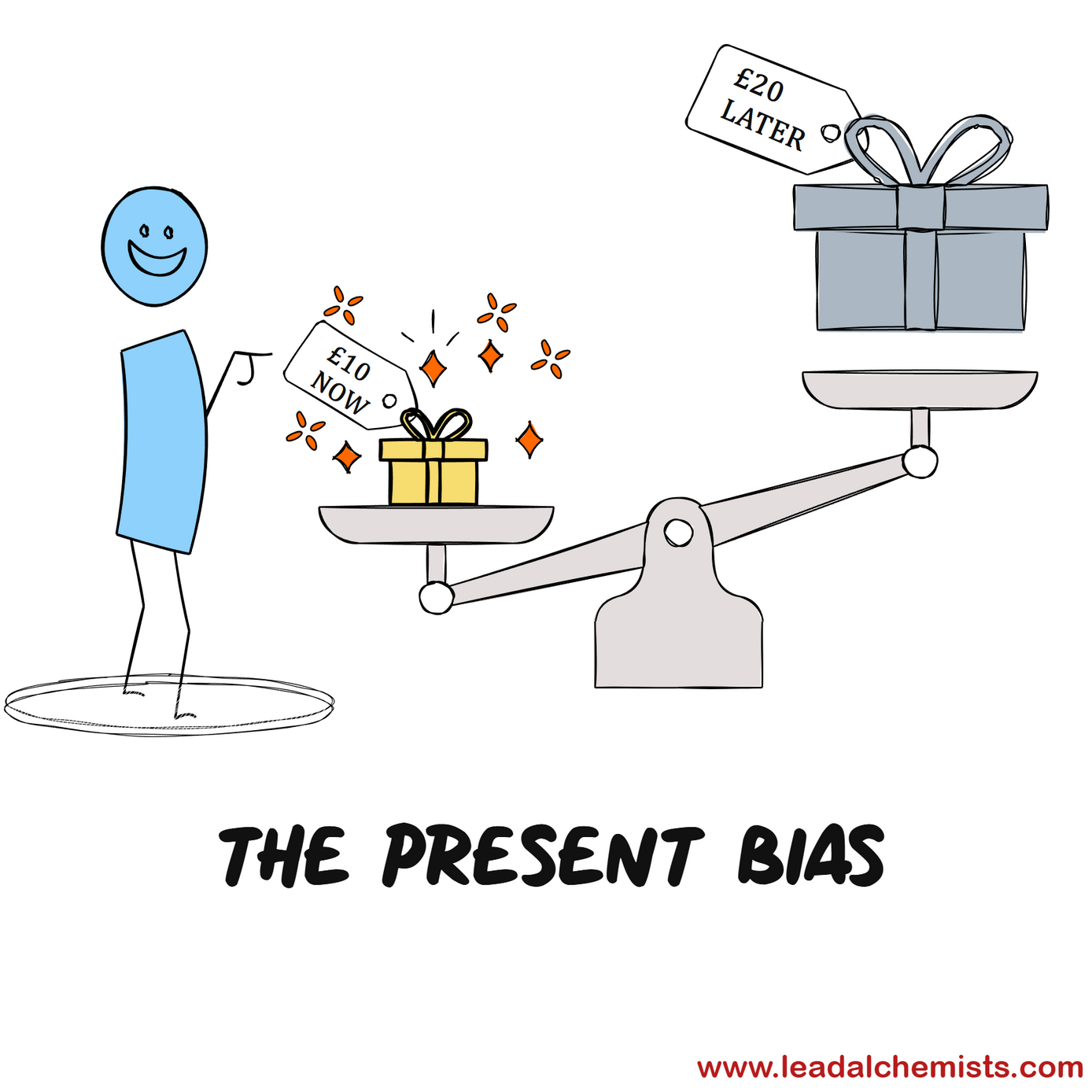
At its psychological core, Present Bias works because humans are cognitive misers – we instinctively prioritize immediate rewards that activate our brain’s reward centers more intensely than delayed ones. When faced with a choice between present and future benefits, our brains automatically amplify the value of what’s available now while dramatically diminishing future rewards, making it far more likely that we’ll choose instant gratification rather than waiting for something objectively better, even when we intellectually understand the long-term benefits.
For marketers and advertisers, understanding this bias gives a real competitive edge. By purposefully and strategically structuring offers that emphasize immediate benefits, instant access, and present-moment value while still delivering genuine long-term solutions to customer needs, you can overcome purchase hesitation and drive conversions in ways that other persuasion techniques simply cannot match.
How The Present Bias Works (The Psychology Behind It)
Present Bias operates through several interconnected psychological mechanisms that marketers can leverage ethically and effectively.
Neural Basis: Neuroscience research reveals that immediate rewards activate the brain’s reward centres – particularly the corpus striatum – more strongly than delayed rewards. Meanwhile, decisions to wait for future rewards engage different regions like the posterior insular cortex. This creates a neurological “tug of war” between immediate gratification and long-term planning.
Dual-System Processing: The bias emerges from conflict between two decision-making systems. The impulsive, emotional system favours immediate rewards and operates automatically. The reflective, self-control system prefers delayed rewards but requires conscious effort to engage. When cognitive resources are depleted – through stress, fatigue, or distraction – the impulsive system dominates.
Hyperbolic Discounting: Present Bias closely relates to hyperbolic discounting, where the perceived value of future rewards drops sharply as delays approach the present. A reward available in one week versus two weeks feels dramatically different, while the same one-week difference between months 11 and 12 feels negligible.
Time-Inconsistency: The bias only appears when preferences change over time. Someone might prefer £100 in 13 months over £90 in 12 months, but when those same options become £100 tomorrow versus £90 today, they often reverse their preference.
Emotional Amplification: Immediate rewards trigger stronger emotional responses, creating visceral reactions that override rational analysis. This emotional component explains why “instant” messaging in marketing often outperforms purely logical appeals.
Real-World Examples of The Present Bias
Present Bias influences decisions across numerous contexts, providing valuable insights for marketing applications.
Amazon Prime’s Success: Amazon Prime demonstrates Present Bias perfectly. Customers pay an annual fee for immediate benefits like fast shipping and streaming access. Research by Anderson & Simester (MIT Sloan Management Review, 2014) shows customers value these immediate benefits even when they don’t fully utilise all services, leading to increased loyalty and spending.
Buy Now, Pay Later (BNPL) Services: Companies like Afterpay and Klarna exploit Present Bias by allowing immediate consumption with deferred payment. Industry reports indicate BNPL services increase sales by removing immediate financial burden, though specific conversion rates vary by sector and implementation.
Subscription Box Models: Services like Birchbox create recurring immediate gratification through monthly deliveries. The anticipation and surprise elements appeal to Present Bias, encouraging continued subscriptions through regular “reward” experiences.
Beyond Marketing Applications:
- Healthcare: Patients often skip preventive care (immediate inconvenience) despite long-term health benefits
- Finance: Individuals struggle with retirement saving, preferring immediate spending over future security
- Education: Students procrastinate on assignments, choosing immediate leisure over academic achievement
Small Business Example: A local plumbing company increased call volume by 40% when they changed their Google Ads from “Reliable Plumbing Services” to “Emergency Leak? Get Immediate Help!” The emphasis on immediate problem-solving triggered Present Bias more effectively than general reliability messaging.
How The Present Bias Affects Consumer Behaviour
Understanding how Present Bias shapes consumer psychology provides marketers with powerful insights for campaign development.
Neurological Response: When consumers encounter immediate rewards, their brains release dopamine and activate pleasure centres. This creates a physiological urge to act quickly, often bypassing rational evaluation. Delayed rewards, conversely, engage analytical brain regions that weigh costs and benefits more carefully.
Decision-Making Shortcuts: Present Bias leads consumers to use mental shortcuts that favour immediate options. They may focus disproportionately on upfront benefits while underweighting future costs or consequences. This explains why “free trial” offers often outperform “money-back guarantees” – the immediate benefit feels more tangible.
Attention and Focus: Immediate rewards capture attention more effectively than delayed ones. Consumers spend more time considering immediate options and remember them more vividly. This attention bias amplifies the effect of present-focused marketing messages.
Emotional Override: Present Bias often involves emotional responses overriding rational analysis. Consumers may know a delayed option is objectively better, but still choose the immediate alternative because it “feels” right. This emotional component makes Present Bias particularly powerful in marketing contexts.
Context Dependency: The strength of Present Bias varies with situational factors. Stress, time pressure, and cognitive load all increase bias towards immediate rewards. Marketers can leverage these insights by timing campaigns when consumers are most susceptible to immediate appeals.
Case Studies: How Marketers Use The Present Bias in Advertising
Real-world applications demonstrate how businesses successfully leverage Present Bias for improved marketing outcomes.
Case Study 1: Amazon Prime’s Immediate Value Proposition
Amazon Prime exemplifies strategic Present Bias application. Rather than emphasising long-term savings, Amazon highlights immediate benefits: free same-day delivery, instant streaming access, and exclusive deals available “right now.”
Strategy: Amazon positions Prime membership as providing instant gratification rather than future value. The signup process emphasises immediate access to benefits, not annual cost calculations.
Results: Academic research confirms customers value immediate Prime benefits even when they don’t fully utilise services, leading to higher retention rates and increased spending per member.
Key Insight: Focus marketing messages on immediate benefits rather than long-term value propositions, even when the long-term benefits are objectively superior.
Case Study 2: BNPL Services Removing Immediate Pain
Buy Now, Pay Later services demonstrate Present Bias by eliminating immediate financial discomfort while maintaining immediate product access.
Strategy: Companies like Klarna and Afterpay position their services as “get it now, pay later” rather than emphasising financing or credit aspects. Marketing focuses on immediate product enjoyment, not payment terms.
Application: E-commerce sites report increased conversion rates when BNPL options are prominently displayed at checkout, particularly for higher-value items where immediate payment creates more psychological resistance.
Lesson: Remove immediate barriers (financial, logistical, or psychological) while maintaining immediate benefits to leverage Present Bias effectively.
Case Study 3: Service-Based Business Transformation
A Manchester-based marketing consultancy increased consultation bookings by 65% by restructuring their lead generation approach around Present Bias principles.
Before: “Schedule a consultation to discuss your long-term marketing strategy” After: “Get immediate insights into your marketing gaps – free 15-minute audit available today”
Strategy Changes:
- Offered immediate value (quick audit) instead of future planning
- Reduced time commitment from 60 minutes to 15 minutes
- Provided instant takeaways rather than proposals for future work
Results: Higher booking rates, better show-up rates, and increased conversion to paid services.
Practical Applications for Google Ads & Lead Generation
Present Bias offers numerous opportunities for improving Google Ads performance and lead generation effectiveness.
Google Ads Optimisation
Ad Copy Strategies:
- Use “Now,” “Today,” “Instant,” and “Immediate” in headlines
- Emphasise immediate benefits over long-term outcomes
- Create urgency without false scarcity
Example Transformation:
- Before: “Professional Tax Services – Expert Preparation”
- After: “File Your Taxes Today – Get Refund Fast”
Landing Page Alignment: Ensure landing pages reinforce immediate benefits promised in ads. If your ad promises “instant quote,” your landing page should deliver that quote immediately, not require extensive form completion.
A/B Testing Framework: Test immediate versus delayed benefit messaging:
- Control: “Improve your marketing ROI over time”
- Test: “See marketing results this month”
- Measure: Click-through rates, conversion rates, and cost per acquisition
Lead Generation Website Optimisation
Immediate Gratification Lead Magnets: Replace lengthy ebooks with instant-value tools:
- Quick calculators instead of comprehensive guides
- Immediate assessments rather than detailed reports
- “Get results in 2 minutes” tools over “comprehensive analysis”
Form Optimisation: Minimise immediate effort required:
- Reduce form fields to essential information only
- Use progressive profiling to gather information over time
- Offer immediate value before requesting detailed information
Testimonial Strategy: Feature testimonials emphasising immediate positive impact:
- Generic: “Great service and results”
- Present Bias-Focused: “Called Monday morning, problem solved by Tuesday afternoon”
Limited-Time Offers: Create genuine urgency through time-bound offers:
- “Book consultation this week, receive 10% discount”
- “First 50 respondents get immediate strategy session”
- “Today only: instant access to premium resources”
Small Business Implementation
Low-Cost Strategies:
- Keyword Targeting: Focus on long-tail keywords indicating immediate needs (“emergency,” “today,” “now,” “urgent”)
- Content Marketing: Create content addressing immediate problems rather than long-term education
- Social Media: Share immediate tips and quick wins rather than comprehensive strategies
- Email Marketing: Use subject lines emphasising immediate value (“Quick tip inside,” “2-minute read”)
Budget-Friendly Tools:
- Google Optimize for A/B testing landing pages
- Hotjar for understanding user behaviour
- Canva for creating urgency-focused visuals
- Calendly for immediate booking capabilities
Why Marketers Should Care About The Present Bias
Present Bias represents a fundamental aspect of human psychology that directly impacts marketing effectiveness across all channels and industries.
Competitive Advantage: Understanding Present Bias provides significant competitive advantages. While competitors focus on long-term benefits and rational appeals, businesses leveraging Present Bias can capture attention and drive action more effectively.
Universal Application: Present Bias affects all consumer segments and decision types. Whether targeting B2B executives or consumer markets, immediate benefits consistently outperform delayed ones in capturing attention and driving action.
Measurable Impact: Present Bias applications produce measurable results. A/B tests consistently show higher engagement rates for immediate versus delayed benefit messaging, providing clear ROI on implementation efforts.
Cross-Channel Effectiveness: The bias works across all marketing channels – email, social media, paid advertising, content marketing, and sales conversations. This universality makes it a valuable addition to any marketing toolkit.
Ethical Considerations: When applied ethically, Present Bias helps consumers make decisions that align with their actual preferences. Rather than manipulating consumers, it removes barriers to choices they genuinely want to make.
Risk Management: Understanding Present Bias helps avoid common marketing mistakes. Many campaigns fail because they emphasise future benefits that consumers discount heavily, leading to poor performance despite strong products or services.
Customer Experience: Present Bias applications often improve customer experience by reducing friction, providing immediate value, and aligning marketing messages with natural decision-making patterns.
How to Implement The Present Bias in Your Marketing Strategy
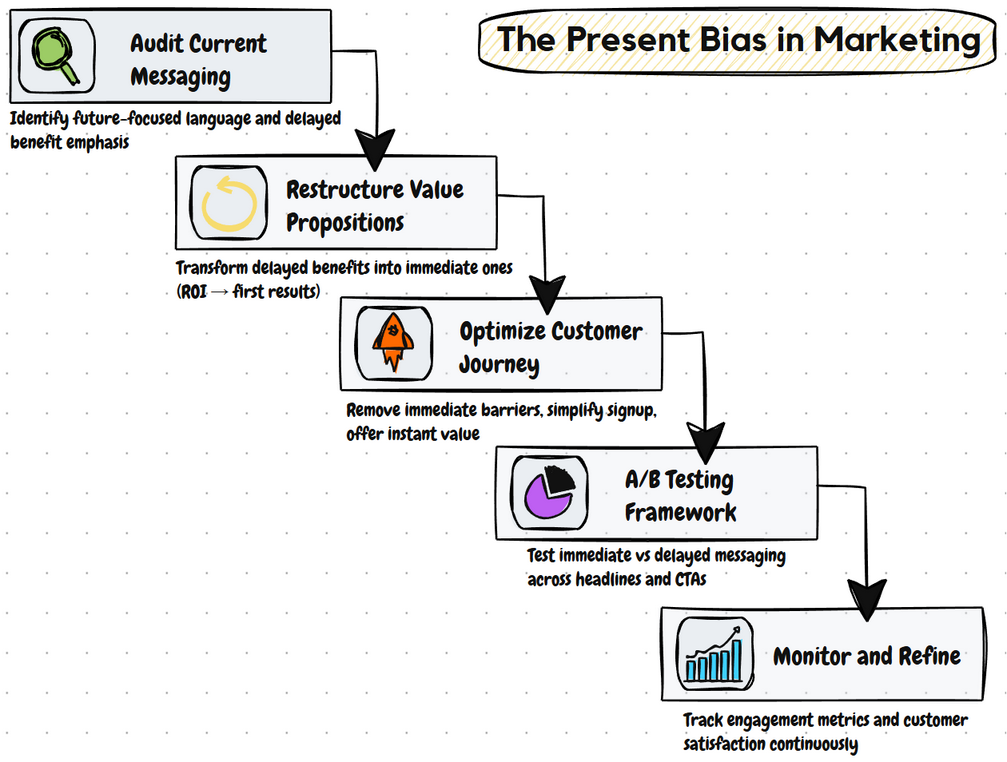
Successfully implementing Present Bias requires systematic approach and careful testing to ensure ethical and effective application.
Step 1: Audit Current Messaging
Review existing marketing materials for:
- Future-focused language (“will,” “eventually,” “long-term”)
- Delayed benefit emphasis
- Complex value propositions requiring extensive analysis
Identify opportunities to:
- Highlight immediate benefits
- Reduce perceived effort or time investment
- Create legitimate urgency
Step 2: Restructure Value Propositions
Transform delayed benefits into immediate ones:
- “Improve ROI over 12 months” becomes “See first results within 30 days”
- “Comprehensive solution” becomes “Quick wins available immediately”
- “Long-term partnership” becomes “Immediate support when you need it”
Step 3: Optimise Customer Journey
Remove immediate barriers:
- Simplify signup processes
- Reduce form fields
- Offer immediate value before requesting information
- Provide instant confirmations and next steps
Create immediate wins:
- Quick assessments or audits
- Immediate access to valuable resources
- Fast response times to inquiries
Step 4: A/B Testing Framework
Test systematically:
- Headlines: Immediate versus delayed benefit focus
- Call-to-Actions: “Now” versus “Future” language
- Offers: Immediate versus delayed value delivery
- Content: Quick tips versus comprehensive guides
Measure consistently:
- Click-through rates
- Conversion rates
- Time on page
- Bounce rates
- Customer lifetime value
Step 5: Monitor and Refine
Track performance indicators:
- Engagement metrics across channels
- Conversion rate improvements
- Customer feedback and satisfaction
- Long-term retention rates
Common Pitfalls to Avoid:
- False urgency that damages trust
- Over-emphasising immediate benefits while ignoring quality
- Neglecting long-term customer relationships
- Applying Present Bias inappropriately to high-consideration purchases
Best Practices
Maintain authenticity: Ensure immediate benefits are genuine and valuable, not just marketing gimmicks.
Balance short and long-term: Use Present Bias to initiate relationships, then demonstrate long-term value.
Segment appropriately: Some audiences and purchase types require more rational, long-term focused approaches.
Test continuously: Present Bias effectiveness varies by industry, audience, and context – regular testing ensures optimal implementation.
Related Psychological Biases & Effects
Present Bias works synergistically with several related psychological phenomena that marketers should understand.
Loss Aversion: People feel losses more intensely than equivalent gains. Combine with Present Bias by emphasising immediate losses avoided rather than future gains achieved.
Social Proof: People follow others’ behaviour, especially under uncertainty. Combine with Present Bias by showing immediate social validation (“Join 1,000+ people who started today”).
Scarcity Principle: Limited availability increases perceived value. Create legitimate scarcity around immediate opportunities while maintaining abundant future options.
Hyperbolic Discounting: The mathematical model underlying Present Bias, where discount rates decrease over time. Understanding this helps predict when Present Bias will be strongest.
FOMO (Fear of Missing Out): Anxiety about missing immediate opportunities. Closely related to Present Bias, but focuses on emotional rather than rational decision-making.
Instant Gratification: The desire for immediate pleasure or satisfaction. Present Bias provides the psychological mechanism explaining why instant gratification is so powerful.
Understanding these related biases enables more sophisticated marketing strategies that leverage multiple psychological principles simultaneously while maintaining ethical standards and genuine customer value.
Ready to Transform Your Marketing with Present Bias?
Understanding Present Bias is just the beginning. Implementing it effectively requires strategic thinking, careful testing, and ongoing optimisation. Whether you’re running Google Ads campaigns, optimising landing pages, or developing content strategies, Present Bias can significantly improve your marketing performance.
The key is starting with small tests, measuring results carefully, and scaling successful applications across your marketing efforts. Remember: Present Bias works best when it genuinely serves customer needs while driving business results.
FAQs About Present Bias
What is Present Bias and how does it affect our daily decisions?
Present Bias is the tendency to overvalue immediate rewards at the expense of larger, delayed rewards, leading us to make choices that favour short-term gratification over long-term benefits. This psychological phenomenon affects countless daily decisions, from choosing fast food over cooking a healthy meal to scrolling social media instead of exercising.
The bias occurs because immediate rewards activate our brain’s reward centres more strongly than delayed ones, creating a conflict between our impulsive emotional systems and our reflective self-control systems. This explains why we might know that saving money is important but still make impulse purchases, or why we procrastinate on important tasks despite understanding the consequences.
How does Present Bias make us prioritise immediate rewards over long-term benefits?
Present Bias works through hyperbolic discounting, where the perceived value of future rewards drops sharply as the delay approaches the present. Essentially, our brains are wired to see immediate rewards as disproportionately more valuable than they actually are.
This creates time-inconsistent preferences – we may plan to act in our long-term interest (like starting a diet next Monday), but reverse those plans when immediate options become available (like ordering takeaway tonight). The closer a reward is to the present moment, the more our emotional, impulsive systems override our rational planning systems.
What’s the difference between Present Bias and procrastination?
While closely related, Present Bias is the underlying psychological mechanism, whilst procrastination is one of its behavioural outcomes. Present Bias refers to the systematic preference for immediate rewards over delayed ones, even when we’re aware of the long-term consequences.
Procrastination specifically involves delaying tasks to avoid immediate effort, even when completing them sooner would be more beneficial. Think of Present Bias as the engine and procrastination as one of the cars it drives – along with other behaviours like impulse buying, poor health choices, and inadequate saving.
Who first discovered Present Bias and what research supports it?
The term “Present Bias” was coined by Edmund Phelps and Robert Pollak in 1968, who developed the quasi-hyperbolic discounting model. Early empirical work by George Ainslie (1975) and later by David Laibson (1997) formalised the concept in behavioural economics.
Key supporting research includes:
- O’Donoghue & Rabin (1999): Demonstrated present bias in intertemporal choices
- Meier & Sprenger (2010): Found present-biased individuals borrow more and save less
- Recent health studies (PMC, 2019): Used dynamic models to quantify present bias in healthcare decisions
The research consistently shows that people disproportionately favour immediate rewards even when waiting yields significantly greater benefits.
What brain mechanisms are responsible for Present Bias behaviour?
Immediate rewards activate the brain’s reward centres (notably the corpus striatum) more strongly than delayed rewards, whilst decisions to wait for future rewards engage regions like the posterior insular cortex. This creates a neurological tug-of-war between different brain systems.
The dual-system model explains this as a conflict between:
- Impulsive, emotional systems that favour immediate rewards
- Reflective, self-control systems that favour delayed rewards
When immediate options are available, the emotional systems often override the rational ones, leading to present-biased decisions even when we intellectually know better.
Are there any studies that challenge the validity of Present Bias?
Some researchers argue that hyperbolic discounting models may oversimplify real-world decision-making. Critics suggest that attention, framing, and context play more significant roles than previously thought, and that direct measures of present bias (rather than inferred from utility functions) are needed for accuracy.
However, the core concept remains well-supported by research. The debates centre more on methodology and measurement rather than questioning whether present bias exists. Most conflicting viewpoints focus on refining our understanding rather than dismissing the phenomenon entirely.
What are some famous real-world examples of Present Bias in action?
Amazon Prime is a classic example – customers pay an annual fee for immediate benefits like fast shipping and streaming, even if they don’t fully utilise all services. The immediate gratification outweighs the upfront cost.
Buy Now, Pay Later (BNPL) services like Afterpay and Klarna exploit present bias by allowing immediate purchases with deferred payment. Subscription boxes provide recurring immediate gratification through surprise elements and monthly anticipation.
In everyday life, present bias explains why people choose unhealthy food (immediate pleasure) over healthier options (long-term health benefits), or why they struggle with retirement saving despite knowing its importance.
How does Present Bias explain why people struggle with saving money?
Present bias makes spending money now feel more rewarding than saving for future benefits. The immediate pleasure of a purchase activates our brain’s reward systems more strongly than the abstract concept of future financial security.
This creates a psychological disconnect where people may intellectually understand the importance of saving but consistently choose immediate consumption. The pain of not spending (immediate) feels greater than the benefit of having money later (delayed), even when the future benefit is objectively larger.
Present-biased individuals tend to spend more, borrow excessively, and save less, resulting in poorer long-term financial outcomes – a pattern extensively documented in behavioural finance research.
Can you see Present Bias in popular movies or TV shows?
Present Bias appears frequently in media, though it’s rarely labelled as such. Characters who choose immediate pleasures over long-term consequences demonstrate this bias – think of protagonists who skip important responsibilities for immediate fun, or who make impulsive decisions despite knowing better.
Reality TV shows often exploit present bias by creating scenarios where contestants must choose between immediate rewards and strategic long-term thinking. Game shows that offer “take the money now or risk it for more later” directly test present bias in participants.
The classic “marshmallow test” scenario appears in various forms across media, highlighting the universal struggle between immediate gratification and delayed rewards.
How is Present Bias different from the Availability Heuristic?
Present Bias focuses on timing preferences, whilst the Availability Heuristic relates to information accessibility. Present Bias is about preferring immediate rewards over delayed ones, regardless of the information available.
The Availability Heuristic involves judging probability or importance based on how easily examples come to mind. For instance, overestimating plane crash risks after seeing news coverage.
While both are cognitive biases, they operate in different domains – Present Bias affects when we want rewards, whilst the Availability Heuristic affects how we assess likelihood and importance based on memory accessibility.
What’s the relationship between Present Bias and Hyperbolic Discounting?
Present Bias is closely linked to hyperbolic discounting – they’re essentially two ways of describing the same phenomenon. Hyperbolic discounting is the mathematical model that explains how the perceived value of future rewards drops sharply as delays approach the present.
The “hyperbolic” shape of the discount curve means that rewards lose value more rapidly for delays closer to the present but less so for delays further in the future. This creates the time-inconsistent preferences characteristic of Present Bias.
Think of hyperbolic discounting as the technical explanation for why Present Bias occurs – it’s the mathematical framework underlying the psychological tendency.
Is Present Bias the same as instant gratification syndrome?
Present Bias is the broader psychological concept, whilst “instant gratification syndrome” is more of a popular term describing the behavioural outcomes. Present Bias is a systematic, time-inconsistent preference for immediate rewards, even when people are aware of long-term consequences.
Instant gratification syndrome typically refers to the inability to delay satisfaction, but Present Bias is more nuanced – it’s not simply about lacking willpower, but about how our brains systematically overvalue immediate rewards relative to delayed ones.
Present Bias can occur even in people with good self-control; it’s a fundamental aspect of human psychology rather than a character flaw or syndrome.
How do marketers use Present Bias to influence consumer purchases?
Marketers leverage Present Bias through several proven strategies:
Buy Now, Pay Later (BNPL) services remove immediate financial burden whilst providing instant product access. Limited-time offers and flash sales create urgency by emphasising immediate benefits of discounted prices.
Subscription models use free trials and introductory discounts to emphasise immediate rewards over future costs. “Instant” messaging in advertising (instant results, immediate relief, same-day delivery) directly appeals to present-biased decision-making.
However, marketers should focus on behavioural economics principles and cite industry best practices rather than claiming guaranteed conversion improvements without peer-reviewed evidence.
Why do subscription services rely on Present Bias for customer retention?
Subscription services exploit Present Bias by providing recurring immediate gratification whilst making future costs feel distant and abstract. The immediate access to content, products, or services feels more valuable than the ongoing monthly charges.
Subscription boxes particularly leverage this through surprise elements and monthly anticipation – the immediate excitement of receiving a package outweighs the cumulative cost over time. Streaming services provide instant access to entertainment, making the monthly fee feel insignificant compared to immediate viewing pleasure.
The psychological principle works because customers focus on immediate benefits (watching a show tonight) rather than long-term costs (£10/month for years), even when the total cost exceeds the perceived value.
How does Present Bias impact pricing strategies in retail?
Present Bias influences several key pricing strategies:
Payment deferrals (0% interest for 12 months) make large purchases feel more accessible by removing immediate financial pain. Bundling strategies emphasise immediate comprehensive value over individual component costs.
“Free” shipping with minimum orders leverages present bias by highlighting immediate savings whilst obscuring the requirement to spend more. Membership programmes like Amazon Prime use upfront annual fees to make subsequent purchases feel “free” or discounted.
Retailers also use urgency-based pricing (limited-time offers, flash sales) to trigger immediate purchase decisions before rational evaluation can occur.
Is it ethical for companies to exploit Present Bias in their marketing?
The ethics depend on transparency, consumer benefit, and potential harm. Using Present Bias to help customers access genuinely beneficial products or services can be ethical, especially when terms are clear and consumers aren’t misled.
Ethical concerns arise when:
- Companies hide long-term costs or consequences
- Marketing targets vulnerable populations (those with low financial literacy)
- Products cause genuine harm (predatory lending, unhealthy behaviours)
Best practices include: transparency in pricing and terms, avoiding manipulative language, providing easy opt-out options, and ensuring marketing genuinely serves customer interests rather than exploiting psychological vulnerabilities.
Industry guidelines recommend clear communication of long-term consequences alongside immediate benefits.
What are the dangers of Present Bias in financial decision-making?
Present Bias can lead to severe long-term financial consequences:
Undersaving for retirement occurs because immediate consumption feels more rewarding than abstract future security. Accumulating high-interest debt happens when immediate purchases outweigh future payment obligations.
Poor investment decisions result from preferring immediate returns over long-term growth strategies. Inadequate emergency savings occur because immediate spending feels more important than preparing for uncertain future needs.
The compounding effect means that small present-biased decisions accumulate into major financial problems over time, particularly affecting retirement readiness and financial stability.
How can Present Bias lead to poor health and lifestyle choices?
Present Bias significantly impacts health decisions because immediate comfort often conflicts with long-term wellbeing:
Dietary choices: Fast food provides immediate satisfaction whilst healthy cooking requires immediate effort for delayed health benefits. Exercise avoidance: The immediate discomfort of working out outweighs the delayed benefits of fitness.
Preventive healthcare: People skip check-ups, screenings, and vaccinations because they require immediate time and discomfort for uncertain future benefits. Smoking and substance use: Immediate pleasure or stress relief outweighs long-term health consequences.
Sleep patterns: Immediate entertainment (late-night scrolling) feels more appealing than the delayed benefits of adequate rest.
How does Present Bias affect our relationships and social interactions?
Present Bias can strain relationships by prioritising immediate personal gratification over long-term relationship health:
Communication: Avoiding difficult conversations provides immediate comfort but can damage relationships long-term. Commitment: Choosing immediate social opportunities over relationship obligations can erode trust and intimacy.
Conflict resolution: Present bias may lead to avoiding immediate discomfort of addressing issues, allowing problems to compound. Investment in relationships: Immediate personal activities might take precedence over time spent nurturing relationships.
However, understanding Present Bias can also improve relationships by recognising when immediate impulses conflict with long-term relationship goals, allowing for more intentional decision-making.
Why does Present Bias make it hard to stick to exercise routines?
Exercise perfectly illustrates Present Bias because it requires immediate effort and discomfort for delayed benefits. The immediate costs (time, physical discomfort, inconvenience) feel more significant than the delayed rewards (fitness, health, appearance).
Immediate barriers include:
- Physical discomfort during exercise
- Time taken from other activities
- Inconvenience of changing clothes, travelling to gym
- Mental effort required to maintain motivation
Delayed benefits include:
- Improved fitness and health
- Better appearance
- Enhanced mood and energy
- Reduced disease risk
Since our brains overvalue immediate experiences, the immediate costs consistently outweigh the delayed benefits, making exercise routines difficult to maintain.
How can you overcome Present Bias in your personal life?
Several evidence-based strategies can help counteract Present Bias:
Commitment devices: Set up automatic savings transfers or use apps that block social media during work hours. Pre-commitment strategies: Make decisions when you’re not facing immediate temptation (meal prep on Sundays, schedule exercise appointments).
Make future benefits more vivid: Use visual reminders of long-term goals, create detailed mental images of future outcomes. Reduce friction for good choices: Make healthy foods easily accessible, lay out exercise clothes the night before.
Environmental design: Remove temptations from your environment, create systems that make good choices easier than bad ones. Social accountability: Share goals with others who can provide support and gentle pressure.
What role does Present Bias play in workplace productivity?
Present Bias significantly impacts workplace productivity through procrastination and task prioritisation:
Procrastination: Employees may delay challenging tasks because the immediate effort feels greater than the delayed benefits of completion. Distraction susceptibility: Immediate pleasures (social media, personal messages) compete with work tasks that have delayed rewards.
Meeting deadlines: Present bias makes it difficult to start projects early, leading to last-minute rushes and stress. Skill development: Immediate work demands often take precedence over long-term learning and development activities.
Email and communication: The immediate satisfaction of responding to messages can interrupt deep work that would provide greater long-term value.
How does Present Bias influence online shopping behavior?
Online shopping environments are designed to exploit Present Bias through several mechanisms:
One-click purchasing removes friction between desire and acquisition. Same-day or next-day delivery makes rewards feel more immediate. Limited-time offers create artificial urgency to purchase now rather than deliberate.
Visual product displays trigger immediate desire whilst hiding long-term costs (monthly subscriptions, total cost of ownership). “Add to basket” notifications create immediate satisfaction even before purchase completion.
Recommendation algorithms present immediate gratification opportunities based on browsing history, making impulse purchases feel personalised and justified.
Why do people with Present Bias struggle with retirement planning?
Retirement planning is particularly vulnerable to Present Bias because it involves immediate sacrifice for very distant, abstract benefits:
Immediate costs of retirement saving include:
- Reduced current spending power
- Opportunity cost of immediate purchases
- Mental effort required for financial planning
- Complexity of investment decisions
Delayed benefits include:
- Financial security decades in the future
- Abstract concept of “future self”
- Uncertain future needs and circumstances
- Benefits that feel hypothetical rather than real
The psychological distance of retirement makes these future benefits feel less real and valuable than immediate spending opportunities, leading to chronic undersaving.
What are the most searched questions about Present Bias online?
Common search queries related to Present Bias include:
“How to overcome procrastination” and “instant gratification vs delayed gratification” indicate widespread awareness of present-bias challenges. “Why do I make bad financial decisions” and “how to save money” reflect financial applications.
“Marshmallow test” and “self-control psychology” show interest in the underlying research. “Impulse buying” and “why do I procrastinate” represent practical concerns about present-biased behaviours.
FOMO (Fear of Missing Out) and YOLO (You Only Live Once) are related trending terms that involve prioritising immediate experiences, often at the expense of future outcomes.