
Guide to The Temporal Discounting & Hyperbolic Discounting in Marketing: Description, Psychology, and Examples
What Is The Temporal Discounting & Hyperbolic Discounting?
Temporal Discounting is the tendency for people to devalue rewards as the delay to receiving them increases, preferring smaller immediate rewards over larger delayed ones. Hyperbolic Discounting is a specific form of this bias where the perceived value drops sharply for short delays but decreases more gradually for longer delays, explaining why we make inconsistent choices over time – choosing £10 today over £12 tomorrow, yet preferring £12 in 31 days over £10 in 30 days, despite the identical one-day difference.
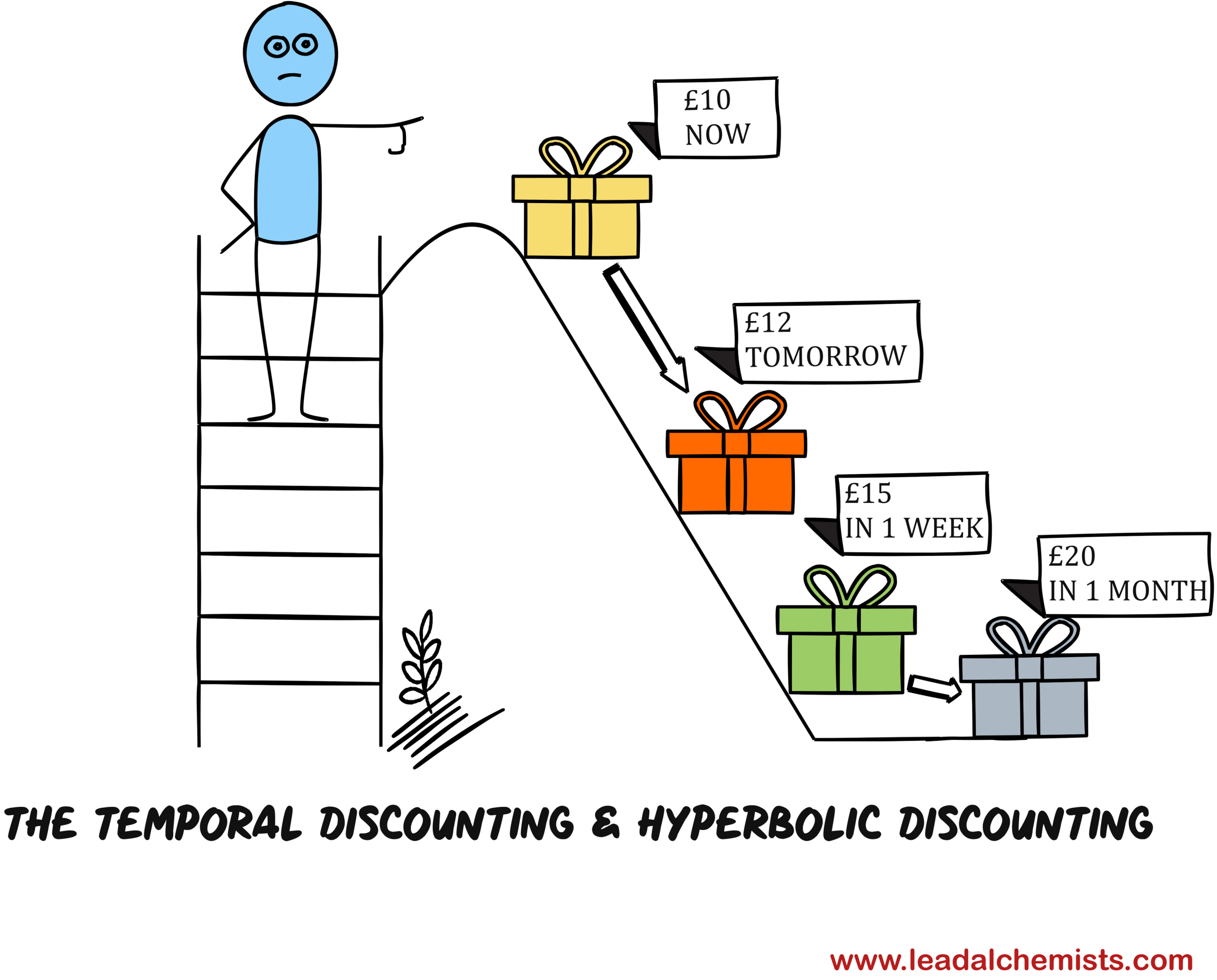
At its psychological core, Temporal Discounting works because humans are cognitive misers – we instinctively prioritize immediate gratification over future rewards to conserve mental energy and avoid uncertainty. When faced with a choice between present and future benefits, our brains automatically inflate the value of immediate options while dramatically deflating distant ones, making it far more likely that we’ll choose instant rewards rather than waiting for something better, even when the delayed option is objectively superior.
For marketers and advertisers, understanding this bias gives a real competitive edge. By purposefully and strategically structuring offers that emphasize immediate benefits while minimizing perceived near-term costs, and pairing this with genuine long-term value delivery, you can drive immediate action and trial conversions in ways that other persuasion techniques simply cannot match.
How The Temporal Discounting & Hyperbolic Discounting Works (The Psychology Behind It)
The Cognitive Mechanisms
Temporal discounting operates through several key psychological mechanisms:
Present bias: We disproportionately value immediate rewards over future ones, even when waiting would yield a larger payoff. This explains why “Buy Now” buttons are so effective.
Nonlinear time perception: Research by Kim & Zauberman (2009, 2013) revealed that we perceive time nonlinearly. Short delays feel longer than they objectively are, whilst long delays feel shorter – amplifying our preference for immediate gratification.
Dual-system processing: Neuroimaging studies show that different brain regions activate when evaluating immediate versus delayed rewards. The ventral striatum (associated with pleasure and reward) lights up for immediate rewards, whilst the prefrontal cortex (responsible for planning and self-control) engages more with delayed rewards.
What Happens in the Brain
When faced with a choice between immediate and delayed rewards, our brain experiences a tug-of-war between two systems:
- The limbic system (our emotional, impulsive brain) pushes for immediate gratification
- The prefrontal cortex (our rational, planning brain) considers long-term benefits
For marketers, this presents an opportunity: by emphasising immediate benefits, you can activate the limbic system and increase the likelihood of conversion.
Psychological Triggers That Amplify the Effect
Several factors can strengthen the temporal discounting effect:
Uncertainty: When future outcomes are uncertain, immediate rewards become even more attractive
Emotional state: Stress and arousal increase present bias
Concreteness: Immediate rewards feel more tangible and vivid than abstract future benefits
Framing: How choices are presented significantly impacts decision-making
Real-World Examples of The Temporal Discounting & Hyperbolic Discounting
Beyond Marketing
Temporal discounting influences decisions across many domains:
Health: People choose immediate pleasure (unhealthy food) over long-term health benefits (proper nutrition)
Finance: Under-saving for retirement despite knowing its importance
Education: Procrastinating on assignments in favour of immediate leisure
Environment: Reluctance to make immediate sacrifices for long-term environmental benefits
In Marketing and Consumer Behaviour
Brands leverage temporal discounting in numerous ways:
Limited-time offers: Creating urgency through time constraints (“Sale ends tonight!”)
Free trials: Offering immediate access with delayed payment
Buy-now-pay-later services: Separating the pleasure of purchase from the pain of payment
Countdown timers: Visually emphasising the limited time available
Immediate bonuses: Providing instant rewards for signing up or purchasing
How The Temporal Discounting & Hyperbolic Discounting Affects Consumer Behaviour
When temporal discounting kicks in, consumers:
- Overvalue immediate benefits and undervalue future costs
- Make more impulsive decisions when faced with time constraints
- Respond strongly to urgency triggers in marketing messages
- Prefer smaller immediate rewards over larger delayed ones
- Show inconsistent preferences over different time horizons
This bias is particularly powerful in digital marketing, where decisions happen quickly and immediate gratification is just a click away.
Case Studies: How Marketers Use The Temporal Discounting & Hyperbolic Discounting in Advertising
Whilst direct, peer-reviewed case studies isolating temporal discounting as the sole driver of marketing success are rare, behavioural economics research strongly supports its effectiveness. Here are evidence-based applications:
Subscription Services: Free Trials and Introductory Pricing
Concept: Free trials and discounted introductory offers leverage temporal discounting by making the immediate benefit (free access) more appealing than the long-term cost.
Application: Subscription businesses consistently find that free trial offers generate higher sign-up rates than standard pricing models, though the specific impact varies by industry and offering.
Why It Works: Consumers focus on the immediate value (accessing the service now) whilst discounting the future cost (the subscription fee after the trial ends).
Google Ads: Urgency in Ad Copy
Concept: Time-sensitive language in ad copy can increase click-through rates by activating temporal discounting.
Application: Google’s own best practices recommend using urgency signals in ad copy, though they attribute the effect to a combination of psychological factors including scarcity, FOMO, and temporal discounting.
A/B Test Idea: For a local service business:
Control: “Professional Plumbing Services in [Location]” Test: “Emergency Plumber Available Today – Call Now!” Metrics: Click-through rate, conversion rate, cost per lead
Lead Generation: Immediate-Value Lead Magnets
Concept: Lead magnets that provide instant gratification outperform those promising delayed benefits.
Application: A marketing agency offering a “Free Website Audit: 5 Immediate Fixes to Boost Traffic” will typically generate more leads than one offering a generic “Guide to SEO Best Practices.”
Why It Works: The promise of immediate, actionable insights activates the temporal discounting bias, making the offer more compelling than one with delayed or abstract benefits.
Practical Applications for Google Ads & Lead Generation
Google Ads Copywriting & Design
Use time-bound language in headlines and descriptions:
- “Book Your Free Consultation Today”
- “Limited Appointments This Week”
- “Same-Day Service Available”
Create ad extensions with urgency:
- Callout extensions: “24-Hour Response” or “Immediate Quote”
- Structured snippets highlighting quick-start benefits
Implement countdown timers for special offers:
- Google Ads allows dynamic countdown timers in ad copy
- “Offer Ends in {=countdown(“YYYY/MM/DD HH:MM:SS”)}”
Landing Page Structure for Lead Generation
Headline and subheadline strategies:
- Lead with immediate benefits: “Get Your Free Quote in 2 Minutes”
- Address urgent pain points: “Stop Losing Customers Today”
Form optimisation techniques:
- Minimise perceived effort with shorter forms or multi-step forms
- Use progress indicators to show how quickly users can complete the process
- Place forms above the fold for immediate visibility
Call-to-action optimisation:
- Use action-oriented, present-tense verbs: “Start Now” vs “Get Started”
- Create urgency with time-bound language: “Claim Your Spot Today”
- Emphasise immediate next steps: “Book Your Free Consultation Now”
Website UX and Form Optimisation
Lead magnet strategies:
- Offer immediate-value resources (checklists, templates, quick guides)
- Emphasise instant delivery: “Download Instantly”
- Focus on solving immediate problems rather than long-term benefits
Form design best practices:
- Break longer forms into steps to reduce perceived effort
- Use microcopy that emphasises speed: “Takes just 30 seconds”
- Include progress indicators to show completion is near
Urgency indicators:
Use colour psychology (red, orange) to signal urgency
Implement ethical countdown timers for limited offers
Show real-time availability: “Only 3 consultation slots left this week”
Why Marketers Should Care About The Temporal Discounting & Hyperbolic Discounting
Temporal discounting offers marketers a powerful tool for influencing consumer decisions because it:
- Accelerates the decision-making process by creating a sense of urgency
- Increases conversion rates by emphasising immediate benefits
- Reduces decision paralysis by focusing attention on present value
- Works across industries and contexts, from e-commerce to service businesses
- Can be implemented with minimal cost through simple copy and design changes
Ethical Considerations and Responsible Use
Whilst temporal discounting is a powerful tool, ethical marketers should:
- Avoid false scarcity or manufactured urgency
- Be transparent about future costs or commitments
- Deliver on promised immediate benefits
- Consider the impact on vulnerable populations who may be more susceptible to impulsive decisions
- Test different approaches to find what genuinely helps customers make better decisions
The line between persuasion and manipulation is thin. The most effective long-term strategy is to use temporal discounting to highlight genuine value and urgency, not to create artificial pressure.
How to Implement The Temporal Discounting & Hyperbolic Discounting in Your Marketing Strategy
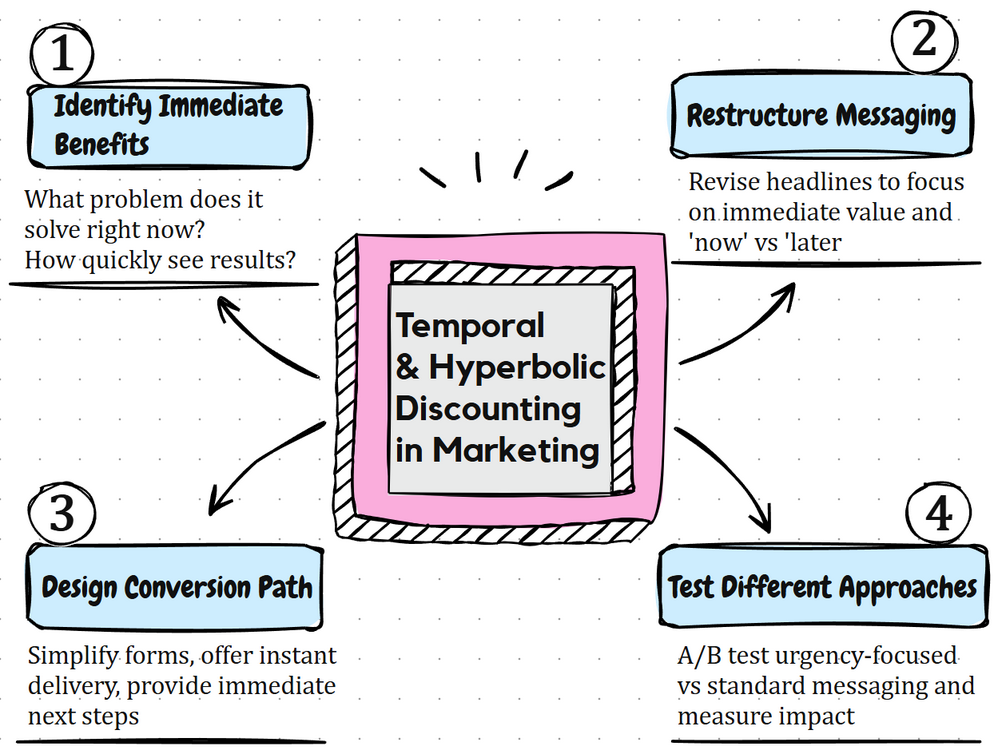
Step-by-Step Implementation Guide
Identify immediate benefits of your product or service:
- What problem does it solve right now?
- What instant gratification does it provide?
- How quickly can customers see results?
Restructure your messaging to emphasise these immediate benefits:
- Revise headlines to focus on immediate value
- Rewrite benefit statements to highlight “now” vs “later”
- Create urgency through time-bound offers when appropriate
Design your conversion path to reduce perceived delays:
- Simplify forms to minimise completion time
- Offer instant delivery where possible
- Provide immediate next steps after conversion
Test different approaches:
- A/B test urgency-focused vs standard messaging
- Compare conversion rates between immediate-value and future-value propositions
- Measure impact on lead quality, not just quantity
Best Practices and Common Pitfalls
Best Practices:
- Focus on genuine value and authentic urgency
- Balance immediate benefits with long-term value
- Test different approaches with your specific audience
- Consider the customer journey and buying cycle
Common Pitfalls:
- Creating false urgency that damages trust
- Overusing urgency tactics, leading to message fatigue
- Focusing on immediate conversion at the expense of lead quality
- Ignoring industry context (high-consideration purchases may require different approaches)
A/B Testing Ideas
Google Ads Test: Compare standard service descriptions vs time-sensitive offers
Control: “Professional Tax Services in [Location]” Test: “Get Your Tax Questions Answered Today – Free 30-Min Consultation”
Landing Page Test: Compare immediate vs delayed benefit framing
Control: “Our marketing strategy will improve your business over time” Test: “Start seeing more leads within 30 days”
Lead Magnet Test: Compare immediate-value vs comprehensive resources
Control: “Complete Guide to Digital Marketing” (comprehensive) Test: “5 Website Fixes to Implement Today” (immediate)
Related Psychological Biases & Effects
Temporal discounting works alongside several other cognitive biases:
Scarcity bias: Limited availability increases perceived value
Loss aversion: People fear missing out on limited-time offers
Framing effect: How choices are presented affects decisions
Anchoring bias: Initial information influences subsequent judgements
Present bias: Tendency to focus on the present at the expense of the future
Understanding how these biases interact can help you create more effective marketing strategies that align with how people actually make decisions.
By applying temporal discounting principles ethically and strategically, marketers can create more compelling offers, increase conversion rates, and generate higher-quality leads – all by working with, rather than against, the natural psychology of decision-making.
Understanding how people value immediate versus future rewards isn’t just academic – it’s a practical tool that can transform your marketing effectiveness and help you connect with customers at the moment they’re most ready to act.
FAQs About Temporal Discounting & Hyperbolic Discounting
What is Temporal Discounting & Hyperbolic Discounting and how does it affect our daily decisions?
Temporal discounting is the tendency to devalue rewards as the delay to their receipt increases. It affects our daily decisions by making immediate rewards seem more valuable than future ones, even when waiting would yield greater benefits.
Temporal discounting explains why we might:
- Choose a small treat today over better health tomorrow
- Spend money now rather than save for retirement
- Procrastinate on important tasks with long-term benefits
Hyperbolic discounting is a specific mathematical form of temporal discounting where the value of delayed rewards decreases more steeply for short delays than for long ones. This creates inconsistent preferences over time, such as planning to start a diet “next week” but changing your mind when that day arrives.
How does Temporal Discounting & Hyperbolic Discounting explain why we choose immediate rewards over long-term benefits?
Temporal discounting explains our preference for immediate rewards through present bias – a cognitive mechanism where we disproportionately value immediate gratification over future benefits, even when waiting would be more rational.
Research shows this happens because:
Nonlinear time perception: We perceive short delays as longer and long delays as shorter than they objectively are, amplifying our present bias
Neural mechanisms: Brain imaging studies show the ventral striatum (reward centre) activates more strongly for immediate rewards, whilst the prefrontal cortex (responsible for planning) engages more for delayed rewards
Uncertainty about the future: Immediate rewards are certain, whilst future rewards carry inherent risk
This explains why we struggle with saving money, maintaining healthy habits, and completing long-term projects despite knowing the future benefits would outweigh immediate gratification.
What’s the difference between Temporal Discounting & Hyperbolic Discounting and exponential discounting?
The key difference is that hyperbolic discounting predicts inconsistent preferences over time, whilst exponential discounting predicts consistent preferences.
Exponential discounting:
- Assumes a constant discount rate over time
- Leads to time-consistent preferences (what you prefer now is what you’ll prefer later)
- The mathematical model originally proposed by Samuelson (1937)
- More aligned with rational economic theory
Hyperbolic discounting:
- Features a steeper discount rate for short delays than for long delays
- Creates preference reversals (e.g., choosing $10 today over $12 tomorrow, but preferring $12 in 31 days over $10 in 30 days)
- Better matches actual human behaviour in studies
- Explains procrastination and impulsive decision-making
Recent research by Kim & Zauberman (2009, 2013) suggests that what appears as hyperbolic discounting may partly result from nonlinear subjective time perception, not just internal discount rates.
Who first discovered Temporal Discounting & Hyperbolic Discounting and what research supports it?
Temporal discounting was first formalised in economics by Paul Samuelson in 1937, who proposed an exponential model. However, hyperbolic discounting was introduced by George Ainslie in 1975, who observed that both humans and animals discount future rewards hyperbolically rather than exponentially.
Key supporting research includes:
Richard Herrnstein’s matching law (1961): Laid groundwork for understanding choice behaviour
Ainslie’s work (1975): Demonstrated hyperbolic discounting patterns in both humans and animals
Laibson’s “golden eggs” model (1997): Applied hyperbolic discounting to economic decision-making
McClure et al. (2004): Used fMRI to show different brain regions activate for immediate versus delayed rewards
Kim & Zauberman (2009, 2013): Showed nonlinear time perception explains much of hyperbolic discounting
Recent studies from Harvard Business School (2024) confirm hyperbolic discounting persists in complex, real-world decisions, not just laboratory tasks, whilst research published in Nature (2024) demonstrates that temporal discounting robustly predicts real-world procrastination.
What brain regions are involved in Temporal Discounting & Hyperbolic Discounting according to neuroscience research?
Neuroscience research has identified distinct brain networks involved in evaluating immediate versus delayed rewards during temporal discounting decisions:
For immediate rewards:
- Ventral striatum: Part of the brain’s reward system that processes pleasure and reinforcement
- Nucleus accumbens: Plays a central role in the reward circuit and immediate gratification
- Medial prefrontal cortex: Involved in self-referential thinking and valuation
For delayed rewards:
- Dorsolateral prefrontal cortex: Crucial for executive function, planning, and self-control
- Posterior parietal cortex: Helps with future planning and abstract thinking
- Anterior cingulate cortex: Involved in conflict monitoring when choosing between options
A meta-analysis by Peters & Büchel (2014) confirmed these activation patterns across multiple neuroimaging studies. The interaction between these systems explains why we experience internal conflict when choosing between immediate and delayed gratification. When the “immediate reward” system dominates, we tend to make impulsive choices; when the “delayed reward” system prevails, we make more patient, future-oriented decisions.
Are there any studies that challenge the validity of Temporal Discounting & Hyperbolic Discounting?
Yes, several studies challenge aspects of hyperbolic discounting theory, though the general phenomenon of temporal discounting is well-established:
Alternative explanations:
- Subjective time perception: Kim & Zauberman (2009, 2013) demonstrated that nonlinear time perception, rather than true changes in discount rates, may explain hyperbolic patterns. When subjective time is accounted for, discounting appears more exponential.
Methodological critiques:
- Some researchers argue that experimental designs using hypothetical rewards or limited time frames may not accurately reflect real-world decision-making.
- Studies using different elicitation methods sometimes yield inconsistent results.
Contextual factors:
- Research shows discount rates vary significantly based on the type of reward (money vs. health), framing, and cultural context, suggesting a single discounting function may be insufficient.
Alternative models:
- Some researchers propose that quasi-hyperbolic or other mathematical functions may better describe certain decision contexts.
Despite these challenges, the core insight that people discount future rewards in a way that leads to time-inconsistent preferences remains robust across numerous studies and real-world observations.
What are some famous real-world examples of Temporal Discounting & Hyperbolic Discounting in action?
Temporal discounting manifests in numerous real-world scenarios that demonstrate our tendency to prioritise immediate rewards over future benefits:
Health behaviours:
- Smoking cigarettes (immediate pleasure despite long-term health risks)
- Skipping exercise (immediate comfort over long-term fitness)
- Unhealthy eating (immediate taste satisfaction over long-term health)
Financial decisions:
- Insufficient retirement savings (current spending over future security)
- Credit card debt (immediate purchases despite high interest costs)
- Payday loans (immediate cash despite extremely high fees)
Environmental issues:
- Climate change inaction (immediate economic benefits over long-term environmental costs)
- Resource depletion (immediate consumption over sustainable management)
Educational contexts:
- Student procrastination (immediate leisure over future academic success)
- Dropping out (immediate relief from academic pressure versus long-term career benefits)
Policy challenges:
- Infrastructure underinvestment (immediate budget savings versus long-term economic benefits)
- Preventative healthcare underfunding (immediate budget savings versus long-term health cost reductions)
Research from Nature (2024) confirms that temporal discounting robustly predicts these behaviours in real-world settings, not just laboratory experiments.
How does Temporal Discounting & Hyperbolic Discounting appear in popular movies and literature?
Temporal discounting appears frequently in popular culture, often as a central character flaw or plot device:
Films:
- “The Wolf of Wall Street”: Jordan Belfort consistently chooses immediate gratification (drugs, luxury, risky business practices) over long-term stability and ethics
- “Click” with Adam Sandler: The protagonist uses a remote to fast-forward through life’s challenges, prioritising immediate relief over meaningful experiences
- “Inside Out”: Riley’s impulsive decision to run away represents choosing immediate emotional relief over long-term family relationships
Literature:
- “The Picture of Dorian Gray”: The protagonist chooses immediate pleasure and eternal youth whilst deferring the consequences to his portrait
- “A Christmas Carol”: Scrooge prioritises immediate wealth accumulation over relationships until shown the long-term consequences
- “The Odyssey”: The crew eating the cattle of Helios despite warnings, choosing immediate hunger satisfaction over long-term survival
TV Shows:
- “Breaking Bad”: Walter White repeatedly makes decisions for immediate gain despite escalating long-term consequences
- “The Good Place”: Characters learn to overcome their impulsive tendencies and consider the broader consequences of their actions
These narratives often resolve when characters learn to overcome their present bias and make decisions that account for long-term wellbeing – essentially overcoming hyperbolic discounting.
What’s the connection between Temporal Discounting & Hyperbolic Discounting and addiction behaviours?
Temporal discounting has a strong, well-documented relationship with addiction behaviours. Research shows that individuals with addiction consistently display steeper discount rates (stronger present bias) than control groups.
Key connections:
Impulsivity: Steeper discounting correlates with higher impulsivity, a trait linked to addiction vulnerability
Immediate rewards: Addictive substances/behaviours provide immediate rewards whilst their costs are delayed
Relapse patterns: The classic addiction cycle reflects hyperbolic discounting – when not experiencing cravings, people plan to abstain, but preference reverses during moments of temptation
Research evidence:
- A meta-analysis by Sharma et al. (2013) confirmed a significant positive correlation between delay discounting and impulsivity
- Bickel et al. (2018) reviewed neuroimaging studies showing that individuals with addiction show altered activation in brain regions associated with temporal discounting
- Studies consistently show steeper discount rates across various addictions: alcohol, nicotine, opioids, gambling, and internet addiction
Treatment implications:
- Effective addiction treatments often incorporate strategies to overcome temporal discounting, such as contingency management (providing immediate rewards for abstinence) and cognitive restructuring to better value future outcomes
This connection explains why addiction is so difficult to overcome – it’s not just about willpower but about fundamental decision-making processes affected by hyperbolic discounting.
How is Temporal Discounting & Hyperbolic Discounting different from present bias and procrastination?
Temporal discounting, present bias, and procrastination are related but distinct concepts:
Temporal discounting:
- The broader phenomenon of devaluing future rewards as delay increases
- A general cognitive mechanism present in all decision-making involving time
- Can be measured quantitatively through discount rates
Hyperbolic discounting:
- A specific mathematical form of temporal discounting
- Characterised by steeper discounting for short delays than long delays
- Explains why preferences can reverse as time passes
Present bias:
- A consequence or manifestation of hyperbolic discounting
- The disproportionate weight given to immediate outcomes compared to all future outcomes
- Often used in behavioural economics to describe the psychological tendency
Procrastination:
- A behavioural outcome resulting from present bias and hyperbolic discounting
- The act of delaying tasks despite expecting negative consequences
- Involves additional factors like task aversion, perfectionism, and anxiety
Recent research in Nature (2024) confirms that temporal discounting robustly predicts real-world procrastination, demonstrating the causal relationship between these concepts. Essentially, temporal discounting is the cognitive mechanism, present bias is the psychological tendency, and procrastination is one of the behavioural outcomes.
What’s the relationship between Temporal Discounting & Hyperbolic Discounting and the availability heuristic?
Temporal discounting and the availability heuristic are distinct cognitive mechanisms that can interact to influence decision-making:
Availability heuristic:
- A mental shortcut where we judge probability based on how easily examples come to mind
- Focuses on ease of recall and mental accessibility
- Primarily affects judgements about frequency and probability
Temporal discounting:
- Involves devaluing future rewards based on delay
- Focuses on time preference and valuation
- Primarily affects intertemporal choice
How they interact:
- Immediate rewards may be more mentally available than delayed rewards, potentially amplifying temporal discounting
- Vivid, easily imagined immediate outcomes may be overweighted compared to abstract future outcomes
- Recent experiences with rewards or punishments may be more available, affecting how we discount similar future outcomes
Whilst conceptually distinct, these biases can work together to create stronger present-focused decision patterns. For example, the immediate pleasure of eating cake is both temporally immediate (temporal discounting) and easily imaginable (availability heuristic), whilst the health benefits of abstaining are both delayed and abstract.
Research confirms these are separate psychological mechanisms, though they may operate simultaneously in many real-world decisions.
Is there an opposite effect to Temporal Discounting & Hyperbolic Discounting in psychology?
Whilst there isn’t a direct “opposite” to temporal discounting, several psychological phenomena represent contrasting tendencies:
Delayed gratification:
- The ability to resist immediate rewards in favour of larger future rewards
- Demonstrated in the famous “marshmallow test” by Walter Mischel
- Associated with better life outcomes and stronger executive function
Future bias:
- In some contexts, people show a preference for delayed rewards over immediate ones
- Often occurs with negative outcomes (preferring to get bad news now rather than later)
- Can appear in anticipatory consumption (saving a favourite food for later)
Negative time preference:
- Some studies show people occasionally prefer to delay positive experiences to extend anticipation
- Examples include saving vacation souvenirs or delaying opening gifts
- Related to savouring and the pleasure derived from anticipation
Hyperbolic magnitude effect:
- People tend to discount smaller amounts more steeply than larger amounts
- Can counteract temporal discounting when future rewards are substantially larger
These phenomena don’t negate temporal discounting but represent complementary aspects of how humans value experiences across time. The ability to override temporal discounting through self-control mechanisms is a crucial aspect of adaptive decision-making.
How do marketers use Temporal Discounting & Hyperbolic Discounting to influence consumer behaviour?
Marketers leverage temporal discounting to influence consumer behaviour through several evidence-based strategies:
Urgency tactics:
- Limited-time offers (“Sale ends tonight!”)
- Countdown timers on websites
- “Flash sales” with short durations
Immediate benefits emphasis:
- Highlighting immediate rewards in advertising (“Feel better today!”)
- Focusing on instant results rather than long-term benefits
- Using language that triggers immediate emotional responses
Reducing immediate pain:
- “Buy now, pay later” options
- Free trials and deferred payments
- Low initial payments with higher payments later
Immediate access:
- “Instant download” for digital products
- Same-day delivery options
- Immediate account access
A/B testing opportunity:
- Test standard messaging vs. urgency-focused messaging
- Compare conversion rates between “Sign up” vs. “Start your free trial now”
- Measure response to immediate vs. delayed incentives
Whilst these tactics are based on established behavioural economics principles, it’s important to note that no direct, peer-reviewed case studies isolate temporal discounting as the sole driver of increased conversions. These approaches should be viewed as best practices based on theoretical understanding rather than guaranteed conversion boosters.
What role does Temporal Discounting & Hyperbolic Discounting play in subscription pricing strategies?
Subscription businesses strategically leverage temporal discounting in their pricing models to maximise acquisition and retention:
Free trials and introductory offers:
- Provide immediate access with delayed payment
- Capitalise on the tendency to value immediate benefits over future costs
- Example: “30-day free trial, then £9.99/month”
Annual vs. monthly pricing:
- Offer discounts for annual commitments (e.g., “£8/month billed annually”)
- Appeal to the rational mind by highlighting total savings
- Counteract hyperbolic discounting by making the long-term option more attractive
Freemium models:
- Provide immediate value at no cost
- Gradually introduce premium features to overcome initial price resistance
- Build habit and dependence before introducing payment
Tiered pricing psychology:
- Structure tiers to make middle options seem most reasonable
- Use temporal framing: “Less than £1 per day” vs. “£30 per month”
Implementation considerations:
- The effectiveness varies by industry and target audience
- High-consideration B2B services may be less influenced by these tactics
- A/B testing is essential to determine what works for specific customer segments
Whilst behavioural economics theory strongly supports these approaches, marketers should note that no peer-reviewed studies isolate temporal discounting as the sole driver of subscription conversion increases. These strategies represent best practices based on theoretical understanding rather than guaranteed conversion tactics.
How can businesses leverage Temporal Discounting & Hyperbolic Discounting in their sales funnels?
Businesses can strategically apply temporal discounting principles throughout their sales funnels to increase conversions:
Top of funnel (Awareness):
- Use ad copy emphasising immediate problem-solving
- Highlight “quick wins” or instant results in content marketing
- Create urgency around educational resources: “Download this guide today”
Middle of funnel (Consideration):
- Offer immediate-value lead magnets (templates, checklists, quick audits)
- Provide instant assessments or calculators that deliver immediate insights
- Use case studies that emphasise quick implementation and fast results
Bottom of funnel (Decision):
- Implement limited-time offers or bonuses
- Offer free trials with immediate access
- Use countdown timers on checkout pages
- Provide immediate next steps post-purchase
Post-purchase (Retention):
- Deliver quick wins early in the customer journey
- Provide immediate onboarding support
- Celebrate early milestones to reinforce immediate value
- Use renewal reminders that emphasise benefits gained rather than future costs
Key implementation tips:
- Ensure urgency is authentic and value is genuine
- Test different timeframes for limited offers
- Balance immediate and long-term value propositions
- Track not just conversion rates but also customer satisfaction and retention
The most effective approach combines temporal discounting with other psychological principles whilst maintaining ethical standards and delivering genuine value at every stage.
Conclusion: Using Temporal Discounting Wisely
Temporal discounting is one of the most fundamental biases in human decision-making, and understanding it gives marketers a significant advantage. But that advantage comes with responsibility.
The businesses that succeed long-term aren’t those that exploit temporal discounting to manipulate customers into regrettable purchases. They’re the ones that use it to help customers overcome their own barriers to making decisions that genuinely benefit them.
When you create a limited-time offer, ask yourself: am I creating artificial urgency to pressure someone into a poor decision, or am I helping someone overcome procrastination on something they actually need? When you emphasise immediate benefits, are those benefits real and meaningful, or are you just distracting from significant long-term costs?
The most effective applications of temporal discounting share a common thread: they reduce friction in the decision-making process for purchases that deliver genuine value. A free trial that lets someone experience your product immediately isn’t manipulation – it’s reducing the risk of making a decision based on incomplete information. A countdown timer on a legitimate sale isn’t deceptive – it’s helping people make decisions rather than endlessly deliberating.
Start implementing these principles by auditing your current marketing for opportunities to emphasise immediate benefits. Look at your Google Ads, your landing pages, your email campaigns. Where can you make the value proposition more immediate? Where can you reduce the perceived delay between action and benefit?
Test your changes methodically. Some audiences and contexts are more responsive to temporal discounting than others. High-consideration B2B purchases might require a different approach than impulse consumer purchases. The only way to know what works for your specific situation is to test it.
Most importantly, maintain the trust you build with customers. Every tactic in this guide can be used ethically or manipulatively. The difference isn’t in the tactic itself – it’s in whether you’re using it to highlight genuine value or to obscure poor value. Choose the former, and temporal discounting becomes a tool for building a sustainable business. Choose the latter, and you might see short-term gains followed by long-term damage to your reputation and customer relationships.
Understanding temporal discounting isn’t about tricking people into bad decisions. It’s about working with human psychology to help people make good decisions more easily. That’s the kind of marketing that builds businesses that last.