Guide to The Reciprocity (Cialdini) in Marketing: Description, Psychology, and Examples
What Is The Reciprocity (Cialdini)?
Reciprocity is the tendency for people to feel obligated to return favours, gifts, or services they’ve received from others, creating a sense of indebtedness that motivates reciprocal behavior. This powerful psychological principle explains why free samples at supermarkets compel purchases, why small gifts from charities increase donations, and why providing value upfront dramatically improves conversion rates.
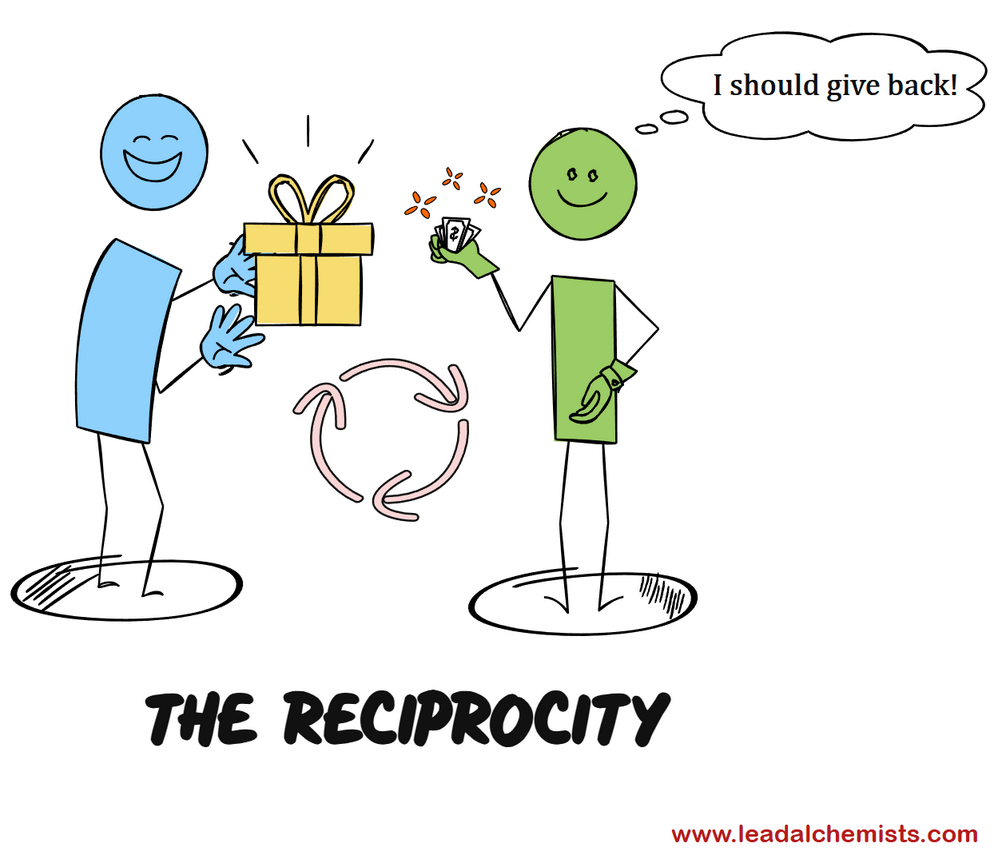
At its psychological core, Reciprocity works because humans are inherently social beings with deeply ingrained fairness norms – we instinctively experience psychological discomfort when we receive something without reciprocating. When someone provides us with value, our brains create a sense of obligation that persists until we’ve “evened the score,” making it far more likely that we’ll return the favor through a purchase, engagement, or loyalty rather than walking away with the uncomfortable feeling of being indebted.
For marketers and advertisers, understanding this bias gives a real competitive edge. By purposefully and strategically offering free samples, valuable content, or helpful services upfront while delivering genuine solutions to customer needs, you can trigger reciprocal behavior and build lasting relationships in ways that other persuasion techniques simply cannot match.
How The Reciprocity (Cialdini) Works (The Psychology Behind It)
The psychology behind reciprocity operates through several interconnected mechanisms that make it such a compelling force in human behaviour.
Social Exchange Theory
Individuals engage in reciprocal behaviour to maintain social relationships and ensure future cooperation. This evolutionary mechanism helped our ancestors survive by promoting mutual support within groups. When someone provides value first, it triggers an almost automatic response to reciprocate.
Cognitive Dissonance
Failing to reciprocate creates psychological discomfort. Our brains are wired to maintain consistency between our actions and beliefs. When we receive something without giving back, it creates mental tension that we’re motivated to resolve through reciprocal action.
Neurological Response
Research using fMRI scans shows that receiving gifts or favours activates reward centres in the brain, creating positive associations with the giver. This neurological response reinforces the desire to reciprocate and maintain the relationship.
The strength of reciprocity varies across cultures and individual personalities, but its presence is remarkably universal. Some researchers note that while the principle is consistent, its expression can differ based on cultural context and personal values.
Real-World Examples of The Reciprocity (Cialdini)
Reciprocity influences behaviour far beyond marketing, appearing in numerous aspects of daily life and business interactions.
Beyond Marketing Applications
Negotiation: Offering concessions during negotiations often leads the other party to reciprocate, facilitating agreement. This “door-in-the-face” technique involves making a large request followed by a smaller one, increasing compliance due to perceived reciprocal concessions.
Healthcare: Patients show greater adherence to treatment plans when they feel their healthcare providers are genuinely invested in their well-being, reflecting reciprocal care and trust.
Education: Teachers who demonstrate personal interest in their students often find increased engagement and effort in return, creating positive learning environments through reciprocal investment.
Politics and Economics: Political favours, lobbying, and public goods participation all leverage reciprocity, where contributions or support are exchanged for policy considerations or community benefits.
Classic Marketing Examples
The Disabled American Veterans (DAV) Case: This well-documented fundraising campaign included small gifts (personalised address labels) with donation request letters. The result? Response rates doubled from 18% to 35%, demonstrating the measurable power of reciprocity in direct marketing.
Restaurant Industry: The famous mint study by Strohmetz et al. (2002) showed that when servers provided small gifts with the bill, tips increased by 3.3%. When the gesture felt personalised (like returning with a second mint), tip increases became even more significant.
How The Reciprocity (Cialdini) Affects Consumer Behaviour
When reciprocity is triggered in marketing contexts, it creates a cascade of psychological responses that directly impact purchasing decisions.
Brain Response to Value
Receiving unexpected value – whether it’s a free sample, helpful content, or personalised service – activates reward centres in the brain. This creates positive associations with the brand and generates a psychological debt that consumers feel compelled to repay.
Trust and Relationship Building
Reciprocity doesn’t just drive immediate action; it builds long-term trust. When businesses provide genuine value upfront without obvious strings attached, consumers develop stronger emotional connections to the brand. This trust translates into higher lifetime customer value and increased word-of-mouth referrals.
The Obligation Loop
The most powerful aspect of reciprocity in consumer behaviour is how it creates an “obligation loop.” Customers who receive unexpected value feel indebted to the business, leading to purchases, referrals, or continued engagement. When handled ethically, this creates a positive cycle where both parties benefit.
Case Studies: How Marketers Use The Reciprocity (Cialdini) in Advertising
The Restaurant Mint Study: Quantified Reciprocity
The Experiment: Strohmetz et al. (2002) conducted a controlled study where restaurant servers provided mints with bills under different conditions.
Results:
- One mint increased tips by 3%
- Two mints increased tips by 14%
- Personalised gesture (returning with a second mint) increased tips by 23%
Marketing Application: This demonstrates how small, unexpected gestures can create disproportionate returns. The key insight is that personalisation amplifies the reciprocity effect significantly.
SaaS Free Trial Success
The Strategy: Software companies offer fully functional free trials, allowing users to experience value before committing to paid subscriptions.
Why It Works: The free trial creates a sense of indebtedness while demonstrating product value. Users who experience genuine benefit feel obligated to reciprocate through subscription, especially when the trial provides unexpected value beyond basic features.
Industry Impact: While specific conversion rates vary, SaaS companies consistently report higher conversion rates from free trial users compared to those who only see marketing materials, with the reciprocity effect being one of several contributing factors.
Lead Generation Through Value-First Content
The Approach: Digital marketing agencies offer free, downloadable resources (SEO checklists, marketing templates, industry guides) in exchange for contact information.
Psychological Mechanism: By providing immediate, actionable value before asking for anything in return, businesses trigger reciprocity while demonstrating expertise.
A/B Test Framework: Compare standard lead generation ads (“Get a Free Quote”) with value-first approaches (“Download Our Free Industry Guide”). Measure conversion rates, cost per lead, and lead quality to quantify the reciprocity effect.
Practical Applications for Google Ads & Lead Generation
Google Ads Strategies
Free Value Proposition in Ad Copy: Instead of generic calls-to-action like “Get a Free Quote,” offer specific, valuable resources. For example, an accounting firm might advertise: “Free Tax Deduction Checklist – Download Now! Get Expert Tips to Save Money.”
Landing Page Alignment: Ensure your landing page delivers on the promised value immediately. The resource should be high-quality and genuinely helpful, not a thinly veiled sales pitch.
A/B Testing Framework:
- Control: Standard service-focused ad with consultation offer
- Variation: Value-first ad offering free, relevant resource
- Metrics: Track conversion rate, cost per lead, and lead quality
Service-Based Landing Page Optimization
Free Initial Assessments: Offer no-obligation evaluations relevant to your service. A web design agency might provide free website audits, while a financial advisor could offer retirement planning consultations.
Valuable Lead Magnets: Create downloadable resources that solve immediate problems for your target audience. A landscaping company could offer a “Guide to Low-Maintenance Gardens,” while an HVAC company might provide energy-saving tips.
Content-First Strategy: Provide genuinely helpful information on your landing page before asking for contact details. This establishes expertise while triggering reciprocity through valuable content.
Implementation Best Practices
Prominent Value Display: Clearly showcase your free offer above the fold, emphasising how it solves specific problems for your audience.
Minimal Friction: Reduce form fields to essential information only. The easier it is to access your value, the stronger the reciprocity effect.
Quality Over Quantity: Ensure your free resources are genuinely valuable. Poor-quality offerings can backfire, creating negative associations instead of positive reciprocity.
Why Marketers Should Care About The Reciprocity (Cialdini)
Competitive Advantage Through Psychology
Understanding reciprocity gives marketers a significant edge in crowded markets. While competitors focus on features and benefits, businesses leveraging reciprocity build emotional connections that transcend price comparisons.
Measurable Impact on Key Metrics
Reciprocity-based strategies consistently show measurable improvements in:
- Lead generation conversion rates
- Customer lifetime value
- Word-of-mouth referrals
- Brand loyalty and retention
Cost-Effective Customer Acquisition
Providing upfront value often costs less than traditional advertising while generating higher-quality leads. A well-crafted lead magnet can continue generating leads for months or years after creation.
Ethical Considerations and Responsible Use
The Fine Line: Reciprocity becomes manipulation when businesses offer low-value items solely to create obligation. Ethical application requires genuine value that benefits the recipient regardless of whether they reciprocate.
Building Trust vs. Exploiting Psychology: The most successful reciprocity strategies focus on building long-term relationships rather than extracting immediate value. This approach creates sustainable competitive advantages while maintaining ethical standards.
Transparency Matters: Be clear about your intentions. Customers appreciate honesty about the business relationship while still responding positively to genuine value.
How to Implement The Reciprocity (Cialdini) in Your Marketing Strategy
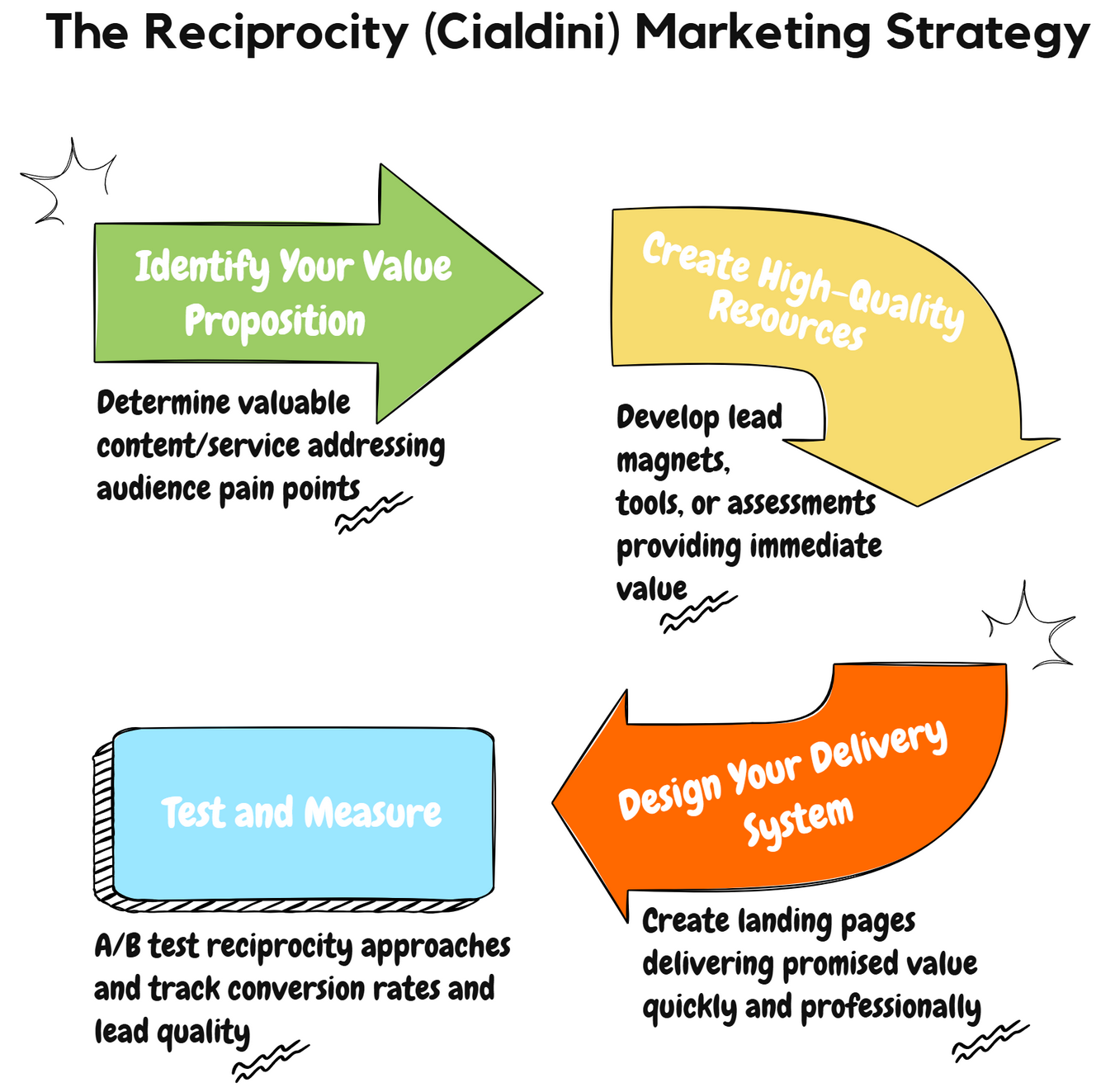
Step 1: Identify Your Value Proposition
Determine what valuable, relevant content or service you can provide upfront. This should address genuine pain points for your target audience while showcasing your expertise.
Step 2: Create High-Quality Resources
Develop lead magnets, free tools, or assessments that provide immediate value. Invest in quality – poorly executed freebies can damage your brand reputation.
Step 3: Design Your Delivery System
Create landing pages and email sequences that deliver promised value quickly and professionally. The experience should reinforce your brand’s competence and reliability.
Step 4: Test and Measure
Implement A/B tests comparing reciprocity-based approaches with traditional methods. Track conversion rates, lead quality, and long-term customer value to quantify impact.
Common Pitfalls to Avoid
Over-Promising and Under-Delivering: Ensure your free offerings match or exceed expectations set in your marketing materials.
Immediate Sales Pressure: Avoid aggressive follow-up immediately after providing value. Allow the reciprocity effect to develop naturally.
Generic Value: Tailor your offerings to specific audience segments rather than creating one-size-fits-all resources.
A/B Testing Ideas
Email Campaigns: Test value-first subject lines (“Free Guide: 10 Tax Deductions You’re Missing”) against traditional approaches (“Schedule Your Tax Consultation”).
Landing Pages: Compare pages leading with free resources versus those focusing on service descriptions.
Social Media: Test posts sharing valuable tips versus promotional content, measuring engagement and click-through rates.
Related Psychological Biases & Effects
Understanding reciprocity becomes more powerful when combined with related psychological principles:
Social Proof: The Power of the Crowd – Combine reciprocity with testimonials showing how others benefited from your free resources.
Authority Bias: We Trust Experts (and People Who Look Like Experts) – Establish expertise through valuable content before making service offers, leveraging both reciprocity and authority bias.
The Scarcity Effect: People Want What They Might Lose – Create limited-time offers for your valuable resources to amplify urgency alongside reciprocity.
Consistency: After someone accepts your free value, they’re more likely to see themselves as someone who engages with your brand, increasing future conversion likelihood.
The reciprocity principle differs from these related biases in its focus on direct exchange rather than social influence or cognitive shortcuts. However, when used together, these principles create powerful, ethical persuasion strategies.
Understanding The Reciprocity (Cialdini) can significantly improve your marketing effectiveness by building genuine relationships with prospects while driving measurable business results. The key lies in providing authentic value first, creating positive obligation loops that benefit both your business and your customers.
Ready to apply reciprocity principles to your lead generation strategy? Start by identifying one valuable resource you can offer your target audience, then test its impact against your current approach.
FAQs About Reciprocity (Cialdini)
What is Reciprocity (Cialdini) and how does it work?
Reciprocity is a universal social norm where people feel obligated to return favours, gifts, or services they’ve received from others. This psychological principle, popularised by Robert Cialdini, operates through our deep-seated need to maintain social balance and avoid being seen as ungrateful.
The mechanism works in three key ways:
- Social obligation: We experience psychological pressure to reciprocate when someone does something for us
- Evolutionary basis: Reciprocity evolved as a survival mechanism that promotes cooperation within groups
- Neurological response: Receiving unexpected gifts or favours activates reward centres in our brain, reinforcing the desire to give back
This principle is so powerful that it works even when we don’t particularly like the person offering the favour, as demonstrated in Regan’s classic 1971 study where participants bought raffle tickets from someone they disliked simply because that person had given them a Coke earlier.
How does Reciprocity (Cialdini) influence our daily decision-making?
Reciprocity shapes countless everyday decisions, often without us realising it. We return dinner invitations, feel compelled to help colleagues who’ve assisted us, and even tip more generously when servers provide small unexpected gifts like mints.
Common daily examples include:
- Social interactions: Returning favours, accepting invitations from people who’ve invited us previously
- Workplace dynamics: Helping colleagues who’ve supported us, even when it’s inconvenient
- Consumer behaviour: Feeling obligated to make purchases after receiving free samples or consultations
- Charitable giving: Responding more generously to donation requests that include small gifts like address labels
The Disabled American Veterans charity famously doubled their response rates from 18% to 35% simply by including personalised address labels with donation requests – a perfect example of reciprocity driving real-world decision-making.
What are the key characteristics of Reciprocity (Cialdini) in psychology?
Reciprocity has several distinctive psychological characteristics that make it particularly powerful as a persuasion principle.
Core characteristics include:
- Universality: Found across all cultures, though expression may vary
- Automaticity: Often triggers unconscious responses rather than deliberate decisions
- Asymmetry: Small initial favours can generate disproportionately large reciprocal responses
- Persistence: The obligation to reciprocate can last for extended periods
- Social enforcement: People who don’t reciprocate face social sanctions and negative labelling
What makes it unique:
- It works even with unwanted or unsolicited gifts
- The reciprocal response often exceeds the original favour’s value
- It can override personal preferences and logical decision-making
- It creates genuine psychological discomfort when the obligation remains unfulfilled
Research shows that reciprocity is so ingrained that it influences behaviour even when people are aware they’re being influenced – a testament to its deep psychological roots.
How is Reciprocity (Cialdini) different from other persuasion techniques?
Reciprocity differs fundamentally from other persuasion techniques because it creates a genuine sense of personal obligation rather than relying on external social cues or logical arguments.
Key differences:
- vs Social Proof: Social proof relies on what others are doing; reciprocity is based on direct personal exchange
- vs Authority: Authority uses expertise or status; reciprocity uses personal indebtedness
- vs Scarcity: Scarcity creates urgency through limited availability; reciprocity creates obligation through received value
- vs Commitment: Commitment leverages consistency with past decisions; reciprocity leverages the need to repay favours
What makes reciprocity unique:
- It works one-to-one rather than through group influence
- It creates internal pressure rather than external social pressure
- It can be triggered by very small initial investments
- It often works regardless of the recipient’s initial attitude towards the giver
This personal, obligation-based nature makes reciprocity particularly effective in building long-term relationships and trust, unlike techniques that rely purely on momentary influence.
Who is Robert Cialdini and why is Reciprocity (Cialdini) named after him?
Robert Cialdini is a renowned social psychologist and professor emeritus at Arizona State University, widely considered the leading expert on the psychology of persuasion and influence.
Why reciprocity bears his name:
- Systematic research: While reciprocity existed long before Cialdini, he was the first to systematically study and document its power as a persuasion principle
- Academic foundation: His rigorous research provided the scientific backing that transformed reciprocity from folk wisdom into evidence-based psychology
- Practical application: Cialdini’s work bridged the gap between academic research and real-world applications in marketing, sales, and negotiation
His broader contribution: Cialdini identified six key principles of persuasion: reciprocity, commitment/consistency, social proof, authority, liking, and scarcity. His 1984 book “Influence: The Psychology of Persuasion” became the definitive guide to understanding how these principles work in practice.
Academic credentials:
- Over 35 years of research in social psychology
- Extensive peer-reviewed publications on influence and persuasion
- Consultant to major corporations and government agencies on ethical persuasion techniques
What scientific research supports the effectiveness of Reciprocity (Cialdini)?
Reciprocity is one of the most thoroughly researched principles in social psychology, with decades of peer-reviewed studies confirming its effectiveness across various contexts.
Landmark studies:
- Regan (1971): Demonstrated that unsolicited favours (giving someone a Coke) increased compliance with requests, even when recipients disliked the favour-giver
- Strohmetz et al. (2002): Found that restaurant servers who gave mints with the bill increased tips by 3%, and personalised gestures increased tips by up to 23%
- Door-in-the-face technique studies: Show that making a large request followed by a smaller one increases compliance due to perceived reciprocal concessions
Recent research (2013+):
- Digital environments: Studies show reciprocity remains effective in online contexts, influencing user behaviour in recommender systems and digital marketing
- Cross-cultural validation: Research confirms reciprocity’s presence across cultures, though expression varies
- Neurological evidence: fMRI studies suggest that receiving gifts activates brain reward centres, providing biological basis for reciprocal behaviour
Key findings:
- Even small, inexpensive favours can generate significant reciprocal responses
- The principle works regardless of whether the favour was requested
- Personalised gestures amplify the reciprocity effect considerably
What neurological mechanisms drive Reciprocity (Cialdini) in the human brain?
While research into the neurological basis of reciprocity is still developing, several brain mechanisms appear to drive this powerful social behaviour.
Key neurological processes:
- Reward system activation: Receiving unexpected gifts or favours activates the brain’s reward centres, creating positive associations with the giver
- Social cognition networks: Brain regions responsible for understanding others’ intentions and maintaining social relationships become active during reciprocal exchanges
- Stress response: Failing to reciprocate can trigger stress responses, creating psychological discomfort that motivates reciprocal behaviour
Evolutionary perspective:
- Survival advantage: Reciprocity likely evolved because it promoted cooperation and mutual aid within groups, increasing survival chances
- Social bonding: The neurological reward for reciprocal behaviour reinforces social bonds that were crucial for early human communities
- Trust mechanisms: Brain systems that evaluate trustworthiness are closely linked to reciprocity responses
Important note: While neuromarketing studies suggest these mechanisms exist, direct peer-reviewed research specifically on reciprocity’s neurological basis remains limited. Most evidence comes from broader studies on social cooperation and reward processing.
The psychological effects, however, are well-documented and consistently observed across cultures and contexts.
Are there any studies that challenge the validity of Reciprocity (Cialdini)?
While reciprocity is widely accepted as a robust psychological principle, some research highlights important limitations and contextual factors that affect its effectiveness.
Key challenges and limitations:
- Cultural variation: Some studies suggest reciprocity’s strength and expression vary significantly across cultures, challenging claims of universality
- Individual differences: Research shows that personality traits, cultural background, and personal values influence susceptibility to reciprocity
- Context dependency: The effectiveness of reciprocity can be reduced in certain situations, such as when the favour feels manipulative or insincere
Methodological concerns:
- Laboratory vs. real-world: Some critics argue that laboratory studies may not accurately reflect how reciprocity works in complex, real-world situations
- Ethical considerations: Questions have been raised about whether studying reciprocity through deception (common in early studies) provides valid insights
- Measurement challenges: Defining and measuring reciprocal behaviour consistently across studies remains difficult
Nuanced findings:
- Reciprocity anxiety: Some people experience stress rather than obligation when receiving unexpected favours
- Perceived manipulation: When recipients suspect ulterior motives, reciprocity effects can backfire
- Relationship context: Reciprocity works differently in established relationships versus interactions with strangers
These challenges don’t invalidate reciprocity but highlight the importance of understanding when and how it works most effectively.
What are some famous real-world examples of Reciprocity (Cialdini) in action?
Several well-documented cases demonstrate reciprocity’s power across different industries and contexts, providing concrete evidence of its real-world effectiveness.
Classic documented examples:
- Disabled American Veterans (DAV): Including small gifts (personalised address labels) with donation requests doubled response rates from 18% to 35%
- Restaurant industry: The Strohmetz study showed that servers giving mints with bills increased tips by 3-23%, depending on personalisation
- Hare Krishna fundraising: Members gave flowers to airport visitors before requesting donations, significantly increasing contribution rates
Modern business applications:
- SaaS free trials: Companies like Dropbox and Spotify use free versions to create reciprocal obligation for paid subscriptions
- Content marketing: Businesses provide valuable free resources (guides, tools, consultations) to generate leads and build customer relationships
- Costco sampling: Free product samples create sense of obligation that increases purchase likelihood
Digital marketing examples:
- HubSpot’s free tools: Offering free CRM and marketing tools generates leads for premium services
- Neil Patel’s SEO analyser: Free website audits create reciprocal obligation for consulting services
Key success factors:
- Genuine value: The initial favour must provide real benefit
- Unexpected nature: Unsolicited gifts or services are more powerful than requested ones
- Personal touch: Customised or personalised favours generate stronger reciprocal responses
How does Reciprocity (Cialdini) appear in popular movies and literature?
While reciprocity appears frequently in storytelling, it’s often woven into character development and plot progression rather than explicitly highlighted as a psychological principle.
Common narrative patterns:
- Debt and obligation stories: Characters who receive help early in the story feel compelled to repay the favour later, often at great personal cost
- Mentor-student relationships: Students who receive training or wisdom feel obligated to honour their mentor’s teachings or sacrifice
- Redemption arcs: Characters who receive unexpected kindness or forgiveness often reciprocate by changing their behaviour or making sacrifices
Classic examples:
- The Godfather: The opening scene establishes the reciprocal obligation system that drives much of the plot
- Les Misérables: Jean Valjean’s transformation after receiving unexpected mercy from the bishop demonstrates reciprocity’s power
- Gift-giving traditions: Many cultural stories emphasise the importance of reciprocal gift exchange and the social consequences of failing to reciprocate
Modern applications:
- Customer testimonials in marketing: Businesses that provide exceptional service often receive enthusiastic endorsements from grateful customers
- Influencer partnerships: Brands that provide value to influencers (products, experiences, payment) receive promotional content in return
The prevalence of reciprocity themes in storytelling reflects its deep cultural significance and universal recognition as a fundamental human behaviour.
What historical events demonstrate the power of Reciprocity (Cialdini)?
Throughout history, reciprocity has played crucial roles in diplomacy, trade, and social movements, often determining the success or failure of major initiatives.
Diplomatic examples:
- Marshall Plan: America’s post-WWII aid to Europe created lasting reciprocal obligations that shaped Cold War alliances
- Gift diplomacy: Historical exchanges of valuable gifts between rulers established reciprocal obligations that prevented conflicts or secured alliances
- Trade relationships: The concept of “most favoured nation” status in international trade relies heavily on reciprocal treatment
Social and political movements:
- Civil rights activism: Organisations that provided legal aid, education, or protection to communities often received strong grassroots support in return
- Labour movements: Unions that successfully negotiated benefits for workers created strong reciprocal loyalty that sustained long-term membership
Economic examples:
- Microcredit systems: Programs like Grameen Bank succeed partly because recipients feel obligated to repay loans and help other community members
- Corporate philanthropy: Companies that invest in community development often receive preferential treatment from local governments and consumers
Key historical lessons:
- Long-term thinking: The most successful applications of reciprocity involve genuine, long-term value creation rather than short-term manipulation
- Cultural sensitivity: Understanding local customs around reciprocity is crucial for international success
- Trust building: Reciprocity works best when initial gestures are seen as genuine rather than calculated
How do free samples use Reciprocity (Cialdini) to increase sales?
Free samples are one of the most direct and effective applications of reciprocity in retail marketing, creating immediate obligation that translates into measurable sales increases.
How the mechanism works:
- Unexpected value: Customers receive something of value without being asked to pay
- Immediate obligation: The gift creates psychological pressure to reciprocate through purchase
- Reduced risk: Sampling allows customers to experience product quality, reducing purchase anxiety
- Social pressure: Accepting a sample in front of staff creates additional pressure to buy
Documented effectiveness:
- Costco’s success: Their extensive sampling program significantly increases sales of sampled products
- Food industry: Studies show that food samples can increase sales by 10-2000% depending on the product and context
- Beauty industry: Cosmetic samples create trial opportunities that lead to full-size purchases
Best practices for maximum impact:
- Quality over quantity: High-quality samples create stronger reciprocal obligation than cheap alternatives
- Personal interaction: Staff who engage customers during sampling create stronger connections
- Timing: Samples offered when customers are relaxed and unhurried are more effective
- Follow-up: Immediate purchase opportunities capitalise on the reciprocal obligation
Limitations to consider:
- Professional samplers: Customers who regularly seek free samples may be less susceptible to reciprocity
- Product mismatch: Samples that don’t represent the full product experience can backfire
- Cost considerations: Sampling programs must balance reciprocity benefits against product costs
What’s the difference between Reciprocity (Cialdini) and the halo effect?
Reciprocity and the halo effect are distinct psychological phenomena that operate through completely different mechanisms, though both can influence decision-making and behaviour.
Reciprocity characteristics:
- Direct exchange: Based on receiving something of value and feeling obligated to give back
- Personal obligation: Creates individual sense of indebtedness to specific person or organisation
- Action-based: Triggered by concrete favours, gifts, or services received
- Relationship-focused: Builds ongoing connection between giver and receiver
Halo effect characteristics:
- Generalised impression: One positive trait influences perception of unrelated characteristics
- Cognitive bias: Based on mental shortcuts rather than actual exchange
- Perception-based: Affects how we interpret information rather than creating obligation
- Attribute-focused: Spreads positive impressions across different qualities
Practical differences:
- Marketing applications: Reciprocity uses free samples or consultations; halo effect leverages attractive packaging or celebrity endorsements
- Duration: Reciprocity creates lasting obligation; halo effect can be temporary and easily disrupted
- Measurement: Reciprocity can be measured through direct behavioural responses; halo effect requires attitude and perception surveys
When they work together: Companies often combine both principles – using reciprocity to create initial positive experience, then leveraging halo effect to extend positive impressions to other products or services. However, understanding each principle’s distinct mechanism is crucial for effective application.