Guide to The Unit Bias in Marketing: Description, Psychology, and Examples
What Is The Unit Bias?
Unit Bias is the tendency for people to perceive a single unit of something as the appropriate or optimal amount to consume or purchase, regardless of its actual size or their personal needs. This powerful cognitive bias explains why customers feel compelled to finish entire bags of crisps even when full, why they’re drawn to “complete packages” over individual services, and why presented units become default anchors for consumption and purchase behavior.
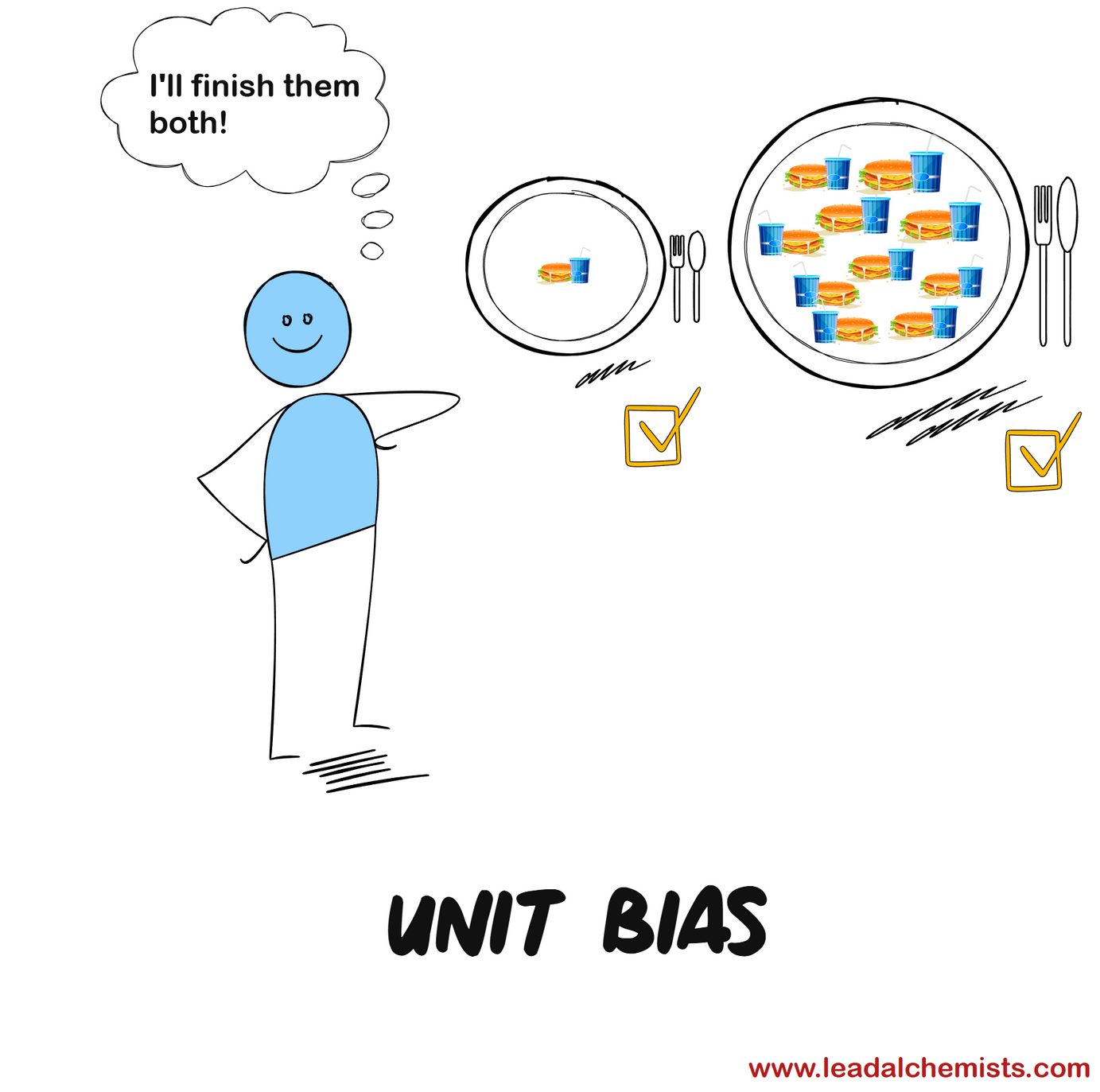
At its psychological core, Unit Bias works because humans use mental shortcuts to simplify decision-making – rather than carefully evaluating how much they actually need, our brains automatically default to treating the presented unit as the standard appropriate amount. When products or services are packaged as single, complete units, customers perceive them as the “right” amount regardless of size or actual requirements, making it far more likely that they’ll consume or purchase the entire unit rather than expending mental energy to determine optimal quantities themselves.
For marketers and advertisers, understanding this bias gives a real competitive edge. By purposefully and strategically packaging offerings into units that feel natural and complete while delivering genuine value that justifies full engagement, you can increase consumption, boost bundle sales, and drive completion rates in ways that other persuasion techniques simply cannot match.
How The Unit Bias Works (The Psychology Behind It)
The psychological mechanisms behind Unit Bias involve several cognitive processes working together to influence our decision-making.
Heuristic Processing forms the foundation of this bias. When faced with decisions about quantity or completion, our brains use the presented unit as a mental shortcut. This reduces cognitive effort – instead of calculating optimal amounts, we simply accept the pre-defined unit as appropriate.
Cultural reinforcement amplifies the effect. Society teaches us that certain units represent “proper” portions or complete tasks. A plate of food, a work assignment, or a service package carries implicit social messaging about what constitutes a finished unit.
The Default Effect also plays a crucial role. Psychologically, we’re inclined to accept pre-set options without considering alternatives. The presented unit becomes our default choice, requiring additional mental effort to deviate from it.
Closure-seeking behaviour drives the compulsion to complete units. Our brains are wired to prefer finished states over incomplete ones. This creates psychological pressure to reach the end of whatever unit we’ve started, whether it’s beneficial or not.
Research by Geier, Rozin, and Doros (2006) demonstrated this effect through controlled experiments. Participants consistently consumed more when offered larger units, even when allowed to take multiple smaller units at no additional cost. The key finding: people weren’t just eating more because more was available – they were specifically responding to the unit structure itself.
Neurologically, while specific brain imaging studies on Unit Bias remain limited, the behaviour aligns with known reward and completion pathways. The anticipation of finishing a unit activates satisfaction centres, creating a feedback loop that reinforces the behaviour.
Real-World Examples of The Unit Bias
Unit Bias influences behaviour far beyond marketing contexts, appearing in healthcare, education, economics, and social interactions.
In Healthcare, patients often complete prescribed medication courses even after symptoms disappear. A study tracking antibiotic usage found that patients felt compelled to finish entire courses, sometimes contributing to resistance issues when the full course wasn’t medically necessary.
Educational settings reveal Unit Bias when students persist with entire readings or assignments after mastering the material. Research shows students frequently complete full chapters or problem sets even when they’ve already achieved learning objectives, leading to inefficient study time allocation.
Economic behaviour demonstrates the bias through gift card spending patterns. Consumers typically spend the full value of vouchers, often purchasing unnecessary items to “complete” the unit, even when partial usage would be more rational.
Food industry applications provide the most documented examples. Restaurant chains have long leveraged Unit Bias by offering larger portion sizes. When McDonald’s introduced “Super Size” options, consumption increased not just because more food was available, but because customers perceived the larger portion as a single, appropriate unit to complete.
Subscription services exploit Unit Bias through “unlimited” offerings. Gym memberships, streaming services, and data plans benefit from customers feeling compelled to maximise usage to justify costs and achieve the full “unit” of value. Netflix’s binge-watching culture partly stems from viewers treating entire seasons as units to complete.
Product bundling creates artificial units that consumers feel compelled to purchase entirely. Beauty brands bundle cleansers, toners, and moisturisers as “complete skincare routines.” Customers are more likely to buy the entire bundle than individual items because it represents a finished unit.
How The Unit Bias Affects Consumer Behaviour
Understanding how Unit Bias influences consumer psychology reveals powerful insights for marketers seeking to optimise their strategies.
Decision-making simplification represents the primary mechanism. When consumers encounter choices about quantity or scope, Unit Bias reduces cognitive load by providing a default standard. Rather than evaluating personal needs against available options, customers accept the presented unit as appropriate.
Perceived value increases when offerings are framed as complete units. A “Full Website Design Package” feels more valuable than individual services like “Logo Design + Copywriting + Development,” even when containing identical elements. The unit framing suggests completeness and professional thoroughness.
Completion motivation drives engagement beyond rational need. Once customers begin consuming or using a unit, psychological pressure builds to finish it. This explains why progress bars on forms increase completion rates – they visualise the unit and create completion urgency.
Purchase justification becomes easier with unit framing. Customers can rationalise buying complete packages more readily than assembling individual components. The unit structure provides mental permission to purchase everything included.
Consumption patterns shift when products are presented as units. Research shows people consume more when items are packaged as single units, even when the same quantity is available in smaller portions. This isn’t just about convenience – it’s about the psychological framing of what constitutes “one serving.”
Brand loyalty can strengthen through unit-based offerings. When customers complete entire service packages or product bundles, they experience satisfaction from finishing something comprehensive. This completion satisfaction becomes associated with the brand, potentially increasing repeat business.
Case Studies: How Marketers Use The Unit Bias in Advertising
While direct, data-driven case studies specifically isolating Unit Bias in marketing campaigns remain limited in peer-reviewed literature, several documented applications demonstrate the principle’s effectiveness.
Food Industry Applications provide the most verified examples. Brian Wansink’s research documented how restaurants and food manufacturers leverage Unit Bias through portion sizing. When fast-food chains offer larger portions as single units, consumption increases significantly. However, these represent behavioural studies rather than branded marketing campaigns with specific conversion data.
Subscription Service Psychology shows conceptual applications. Services offering “unlimited” access create perceived units that consumers feel compelled to maximise. While Barry Schwartz’s research on choice psychology supports this concept, specific branded case studies with measurable conversion improvements aren’t documented in academic literature.
E-commerce Bundling Strategies demonstrate Unit Bias principles. Companies bundle products as “complete solutions,” encouraging customers to purchase entire packages rather than individual items. This aligns with Robert Cialdini’s commitment and consistency principles, though direct conversion data attributing success specifically to Unit Bias remains limited.
Progress Bar Implementation in user experience design shows related effects. Visual cues indicating completion status increase form submission rates, though this primarily leverages completion bias rather than pure Unit Bias. Steve Krug’s usability research supports these applications, but specific conversion metrics aren’t tied directly to Unit Bias mechanisms.
Recommended A/B Test Scenario: An online education platform could test two Google Ads approaches:
- Control Ad: “Enroll in our comprehensive course and learn valuable skills”
- Test Ad: “Complete all 5 modules of our comprehensive course and earn your certificate”
Tracking click-through rates, enrollment rates, and course completion rates would measure Unit Bias effectiveness in digital marketing contexts.
Practical Applications for Google Ads & Lead Generation
Small businesses can leverage Unit Bias principles through strategic framing and presentation, though these applications should be tested rather than assumed effective.
Google Ads & PPC Marketing
Service Package Framing involves presenting offerings as complete units rather than individual services. A cleaning service advertising “Complete Home Cleaning Package” may generate more inquiries than listing “Kitchen Cleaning, Bathroom Cleaning, Floor Cleaning” separately. The package framing suggests comprehensiveness and completion.
Landing Page Structure benefits from unit-based presentation. Web design agencies offering “Three Website Design Packages: Basic, Standard, Premium” create clear units for decision-making. Each package represents a complete solution, simplifying customer choice.
A/B Testing Opportunities allow businesses to measure Unit Bias effectiveness. A landscaping company could test:
- Version A: “Lawn Care Services: Mowing, Edging, Fertilising”
- Version B: “Complete Lawn Care Package: Everything Your Lawn Needs”
Measuring click-through rates and conversion rates would reveal whether unit framing improves performance.
Lead Generation Website Optimization
Multi-step Forms leverage completion psychology by breaking long forms into manageable units. Instead of single lengthy contact forms, home renovation companies can use: “Step 1: Tell us about your project. Step 2: Your contact information. Step 3: Schedule consultation.” Each step feels like a complete unit, reducing abandonment.
Lead Magnet Presentation works better with comprehensive framing. Marketing consultants offering “Complete Guide to Local SEO” typically see higher download rates than fragmented resources. The “complete” framing suggests thorough coverage and professional value.
Visual Completion Cues help emphasise service comprehensiveness. Financial advisors can feature infographics showing all elements of their “Retirement Planning Service” as interconnected parts of a whole, reinforcing the complete unit concept.
Implementation Best Practices
Always test strategies in your specific context. Unit Bias effectiveness varies by industry, audience, and offer type. What works for service businesses may not apply to product sales.
Avoid overgeneralising results. Success in one campaign doesn’t guarantee universal application. Cultural factors, individual differences, and market conditions all influence effectiveness.
Use ethical framing that doesn’t mislead customers about value or completeness. Unit Bias should enhance genuine offerings, not create false impressions about scope or quality.
Measure completion rates alongside conversion rates. Unit Bias aims to increase both initial engagement and follow-through behaviour.
Why Marketers Should Care About The Unit Bias
Unit Bias offers marketers a scientifically-backed approach to influence consumer choices, but its application requires careful consideration of ethical boundaries and practical limitations.
Conversion Optimisation Potential represents the primary marketing benefit. By framing offerings as complete units, businesses can simplify customer decision-making and increase perceived value. This psychological shortcut reduces cognitive friction in the purchase process.
Customer Satisfaction Enhancement occurs when unit framing aligns with genuine value delivery. Customers who purchase complete packages often experience greater satisfaction from finishing comprehensive solutions, potentially increasing loyalty and referrals.
Pricing Strategy Advantages emerge from unit-based presentation. Complete packages can command premium pricing compared to individual components, as customers perceive greater value in comprehensive solutions.
Competitive Differentiation becomes possible through strategic unit framing. While competitors list individual services, businesses presenting complete packages can appear more professional and thorough.
However, ethical considerations must guide implementation. Using Unit Bias to encourage unnecessary consumption or mislead customers about value crosses ethical boundaries. The goal should be enhancing genuine offerings, not manipulating vulnerable consumers.
Responsible use guidelines include:
- Transparency about what packages actually include
- Genuine value in bundled offerings
- Customer benefit as the primary motivation
- Avoiding manipulation of vulnerable populations
Risk management involves recognising that Unit Bias can backfire if customers feel deceived or pressured. Overuse can damage brand reputation and customer trust.
Industry context matters significantly. Unit Bias applications that work in food service may not translate to professional services or technology products. Market research and testing remain essential.
How to Implement The Unit Bias in Your Marketing Strategy
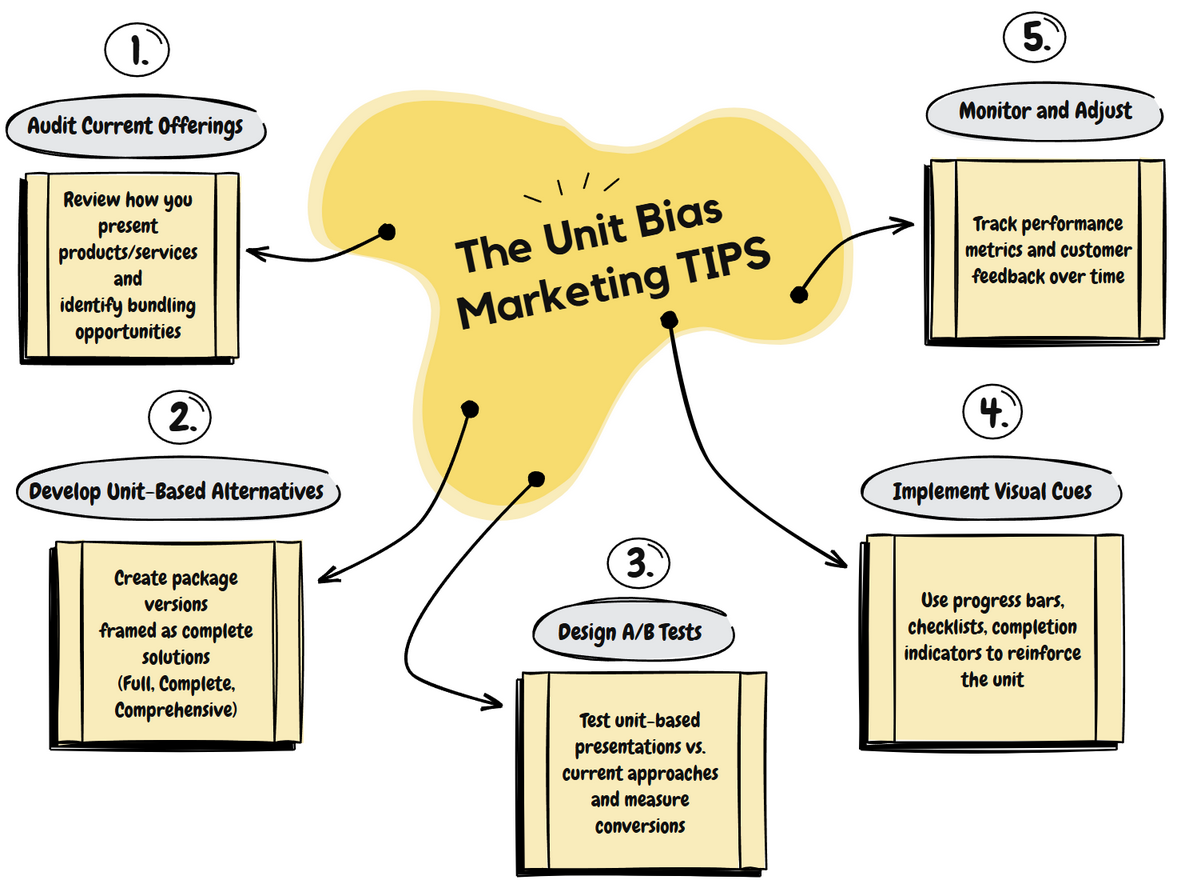
Implementing Unit Bias requires systematic testing and careful attention to customer response, as effectiveness varies significantly across contexts and audiences.
Step-by-Step Implementation Guide
1. Audit Current Offerings Review how you currently present products or services. Identify opportunities to group individual elements into logical, complete units. Look for natural bundling possibilities that provide genuine customer value.
2. Develop Unit-Based Alternatives Create package versions of your offerings. Frame these as complete solutions rather than collections of parts. Use language emphasising completeness: “Full,” “Complete,” “Comprehensive,” “Total.”
3. Design A/B Tests Test unit-based presentations against current approaches. Measure both initial conversion rates and completion/satisfaction rates. Track customer feedback to ensure unit framing enhances rather than confuses the experience.
4. Implement Visual Cues Use progress bars, checklists, or completion indicators where appropriate. These visual elements reinforce the unit concept and encourage follow-through behaviour.
5. Monitor and Adjust Track performance metrics closely. Unit Bias effectiveness can change over time as markets evolve and customer expectations shift.
Best Practices and Common Pitfalls
Best Practices:
- Ensure bundled offerings provide genuine value beyond individual components
- Use clear, honest language about what packages include
- Test extensively before full implementation
- Consider cultural and demographic factors that might influence effectiveness
- Maintain flexibility to adjust based on customer feedback
Common Pitfalls:
- Assuming Unit Bias works universally across all contexts
- Creating artificial bundles that don’t provide real value
- Overcomplicating simple offerings in pursuit of unit framing
- Ignoring customer preferences for individual component selection
- Failing to test effectiveness before widespread implementation
A/B Testing Ideas
Service Business Test: Compare “Individual Consultations Available” versus “Complete Business Analysis Package” for professional services.
Lead Generation Test: Test single-page forms against multi-step “Complete Information Gathering Process” approaches.
Content Marketing Test: Compare individual blog posts versus “Complete Guide Series” presentations for the same information.
Email Campaign Test: Test individual promotional emails versus “Complete Solution Showcase” campaign sequences.
Related Psychological Biases & Effects
Unit Bias operates alongside several related cognitive biases that marketers should understand for comprehensive strategy development.
Anchoring Bias shares similarities with Unit Bias but focuses on initial information rather than completion. While Unit Bias uses the unit as a default standard, Anchoring Bias involves relying heavily on first-presented information. Both can work together when the first-presented option is framed as a complete unit.
Completion Bias closely relates to Unit Bias but specifically concerns task finishing rather than consumption amounts. Progress bars leverage Completion Bias more directly than Unit Bias, though both contribute to increased follow-through behaviour.
Default Effect underlies Unit Bias by explaining why people accept pre-set options. Unit Bias represents a specific application of default psychology, where the presented unit becomes the default choice.
Social Proof can amplify Unit Bias when complete packages are presented as popular or standard choices. Combining “Most customers choose our Complete Package” messaging leverages both biases simultaneously.
Loss Aversion connects to Unit Bias through the psychology of incomplete units. Not finishing a started unit can feel like a loss, motivating completion behaviour even when continuation isn’t beneficial.
Commitment and Consistency principles from Robert Cialdini’s work align with Unit Bias applications. Once customers begin a unit, consistency pressure encourages completion to match their initial commitment.
Understanding these relationships helps marketers create more sophisticated strategies that leverage multiple psychological principles without overwhelming or manipulating customers.
Understanding The Unit Bias can significantly improve your marketing effectiveness by helping you frame offerings in psychologically compelling ways. However, success requires careful testing, ethical application, and genuine value creation rather than manipulation.
FAQs About Unit Bias
What is the Unit Bias and how does it affect our decisions?
Unit Bias is the tendency to perceive a single unit of something as the appropriate or optimal amount to consume or complete, regardless of its actual size or personal need. This cognitive bias leads people to finish entire portions, packages, or tasks simply because they’re presented as complete “units,” even when doing so exceeds their requirements or desires.
The bias affects our decisions by acting as a mental shortcut that simplifies choice-making. Rather than evaluating how much we actually need, we default to completing whatever unit is presented to us. This happens because our brains treat the presented unit as a culturally appropriate standard, reducing the cognitive effort required to make consumption decisions.
How does Unit Bias influence portion control and eating habits?
Unit Bias significantly impacts eating behaviour by making people consume more when presented with larger portions. Research by Geier, Rozin, and Doros (2006) demonstrated that individuals eat more when offered larger units, even when they’re not particularly hungry or when smaller portions are freely available.
This occurs because we perceive the entire portion as a single, indivisible entity that should be completed. The bias overrides internal satiety cues, leading to overconsumption simply because the food is packaged or served as one “unit.” This effect is particularly pronounced in restaurant settings and with packaged foods, where portion sizes have grown significantly over recent decades.
What’s the difference between Unit Bias and other cognitive biases?
Unit Bias differs from other cognitive biases in several key ways:
- Anchoring Bias: Uses initial information as a reference point for decisions, whilst Unit Bias specifically focuses on completing presented units
- Social Proof: Involves copying others’ behaviour, whereas Unit Bias operates independently of what others are doing
- Default Effect: Involves choosing pre-set options, but Unit Bias specifically drives completion behaviour rather than just selection
Unit Bias is unique because it creates a psychological pressure to finish something once started, using the unit itself as the decision-making framework rather than external social cues or initial anchors.
Who first discovered the Unit Bias and when was it studied?
The term “Unit Bias” was formally introduced and studied by Geier, Rozin, and Doros in 2006 in their groundbreaking research published in Psychological Science. However, the underlying phenomenon had been observed in earlier portion size research by scientists like Brian Wansink and Barbara J. Rolls.
The 2006 study was pivotal because it specifically identified and named the bias, demonstrating through controlled experiments that people consume more when offered larger units, even when multiple smaller units are available at no additional cost. This research established Unit Bias as a distinct psychological phenomenon rather than simply a manifestation of other factors.
What are the psychological mechanisms behind Unit Bias?
Unit Bias operates through several psychological mechanisms:
Heuristic Processing: People use the presented unit as a mental shortcut, reducing cognitive effort in deciding how much to consume. Rather than carefully evaluating personal needs, the brain defaults to the unit as an appropriate standard.
Cultural Norms: The bias is reinforced by culturally designated consumption norms that define what constitutes a “proper” portion or complete task. These social standards become internalised decision-making rules.
Default Effect: Individuals accept pre-set units without considering alternatives, similar to how people often stick with default settings on devices or forms.
Importantly, current research focuses on behavioural and cognitive explanations rather than specific neurological mechanisms, as direct brain imaging studies on Unit Bias remain limited.
Are there any studies that challenge the validity of Unit Bias?
Current peer-reviewed literature shows no major conflicting viewpoints regarding Unit Bias validity. The effect is widely accepted as a robust psychological phenomenon, supported by multiple studies and meta-analyses.
Some early criticisms suggested that Unit Bias might simply be a manifestation of other factors like social norms or availability heuristics. However, the persistence of the effect even when controlling for these variables demonstrates its unique psychological underpinnings.
Recent research, including meta-analyses like Orquin & Elfving (2020), confirms the robustness of Unit Bias across various populations and contexts. Most methodological discussions focus on ecological validity (lab versus real-world settings) rather than questioning the bias’s existence.
What are some famous real-world examples of Unit Bias in action?
Food Industry: Restaurants and manufacturers leverage Unit Bias by offering larger portion sizes, encouraging customers to consume more than they otherwise would. Fast-food chains particularly benefit from this effect with “super-size” options.
Healthcare: Patients may complete prescribed medication courses (like antibiotics) even after symptoms subside, driven by the desire to finish the complete “unit” of treatment.
Gift Cards: Consumers tend to spend the full value of gift cards or vouchers, even purchasing unnecessary items to “complete” the unit, rather than leaving partial balances unused.
Education: Students often feel compelled to finish entire assignments or readings, even after mastering the core concepts, because the material is presented as a complete unit.
These examples demonstrate how Unit Bias operates across various contexts beyond just food consumption.
How does Unit Bias appear in movies and popular culture?
Unit Bias appears in popular culture primarily through food-related scenarios and completion-driven narratives, though it’s rarely explicitly named or recognised as a psychological phenomenon.
Film and Television: Characters often finish entire meals or drinks regardless of hunger, reflecting real-world Unit Bias. Competitive eating scenes and “clean your plate” family dynamics showcase the bias in action.
Literature: Stories frequently feature characters compelled to complete tasks or consume entire portions simply because they’re presented as units, though authors typically frame this as personality traits rather than cognitive bias.
Advertising: Marketing campaigns often exploit Unit Bias without naming it, using phrases like “complete your collection” or “finish the set” to drive consumer behaviour.
However, Unit Bias lacks the cultural recognition of biases like confirmation bias or the placebo effect, remaining primarily within academic and marketing psychology discussions.
Can you give historical examples where Unit Bias influenced major decisions?
Direct historical documentation of Unit Bias influencing large-scale decisions is limited in current research, as the bias was only formally identified in 2006. Most documented examples focus on individual and small-group behaviour rather than major historical events.
Military Rations: Historical military meal planning often reflected Unit Bias principles, with standardised portions designed as complete units regardless of individual soldier needs or circumstances.
Industrial Food Production: The development of standardised packaging sizes in the 20th century inadvertently leveraged Unit Bias, with manufacturers creating “family size” or “individual” portions that became consumption norms.
Educational Systems: Traditional academic structures like semester-long courses or standardised textbook chapters reflect Unit Bias thinking, where completion of the entire unit becomes the goal rather than mastery of specific skills.
However, researchers note that more investigation is needed to document Unit Bias effects in large-scale historical decision-making.
How is Unit Bias different from the anchoring bias?
Unit Bias and Anchoring Bias operate through fundamentally different mechanisms:
Anchoring Bias involves relying too heavily on the first piece of information encountered (the “anchor”) when making decisions. It affects judgements about value, quantity, or probability based on initial reference points.
Unit Bias specifically focuses on the psychological pressure to complete whatever is presented as a single, whole unit. It’s about finishing behaviour rather than using reference points for judgement.
Key Differences:
- Scope: Anchoring affects various judgements; Unit Bias specifically drives completion behaviour
- Mechanism: Anchoring uses initial information as a reference; Unit Bias treats the unit itself as the appropriate standard
- Outcome: Anchoring influences estimates and valuations; Unit Bias drives consumption and task completion
Both biases can work together – the unit can serve as an anchor – but they represent distinct psychological processes.
What’s the relationship between Unit Bias and the halo effect?
Unit Bias and the Halo Effect are largely unrelated cognitive biases that operate through different psychological mechanisms:
Halo Effect occurs when positive impressions in one area influence opinions in other areas. For example, finding someone physically attractive might lead to assuming they’re also intelligent or kind.
Unit Bias focuses specifically on completion behaviour driven by how something is packaged or presented as a unit, without involving judgements about quality or characteristics.
Limited Relationship: The only potential connection occurs when positive perceptions of a brand or product (halo effect) might make consumers more likely to complete entire units of that product. However, this represents two separate biases working in sequence rather than a direct relationship.
Current research doesn’t establish any significant interaction between these biases, as they address different aspects of decision-making and perception.
Is there an opposite effect to Unit Bias?
There isn’t a formally recognised “opposite” to Unit Bias in psychological literature, but several related phenomena work in contrasting directions:
Satisficing Behaviour: Herbert Simon’s concept where people seek “good enough” solutions rather than completing entire units or finding optimal outcomes.
Portion Control Awareness: Conscious efforts to consume less than presented units, though this requires deliberate cognitive override of the bias rather than representing a natural opposite tendency.
Task Switching: The tendency to jump between incomplete tasks rather than finishing units, though this typically reflects attention issues rather than a systematic bias against completion.
Minimalism Psychology: Some individuals develop preferences for consuming or using less than complete units, but this usually results from learned behaviour or conscious choice rather than an automatic cognitive bias.
The absence of a clear opposite suggests that Unit Bias represents a default human tendency that requires conscious effort to overcome.
How do marketers use Unit Bias to influence consumer behavior?
Marketers leverage Unit Bias through several evidence-based strategies, though direct conversion data for many applications remains limited:
Product Bundling: Creating “complete” packages that consumers feel compelled to purchase entirely, such as skincare routines or software suites presented as integrated units.
Portion Sizing: Food and beverage companies use larger unit sizes to drive higher consumption, supported by research showing people consume more when presented with bigger portions.
Service Packages: Framing offerings as “complete solutions” (e.g., “Full Home Cleaning Package”) rather than listing individual services, making the entire package feel like an appropriate unit to purchase.
Progress Indicators: Using visual cues like progress bars on forms or loyalty programmes to encourage completion of the entire “unit” of engagement.
However, marketers should note that most applications are conceptually supported rather than proven through direct A/B testing, and effectiveness varies significantly by industry, audience, and context.
What role does Unit Bias play in restaurant portion sizes and pricing?
Unit Bias plays a significant role in restaurant industry practices, supported by extensive research on portion size effects:
Portion Size Strategy: Restaurants leverage Unit Bias by offering larger portions, knowing customers will likely finish whatever is served as a complete unit. This drives higher consumption and perceived value.
Menu Psychology: Items are often presented as complete meals or “platters” rather than individual components, encouraging customers to order and consume entire units.
Pricing Structure: “Value meals” and combo deals create larger units that feel complete, leading customers to purchase and consume more than they might with à la carte options.
Research Support: Studies by Geier, Rozin, and Doros (2006) and subsequent research demonstrate that people consistently consume more when presented with larger units, even when not particularly hungry.
This application is one of the most well-documented uses of Unit Bias, with clear behavioural evidence supporting its effectiveness in driving consumption.
How do brands leverage Unit Bias in their packaging strategies?
Brands use Unit Bias in packaging through several research-supported approaches:
Single-Serve Sizing: Creating packages that feel like complete, appropriate units for individual consumption, encouraging people to finish entire packages regardless of actual hunger or need.
Family Size Positioning: Larger packages marketed as “family size” create units that families feel compelled to consume completely, often leading to overconsumption.
Multi-Pack Bundling: Grouping products together (like 6-packs or variety packs) creates larger units that consumers are more likely to purchase and consume entirely.
Visual Completeness: Package designs that emphasise wholeness and completion, using visual cues that reinforce the unit as a single, indivisible entity.
Portion Segmentation: Interestingly, breaking items into smaller visible units (like individually wrapped pieces) can reduce overall consumption by creating multiple smaller units rather than one large one.
These strategies are supported by foundational research, though specific branded case studies with conversion data remain limited in peer-reviewed literature.
What are the ethical concerns surrounding Unit Bias manipulation?
Several documented ethical concerns surround the use of Unit Bias in marketing:
Overconsumption Promotion: Using Unit Bias to encourage consumption beyond actual need can contribute to obesity, waste, and unhealthy habits, particularly when applied to food products.
Vulnerable Population Targeting: Exploiting Unit Bias among children, elderly individuals, or those with eating disorders raises significant ethical questions about manipulation versus legitimate marketing.
Transparency Issues: Failing to clearly communicate portion sizes or using deceptive unit framing can mislead consumers about what they’re actually purchasing or consuming.
Health Impact: The bias contributes to portion distortion and overeating, potentially exacerbating public health issues related to diet and consumption.
Best Practices: Ethical marketing guidelines recommend transparency about portion sizes, avoiding manipulation of vulnerable populations, and considering the health and social consequences of marketing strategies that exploit psychological biases.
While no specific brand controversies related to Unit Bias are documented in current research, the potential for misuse requires careful consideration of ethical implications.
Can Unit Bias be used to spread misinformation or create unrealistic expectations?
Unit Bias primarily affects consumption and completion behaviour rather than belief formation, so its direct role in spreading misinformation is limited compared to biases like confirmation bias or the availability heuristic.
Potential Misuse Areas:
- Information Packaging: Presenting incomplete or biased information as “complete” units might encourage people to accept entire packages of information without critical evaluation
- Course/Training Marketing: Framing educational content as “complete systems” might create unrealistic expectations about learning outcomes
- Service Promises: Marketing services as “complete solutions” when they’re actually partial offerings
Limited Research: Current academic literature doesn’t extensively document Unit Bias being used for misinformation campaigns, as the bias is more commonly studied in consumption contexts.
Realistic Concerns: The main risk involves creating unrealistic expectations about completeness or comprehensiveness rather than directly spreading false information. Marketers should ensure that “complete” packages actually deliver on their promises.
What are the risks of exploiting Unit Bias in advertising?
Primary risks of exploiting Unit Bias in advertising include:
Consumer Backlash: If customers feel manipulated into overconsumption or unnecessary purchases, it can damage brand reputation and customer trust.
Regulatory Scrutiny: Advertising practices that exploit psychological biases to encourage overconsumption may face increased regulatory attention, particularly in food and health-related industries.
Health Consequences: Encouraging overconsumption through Unit Bias can contribute to obesity, waste, and other negative health outcomes, potentially exposing brands to criticism or liability.
Effectiveness Limitations: Over-relying on Unit Bias without considering individual differences, cultural factors, and context can lead to ineffective campaigns that don’t deliver expected results.
Ethical Reputation: Brands perceived as manipulating consumer psychology may face public criticism, particularly from increasingly conscious consumers who value transparency and ethical business practices.
Best Practice: Successful long-term marketing requires balancing psychological insights with ethical considerations and genuine value delivery.
How does Unit Bias affect our daily food choices and meal planning?
Unit Bias significantly influences everyday eating decisions through several mechanisms:
Portion Acceptance: People typically consume whatever portion size is served or packaged, treating it as the appropriate amount regardless of actual hunger or nutritional needs.
Package Completion: Individuals often finish entire packages of snacks, beverages, or meals simply because they’re presented as single units, leading to overconsumption.
Meal Planning: When planning meals, people often think in terms of complete units (whole recipes, entire packages) rather than adjusting quantities based on actual needs or appetite.
Restaurant Behaviour: Diners frequently finish entire plates regardless of satisfaction levels, driven by the perception that the served portion represents a complete, appropriate unit.
Shopping Decisions: Consumers purchase pre-packaged portions that become their consumption units, rather than buying ingredients and determining appropriate quantities themselves.
This bias can override natural satiety cues and contribute to portion distortion, where artificially large units become normalised as appropriate serving sizes.
Why do people tend to finish entire portions due to Unit Bias?
People finish entire portions due to Unit Bias because of several psychological mechanisms:
Cognitive Simplification: The brain uses the presented unit as a mental shortcut, eliminating the need to make complex decisions about appropriate consumption amounts. This reduces cognitive load and decision fatigue.
Cultural Programming: Society teaches us that complete units represent appropriate portions. From childhood messages like “clean your plate” to cultural norms about waste avoidance, we learn to view completion as proper behaviour.
Closure Seeking: Humans have a psychological preference for completion and closure. Leaving food unfinished can create mild psychological discomfort, while finishing provides satisfaction.
Default Acceptance: People tend to accept pre-set options without questioning them. When food is presented as a unit, we default to treating that unit as the correct amount.
Loss Aversion: Not finishing might feel like waste or loss, creating negative emotions that people avoid by consuming the entire portion.
These mechanisms work together to override internal hunger and satiety signals, leading to consumption based on external unit cues rather than internal needs.
Curious about other psychological biases that influence customer behavior? Explore our comprehensive guide to cognitive biases in marketing here.