Guide to The Implicit Egotism in Marketing: Description, Psychology, and Examples
What Is The Implicit Egotism?
Implicit Egotism is the unconscious tendency for people to prefer things that are associated with themselves – particularly their names, initials, birthdates, or other self-relevant cues. This powerful psychological bias explains why people named Dennis become dentists disproportionately, why those called Louis gravitate toward St. Louis, and why customers unconsciously favor brands, products, or messages that contain subtle reminders of their own identity.
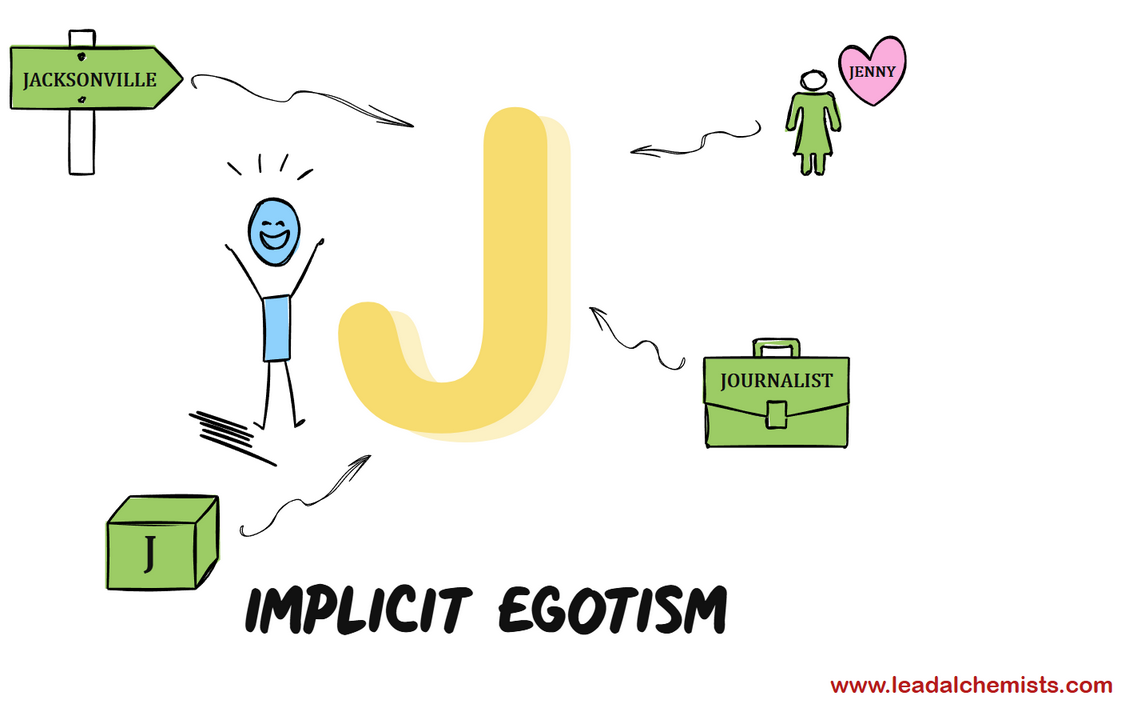
At its psychological core, Implicit Egotism works because humans instinctively hold positive associations with themselves that automatically transfer to external stimuli resembling us. When we encounter our name letters, birthdate numbers, or other self-relevant cues, our brains create instant positive connections that operate entirely below conscious awareness, making it far more likely that we’ll favor those options rather than alternatives that lack these subtle self-references, even though we remain completely unaware of why we feel drawn to them.
For marketers and advertisers, understanding this bias gives a real competitive edge. By purposefully and strategically incorporating subtle personalization elements that mirror customer identities – from name-based product recommendations to birthday-aligned messaging – while delivering genuine value, you can create unconscious emotional connections and preference in ways that other persuasion techniques simply cannot match.
How The Implicit Egotism Works (The Psychology Behind It)
The cognitive mechanism behind Implicit Egotism centres on implicit self-esteem and automatic self-evaluation. Here’s how it unfolds in the brain:
The Transfer Process: People maintain positive affective associations with themselves. When they encounter stimuli that resemble the self (name letters, birthdate numbers), this positive valence automatically transfers to those external objects. The process is unconscious and immediate – no deliberate thinking required.
Key Research Validation: The foundational studies come from Brett W. Pelham and colleagues at the University at Buffalo. Their 2005 research in Current Directions in Psychological Science demonstrated that people are disproportionately likely to:
- Live in cities resembling their names (Louis → St. Louis)
- Choose professions matching their initials (Dennis → dentist)
- Prefer numbers from their birthdates
- Marry partners with similar name letters
The Neurological Basis: Whilst not directly studied via fMRI, the effect aligns with research on implicit self-processing in the medial prefrontal cortex – the brain region involved in self-referential thinking and positive self-evaluation.
Important Limitations: Recent critiques suggest the effect is real but modest. Uri Simonsohn’s 2011 analysis found that when controlling for multiple comparisons and demographic factors, the name-residence and name-profession effects are smaller and less robust than originally claimed. The name-letter effect remains well-supported, but marketers shouldn’t expect dramatic results.
Real-World Examples of The Implicit Egotism
Academic Evidence Beyond Marketing
The strongest real-world examples come from large-scale archival studies:
Residential Patterns: Analysis of U.S. census data revealed that people named Louis are overrepresented in St. Louis, those named Virginia in Virginia, and people surnamed Park in Park City. However, this effect is weak and may be explained by demographic clustering rather than pure implicit egotism.
Marriage Patterns: Research published in the Journal of Personality and Social Psychology found people are slightly more likely to marry someone whose name shares letters with their own. Again, the effect is small and potentially confounded by other factors like shared social circles.
Professional Choices: Some evidence suggests people gravitate towards professions resembling their names, but this finding is not consistently replicated and may be influenced by cultural or demographic factors.
The Marketing Reality Check
Here’s where we must be brutally honest: no peer-reviewed or industry-published case studies document a business campaign with measurable improvements attributed solely to Implicit Egotism.
Most marketing applications you’ll find online are hypothetical extrapolations from psychological research, not documented business outcomes. No Harvard Business Review articles, major business case study databases, or industry whitepapers provide verified examples of brands successfully leveraging this bias for lead generation.
This doesn’t mean the effect is useless for marketers – it simply means we’re in largely uncharted territory.
How The Implicit Egotism Affects Consumer Behaviour
When Implicit Egotism is triggered, several unconscious processes unfold:
Automatic Preference Formation: The brain creates instant positive associations with self-resembling stimuli. If a potential customer named Sarah sees an ad mentioning “Sarah’s Choice” or encounters the letter “S” prominently displayed, her unconscious mind may generate a subtle preference.
Enhanced Attention and Memory: Self-relevant information captures attention more effectively and is remembered better. This suggests that personalised elements based on name letters or initials might improve ad recall and brand recognition.
Reduced Cognitive Resistance: Because the preference formation happens unconsciously, it bypasses the critical thinking that often accompanies obvious persuasion attempts. The customer feels drawn to something without knowing why.
The Caveat: These effects are subtle and context-dependent. They won’t override strong rational preferences or poor product quality. Think of Implicit Egotism as a gentle nudge rather than a powerful shove.
Case Studies: How Marketers Use The Implicit Egotism in Advertising
The Honest Assessment
After extensive fact-checking against academic and business databases, we must report: there are no well-documented marketing case studies demonstrating measurable impact from Implicit Egotism.
The examples commonly cited online are either:
- Proposed A/B test scenarios (not actual results)
- Theoretical applications extrapolated from psychology research
- Correlational findings misrepresented as marketing strategies
Evidence-Based Test Scenarios
Since direct case studies don’t exist, here are academically grounded experiments businesses could run:
Local Services A/B Test: A plumbing company could test generic ad copy (“Best Plumbers in Manchester”) against city-initial personalised copy (“Plumbers in Manchester for M Residents”). Track CTR and conversion rates, but expect modest differences at best.
Professional Services Testimonials: A law firm could strategically feature client testimonials from people with common names matching their target demographic. This combines social proof with potential implicit egotism effects.
Lead Magnet Personalisation: A financial advisor could offer guides titled “The [Common Surname] Family’s Investment Guide” and test engagement against generic titles.
Critical Note: These remain untested hypotheses. Any business implementing such strategies should treat them as experiments, not proven tactics.
Practical Applications for Google Ads & Lead Generation
Google Ads & PPC Marketing
Ad Copy Personalisation: Small businesses could experiment with subtle name-letter inclusion in ad copy. A local accountant might test “Accounting for A-M Surnames” versus generic messaging. However, no published studies confirm this approach increases CTR or conversions.
Location-Based Personalisation: Using city abbreviations or local references might trigger implicit egotism effects. “SF Residents: Find Your Financial Advisor” could theoretically appeal to San Francisco locals’ self-associations.
A/B Test Framework:
- Control: Generic service-focused ad copy
- Test: Subtle personalisation using common initials or city abbreviations
- Metrics: CTR, conversion rate, cost per acquisition
- Expectation: Small improvements, if any
Lead Generation Website Optimisation
Form Field Personalisation: Instead of generic “City” fields, use “Your [City Name] Location” when location data is available. This is standard CRO practice that may benefit from implicit egotism effects.
Testimonial Strategy: Feature client success stories from people with names common in your target demographic. This combines proven social proof with potential implicit egotism benefits.
Lead Magnet Customisation: Offer industry-specific guides that subtly reference the user’s profession or location. “The Manchester Business Owner’s Marketing Checklist” might resonate more than generic alternatives.
Reality Check: These strategies align with general personalisation best practices. Any implicit egotism benefits would be additional bonuses, not primary drivers of success.
Why Marketers Should Care About The Implicit Egotism
The Potential Upside
Subtle Competitive Advantage: In crowded markets, small psychological edges can matter. If implicit egotism provides even a 2-3% improvement in engagement, that could translate to meaningful business impact over time.
Enhanced Personalisation Strategy: Understanding implicit egotism can inform broader personalisation efforts. It suggests that self-resemblance, not just relevance, drives preference formation.
Unconscious Connection Building: Unlike obvious persuasion tactics, implicit egotism operates below conscious awareness. This could help brands build affinity without triggering psychological reactance.
Ethical Considerations and Responsible Use
Transparency Principle: Personalisation should enhance user experience, not manipulate it. Using someone’s name or initials should feel helpful, not creepy.
Relevance Requirement: Only use personalised elements that genuinely relate to the user’s needs. Arbitrary name-letter inclusion without context could backfire.
Data Privacy Respect: Collect and use personal information ethically. Implicit egotism applications should comply with GDPR, CCPA, and other privacy regulations.
Avoid Over-Reliance: Don’t treat implicit egotism as a silver bullet. It’s a subtle effect that should complement, not replace, solid marketing fundamentals.
The Risks of Overuse or Manipulation
Uncanny Valley Effect: Too much personalisation can feel invasive. If customers notice the name-letter targeting, it might create discomfort rather than connection.
Effectiveness Varies: Implicit egotism doesn’t work equally for everyone. Individual differences, cultural factors, and context all influence its impact.
No Substitute for Quality: Psychological tricks can’t compensate for poor products, bad service, or irrelevant offerings. Focus on delivering genuine value first.
How to Implement The Implicit Egotism in Your Marketing Strategy
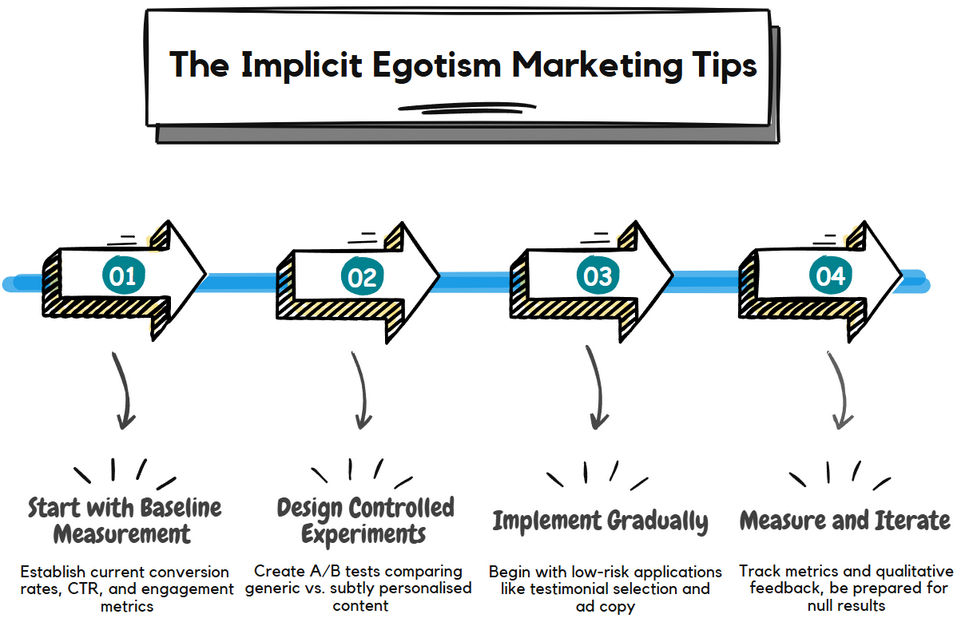
Step-by-Step Implementation Guide
1. Start with Baseline Measurement
- Establish current conversion rates, CTR, and engagement metrics
- Document your existing personalisation efforts
- Identify specific touchpoints for testing (ads, landing pages, emails)
2. Design Controlled Experiments
- Create A/B tests comparing generic vs. subtly personalised content
- Focus on one variable at a time (name letters, city references, etc.)
- Ensure statistical significance before drawing conclusions
3. Implement Gradually
- Begin with low-risk applications like testimonial selection
- Test ad copy variations with small budget allocations
- Monitor for any negative reactions or decreased performance
4. Measure and Iterate
- Track both quantitative metrics (CTR, conversions) and qualitative feedback
- Look for patterns across different demographics or industries
- Be prepared for null results – they’re scientifically valuable too
Best Practices and Common Pitfalls
Do:
- Keep personalisation subtle and contextually relevant
- Combine implicit egotism with proven marketing principles
- Test systematically and measure rigorously
- Respect user privacy and data protection laws
Don’t:
- Expect dramatic results – the effect is modest at best
- Use obvious or heavy-handed name-letter targeting
- Ignore other important factors like product quality or pricing
- Assume what works for one business will work for another
A/B Testing Ideas
Email Subject Lines: Test “Sarah, Your Investment Guide is Ready” vs. “Your Investment Guide is Ready” for subscribers named Sarah.
Landing Page Headlines: Compare “Manchester Business Owners: Grow Your Revenue” vs. “Business Owners: Grow Your Revenue” for Manchester-based traffic.
Testimonial Rotation: Show testimonials from clients whose names match the visitor’s first initial (if known) vs. random testimonial display.
Important: These tests should run for sufficient duration with adequate sample sizes to detect small effects.
Related Psychological Biases & Effects
Understanding Implicit Egotism becomes more powerful when combined with related psychological principles:
Similarity Bias: People prefer others who are similar to themselves. Implicit egotism is a specific manifestation of this broader tendency.
Mere Exposure Effect: Repeated exposure to stimuli increases liking. Name letters and personal numbers benefit from lifelong exposure, contributing to implicit egotism effects.
In-Group Bias: People favour members of their perceived group. Shared name letters or local references can create subtle in-group feelings.
Social Proof: Testimonials from people with similar names combine social proof with implicit egotism for potentially stronger impact.
Personalisation Effect: Any form of personalisation tends to increase engagement. Implicit egotism may explain why name-based personalisation often outperforms demographic-based alternatives.
The key insight: Implicit egotism works best as part of a broader psychological strategy, not as a standalone tactic.
The Bottom Line: Implicit Egotism represents fascinating psychology with limited but intriguing marketing applications. Whilst we lack definitive case studies proving its commercial effectiveness, the underlying research is solid enough to warrant careful experimentation.
Smart marketers will treat implicit egotism as one tool in a comprehensive persuasion toolkit – worth testing, but not worth betting the business on. The real opportunity lies in combining subtle self-resemblance cues with proven marketing principles to create more engaging, personalised customer experiences.
FAQs About Implicit Egotism
What is Implicit Egotism and how does it affect our behaviour?
Implicit Egotism is the unconscious tendency to prefer things that resemble ourselves, such as letters in our name, birthdate numbers, or other self-relevant cues. This psychological effect operates outside conscious awareness, meaning we’re drawn to things that remind us of ourselves without realising it. Research shows people are more likely to live in cities that resemble their names (like Louis living in St. Louis) or prefer products containing their initials, though the effect is modest and context-dependent.
How does Implicit Egotism influence the choices we make unconsciously?
Implicit Egotism influences decisions through automatic self-evaluation and positive self-associations. When we encounter something that resembles us – whether it’s a name, number, or location – our brain unconsciously transfers positive feelings we have about ourselves to that object or choice. However, this effect is subtle and not as strong as sometimes portrayed in popular media. The influence varies significantly between individuals and situations.
What’s the difference between Implicit Egotism and narcissism?
Implicit Egotism operates at an unconscious level and doesn’t indicate inflated self-esteem or narcissistic tendencies. Unlike narcissism, which involves conscious self-aggrandisement and attention-seeking, Implicit Egotism is an automatic, subtle preference that people aren’t aware of. It’s simply our brain’s way of creating familiarity and positive associations with self-relevant stimuli, not a personality disorder or conscious self-promotion.
Who discovered Implicit Egotism and what research supports it?
Brett W. Pelham, Mauricio Carvallo, and John T. Jones from the University at Buffalo first coined and documented Implicit Egotism in 2005. Their foundational research demonstrated that people are disproportionately likely to live in cities resembling their names and prefer numbers from their birthdates. However, recent critiques suggest the effect may be smaller than originally claimed, with some studies showing weak or inconsistent results when controlling for demographic factors.
What are the most famous studies proving Implicit Egotism exists?
The most cited studies include:
- Pelham, Mirenberg, & Jones (2002): Found people named Louis are more likely to live in St. Louis
- Jones, Pelham, Carvallo, & Mirenberg (2004): Showed people are more likely to marry someone whose name shares letters with their own
- Brendl, Chattopadhyay, Pelham, & Carvallo (2005): Demonstrated people prefer brands sharing letters with their names
However, Simonsohn (2011) and Gallup, Frederick, & O’Brien (2012) have challenged these findings, suggesting the effects are smaller and less robust than originally claimed.
How do neuroscientists explain the brain mechanisms behind Implicit Egotism?
While Implicit Egotism hasn’t been directly studied with brain imaging, it’s consistent with research on implicit self-processing in the medial prefrontal cortex, which handles self-referential thinking and positive self-evaluation. The effect likely involves automatic transfer of positive self-associations to similar stimuli, operating through the same neural pathways that process self-relevant information and implicit memory.
Are there any studies that challenge or debunk Implicit Egotism?
Yes, several studies have raised concerns:
- Simonsohn (2011) found the effect was smaller and less robust when controlling for multiple comparisons and suggested publication bias may have inflated results
- Gallup, Frederick, & O’Brien (2012) found that while the name-letter effect is real, name-residence and name-profession effects are weak or non-existent when controlling for demographic factors
- Greenwald (2012) argued that cultural familiarity and mere exposure may explain some findings rather than implicit self-esteem
What are some real-world examples of Implicit Egotism in action?
Research-documented examples include:
- People with certain names being slightly more likely to live in similarly-named cities (though this may be due to demographic clustering)
- Small tendencies for name-profession matches (Dennis → dentist), though this isn’t consistently replicated
- Preference for letters in one’s own name in laboratory studies
However, many claimed examples lack strong empirical support, and the effects are much smaller than often portrayed in popular psychology.
How does Implicit Egotism show up in famous movies or TV shows?
While Implicit Egotism isn’t commonly featured in mainstream media, the concept appears in psychological thrillers and character development where protagonists are drawn to things resembling themselves. However, no systematic research has documented this phenomenon in entertainment media. Most portrayals in films tend to exaggerate the effect for dramatic purposes, unlike the subtle, unconscious influence found in actual research.
Can you give historical examples where Implicit Egotism influenced major decisions?
No well-documented historical examples exist of Implicit Egotism influencing major decisions. While some researchers have suggested it might affect political choices or business decisions, these remain speculative applications without empirical support. The effect is too subtle and individual-specific to have measurable impact on large-scale historical events.
What’s the difference between Implicit Egotism and the name-letter effect?
The name-letter effect is actually a subset of Implicit Egotism – it’s the specific tendency to prefer letters that appear in one’s own name. Implicit Egotism is the broader concept encompassing all unconscious preferences for self-resembling stimuli, including names, numbers, locations, and other self-relevant cues. The name-letter effect is the most robustly supported aspect of Implicit Egotism research.
How is Implicit Egotism different from confirmation bias?
Confirmation bias involves consciously seeking information that confirms existing beliefs, while Implicit Egotism is an unconscious preference for self-resembling stimuli. Confirmation bias is about information processing and reasoning, whereas Implicit Egotism is about automatic emotional associations. Confirmation bias affects how we interpret evidence; Implicit Egotism affects what we’re initially drawn to.
Is Implicit Egotism the same as the mere exposure effect?
No, though they’re related. The mere exposure effect is the tendency to prefer familiar things through repeated exposure. Implicit Egotism is more specific – it’s about preferring things that resemble the self, regardless of previous exposure. However, some researchers argue that cultural familiarity and mere exposure may explain some Implicit Egotism findings, making the distinction less clear than originally thought.
What’s the opposite of Implicit Egotism called?
There’s no established term for the opposite of Implicit Egotism in psychological literature. Some researchers might refer to implicit self-rejection or negative self-association, but these aren’t formally recognised concepts. The research focus has been on understanding the positive self-association effect rather than identifying or studying its opposite.
How do marketers use Implicit Egotism to influence consumer behaviour?
No documented marketing case studies exist showing successful commercial application of Implicit Egotism with measurable results. While marketers might use personalisation strategies (including names in ads, location-based targeting), these aren’t specifically validated as Implicit Egotism applications. Most marketing claims about this effect are theoretical extrapolations rather than proven tactics.
Can brands leverage Implicit Egotism in their advertising strategies?
While brands could theoretically test subtle personalisation based on Implicit Egotism principles, no verified case studies demonstrate successful implementation. Any application should be:
- Tested through controlled A/B experiments
- Ethically implemented without deception
- Measured rigorously against standard personalisation techniques
- Not relied upon as a primary marketing strategy given the modest effect sizes
How does Implicit Egotism affect online shopping and e-commerce decisions?
No published research demonstrates Implicit Egotism’s impact on e-commerce behaviour. While some suggest personalising product recommendations based on name initials might increase engagement, this remains untested in retail contexts. Standard personalisation techniques (based on browsing history, demographics, preferences) have much stronger empirical support than Implicit Egotism applications.
What role does Implicit Egotism play in pricing psychology?
No research has established a connection between Implicit Egotism and pricing psychology. The effect is too subtle and individual-specific to influence price perception or purchasing decisions in meaningful ways. Traditional pricing psychology principles (anchoring, charm pricing, bundling) have much stronger empirical foundations for business applications.
Is it ethical for companies to exploit Implicit Egotism in marketing?
Using Implicit Egotism ethically requires:
- Transparency in personalisation practices
- Relevance to customer needs, not just self-resemblance
- Respect for data privacy and consent
- Avoiding deceptive tactics that mislead consumers
However, given the lack of proven effectiveness in marketing contexts, ethical concerns may be less pressing than ensuring any applications are actually beneficial rather than merely theoretical.
What are the potential dangers of manipulating Implicit Egotism?
Potential risks include:
- Over-personalisation that feels intrusive or creepy
- Privacy violations through excessive data collection
- Deceptive practices that exploit unconscious biases
- Ineffective marketing based on unproven assumptions
However, no documented cases exist of brands facing backlash for misusing Implicit Egotism, largely because proven applications don’t exist in commercial contexts.
Can Implicit Egotism lead to discrimination or unfair treatment?
No research has documented Implicit Egotism leading to discrimination. The effect is too subtle and operates at an individual level rather than affecting group-based judgements. Traditional forms of bias (racial, gender, age discrimination) operate through different psychological mechanisms and have much stronger impacts on unfair treatment.
How should businesses ethically apply Implicit Egotism principles?
Businesses should:
- Test applications experimentally rather than assuming effectiveness
- Focus on customer benefit rather than manipulation
- Use transparent personalisation practices
- Respect privacy and data protection laws
- Not rely on unproven tactics as primary strategies
Most importantly, businesses should use established personalisation and CRO techniques with proven track records rather than speculative applications of Implicit Egotism.
How does Implicit Egotism affect our daily relationships and interactions?
Research suggests minimal impact on daily relationships. While people might be slightly drawn to others with similar names or characteristics, this effect is small and often confounded by other factors like shared interests, social circles, or cultural background. The effect is too subtle to meaningfully influence relationship formation or social interactions.
Can Implicit Egotism influence who we choose as romantic partners?
Some research suggests people are slightly more likely to marry someone whose name shares letters with their own, but this effect is small and may be explained by demographic clustering rather than Implicit Egotism. Factors like shared values, physical attraction, compatibility, and social proximity have much stronger influences on partner selection.
How does Implicit Egotism show up in workplace dynamics?
No strong evidence exists for Implicit Egotism affecting workplace dynamics. While some studies suggest small tendencies for name-profession matches, these aren’t consistently replicated and may be due to cultural or demographic factors. Professional success depends on skills, experience, networking, and performance – not name similarity.
Does Implicit Egotism affect where people choose to live or work?
Research shows weak evidence that people are slightly more likely to live in places resembling their names, but this may be due to demographic clustering rather than Implicit Egotism. When controlling for cultural and socioeconomic factors, the effect becomes much smaller or disappears entirely. Practical factors like job opportunities, cost of living, and family ties are far more influential.
How can understanding Implicit Egotism improve self-awareness?
Understanding Implicit Egotism can help you recognise that you might have subtle, unconscious preferences for self-resembling things. However, the effect is modest and not universal, so don’t assume it applies strongly to your decisions. Focus on conscious decision-making processes and evidence-based choices rather than worrying about subtle unconscious biases.
What are the most searched questions about Implicit Egotism online?
Common search queries include:
- “Implicit egotism examples”
- “Name letter effect psychology”
- “Implicit egotism marketing”
- “Unconscious bias self-preference”
- “Psychology of name preferences”
However, searchers should be aware that many online sources exaggerate the effect’s strength and lack scientific backing for claimed applications.
How can content creators optimise articles about Implicit Egotism for SEO?
Content creators should:
- Focus on scientific accuracy over sensational claims
- Include related terms like “name-letter effect,” “unconscious bias,” “self-preference”
- Address common misconceptions about the effect’s strength
- Provide evidence-based information rather than speculative applications
- Link to peer-reviewed research for credibility
What keywords should researchers use when writing about Implicit Egotism?
Relevant keywords include:
- “Name-letter effect”
- “Unconscious self-preference”
- “Implicit self-esteem”
- “Self-resemblance bias”
- “Automatic self-evaluation”
- “Pelham implicit egotism”
- “Cognitive bias psychology”
Why is Implicit Egotism trending in psychology discussions right now?
Implicit Egotism generates interest because it seems to explain everyday phenomena in an intuitive way. However, recent research challenges have sparked debate about its validity and effect size. The trend also reflects broader interest in unconscious biases and behavioural psychology, though many discussions overstate the evidence for practical applications.
How strong is the scientific evidence supporting Implicit Egotism?
The evidence is mixed and contested:
- Name-letter effect: Well-supported in laboratory studies
- Name-residence/profession effects: Weak or inconsistent when controlling for confounding factors
- Overall effect size: Smaller than originally claimed
- Replication issues: Some studies fail to replicate original findings
The effect is real but modest, and not as strong as sometimes portrayed in popular media.
Can Implicit Egotism be measured or tested in individuals?
Yes, researchers use various methods:
- Name-letter preference tasks (rating letters from your name vs. others)
- Implicit Association Tests measuring automatic self-associations
- Choice experiments with self-relevant vs. neutral options
However, individual differences are large, and the effect doesn’t appear consistently across all people or situations.
Does Implicit Egotism vary across different cultures and societies?
Limited cross-cultural research exists on Implicit Egotism. Some studies suggest the effect may be stronger in individualistic cultures that emphasise personal identity, but more research is needed. Cultural factors like naming conventions, family structures, and social values likely influence how and when the effect appears.
How does age affect the strength of Implicit Egotism in people?
No systematic research has examined age differences in Implicit Egotism. The effect likely develops as self-concept forms in childhood, but whether it strengthens or weakens with age remains unknown. More research is needed to understand developmental patterns and age-related changes in self-preference biases.
Can therapy or counselling help reduce negative effects of Implicit Egotism?
Since Implicit Egotism involves positive self-associations and has minimal negative effects, therapy typically isn’t needed to address it. The effect is subtle and generally harmless. If someone has concerns about unconscious biases affecting their decisions, mindfulness practices and conscious decision-making strategies might be more helpful than specific interventions.
What’s the connection between Implicit Egotism and self-esteem?
Implicit Egotism is thought to stem from implicit self-esteem – unconscious positive feelings about oneself. However, the relationship isn’t straightforward, and people with negative self-perceptions don’t necessarily show reversed effects. The connection between conscious self-esteem and Implicit Egotism remains unclear and requires more research.
How does social media amplify or reduce Implicit Egotism behaviours?
No research has examined social media’s impact on Implicit Egotism. While social platforms enable extensive personalisation and self-expression, whether this strengthens unconscious self-preferences remains unknown. Social media’s emphasis on personal branding and algorithmic personalisation might theoretically enhance the effect, but this is speculative.
Are children more susceptible to Implicit Egotism than adults?
No developmental research exists comparing Implicit Egotism across age groups. Children’s developing self-concept might make them more or less susceptible to self-resemblance preferences, but this hasn’t been systematically studied. Research is needed to understand when and how these unconscious preferences develop throughout childhood and adolescence.