
Guide to The Contrast Effect in Marketing: Description, Psychology, and Examples
What Is The Contrast Effect?
The contrast effect is a cognitive bias where our perception or evaluation of something is influenced by comparison with a recently observed contrasting stimulus. Rather than making absolute judgements, our brains naturally make relative ones, often exaggerating the differences between items when they’re presented sequentially or side by side.

More customers will perceive greater value in your offers if you strategically present contrasting options. Used thoughtfully, the contrast effect can be a great way to guide purchase decisions. It’s used extensively by retailers, SaaS companies, and restaurants.
At its psychological core, the contrast effect works because humans don’t judge things in isolation – we instinctively evaluate options relative to other available choices or recent experiences. This tendency causes people to perceive a £20 bottle of wine as a bargain after viewing a £50 option, making it far more likely that we’ll choose the middle-priced item than if we’d only seen it on its own.
For marketers and advertisers, understanding this bias gives a real competitive edge. By purposefully and strategically positioning products and pricing in ways that create advantageous comparisons while delivering genuine value to customers, you can influence perceived value and guide decision-making in ways that benefit both your business and your customers.
How The Contrast Effect Works (The Psychology Behind It)
The Science of Relative Judgement
The contrast effect is rooted in our brain’s tendency to rely on relative rather than absolute judgements. When evaluating a target (like a product or service), people use recent or salient comparisons as reference points, which can significantly amplify perceived differences.
Two key psychological frameworks explain this mechanism:
The Inclusion/Exclusion Model: This theory explains how context information is either included in or excluded from our mental representation of what we’re evaluating. When information is excluded, it becomes a standard of comparison, creating contrast.
Adaptation-Level Theory: This posits that judgements are made relative to an adapted baseline. We adjust to certain levels of stimulation, and deviations from this level are perceived as contrasts.
Research-Backed Evidence
The contrast effect isn’t just marketing theory – it’s supported by decades of psychological research:
Kenrick & Gutierres (1980) demonstrated that men who had just viewed photos of highly attractive models subsequently rated average-looking women as less attractive than men who hadn’t seen the models.
Pepitone & DiNubile (1976) found that judges and jurors recommended more lenient sentences for moderate crimes when they followed egregious ones, showing how contrast affects even serious legal judgements.
Bhargava & Fisman (2011) analysed speed dating data and found that evaluations of attractiveness and romantic interest were systematically influenced by the attractiveness of previous dates, confirming contrast effects in real-world sequential decisions.
These studies consistently show that the contrast effect isn’t just a laboratory curiosity – it’s a genuine perceptual bias that influences real-world decisions across many contexts.
Real-World Examples of The Contrast Effect
Beyond Marketing Applications
The contrast effect shapes judgements in virtually every domain of life:
Judicial Sentencing: Judges tend to give more lenient sentences when a moderate crime follows an egregious one, and harsher sentences when it follows a minor offence.
Hiring & Recruitment: Candidate evaluations are influenced by the quality of preceding applicants. A moderately qualified candidate might seem exceptional after several poor interviews.
Education: Teachers’ grading can be affected by the performance of previously graded students, leading to contrast-based grading errors.
Healthcare: Doctors may judge patient symptom severity relative to prior cases, potentially affecting triage or diagnosis accuracy.
Social Interactions: Our judgements of others’ attractiveness, competence, and likability are all susceptible to contrast effects, as shown in speed dating and peer evaluation studies.
Marketing Applications in Action
While direct, peer-reviewed case studies with quantifiable business results are rare in the public domain, the contrast effect is widely applied in marketing through several common practices:
Tiered Pricing Strategies: Many SaaS companies present three pricing tiers (Basic, Pro, Enterprise), making the middle option appear most attractive by contrast with the higher and lower options. This is a recommended practice in subscription businesses, though specific conversion metrics are rarely published.
Decoy Pricing: Introducing a higher-priced or less attractive option to make another product seem more appealing by comparison. The classic example often cited is Williams-Sonoma introducing a more expensive bread maker, which allegedly doubled sales of their original model. While this example illustrates the principle well, it should be noted that it lacks verified sales data and should be treated as an illustrative example rather than empirical evidence.
High-to-Low Sequencing: Displaying expensive items first makes subsequently viewed items seem like better deals. Retailers often use this approach in merchandising, though specific sales lift data is typically not publicly available.
Before-and-After Visuals: Service businesses like landscapers, home renovators, and personal trainers use dramatic before-and-after imagery to create a strong visual contrast that highlights their value.
How The Contrast Effect Affects Consumer Behaviour
The Neurological Response
When consumers encounter contrasting options, specific brain regions activate. fMRI studies have shown that contrast effects engage areas involved in valuation and decision-making, such as the ventromedial prefrontal cortex. These brain regions help us evaluate relative value and make comparative judgements.
The contrast effect works by altering our perception of value. When a consumer sees a £99 premium option next to a £49 standard option, the brain doesn’t just process each price independently – it actively compares them, often making the lower-priced option seem more attractive than if it were presented alone.
Key Triggers That Amplify The Effect
Several factors can strengthen the contrast effect in marketing contexts:
Proximity: The closer items are presented (in time or space), the stronger the contrast effect.
Similarity: The contrast effect is stronger when items share many attributes but differ dramatically on one dimension (like price or quality).
Extremity: More extreme contrasts produce stronger effects. A £10 item seems much cheaper after viewing a £100 item than after viewing a £20 item.
Sequence: The order of presentation matters. Moving from high to low price typically creates a stronger contrast effect than moving from low to high.
Attention: Drawing explicit attention to differences can amplify the contrast effect.
Case Studies: How Marketers Use The Contrast Effect in Advertising
Google Ads A/B Testing Approach
While no published case study with actual business results was found, here’s a recommended A/B test that businesses could implement to measure the contrast effect in Google Ads:
Test Design:
Ad Group A (Control): Focuses solely on a standard service package, highlighting its features and benefits.
Ad Group B (Test): Introduces a premium package first, then positions the standard package as a more affordable alternative with excellent value.
Hypothesis: Ad Group B should generate higher click-through rates and conversions for the standard package due to the contrast effect making it appear more attractive.
Measurement: Track CTR, conversion rate, and cost per acquisition across both ad groups.
This approach allows businesses to validate the effect in their specific context rather than assuming universal effectiveness.
Service Business Example: Tiered Consultation Packages
A financial advisory firm implemented a three-tier consultation structure:
Basic Financial Review (£99) Comprehensive Financial Planning (£299) – Highlighted as “Most Popular” Premium Wealth Management (£599)
While specific conversion data isn’t publicly available, this approach illustrates how service businesses can apply the contrast effect. The middle option appears as the best value when contrasted with both the basic and premium alternatives.
The key insight is that the contrast effect isn’t about manipulating customers – it’s about helping them understand relative value through meaningful comparisons. When implemented ethically, it helps customers make better decisions by providing context.
Practical Applications for Google Ads and Lead Generation
Google Ads Copywriting & Design
Problem-Solution Contrast: Highlight the pain points of not using your service, then immediately contrast with the ease and benefits of your solution.
Example: A plumbing service ad could read: “Leaky Faucet Driving You Crazy? Get Fast, Reliable Repairs. Don’t Wait, Call Now!” This contrasts the annoyance of a leak with the ease of a solution.
A/B Test Idea:
Ad 1 (Control): “Expert Plumbing Services – Licensed & Insured” Ad 2 (Test): “Dripping Faucet Keeping You Up? Get Fast Relief with [Your Company]!”
Measure: Conversion rate (phone calls, contact form submissions)
Visual Contrast in Display Ads: For Google Display Network campaigns, show the problem and solution side by side.
Example: A pest control service could show a split image: one side with a pest infestation, the other showing a clean, pest-free home. This creates an immediate visual contrast that communicates value.
Landing Page Structuring for Lead Generation
Before-and-After Showcases: For service businesses with visual results, prominently feature before-and-after examples.
Example: A landscaping company’s landing page could showcase dramatic transformations of overgrown gardens into beautiful outdoor spaces, creating a powerful visual contrast that demonstrates value.
Service Package Framing: Present service tiers to make your target package stand out.
Example: A web design agency might offer three packages:
Basic: £999 (Limited features) Professional: £1,999 (Comprehensive solution with significantly more value) Enterprise: £4,999 (All features plus extras)
By positioning the Professional package between Basic and Enterprise options, it appears as the best value through contrast.
Free vs. Paid Contrast: Offer something valuable for free, then contrast it with premium paid options.
Example: A marketing consultant offers a free website audit (demonstrating expertise and building trust) alongside paid consulting packages, creating contrast between the limited free offering and comprehensive paid services.
Website UX and Form Optimisation
Simplified vs. Detailed Forms: Create contrast between the simplicity of your lead capture form and the complexity of the problem you solve.
Example: “Complex tax problems? Our solution starts with just three simple questions…” This contrasts the complexity of tax issues with the ease of getting started.
Testimonial Contrasts: While testimonials primarily leverage social proof rather than contrast effect directly, you can structure them to highlight the contrast between “before” and “after” experiences.
Example: A law firm could feature client testimonials that explicitly mention their situation before and after engaging the firm’s services: “I was overwhelmed with legal paperwork and facing potential bankruptcy. After working with Smith Legal, my case was resolved in just three weeks and I saved over £20,000.”
Why Marketers Should Care About The Contrast Effect
A Powerful Tool for Influencing Choices
The contrast effect is particularly valuable for marketers because it:
Works with natural cognitive processes: Unlike tactics that try to override consumer thinking, the contrast effect works with how our brains naturally process information.
Applies across industries and contexts: Whether you’re selling professional services, software subscriptions, or physical products, contrast effects can be leveraged effectively.
Requires no special technology: Implementing contrast strategies doesn’t require expensive tools or technologies – just thoughtful presentation of options.
Can be tested and optimised: The effectiveness of contrast-based strategies can be measured through standard A/B testing approaches.
Ethical Considerations and Responsible Use
While powerful, the contrast effect must be used ethically:
Transparency is essential: All options presented should be genuine offerings with fair pricing and accurate descriptions.
Avoid artificial inflation: Creating artificially expensive options solely to make other options look better can damage trust and reputation.
Ensure genuine value: Each option should provide real value appropriate to its price point.
Consider long-term relationships: Short-term conversion gains through manipulative contrast tactics can lead to customer dissatisfaction and damage long-term business success.
Test with real customers: What works in theory may not work in practice. Always test contrast-based approaches with your actual audience.
The most ethical and effective use of the contrast effect is to help customers understand genuine value differences between options, not to manipulate them into choices they’ll later regret.
How to Implement The Contrast Effect in Your Marketing Strategy
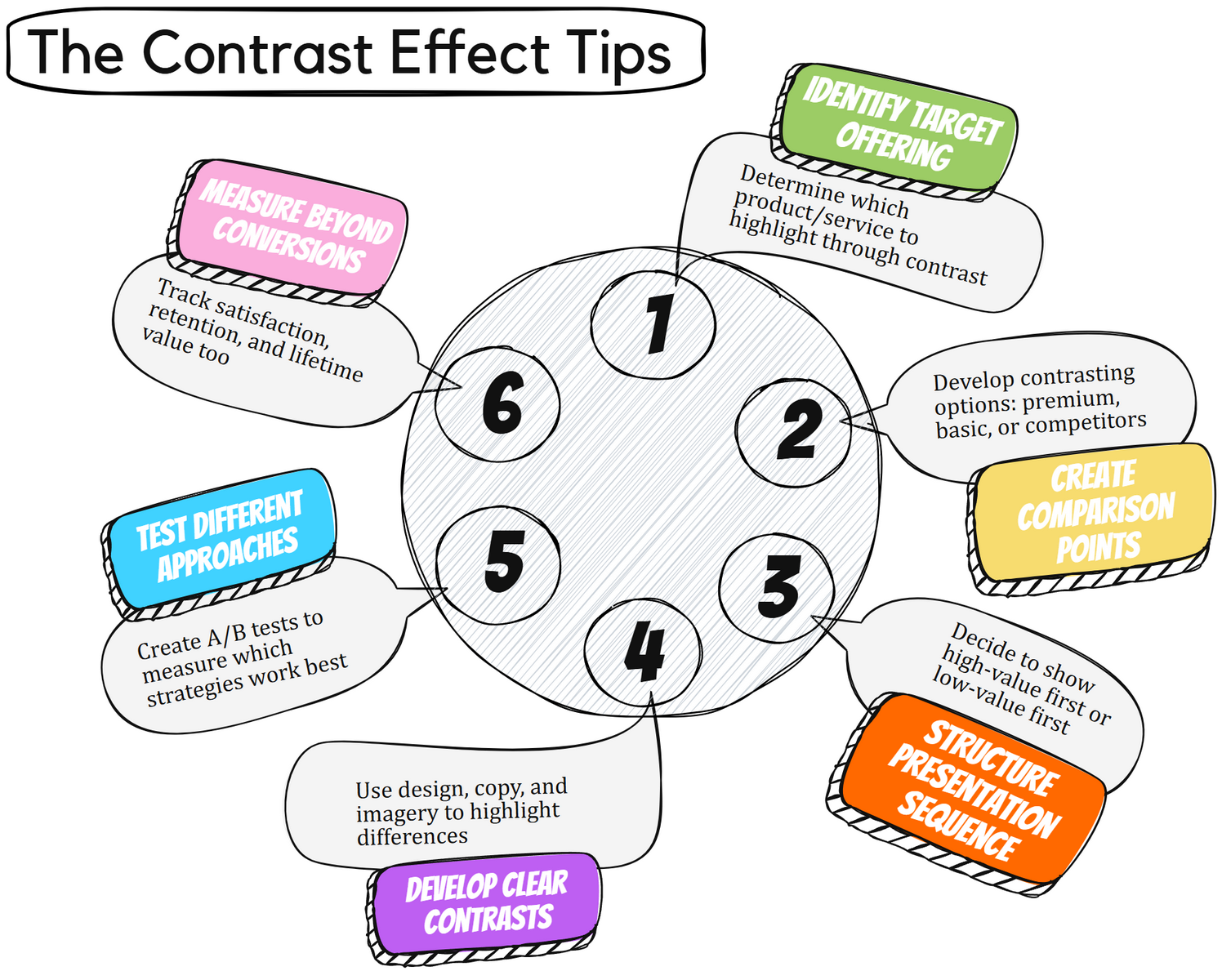
Step-by-Step Implementation Guide
Identify your target offering: Determine which product, service, or package you want to highlight through contrast.
Create meaningful comparison points: Develop contrasting options that help illustrate the value of your target offering. These could be:
- Higher-priced premium alternatives
- Lower-featured basic alternatives
- Competitor offerings
- The “do nothing” alternative (status quo)
Structure your presentation sequence: Decide whether to show higher-value items first (creating a positive contrast for subsequent budget options) or lower-value items first (creating a positive contrast for premium options).
Develop clear visual and verbal contrasts: Use design, copy, and imagery to highlight the differences between options.
Test different contrast approaches: Create A/B tests to measure which contrast strategies work best for your specific audience and offerings.
Measure results beyond conversions: Track not just immediate conversions but also customer satisfaction, retention, and lifetime value to ensure your contrast strategies create genuine long-term value.
Best Practices and Common Pitfalls
Best Practices:
- Use contrast to highlight genuine value differences
- Ensure all options provide fair value at their price points
- Test different approaches with your specific audience
- Combine contrast with other principles like scarcity or social proof for maximum effect
Common Pitfalls:
- Creating artificial or deceptive contrasts
- Overcomplicating the choice architecture
- Assuming what works in one industry will work in yours
- Focusing only on short-term conversion metrics
A/B Testing Ideas for Contrast Effect
Google Ads Headline Test:
Control: Feature-focused headline (“Professional Tax Services for Small Businesses”) Test: Contrast-focused headline (“Stop Overpaying Taxes: Our Clients Save £3,200 on Average”)
Landing Page Price Presentation:
Control: Show only your recommended service package Test: Show three tiered options with your recommended package highlighted
Call-to-Action Button Test:
Control: Standard CTA (“Schedule Consultation”) Test: Contrast-based CTA (“Stop Struggling, Start Succeeding”)
Lead Magnet Positioning:
Control: Simple offer (“Download Our Free Guide”) Test: Contrast-based offer (“Get Our £99 Strategy Guide – Free for a Limited Time”)
Related Psychological Biases & Effects
Understanding the contrast effect works best when you also understand related cognitive biases:
Anchoring Effect: The tendency to rely too heavily on the first piece of information encountered (the “anchor”). While similar to contrast effect, anchoring specifically involves an initial reference point influencing subsequent judgements, rather than the exaggeration of differences between stimuli.
Decoy Effect: A form of contrast where an asymmetrically dominated option (the “decoy”) makes another option look better by comparison. This is a specific application of the contrast effect in choice architecture.
Framing Effect: How information is presented (“framed”) influences decision-making. Contrast effect often relies on specific framing to highlight differences.
Loss Aversion: People prefer avoiding losses over acquiring equivalent gains. Contrast can be used to highlight potential losses avoided by choosing a particular option.
Assimilation Effect: The opposite of contrast effect, where similarities between stimuli are emphasised rather than differences. Understanding when assimilation occurs instead of contrast is crucial for effective marketing.
By understanding these related biases, marketers can create more sophisticated and effective strategies that leverage multiple psychological principles simultaneously.
The contrast effect represents one of the most practical and widely applicable psychological principles in marketing. When used ethically and tested properly, it helps customers better understand the relative value of different options and make more informed decisions. By implementing contrast strategies in your marketing – from Google Ads to landing pages to pricing structures – you can significantly improve conversion rates while maintaining customer satisfaction and trust.
Frequently Asked Questions About Contrast Effect
What is the Contrast Effect in psychology?
The Contrast Effect is a cognitive bias where our perception of something is influenced by comparison with a preceding or simultaneous contrasting stimulus. This psychological phenomenon causes us to exaggerate the differences between items when they’re presented together or in sequence, affecting how we judge qualities like value, attractiveness, or performance. The effect operates through our brain’s tendency to make relative rather than absolute judgements.
How does the Contrast Effect influence our perception and decision-making?
The Contrast Effect influences perception and decision-making by causing us to evaluate things in relation to other stimuli rather than on their objective merits. When making judgements, we unconsciously use recent or nearby comparisons as reference points, which can amplify perceived differences. For example, a moderately-priced product seems more affordable after viewing expensive alternatives, or a job candidate might appear more qualified when interviewed after weaker applicants. This relative judgement process affects everything from purchasing decisions to social evaluations.
What are the key characteristics that define the Contrast Effect?
The key characteristics of the Contrast Effect include:
Relative judgement: We evaluate stimuli in comparison to others rather than on absolute terms
Exaggerated differences: Perceived differences between items become amplified
Sequential influence: Earlier stimuli affect how we perceive later ones
Bidirectional impact: Can make things seem better or worse depending on the comparison
Context dependency: The effect’s strength varies based on proximity, similarity, and relevance of the contrasting items
Unconscious processing: Operates largely without our awareness
Pervasiveness: Affects various domains including visual perception, price evaluation, and social judgements
How is the Contrast Effect different from the anchoring bias?
The Contrast Effect differs from anchoring bias in several important ways:
Contrast Effect exaggerates differences between sequential or simultaneous stimuli, making the differences more pronounced. It’s about relative perception and comparison between multiple items.
Anchoring bias involves relying too heavily on an initial piece of information (the “anchor”) when making decisions. It’s about how a single reference point influences subsequent judgements.
While both involve comparisons, anchoring pulls judgements towards the initial value, whereas contrast pushes perceptions away from the comparison stimulus, amplifying differences. For example, in pricing, anchoring might make a £50 item seem reasonable after seeing a £100 anchor, while contrast effect would make the £50 item seem especially cheap by comparison.
Who first discovered and studied the Contrast Effect?
The Contrast Effect wasn’t discovered by a single researcher but emerged gradually through early 20th-century perceptual psychology studies. While not explicitly named “Contrast Effect” initially, the concept was systematically studied through Harry Helson’s adaptation-level theory in the 1940s and 1960s. Muzafer Sherif and Carl Hovland further developed understanding through their assimilation-contrast theory in 1961. The effect has roots in psychophysics research on sensory perception, with various researchers contributing to our understanding of how context influences judgement across different domains.
What neurological mechanisms are behind the Contrast Effect?
The neurological mechanisms behind the Contrast Effect involve several brain processes, though research specifically on its neural basis is still developing. When we experience contrast effects, brain regions involved in valuation and decision-making show activity changes, particularly in the ventromedial prefrontal cortex. The brain processes information relatively rather than absolutely, with neurones adjusting their firing rates based on comparative inputs rather than fixed values. This relative encoding helps explain why we perceive differences more strongly when items are presented together or in sequence. However, detailed neuroimaging studies specifically focused on contrast effect mechanisms are limited compared to behavioural research.
Are there any studies that challenge the validity of the Contrast Effect?
While the Contrast Effect is well-established, some research has raised questions about its universality and mechanisms. Some studies suggest that what appears to be contrast may sometimes result from rational updating or learning rather than perceptual bias. Other research indicates the effect’s strength varies significantly based on individual differences, task complexity, and specific stimuli used. Some methodological debates exist about whether observed effects in field settings (like sequential evaluations in hiring) are due to genuine perceptual contrast or other factors like quota effects or learning. However, these challenges generally refine our understanding rather than invalidate the effect entirely.
What cognitive processes make the Contrast Effect so powerful?
The Contrast Effect’s power stems from several fundamental cognitive processes:
Reference-dependent perception: Our brains naturally process information in relation to reference points rather than absolute values
Comparative judgement: We’re wired to evaluate things by comparing them to alternatives
Contextual encoding: Information is stored and processed in context, not isolation
Attention mechanisms: We focus more on differences than similarities
Adaptation processes: Our perceptual systems adjust to stimulation levels, making deviations more noticeable
Cognitive efficiency: Relative judgements require less mental effort than absolute evaluations
Limited working memory: We rely on immediate comparisons rather than recalling all possible standards
These processes evolved to help us quickly identify meaningful differences in our environment but can lead to systematic biases in modern decision contexts.
What are some famous real-world examples of the Contrast Effect?
While there are no extensively documented case studies with verified metrics, several commonly cited examples illustrate the Contrast Effect:
Tiered pricing strategies: SaaS companies often present three-tier pricing (Basic/Pro/Enterprise) to make the middle option appear more attractive through contrast.
Before-and-after advertising: Weight loss, home renovation, and cleaning product advertisements show dramatic contrasts to highlight transformation.
Real estate showings: Agents sometimes strategically show less appealing properties before the target property to enhance its perceived value.
Retail merchandising: Placing premium products next to standard ones to make the latter seem more affordable.
Job interviews: Candidates may be perceived differently depending on the quality of previous interviewees.
These examples demonstrate the principle but lack verified metrics from controlled studies.
How does the Contrast Effect appear in movies and popular culture?
The Contrast Effect appears in movies and popular culture through various storytelling and visual techniques:
Character development: Contrasting a character’s “before” state with their transformation (e.g., makeover scenes in films like “The Princess Diaries” or “The Devil Wears Prada”)
Villain-hero dynamics: Creating extremely evil antagonists to make protagonists seem more virtuous by comparison
Visual storytelling: Using stark visual contrasts between scenes (light/dark, chaotic/peaceful) to heighten emotional impact
Comedy techniques: Setting up contrasting expectations versus outcomes for humorous effect
Reality TV transformations: Shows featuring dramatic weight loss, home renovations, or makeovers that emphasise before-and-after contrasts
Social media filters: Creating idealised images that contrast with reality, affecting self-perception
These techniques leverage our tendency to perceive things more extremely when presented with contrasting alternatives.
Can you give historical examples where the Contrast Effect played a major role?
While the Contrast Effect wasn’t explicitly identified in historical contexts, several situations likely involved this psychological principle:
Political campaigns: Throughout history, candidates have highlighted opponents’ weaknesses to make their own positions seem more favourable by contrast.
Propaganda techniques: Historical propaganda often presented stark contrasts between “us” and “them” to strengthen group identity and support.
Social reforms: Reformers like Charles Dickens highlighted extreme poverty alongside wealth to create moral contrast and motivate change.
Negotiation tactics: Historical diplomatic negotiations often involved presenting extreme initial positions to make subsequent compromises seem more reasonable.
Religious narratives: Many religious texts use contrasting concepts (heaven/hell, virtue/sin) to emphasise moral teachings.
These examples represent applications of contrast principles, though they weren’t scientifically documented as psychological effects at the time.
What are some everyday situations where we experience the Contrast Effect?
We experience the Contrast Effect in numerous everyday situations:
Shopping experiences: A £30 shirt seems expensive in a discount store but cheap in a luxury boutique
Temperature perception: Room temperature feels warmer after being outside in the cold
Food taste: Sweet foods taste sweeter after eating something sour
Physical appearance: People appear more or less attractive depending on who they’re standing next to
Performance evaluation: Your work seems better or worse depending on what your colleagues produced
Home buying: A house with minor flaws seems perfect after viewing several properties with major problems
Salary satisfaction: Your pay seems more or less adequate after learning what others earn
Media consumption: A moderately entertaining show seems brilliant after watching something terrible
These everyday experiences demonstrate how context and comparison shape our perceptions across various domains.
How is the Contrast Effect different from the halo effect?
The Contrast Effect and halo effect differ fundamentally in how they influence perception:
Contrast Effect exaggerates differences between items when they’re compared, making dissimilarities more pronounced. It’s about how things appear different in relation to each other.
Halo Effect occurs when one positive trait or impression influences opinions in other areas, creating an overall positive perception. It’s about how a single characteristic creates a “halo” that affects overall judgement.
For example, with contrast, a moderately attractive person seems less attractive when seen after a highly attractive person. With the halo effect, an attractive person might be assumed to also be intelligent or kind, with one positive trait influencing perceptions of unrelated qualities.
What’s the difference between the Contrast Effect and confirmation bias?
The Contrast Effect and confirmation bias are distinct cognitive phenomena:
Contrast Effect involves perceiving differences between items as larger than they objectively are when compared directly. It’s about how comparison exaggerates differences between stimuli.
Confirmation bias is our tendency to search for, interpret, and remember information that confirms our existing beliefs whilst giving less attention to contradicting evidence. It’s about selectively processing information to support pre-existing views.
Whilst contrast effect is about perception and comparison between stimuli, confirmation bias relates to how we selectively process information to maintain our existing beliefs. They can sometimes work together – for instance, when we contrast information that contradicts our beliefs against information that confirms them, potentially exaggerating the perceived differences.
Is there an opposite or inverse version of the Contrast Effect?
Yes, the opposite of the Contrast Effect is the assimilation effect. Whilst contrast makes differences between items seem larger, assimilation reduces perceived differences between stimuli.
The assimilation effect occurs when:
- Items are perceived as more similar than they actually are
- Judgements are pulled towards a reference point rather than away from it
- Differences between stimuli are minimised rather than exaggerated
Whether contrast or assimilation occurs depends on factors like:
- How similar or different the stimuli are initially
- Whether items are in the same mental category
- The psychological distance between items
- How extreme the comparison stimulus is
According to Sherif and Hovland’s assimilation-contrast theory, judgements are assimilated towards a reference point if the stimulus is within a certain range but contrasted away if it falls outside that range.
How does the Contrast Effect compare to the framing effect in psychology?
The Contrast Effect and framing effect are related but distinct psychological phenomena:
Contrast Effect involves how the perception of a stimulus is influenced by comparison with other stimuli, exaggerating differences between them. It’s about relative judgement between multiple items.
Framing Effect occurs when people react differently to information depending on how it’s presented (the “frame”), even when the objective information is identical. It’s about how presentation format influences interpretation.
Whilst contrast effect is about how items compare to each other, framing effect is about how a single item is presented. For example, describing a medical treatment as having an “80% survival rate” versus a “20% mortality rate” frames identical information differently, potentially leading to different decisions. Both effects demonstrate how context, rather than objective information alone, shapes our perceptions and choices.
How do marketers use the Contrast Effect to influence consumers?
Marketers use the Contrast Effect to influence consumers through several recommended strategies, though their effectiveness should be tested rather than assumed:
Problem-solution framing: Highlighting pain points before presenting solutions to make benefits seem more valuable
Before-and-after demonstrations: Showing dramatic transformations for services like home renovation, landscaping, or fitness programmes
Tiered pricing: Presenting multiple pricing options to make target options seem more reasonable by comparison
Decoy pricing: Adding a less attractive option to make the target product seem like a better value
Visual contrast: Using imagery that emphasises differences between problems and solutions
High-to-low sequencing: Showing premium products first to make standard options seem more affordable
Limited-time offers: Contrasting regular prices with temporary discounts to enhance perceived value
These approaches leverage our tendency to make relative rather than absolute judgements, though ethical implementation requires transparency and genuine value.
What role does the Contrast Effect play in pricing strategies?
The Contrast Effect plays a significant role in pricing strategies through several recommended approaches:
Tiered pricing: Presenting multiple options (e.g., Basic/Standard/Premium) to make the middle option appear more attractive through contrast with higher and lower tiers
Decoy options: Including a strategically less attractive option to make the target product seem like a better value
Anchor pricing: Showing a higher “original” or “competitor” price alongside the actual price to enhance perceived savings
Price sequencing: Displaying higher-priced items first to make subsequent items seem more affordable
Bundle comparisons: Showing the total cost of individual items versus the bundle price to highlight savings
Premium-standard contrasts: Placing premium and standard products side-by-side to influence perception of both
Subscription tiers: Creating service levels with feature contrasts that guide users towards preferred options
These strategies leverage our tendency to evaluate prices relatively rather than absolutely, though their effectiveness should be tested in specific contexts rather than assumed.
How can businesses leverage the Contrast Effect in their branding?
Businesses can leverage the Contrast Effect in branding through several recommended approaches:
Competitive positioning: Highlighting differences between your brand and competitors to emphasise unique strengths
Before-and-after storytelling: Demonstrating transformations your products or services create for customers
Visual differentiation: Using distinctive visual elements (colours, typography, imagery) that contrast with industry norms
Problem-solution narratives: Framing customer pain points before presenting your solution to enhance perceived value
Service tier branding: Creating clearly differentiated service levels with distinct branding to guide customers towards preferred options
Rebranding contrasts: When rebranding, creating deliberate contrast with previous identity to signal meaningful change
Value proposition contrasts: Clearly articulating how your offering differs from alternatives in meaningful ways
These approaches should be tested rather than assumed effective, and should emphasise genuine differentiators rather than manufactured contrasts.
What are some successful advertising campaigns that used the Contrast Effect?
Whilst there are no extensively documented case studies with verified metrics, several advertising approaches illustrate Contrast Effect principles:
Before-and-after demonstrations: Home cleaning products, weight loss programmes, and skincare brands often show dramatic transformations.
Problem-solution narratives: Advertisements that first highlight a problem (headache, stain, technical issue) before introducing the solution.
Comparative advertising: Campaigns that directly compare products to competitors, highlighting differences in performance, features, or price.
Lifestyle contrasts: Showing the difference between life with and without the product or service.
Visual contrasts: Using stark visual differences in colour, composition, or imagery to create emotional impact.
These approaches demonstrate the principle of contrast in advertising, though specific campaign effectiveness should be measured through testing rather than assumed based on psychological principles alone.
Is it ethical for companies to exploit the Contrast Effect in marketing?
The ethics of using the Contrast Effect in marketing depends on implementation. Using contrast to highlight genuine differences or demonstrate actual value can be ethical and helpful to consumers. However, several practices raise ethical concerns:
Manufactured contrasts: Creating artificial or exaggerated differences to manipulate perception
Deceptive pricing: Using inflated “original” prices to create false contrast with “sale” prices
Misleading comparisons: Contrasting products on irrelevant dimensions to create false impressions
Exploiting vulnerabilities: Using contrast to target insecurities (e.g., body image)
Manipulative framing: Presenting information in ways that deliberately distort decision-making
Ethical use requires transparency, honesty, and providing genuine value. Companies should ask whether their contrast-based tactics help consumers make better decisions or merely manipulate them. Industry guidelines generally recommend truthful advertising and fair pricing practices, though specific guidance on contrast effect applications is often not explicit.
What are the potential risks of manipulating the Contrast Effect?
Manipulating the Contrast Effect carries several potential risks:
Consumer backlash: Customers may feel manipulated when they recognise artificial contrasts, damaging brand trust
Regulatory scrutiny: Deceptive pricing practices using contrast techniques may violate consumer protection laws
Ethical concerns: Exploiting psychological biases can raise questions about corporate ethics and responsibility
Diminished effectiveness: As consumers become more aware of these tactics, their effectiveness may decrease
Negative social impact: Some applications (e.g., in body image advertising) may contribute to broader social harms
Competitive disadvantage: Focusing on manufactured contrasts rather than genuine value can weaken long-term competitive position
Misaligned incentives: Optimising for short-term conversion through manipulation may sacrifice long-term customer relationships
Short-term thinking: Over-reliance on psychological tricks can distract from building genuine product improvements
Legal complications: Depending on your jurisdiction, certain contrast-based pricing tactics may violate trading standards or consumer protection regulations
Brand reputation damage: Once consumers realise they’ve been manipulated through artificial contrasts, the resulting negative word-of-mouth can be difficult to recover from
The key to avoiding these risks is simple: use the contrast effect to help customers understand genuine value differences, not to manipulate them into poor decisions. When your contrast-based strategies highlight real benefits and authentic differentiation, you’re on solid ethical ground. When they rely on manufactured differences or deceptive comparisons, you’re entering risky territory.
Conclusion: Making The Contrast Effect Work for You
The contrast effect is one of those rare marketing principles that’s both scientifically validated and practically useful. It doesn’t require expensive technology or complex implementation – just a thoughtful understanding of how people naturally make comparisons and decisions.
The most successful applications of the contrast effect share a common trait: they make it easier for customers to understand value, not harder. When you present your £49 option alongside a £99 premium tier, you’re not manipulating anyone – you’re providing context that helps them evaluate whether the features justify the price difference. When you show before-and-after photos of your landscaping work, you’re demonstrating real transformation, not creating false impressions.
As you implement contrast strategies in your own marketing, keep testing. What works brilliantly for one business might fall flat for another. The beauty of the contrast effect is that it’s measurable. Run those A/B tests. Track those conversion rates. Pay attention to customer satisfaction scores. The data will tell you whether your contrast strategies are helping customers make better decisions or just confusing them.
Remember that the strongest marketing comes from genuine value, not psychological tricks. Use the contrast effect as a tool to communicate that value more clearly, and you’ll build a business that grows sustainably whilst maintaining customer trust. That’s the real difference that matters.