Guide to The Ben Franklin Effect in Marketing: Description, Psychology, and Examples
What Is The Ben Franklin Effect?
The Ben Franklin Effect is the tendency for people to develop more positive feelings toward someone after doing them a favour, rather than after receiving a favour from them. This powerful counterintuitive phenomenon explains why asking customers for small favours can make them like your brand more, why involvement creates attachment, and why the act of helping someone paradoxically increases our willingness to help them again and view them more favourably.
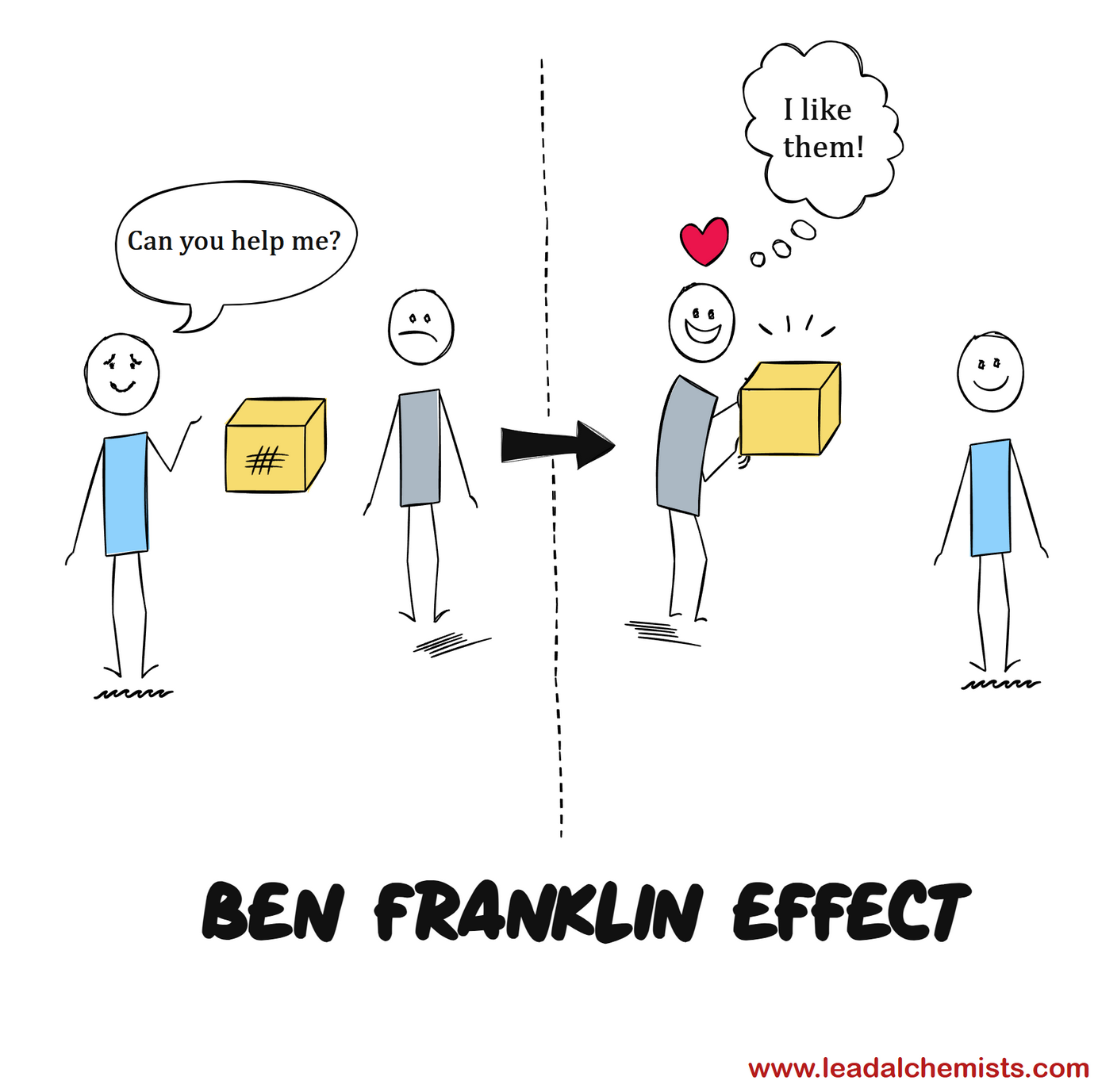
At its psychological core, the Ben Franklin Effect works because humans need cognitive consistency between their actions and attitudes – when we do a favour for someone, our brains rationalize this behavior by concluding that we must like them, since we don’t help people we dislike. This creates a psychological shift where the act of helping increases positive feelings toward the recipient, making it far more likely that we’ll help them again and develop stronger emotional bonds rather than remaining indifferent or distant from those we’ve invested effort in helping.
For marketers and advertisers, understanding this bias gives a real competitive edge. By purposefully and strategically asking customers for small favours like reviews, feedback, content contributions, or community participation while delivering genuine appreciation and value in return, you can deepen emotional connections and foster loyalty in ways that other persuasion techniques simply cannot match.
How The Ben Franklin Effect Works (The Psychology Behind It)
The Ben Franklin Effect operates through several interconnected psychological mechanisms that reveal the complex relationship between our actions and attitudes.
Cognitive Dissonance Theory
The primary explanation lies in cognitive dissonance theory, developed by Leon Festinger in 1957. When we perform a favour for someone we feel neutral or negative about, it creates psychological discomfort, a mismatch between our actions and our feelings. To resolve this dissonance, our brain adjusts our attitudes to justify our helpful behaviour, concluding that we must like the person enough to help them.
This mental reconciliation happens automatically and unconsciously. Our brain essentially asks: “Why did I help this person? I must like them more than I thought.”
Self-Perception Theory
An alternative explanation comes from self-perception theory, which suggests that when we lack strong preexisting attitudes, we infer our feelings by observing our own behaviour. If we see ourselves helping someone, we conclude that we must have positive feelings toward them.
Neurological Mechanisms
While direct neurological studies of the Ben Franklin Effect are limited, research on related phenomena suggests that helping behaviours activate reward centres in the brain, creating positive associations with the recipient. The act of being asked for a favour can also make someone feel respected or acknowledged, further enhancing positive feelings.
Contextual Factors
The effect is most pronounced when the helper previously felt neutral toward the recipient, the favour is small enough to be manageable, and the request doesn’t feel manipulative. Close relationships or overly burdensome requests can diminish or eliminate the effect entirely.
Real-World Examples of The Ben Franklin Effect
The Ben Franklin Effect manifests across various contexts, from historical anecdotes to modern business applications.
The Original Franklin Story
Benjamin Franklin himself described using this technique in his autobiography. Facing opposition from a rival legislator, Franklin asked to borrow a rare book from the man’s library. After the legislator lent him the book, their relationship improved dramatically, and the former rival became a lifelong friend.
Wikipedia’s Donation Strategy
Wikipedia’s fundraising approach exemplifies the Ben Franklin Effect in action. By asking users for small donations, Wikipedia increases users’ positive feelings toward the platform. While specific A/B test data isn’t publicly available, the sustained success of this model – generating millions in donations from small contributions – suggests its psychological effectiveness.
The act of donating reinforces users’ belief in Wikipedia’s value and importance. Having invested in the platform, donors develop stronger emotional connections and are more likely to contribute again.
Educational Settings
Teachers who ask students for feedback on their teaching methods often see improved classroom relationships. When students provide input that teachers implement, it creates a sense of partnership and investment in the learning process.
Workplace Dynamics
Asking colleagues for small favours – such as feedback on a project or assistance with a task – can strengthen professional relationships more effectively than offering help. The colleague who provides assistance develops more positive feelings toward the requester.
How The Ben Franklin Effect Affects Consumer Behaviour
Understanding how this effect influences consumer psychology reveals powerful insights for marketers seeking to build stronger customer relationships.
Psychological Triggers
The Ben Franklin Effect activates several key psychological triggers:
- Investment bias: When customers invest time or effort in helping a brand, they become more committed to its success
- Consistency principle: Having helped once, customers feel compelled to maintain consistent behaviour
- Ownership feeling: Contributing to a brand’s development creates a sense of partial ownership
Brain Response Patterns
When customers perform favours for brands, their brains process these actions as investments. The effort justification mechanism kicks in, where the brain increases the perceived value of something we’ve worked for. This neurological response strengthens the emotional connection between customer and brand.
Decision-Making Impact
Customers who have done favours for a brand show increased:
- Purchase intention
- Brand loyalty
- Willingness to recommend
- Tolerance for minor service issues
- Engagement with brand communications
The effect creates a positive feedback loop where small favours lead to stronger relationships, which encourage larger commitments over time.
Case Studies: How Marketers Use The Ben Franklin Effect in Advertising
While direct case studies isolating the Ben Franklin Effect are limited, several verified applications demonstrate its principles in action.
E-commerce Feedback Requests
Online retailers who request feedback after purchases leverage this effect. Customers who provide reviews or ratings develop stronger positive feelings toward the brand. The act of helping other customers through reviews creates investment in the brand’s success.
Implementation: Automated email sequences asking for product reviews, with follow-up messages thanking customers for their contribution and highlighting how their feedback helps other shoppers.
The Ben Franklin Sales Technique
Sales professionals use a documented technique called the “Ben Franklin sales method,” where they present pros and cons to help customers make decisions. By asking customers to participate in the decision-making process and provide input, salespeople increase engagement and trust.
Application: Rather than simply presenting product benefits, sales teams ask prospects to help evaluate options, creating collaborative decision-making experiences.
Content Co-Creation Strategies
Brands that ask customers to contribute content (whether through user-generated campaigns, testimonials, or product suggestions) see increased engagement and loyalty. While specific metrics aren’t always publicly available, the widespread adoption of these strategies suggests their effectiveness.
Example: A local accounting firm publishes blog posts on tax deductions, then includes simple surveys asking “Was this article helpful?” followed by “What other tax topics would you like us to cover?” This approach transforms passive readers into active contributors.
Practical Applications for Google Ads & Lead Generation
The Ben Franklin Effect offers several practical applications for businesses focused on lead generation and customer acquisition.
Google Ads Implementation
Micro-Commitment Strategy: Instead of directly asking for high-commitment actions like “Book a Consultation,” start with smaller requests in ad copy.
- Traditional approach: “Professional Cleaning Services – Book Now!”
- Ben Franklin approach: “Need a Quick Cleaning Tip? Get our free checklist!”
The second approach initiates a small favour (downloading the checklist) before requesting a quote, potentially increasing conversion rates through the psychological commitment created by the initial action.
A/B Test Framework:
- Control Group: Standard ad copy with direct calls-to-action
- Test Group: Ads requesting small favours first, followed by progressive requests
- Metrics: Click-through rates, landing page conversion rates, cost per lead
Landing Page Optimization
“Help Us Help You” Forms: Frame form submissions as ways for customers to help businesses understand their needs better, rather than one-sided information requests.
- Traditional: “Request a Quote”
- Ben Franklin approach: “Help us understand your needs so we can provide the best quote”
Progressive Profiling: Break forms into smaller steps, each framed as helping the business tailor its services:
- “What are your biggest marketing challenges?”
- “To help us understand your goals better, what are your revenue targets?”
- “Finally, what’s the best way to contact you?”
Lead Magnet Strategy
After someone downloads a lead magnet, ask for feedback. This small favour can increase their sense of connection and commitment.
Example: An SEO consultant provides a free keyword research template, then follows up with: “We hope you found the template useful! Would you mind sharing one quick insight you gained from using it?”
Low-Cost Implementation
The Ben Franklin Effect primarily requires strategic language changes rather than significant resource investments:
Create participation opportunities: Ask customers to contribute ideas, suggestions, or experiences
Reframe requests: Transform transactional language into collaborative language
Add feedback mechanisms: Include simple surveys or feedback requests in existing content
Why Marketers Should Care About The Ben Franklin Effect
The Ben Franklin Effect represents a powerful tool for building customer relationships, but it requires careful and ethical implementation.
Strategic Advantages
Relationship Building: Unlike traditional marketing approaches that focus on giving value to receive loyalty, the Ben Franklin Effect builds relationships through customer investment. When customers contribute to a brand’s success, they develop stronger emotional connections.
Cost-Effective Engagement: Implementing this effect often requires language changes rather than significant resource investments, making it accessible to businesses of all sizes.
Sustainable Loyalty: Customers who feel invested in a brand’s success show higher retention rates and lifetime value compared to those who simply receive benefits.
Ethical Considerations
Transparency Requirements: Requests for favours must be genuine and transparent. Customers should understand how their contributions will be used and benefit from providing them.
Mutual Benefit: The most ethical applications ensure that customer favours genuinely help improve products or services, creating value for all customers.
Voluntary Participation: Requests should never feel coercive or manipulative. Customers must feel free to decline without negative consequences.
Risks of Misuse
Manipulation Concerns: Using the effect to induce customers to act against their interests is unethical and can damage brand reputation when discovered.
Relationship Damage: Overly burdensome requests or deceptive framing can backfire, creating negative associations instead of positive ones.
Trust Erosion: If customers perceive requests as manipulative rather than collaborative, it can permanently damage brand relationships.
How to Implement The Ben Franklin Effect in Your Marketing Strategy
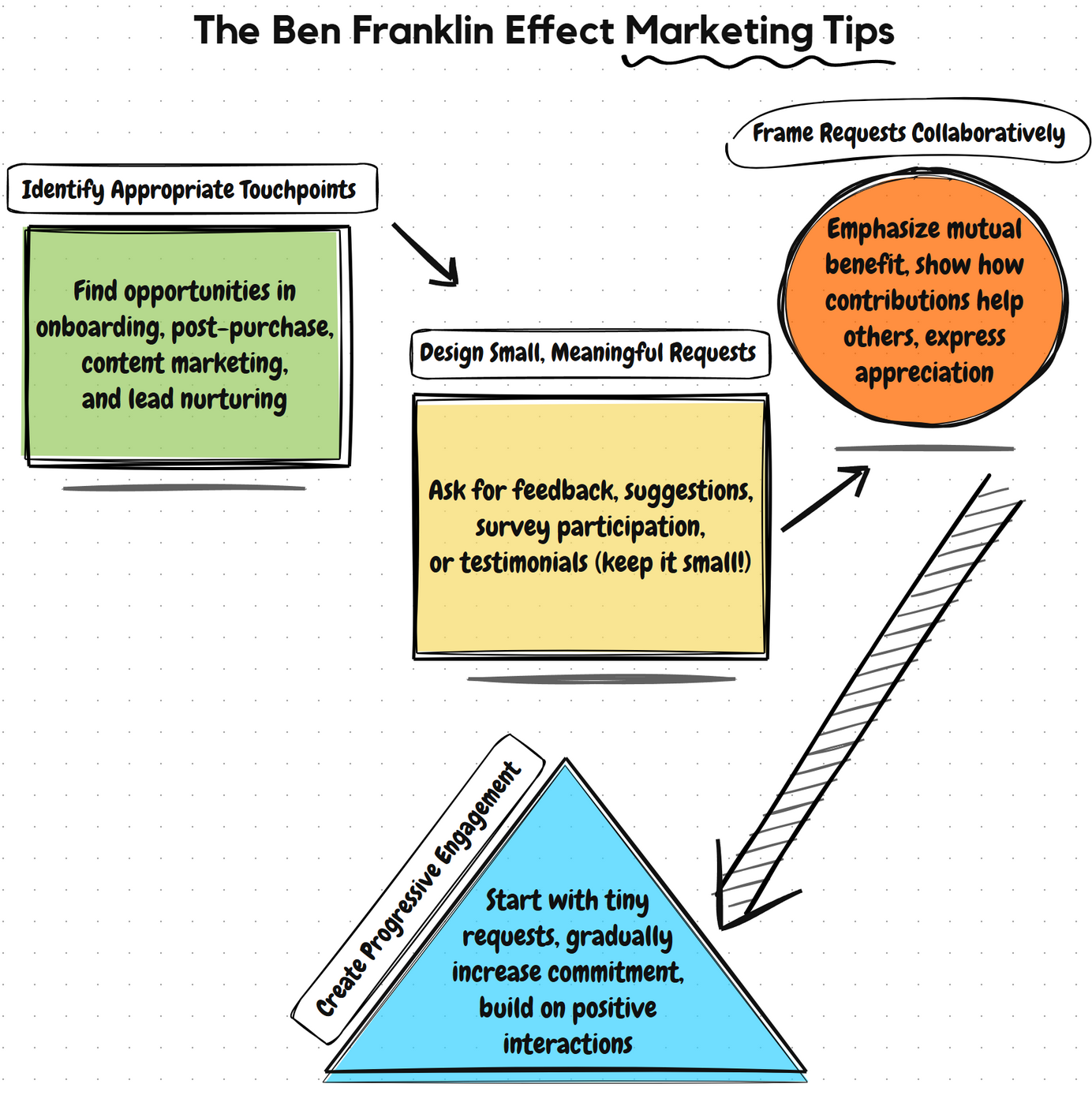
Successfully implementing the Ben Franklin Effect requires strategic planning and careful execution.
Step-by-Step Implementation
1. Identify Appropriate Touchpoints
- Customer onboarding processes
- Post-purchase communications
- Content marketing initiatives
- Lead nurturing sequences
2. Design Small, Meaningful Requests
- Feedback on products or services
- Suggestions for improvements
- Participation in surveys or polls
- Content contributions or testimonials
3. Frame Requests Collaboratively
- Emphasise mutual benefit
- Explain how contributions help other customers
- Show appreciation for participation
- Demonstrate how feedback is implemented
4. Create Progressive Engagement
- Start with very small requests
- Gradually increase commitment levels
- Build on previous positive interactions
- Maintain consistent appreciation
Best Practices
Keep Requests Small: Initial favours should require minimal time and effort. Complex or time-consuming requests can create resistance rather than positive feelings.
Show Impact: Demonstrate how customer contributions make a difference. Share how feedback led to improvements or how suggestions were implemented.
Express Genuine Appreciation: Acknowledge contributions meaningfully, showing that customer input is valued and acted upon.
Maintain Authenticity: Requests must serve genuine business purposes, not just psychological manipulation.
Common Pitfalls
Over-Requesting: Too many favour requests can create fatigue and resentment. Space requests appropriately and vary their nature.
Ignoring Contributions: Failing to acknowledge or act on customer input undermines the effect and damages relationships.
Manipulative Framing: Requests that feel deceptive or self-serving can backfire spectacularly.
One-Size-Fits-All Approach: Different customer segments may respond differently to various types of requests.
A/B Testing Framework
Test Variables:
- Request timing (immediate vs. delayed)
- Request size (small vs. medium favours)
- Framing language (collaborative vs. transactional)
- Follow-up approaches (appreciation methods)
Success Metrics:
- Response rates to initial requests
- Subsequent engagement levels
- Customer lifetime value changes
- Net Promoter Score improvements
Related Psychological Biases & Effects
Understanding how the Ben Franklin Effect relates to other psychological principles helps marketers create more comprehensive strategies.
Foot-in-the-Door Technique
Closely related to the Ben Franklin Effect, this technique involves securing agreement to a small request before making larger ones. The key difference is that the Ben Franklin Effect focuses on how doing favours changes attitudes, while foot-in-the-door emphasises compliance escalation.
Commitment and Consistency Principle
Robert Cialdini’s principle of commitment and consistency explains why people who make small commitments are likely to make larger ones. The Ben Franklin Effect leverages this by turning favour-doing into a form of commitment to the relationship.
Reciprocity Principle
While reciprocity suggests people return favours they receive, the Ben Franklin Effect works in reverse – people like those they help more than those who help them. Understanding both principles allows for more sophisticated relationship-building strategies.
Social Proof
Unlike social proof, which relies on observing others’ behaviour, the Ben Franklin Effect focuses on how our own actions shape our attitudes. Both can be used complementarily in marketing strategies.
Cognitive Dissonance Theory
The broader theory of cognitive dissonance underlies many marketing applications. The Ben Franklin Effect represents one specific application where action-attitude inconsistency drives attitude change.
The Ben Franklin Effect offers marketers a scientifically-backed approach to building stronger customer relationships through strategic engagement. By understanding how small favours create positive feelings and implementing this knowledge ethically, businesses can foster deeper connections that drive long-term success.
Rather than simply giving value to customers, the Ben Franklin Effect suggests that asking customers to contribute creates more powerful emotional bonds. When implemented thoughtfully and transparently, this approach transforms transactional relationships into collaborative partnerships that benefit both businesses and customers.
FAQs About Ben Franklin Effect
What is the Ben Franklin Effect and how does it work?
The Ben Franklin Effect is a psychological phenomenon where people develop more positive feelings toward someone after doing them a favour, rather than after receiving a favour from them. This counterintuitive effect works through cognitive dissonance – when you do a favour for someone you don’t particularly like, your brain resolves the inconsistency by deciding you must actually like them to justify your helpful behaviour.
The effect is supported by self-perception theory as well. When people lack strong preexisting attitudes, they infer their feelings by observing their own actions. If you help someone, you unconsciously conclude you must like that person.
Why is it called the Ben Franklin Effect?
It’s named after Benjamin Franklin, who described using this technique in his autobiography to win over a political rival. Franklin asked an opponent to lend him a rare book, and after the man obliged, their relationship improved significantly. Franklin noted that “he that has once done you a kindness will be more ready to do you another than he whom you yourself have obliged.”
However, the effect was first scientifically tested by Jecker and Landy in 1969, who demonstrated that participants who returned money as a personal favour to an experimenter rated him more positively than those who didn’t.
How does the Ben Franklin Effect influence our relationships?
The Ben Franklin Effect can strengthen relationships by creating positive feedback loops. When you ask someone for a small favour – like advice, feedback, or help with a task – they’re more likely to view you favourably afterward. This works particularly well in:
- Professional settings: Asking a colleague for input on a project
- Social situations: Requesting recommendations or opinions
- New relationships: Where initial attitudes are neutral
The key is asking for reasonable, voluntary favours that make the other person feel valued and respected, not exploited.
What’s the difference between the Ben Franklin Effect and cognitive dissonance?
Cognitive dissonance is the broader psychological theory explaining discomfort from conflicting beliefs and actions. The Ben Franklin Effect is a specific application of this theory.
Cognitive dissonance encompasses many situations where people change attitudes to match behaviour. The Ben Franklin Effect specifically focuses on how performing favours influences liking. While cognitive dissonance explains the mechanism, the Ben Franklin Effect describes the particular outcome in interpersonal relationships.
Who first studied the Ben Franklin Effect scientifically?
Jecker and Landy (1969) conducted the first empirical study of the Ben Franklin Effect. In their experiment, participants who returned money as a personal favour to the experimenter rated him more positively than those who did a favour for charity or weren’t asked for any favour.
Schopler and Compere (1971) provided additional support, showing that teachers who praised students rated them as more likeable, while those who criticised students rated them less favourably. Modern studies in the 2010s-2020s have replicated the effect in various contexts, though some note it’s less robust in close relationships.
What brain mechanisms are involved in the Ben Franklin Effect?
The Ben Franklin Effect primarily involves cognitive processing rather than specific brain regions. The key mechanisms include:
- Cognitive dissonance reduction: The brain resolves inconsistency between actions and attitudes
- Self-perception processing: Inferring feelings from observing one’s own behaviour
- Attribution processes: Deciding why you performed the favour
While no direct neuroimaging studies have isolated the Ben Franklin Effect specifically, it likely involves areas associated with social cognition, decision-making, and attitude formation – including the prefrontal cortex and anterior cingulate cortex.
Are there any studies that challenge the Ben Franklin Effect?
Yes, several factors can limit or moderate the Ben Franklin Effect:
- Relationship closeness: The effect is less robust in existing close relationships
- Perceived manipulation: If the favour request seems manipulative, it can backfire
- Favour size: Overly burdensome requests may create resentment rather than liking
- Cultural factors: The effect may vary across different cultural contexts
Some researchers highlight methodological limitations in early studies, including small sample sizes and artificial laboratory settings. The effect doesn’t generalise to all types of favours or relationships, making it more context-dependent than initially thought.
What are some famous real-world examples of the Ben Franklin Effect?
Beyond Franklin’s original book-borrowing story, documented applications include:
- Wikipedia’s donation model: Asking users for small donations increases positive feelings toward the platform
- Customer feedback requests: E-commerce sites asking for reviews after purchases
- Political engagement: Politicians requesting small acts of support (displaying signs) to increase commitment
However, it’s important to note that few peer-reviewed case studies provide quantifiable results directly attributable to the Ben Franklin Effect. Most examples are supported by behavioural psychology principles rather than controlled marketing experiments.
How is the Ben Franklin Effect portrayed in movies and literature?
The Ben Franklin Effect appears in various forms of media, though often not explicitly named:
- Sales and negotiation scenes where characters build rapport by asking for small favours
- Romantic comedies featuring characters who grow closer after one helps the other
- Workplace dramas showing relationship improvements through collaborative requests
However, specific documented portrayals in major films or literature are limited. The effect is more commonly referenced in business and psychology books rather than popular entertainment media.
Can you see the Ben Franklin Effect in historical events?
While the Ben Franklin Effect is documented in interpersonal psychology, there’s no robust evidence linking it to large-scale historical events. Most documented applications occur at the individual or small-group level.
Historical examples are typically anecdotal rather than scientifically verified. The effect works best in personal relationships and small-scale interactions, making it less applicable to major political or economic decisions that shape history.
What’s the difference between the Ben Franklin Effect and the halo effect?
The halo effect is when an overall positive impression influences specific judgements about someone’s character or abilities. The Ben Franklin Effect specifically involves how doing favours influences liking.
Key differences:
- Halo effect: General impression affects specific judgements
- Ben Franklin Effect: Specific action (doing a favour) affects overall attitude
- Halo effect: Based on existing positive impressions
- Ben Franklin Effect: Creates positive feelings through behaviour
The Ben Franklin Effect is more action-based, while the halo effect is more perception-based.
How does the Ben Franklin Effect compare to anchoring bias?
These are completely different psychological phenomena:
Anchoring bias involves relying too heavily on the first piece of information (the “anchor”) when making decisions. The Ben Franklin Effect involves attitude change through favour-doing.
- Anchoring bias: About information processing and decision-making
- Ben Franklin Effect: About relationship dynamics and attitude formation
- No direct relationship exists between these two cognitive biases
Is there an opposite effect to the Ben Franklin Effect?
There isn’t a formally recognised “opposite” effect, but related phenomena include:
- Reactance: When people resist requests that feel manipulative or coercive
- Exploitation concerns: If favours feel one-sided or burdensome, they can create resentment
- Reciprocity pressure: Feeling obligated to return favours can sometimes create negative feelings
The key factor is whether the favour request feels genuine and voluntary versus manipulative or exploitative.
How do the Ben Franklin Effect and confirmation bias relate to each other?
These operate in different domains but can interact:
Confirmation bias involves seeking information that confirms existing beliefs. The Ben Franklin Effect can create new positive attitudes that then become subject to confirmation bias.
Potential interaction: Once the Ben Franklin Effect creates positive feelings, confirmation bias might lead people to notice more positive qualities in that person, reinforcing the initial effect.
How do marketers use the Ben Franklin Effect in advertising?
Marketers apply the Ben Franklin Effect through verified strategies including:
- Feedback requests: Asking customers for reviews or input after purchases
- Micro-commitments: Starting with small requests (downloading guides) before larger asks (consultations)
- “Help us help you” framing: Positioning form submissions as helping the business serve customers better
Important note: While these strategies are psychologically sound, few peer-reviewed case studies provide quantifiable conversion improvements specifically attributable to the Ben Franklin Effect. Marketers should test these approaches rather than assume guaranteed results.
Can the Ben Franklin Effect influence consumer purchasing decisions?
The Ben Franklin Effect can indirectly influence purchasing through relationship building, but it’s not primarily a direct sales tool.
Applications include:
- Building brand loyalty through feedback requests
- Increasing engagement via customer input opportunities
- Creating positive associations through small favour requests
However, the effect works best for relationship building rather than immediate purchase decisions. It’s more valuable for long-term customer relationships than short-term conversions.
How does the Ben Franklin Effect apply to brand loyalty?
The Ben Franklin Effect can strengthen brand loyalty by making customers feel more invested in the brand relationship:
- Customer feedback: Asking for input makes customers feel valued
- User-generated content: Requesting reviews or testimonials
- Community participation: Inviting customers to share experiences
The key is ensuring requests feel genuine and mutually beneficial rather than exploitative. When customers contribute to a brand, they’re more likely to feel positively toward it.
Do companies use the Ben Franklin Effect in pricing strategies?
There’s limited direct evidence of the Ben Franklin Effect being used specifically in pricing strategies. However, related applications might include:
- Feedback on pricing: Asking customers to evaluate pricing options
- Value co-creation: Involving customers in determining service packages
- Pricing surveys: Requesting input on pricing preferences
These strategies are more about customer engagement than direct pricing manipulation. The effect is better suited to relationship building than pricing psychology.
Is it ethical to use the Ben Franklin Effect in marketing?
Using the Ben Franklin Effect ethically requires transparency and mutual benefit:
Ethical applications:
- Genuine requests for feedback that improve products
- Voluntary participation without pressure or coercion
- Mutual value where both parties benefit
Unethical applications:
- Manipulative requests designed solely to exploit psychological tendencies
- Deceptive framing that misrepresents the purpose
- Excessive demands that burden customers
The key is ensuring requests are authentic, voluntary, and beneficial to both parties.
What are the risks of exploiting the Ben Franklin Effect?
Potential risks include:
- Backfire effects: If customers perceive manipulation, it can damage trust
- Relationship damage: Excessive or inappropriate requests can harm brand perception
- Ethical concerns: Exploitative use can lead to negative publicity
- Diminishing returns: Overuse can reduce effectiveness
Best practices involve keeping requests small, genuine, and mutually beneficial while respecting customer autonomy.
Can the Ben Franklin Effect lead to manipulation or misinformation?
Yes, the Ben Franklin Effect can be misused for manipulation:
Potential misuse:
- False intimacy: Creating artificial closeness through favour requests
- Exploitation: Using small favours to justify larger, unreasonable requests
- Deception: Misrepresenting the purpose of favour requests
Protection strategies include maintaining awareness of the effect, questioning motives behind favour requests, and ensuring any participation is genuinely voluntary.
How can people protect themselves from the Ben Franklin Effect?
Awareness and critical thinking are key protections:
- Recognise the pattern: Understand how doing favours can influence your feelings
- Question motives: Consider whether favour requests serve mutual interests
- Maintain boundaries: Don’t feel obligated to comply with every request
- Evaluate relationships: Assess whether interactions feel genuine or manipulative
The goal isn’t to avoid all favours but to ensure they’re voluntary and mutually beneficial.
How does the Ben Franklin Effect show up in everyday conversations?
The Ben Franklin Effect appears in daily interactions through:
- Asking for advice: People often feel more positive toward those they’ve helped
- Requesting opinions: Seeking input on decisions or preferences
- Small favours: Borrowing items, asking for directions, or requesting assistance
Natural applications include genuinely seeking help or input, which can strengthen relationships when done appropriately.
Can the Ben Franklin Effect improve workplace relationships?
Yes, when applied thoughtfully:
Effective workplace applications:
- Seeking colleague input on projects or decisions
- Asking for feedback on presentations or ideas
- Requesting advice on professional challenges
Important considerations:
- Keep requests reasonable and voluntary
- Ensure mutual benefit rather than one-sided advantage
- Avoid overuse that might seem manipulative
How does the Ben Franklin Effect affect dating and romantic relationships?
The Ben Franklin Effect has limited applicability in romantic contexts:
Potential applications:
- Asking for opinions on choices or preferences
- Seeking advice on topics of mutual interest
- Small collaborative tasks that feel natural
Important limitations:
- The effect works best with neutral or slightly negative initial attitudes
- In romantic contexts, authenticity matters more than psychological techniques
- Overuse can feel manipulative and damage genuine connection
Do social media interactions trigger the Ben Franklin Effect?
Social media can create limited versions of the Ben Franklin Effect:
Possible applications:
- Asking followers for input on content or decisions
- Requesting shares or engagement with posts
- Seeking feedback on products or services
Limitations:
- Digital interactions may be less powerful than face-to-face requests
- Algorithmic filtering can limit who sees requests
- Authenticity concerns in digital environments
How can teachers use the Ben Franklin Effect in education?
Teachers can apply the Ben Franklin Effect through:
Classroom applications:
- Seeking student feedback on teaching methods
- Asking for input on lesson topics or activities
- Requesting help with classroom tasks or organisation
Benefits:
- Improved teacher-student relationships
- Increased student engagement
- Better classroom atmosphere
Cautions: Ensure requests are age-appropriate and genuine rather than manipulative.
What are the most searched questions about the Ben Franklin Effect?
Common search queries include:
- “What is the Ben Franklin Effect” (definition and explanation)
- “Ben Franklin Effect examples” (real-world applications)
- “How to use Ben Franklin Effect” (practical applications)
- “Ben Franklin Effect marketing” (business applications)
- “Ben Franklin Effect psychology” (scientific basis)
These searches indicate interest in both understanding the concept and practical applications.
How can content creators optimise for Ben Franklin Effect searches?
SEO strategies for Ben Franklin Effect content:
- Target long-tail keywords like “Ben Franklin Effect in marketing” or “how to use Ben Franklin Effect”
- Include related terms: cognitive dissonance, persuasion psychology, relationship building
- Provide practical examples and actionable advice
- Address common misconceptions and limitations
- Use clear, structured formatting for featured snippets
Why is the Ben Franklin Effect trending in psychology discussions?
The Ben Franklin Effect gains attention because it:
- Challenges intuition about how relationships work
- Offers practical applications in business and personal contexts
- Connects to broader interest in behavioural psychology and influence
- Provides actionable insights for relationship building
However, trending status varies and depends on current interest in psychology and marketing topics.
What keywords are related to the Ben Franklin Effect for SEO?
Primary keywords:
- Ben Franklin Effect
- Benjamin Franklin psychology
- Cognitive dissonance marketing
Related terms:
- Persuasion psychology
- Relationship building techniques
- Customer loyalty strategies
- Behavioural psychology marketing
- Social influence tactics
Long-tail variations:
- How to use Ben Franklin Effect in business
- Ben Franklin Effect examples in marketing
- Psychology of doing favours
How long does the Ben Franklin Effect typically last?
The duration varies based on several factors:
Influencing factors:
- Relationship context: Effects may be stronger in ongoing relationships
- Favour significance: Larger favours may create longer-lasting effects
- Subsequent interactions: Continued positive or negative experiences affect duration
Research limitations: Most studies measure immediate effects rather than long-term duration. The lasting impact likely depends on whether the initial positive feelings are reinforced through subsequent interactions.
Can the Ben Franklin Effect be measured or quantified?
The Ben Franklin Effect can be measured through:
Research methods:
- Attitude surveys before and after favour requests
- Behavioural observations of subsequent interactions
- Experimental designs comparing favour and control groups
Business metrics:
- Customer satisfaction scores after feedback requests
- Engagement rates following favour-based campaigns
- Relationship quality indicators in ongoing interactions
However, isolating the effect from other factors can be challenging in real-world applications.
Does the Ben Franklin Effect work differently across cultures?
Cultural variation is likely but under-researched:
Potential differences:
- Collectivist vs. individualist cultures may respond differently
- Power distance variations could affect favour dynamics
- Communication styles might influence how requests are perceived
Research gap: Most studies have been conducted in Western contexts, limiting our understanding of cross-cultural applicability. More research is needed to understand cultural moderators.
Curious about other psychological biases that influence customer behavior? Explore our comprehensive guide to cognitive biases in marketing here.