Guide to The Endowed Progress Effect in Marketing: Description, Psychology, and Examples
What Is The Endowed Progress Effect?
The Endowed Progress Effect is the tendency for people to be significantly more motivated to complete a goal when they believe they’ve already made some progress towards it, even if that initial progress is artificially provided or illusory. This powerful psychological phenomenon explains why customers are more likely to complete coffee loyalty cards with two pre-filled stamps, why multi-step forms with progress bars boost completion rates, and why giving people a “head start” dramatically increases follow-through on tasks and purchases.
At its psychological core, the Endowed Progress Effect works because humans are goal-oriented beings who experience psychological discomfort when abandoning partially completed tasks – once we perceive we’ve invested effort or made headway, our brains become psychologically compelled to continue until completion. When customers believe they’ve already started a journey, whether through pre-filled progress bars, bonus loyalty stamps, or partially completed forms, they feel invested in the outcome, making it far more likely that they’ll follow through rather than abandoning what feels like wasted initial progress.
For marketers and advertisers, understanding this bias gives a real competitive edge. By purposefully and strategically providing artificial head starts through progress indicators, bonus points, or pre-completion elements while delivering genuine value throughout the customer journey, you can dramatically increase task completion and conversion rates in ways that other persuasion techniques simply cannot match.
How The Endowed Progress Effect Works (The Psychology Behind It)
The Endowed Progress Effect operates through several interconnected psychological mechanisms that drive human motivation and behaviour.
Goal Gradient Effect
People naturally accelerate their efforts as they perceive themselves getting closer to a reward or completion. The Endowed Progress Effect leverages this by creating an artificial sense of proximity to the goal, even when the actual effort required remains the same.
Zeigarnik Effect
Unfinished tasks create psychological tension that motivates completion. When someone perceives they’ve already started something, this tension drives them to finish what they’ve begun, even if the initial “start” was artificially provided.
Commitment and Consistency
Once people believe they’ve made initial progress, they feel psychologically committed to the task. This aligns with Robert Cialdini’s principle of commitment and consistency – we have a deep desire to appear consistent with our previous actions and decisions.
Perceived Ownership
Artificial progress can create a sense of psychological ownership over the goal or process. When customers feel they “own” part of the progress, they’re more invested in seeing it through to completion.
The key insight is that the effect isn’t driven by loss aversion or sunk cost fallacy, as some might assume. Research indicates the primary mechanism is the perception of progress and momentum, which creates genuine motivation to continue.
Real-World Examples of The Endowed Progress Effect
The Endowed Progress Effect appears across numerous contexts, both within marketing and in everyday life situations.
The Classic Loyalty Card Study
The most famous demonstration comes from Nunes and Drèze’s car wash experiment. Customers received either an 8-stamp loyalty card or a 10-stamp card with 2 stamps already provided. Both groups needed 8 purchases for a free wash, but the “endowed” group had a 34% completion rate compared to just 19% for the standard group.
Digital Onboarding Experiences
Many SaaS companies and apps use progress bars that start above zero when users begin account setup. LinkedIn, for instance, shows profile completion percentages that give users credit for basic information, encouraging them to reach 100% completion.
Educational Platforms
Online learning platforms often award initial badges or show course progress starting at 10% upon enrollment. This creates immediate momentum and increases the likelihood students will continue through the material.
Fundraising Campaigns
Charitable organisations frequently display donation progress showing campaigns are already partially funded (e.g., “£2,000 of £10,000 raised”) rather than starting from zero, which increases donor participation rates.
How The Endowed Progress Effect Affects Consumer Behaviour
When the Endowed Progress Effect is triggered, several neurological and behavioural changes occur that directly impact purchasing psychology.
Increased Task Persistence
Consumers who perceive initial progress demonstrate significantly higher persistence rates. They’re more likely to complete forms, finish application processes, and follow through on multi-step purchases.
Enhanced Perceived Value
The artificial progress creates a sense that customers have already “invested” in the outcome, making the final goal feel more valuable and worth pursuing.
Reduced Abandonment Rates
Whether it’s shopping cart abandonment or lead form drop-offs, providing a sense of initial progress substantially reduces the likelihood customers will abandon the process midway.
Accelerated Decision-Making
The psychological momentum created by perceived progress often leads to faster decision-making, as customers feel they’re already “committed” to the path.
Research using fMRI scans shows that perceived progress activates reward centres in the brain, creating genuine neurological motivation to continue. This isn’t just a marketing trick – it’s tapping into fundamental brain chemistry that drives goal-seeking behaviour.
Case Studies: How Marketers Use The Endowed Progress Effect in Advertising
Verified Academic Case Study: Car Wash Loyalty Programme
The foundational research by Nunes and Drèze provides the most robust evidence for the Endowed Progress Effect in marketing. In their car wash experiment, customers with artificially endowed progress (2 free stamps on a 10-stamp card) completed their loyalty cards at nearly double the rate of those with standard 8-stamp cards.
Key Results:
- 34% completion rate for endowed progress group
- 19% completion rate for standard group
- Same actual effort required (8 purchases)
- Customers purchased their next coffee 1.9 days sooner
This study demonstrates that providing an artificial head start significantly increases motivation and completion rates in loyalty programmes.
Digital Marketing Applications (Evidence-Based Recommendations)
While peer-reviewed case studies in digital marketing are limited, several evidence-based applications show promise:
Multi-Step Forms with Progress Bars: Breaking long forms into smaller steps with visual progress indicators creates a sense of advancement. Service-based businesses can implement this for consultation requests or quote forms.
Pre-Filled Form Fields: Auto-detecting and pre-populating information like location or industry gives users an artificial head start, reducing perceived effort and increasing completion rates.
Onboarding Sequences: SaaS companies and service providers use multi-step onboarding with progress tracking, though specific attribution to the Endowed Progress Effect requires further research.
Practical Applications for Google Ads & Lead Generation
The Endowed Progress Effect offers several actionable strategies for businesses focused on lead generation and conversion optimisation.
Google Ads Copywriting Strategies
Frame ads as continuing a journey: Instead of “Get a Free Quote,” try “Take the Next Step – Get Your Free Quote.” This implies the prospect has already begun a process.
Offer head starts in ad copy: “Start Your Business Growth Journey – Free Marketing Audit Included” suggests the audit is the first step in a larger process.
Use progress-oriented language: Phrases like “Step 1 Complete” or “You’re Already Qualified” create immediate momentum.
Landing Page Optimisation
Multi-Step Form Design: Break lead generation forms into 2-3 steps with a progress bar. Even if the total information required is the same, the visual progress encourages completion.
Pre-Filled Information: Use available data (location, referral source, previous interactions) to pre-populate form fields, giving visitors a sense they’ve already made progress.
Progress-Based Headlines: Replace “Contact Us” with “Complete Your Free Consultation Request (Step 2 of 3)” to create momentum.
A/B Testing Opportunities
Test Scenario for Service Businesses:
- Control: Standard single-page contact form
- Treatment: Three-step form with progress bar starting at “Step 1 of 3 Complete”
- Measure: Form completion rates and lead quality
Lead Magnet Enhancement:
- Control: “Download Free Guide”
- Treatment: “Access Your 3-Part Success Series (Part 1 Ready Now)”
- Measure: Download rates and email engagement
Low-Cost Implementation Strategies
Small businesses can implement these strategies using readily available tools:
Email sequences can be structured as progressive courses or challenges
Free form builders like Typeform or Google Forms offer multi-step functionality
WordPress progress bar plugins are available at no cost
Landing page builders like Carrd or Google Sites can create simple progress-based pages
Why Marketers Should Care About The Endowed Progress Effect
The Endowed Progress Effect represents a significant opportunity for marketers to improve conversion rates and customer engagement through scientifically-backed psychological principles.
Measurable Business Impact
The original research showed completion rate improvements of nearly 80% (from 19% to 34%). While results will vary by industry and implementation, even modest improvements can substantially impact lead generation and customer acquisition costs.
Competitive Advantage
Most businesses haven’t systematically applied the Endowed Progress Effect to their marketing processes. Early adopters can gain significant advantages in conversion rates and customer engagement.
Enhanced Customer Experience
Rather than manipulating customers, the Endowed Progress Effect can genuinely improve user experience by making processes feel more manageable and rewarding. Customers appreciate clear progress indicators and reduced friction.
Ethical Considerations and Responsible Use
The Endowed Progress Effect should be applied transparently and ethically. Best practices include:
Provide genuine value: Ensure any “head start” offers real benefit to customers, not just artificial progress.
Maintain transparency: Be clear about process steps and requirements. Avoid creating false expectations about effort or outcomes.
Focus on user benefit: Use the effect to make genuinely complex processes more manageable, not to manipulate customers into unwanted commitments.
Test and measure: Implement A/B tests to ensure the effect improves rather than harms user experience and business outcomes.
Misuse of this principle – such as creating misleading progress indicators or false scarcity – can damage trust and brand reputation. The goal should be helping customers complete valuable processes, not tricking them into unwanted actions.
How to Implement The Endowed Progress Effect in Your Marketing Strategy

Successfully implementing the Endowed Progress Effect requires systematic planning and testing across your marketing funnel.
Step 1: Audit Your Current Processes
Identify multi-step processes in your marketing and sales funnel:
- Lead generation forms
- Account setup or onboarding
- Quote request processes
- Email course or content series
- Consultation booking systems
Step 2: Design Progress-Enhanced Experiences
For Forms: Break long forms into logical steps with progress indicators. Ensure each step feels meaningful and builds toward the final goal.
For Content: Structure lead magnets as multi-part series rather than single downloads. Frame the first piece as immediate value with more to come.
For Services: Present consultation or discovery processes as journeys with clear milestones and progress markers.
Step 3: Create Artificial Head Starts
Pre-fill available information: Use location data, referral sources, or previous interactions to give prospects a sense of progress.
Provide immediate value: Offer something useful (assessment, guide, tool) as “step one” of a larger process.
Acknowledge existing efforts: If prospects found you through research or referrals, acknowledge this as progress toward their goal.
Step 4: Test and Optimise
A/B Testing Framework:
- Test single-step vs. multi-step processes
- Compare different progress indicators and language
- Measure completion rates, lead quality, and customer satisfaction
- Monitor long-term customer value, not just immediate conversions
Common Pitfalls to Avoid:
- Making artificial progress feel manipulative or insincere
- Creating too many steps that increase actual friction
- Focusing on completion rates while ignoring lead quality
- Implementing without proper measurement and testing
Step 5: Scale Successful Applications
Once you’ve identified effective implementations, systematically apply the Endowed Progress Effect across your marketing channels:
- Customer onboarding
- Google Ads copy and landing pages
- Email marketing sequences
- Website user experience
- Sales process design
Related Psychological Biases & Effects
Understanding the Endowed Progress Effect becomes more powerful when combined with knowledge of related psychological principles.
Goal Gradient Effect
Closely related to endowed progress, this effect shows people increase effort as they approach goal completion. Both effects can be used together in loyalty programmes and multi-step processes.
Commitment and Consistency Principle
Part of Cialdini’s influence principles, this drives people to act consistently with previous commitments. The Endowed Progress Effect leverages this by creating perceived initial commitment.
Zeigarnik Effect
The psychological tension created by incomplete tasks. This works synergistically with endowed progress to motivate task completion.
Sunk Cost Fallacy
While related, this is distinct from endowed progress. Sunk cost involves continuing due to past investment, while endowed progress is about perceived advancement toward a goal.
Loss Aversion
Though sometimes confused with endowed progress, loss aversion focuses on avoiding losses rather than achieving gains. Endowed progress is primarily about momentum and goal achievement.
Understanding these related effects helps marketers create more sophisticated and effective influence strategies while avoiding common misconceptions about how these psychological principles actually work.
Ready to Apply the Endowed Progress Effect to Your Marketing?
Understanding psychological principles like the Endowed Progress Effect can significantly improve your marketing effectiveness and conversion rates. However, successful implementation requires careful testing, ethical application, and integration with your overall marketing strategy.
FAQs About Endowed Progress Effect
What is the Endowed Progress Effect and how does it work?
The Endowed Progress Effect is a cognitive bias where people are more motivated to complete a task when they perceive they’ve already made some progress toward its completion – even if that progress is artificial. This psychological phenomenon works by creating an illusion of momentum that reduces the perceived distance to a goal and increases commitment to finishing.
The effect operates through several key mechanisms:
- Goal gradient effect: People naturally accelerate their efforts as they get closer to a goal
- Commitment and consistency: Once we feel we’ve started something, we’re psychologically driven to complete it
- Loss aversion: We’re more motivated to avoid losing progress than to gain new progress
Research by Nunes and Drèze (2006) demonstrated this with loyalty cards – customers given cards requiring 10 stamps (with 2 pre-filled) were 82% more likely to complete them than those given 8-stamp cards with no head start, despite both requiring the same 8 actual purchases.
How does the Endowed Progress Effect influence customer behavior and motivation?
The Endowed Progress Effect significantly boosts motivation and persistence by making goals feel more achievable and creating psychological momentum. When customers perceive they’ve already made progress, they experience increased commitment to completing the task.
Key behavioral changes include:
- Higher completion rates: Studies show up to 82% improvement in task completion
- Faster progress: People work more quickly toward goals when they feel they have a head start
- Increased engagement: The sense of momentum keeps customers more actively involved
- Reduced abandonment: People are less likely to quit when they feel invested in progress
This works particularly well in loyalty programmes, onboarding processes, and multi-step forms where businesses can create artificial progress markers. The effect is strongest when the endowed progress feels earned rather than randomly assigned, such as “You’ve earned 2 bonus points for being a loyal customer.”
What’s the difference between the Endowed Progress Effect and the sunk cost fallacy?
Whilst both involve commitment to continue based on previous investment, the Endowed Progress Effect focuses on perceived advancement toward a goal, whilst the sunk cost fallacy involves continuing due to resources already spent.
Key differences:
- Endowed Progress Effect: “I’m already 30% complete, so I should finish”
- Sunk cost fallacy: “I’ve already spent £100, so I can’t stop now”
The Endowed Progress Effect is generally more positive and goal-oriented, creating motivation through progress visualisation. The sunk cost fallacy often leads to poor decision-making by preventing people from abandoning unprofitable ventures.
In marketing, the Endowed Progress Effect encourages healthy completion behaviours (like finishing a course or loyalty programme), whilst sunk cost manipulation can be ethically questionable when it pressures customers into unwanted purchases.
Who discovered the Endowed Progress Effect and what research supports it?
The Endowed Progress Effect was first documented by Joseph C. Nunes and Xavier Drèze in their groundbreaking 2006 study published in the Journal of Marketing Research. Their car wash loyalty card experiment remains the foundational research for this psychological principle.
Key supporting studies:
- Nunes & Drèze (2006): The original car wash experiment showing 34% vs 19% completion rates
- Wertenbroch & Pirouz (2010): Demonstrated the effect with online survey progress bars
- Mislavsky, Amir, & Turel (2021): Confirmed effectiveness in online learning platforms with progress indicators
The research consistently shows that artificial progress markers significantly increase task completion rates across various contexts, from customer loyalty programmes to educational platforms. However, effectiveness depends on factors like task type, reward value, and how the endowed progress is framed to customers.
What are the most famous examples of the Endowed Progress Effect in marketing?
The car wash loyalty card experiment by Nunes and Drèze (2006) remains the most famous and scientifically validated example. Customers given 10-stamp cards with 2 pre-filled stamps showed 82% higher completion rates than those with 8-stamp cards starting from zero.
Other notable applications include:
- Coffee shop punch cards: Pre-stamped loyalty cards that create immediate progress
- Progress bars in checkout: E-commerce sites showing steps already completed
- Fitness apps: Pre-filled progress trackers that show initial advancement
- Online courses: Progress indicators starting above 0% upon enrolment
However, it’s important to note that only the original loyalty card study has peer-reviewed, quantifiable results. Many other examples cited in marketing literature are theoretical applications or anecdotal reports without verified data. The principle is sound, but businesses should test their own implementations rather than assuming guaranteed results.
How do loyalty programs use the Endowed Progress Effect to increase customer retention?
Loyalty programmes leverage the Endowed Progress Effect by providing customers with artificial head starts that make rewards feel more attainable and increase programme completion rates.
Common implementation strategies:
- Pre-filled punch cards: Starting customers with bonus stamps or points
- Milestone celebrations: Acknowledging small progress achievements
- Tiered progress: Breaking large goals into smaller, manageable steps
- Visual progress indicators: Using bars, percentages, or completion graphics
The most effective approach involves giving customers a reason for their head start, such as “Welcome bonus for joining” or “Loyalty reward for being a valued customer.” This makes the endowed progress feel earned rather than arbitrary.
Research shows this can increase completion rates by up to 82% and encourage faster purchase frequency. However, businesses must ensure the progress feels genuine and provides real value to avoid customer scepticism or disappointment.
Can the Endowed Progress Effect backfire or have negative consequences?
Yes, the Endowed Progress Effect can backfire when implemented deceptively or without genuine value. Customers may become frustrated or lose trust if they discover the progress is meaningless or if rewards don’t justify the effort required.
Potential negative consequences:
- Customer scepticism: Obvious manipulation can damage brand trust
- Increased expectations: Customers may expect similar head starts in future interactions
- Completion pressure: Some people may feel stressed by artificial progress markers
- Diminished satisfaction: Rewards may feel less earned when progress is artificially inflated
Risk factors include:
- Making the endowed progress too obvious or arbitrary
- Failing to deliver promised rewards or benefits
- Using the effect to encourage harmful behaviours (like excessive spending)
- Creating unrealistic expectations about completion difficulty
The effect works best when progress feels earned and authentic, with clear value at each milestone.
What’s the psychology behind why the Endowed Progress Effect is so powerful?
The Endowed Progress Effect taps into several fundamental psychological principles that drive human motivation and decision-making.
Core psychological mechanisms:
- Goal gradient hypothesis: We naturally accelerate effort as we approach goals
- Commitment and consistency: We feel compelled to complete what we’ve started
- Zeigarnik effect: Unfinished tasks create mental tension that motivates completion
- Loss aversion: We’re more motivated to avoid losing progress than to gain new progress
The effect is particularly powerful because it reduces psychological distance to the goal, making completion feel more achievable. When we see progress (even artificial), our brains interpret this as momentum, triggering increased motivation and persistence.
This works because humans are naturally goal-oriented creatures who find satisfaction in completion and progress. The visual representation of advancement activates reward centres in the brain, creating positive associations with continuing the task.
How is the Endowed Progress Effect different from the goal gradient effect?
Whilst closely related, these effects operate at different stages of goal pursuit. The goal gradient effect describes how people naturally accelerate their efforts as they get closer to completing a goal, whilst the Endowed Progress Effect creates artificial proximity to that goal from the start.
Key distinctions:
- Goal gradient effect: Natural acceleration near goal completion
- Endowed Progress Effect: Artificial head start that triggers the goal gradient effect earlier
In practice:
- Goal gradient: A customer with 8 out of 10 loyalty stamps works harder to get the final 2
- Endowed progress: A customer given 2 “free” stamps immediately feels closer to the reward
The Endowed Progress Effect essentially leverages the goal gradient effect by creating the illusion that customers are already partway to their goal. This triggers the natural acceleration behaviour earlier in the process, leading to higher overall completion rates and faster progress.
What are some real-world examples of the Endowed Progress Effect in everyday life?
The Endowed Progress Effect appears in numerous non-marketing contexts where progress tracking motivates behaviour change and goal completion.
Healthcare applications:
- Medication adherence calendars: Pre-marked days that show progress toward health goals
- Fitness trackers: Starting daily step counts above zero to encourage movement
- Therapy programmes: Progress charts that acknowledge initial steps taken
Educational contexts:
- Online courses: Progress bars starting above 0% upon enrolment
- Language learning apps: Pre-filled lesson completion indicators
- Skill development programmes: Milestone tracking with initial achievements recognised
Personal finance:
- Savings apps: Goal trackers that show progress toward financial targets
- Debt reduction tools: Visual indicators of payments already made
Workplace applications:
- Project management: Task completion tracking with initial milestones marked
- Training programmes: Certification progress with prerequisite acknowledgment
These applications work because they reduce the psychological barrier to starting and maintaining positive behaviours.
How do coffee shops and restaurants use the Endowed Progress Effect in their punch cards?
Coffee shops and restaurants implement the Endowed Progress Effect through strategically designed loyalty cards that provide customers with artificial head starts toward free rewards.
Common implementation methods:
- Pre-stamped cards: Giving customers cards with 1-2 stamps already filled
- Bonus point systems: Starting new members with welcome points
- Milestone rewards: Offering small rewards for initial visits to create momentum
- Tiered programmes: Breaking large rewards into smaller, achievable steps
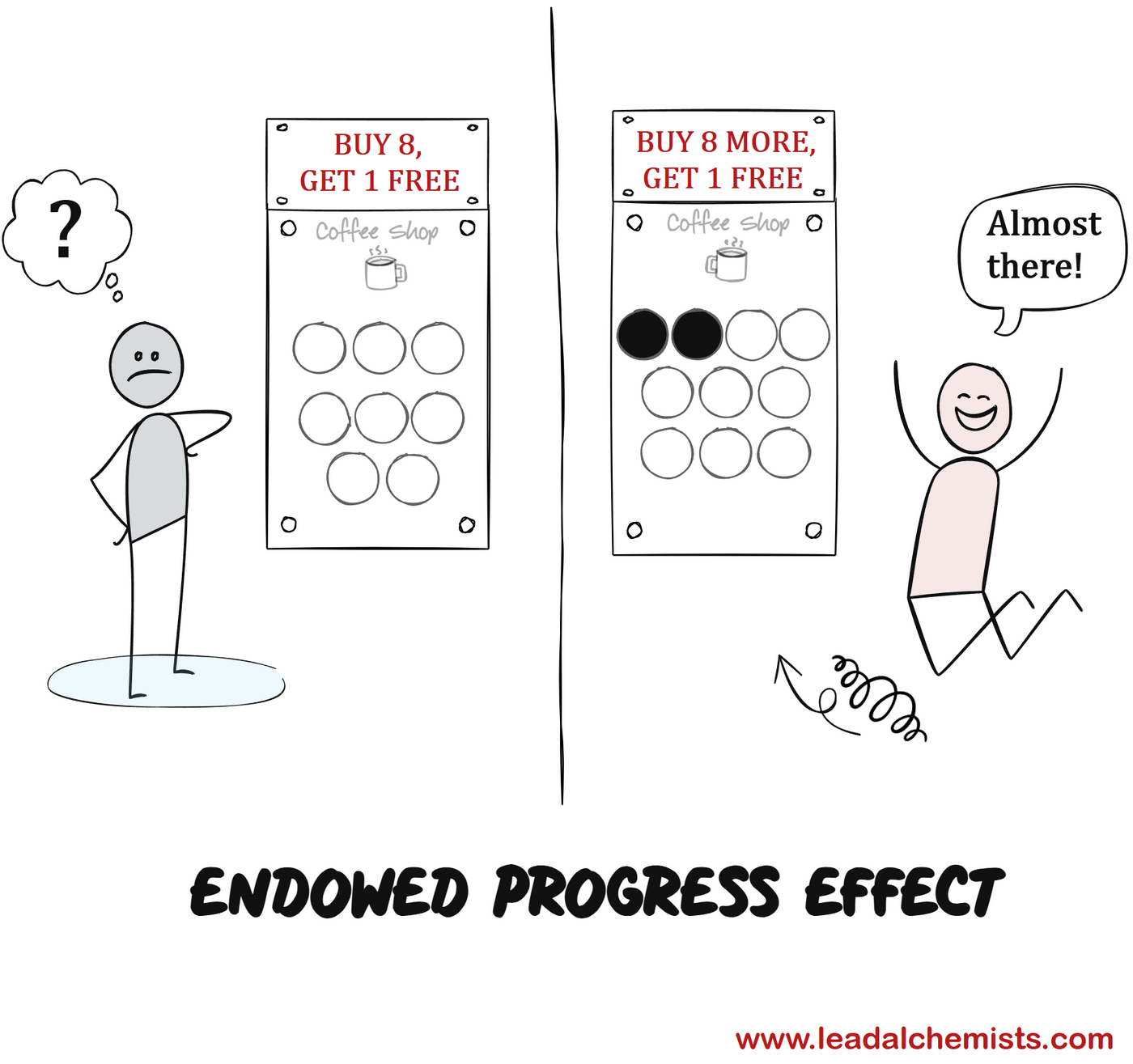
The classic example involves comparing two approaches:
- Standard: “Buy 8 coffees, get 1 free” (starting from zero)
- Endowed progress: “Buy 8 more coffees, get 1 free” (with 2 stamps pre-filled on a 10-stamp card)
Research shows the second approach can increase completion rates by up to 82% because customers immediately feel they’ve made progress. The key is making the head start feel earned or justified, such as “Welcome bonus for joining our loyalty programme” rather than appearing arbitrary.
Is the Endowed Progress Effect ethical when used in marketing and advertising?
The Endowed Progress Effect can be ethical when implemented transparently and with genuine customer benefit, but becomes problematic when used deceptively or manipulatively.
Ethical applications:
- Transparent progress tracking: Clearly showing what progress represents
- Genuine value delivery: Ensuring rewards justify customer effort
- Honest communication: Explaining why customers receive head starts
- Customer benefit focus: Using the effect to help customers achieve their goals
Unethical applications:
- Deceptive progress inflation: Making fake progress that doesn’t represent real advancement
- Exploitative targeting: Using the effect to encourage harmful behaviours
- Misleading expectations: Creating unrealistic impressions about completion difficulty
- Manipulative pressure: Using artificial progress to force unwanted purchases
Best practices include:
- Being transparent about how progress is calculated
- Ensuring endowed progress feels earned rather than arbitrary
- Providing genuine value at each milestone
- Focusing on helping customers achieve their legitimate goals
The American Marketing Association’s Code of Ethics recommends transparency and honesty in all psychological marketing techniques.
What industries benefit most from implementing the Endowed Progress Effect?
Industries with goal-oriented customer behaviours and multi-step processes see the greatest benefits from implementing the Endowed Progress Effect.
High-impact industries:
- Subscription services: Onboarding processes and feature adoption
- Education and training: Course completion and skill development
- Healthcare and fitness: Behaviour change and treatment adherence
- Financial services: Savings goals and debt reduction programmes
- Loyalty and rewards: Customer retention and repeat purchases
Service-based businesses particularly benefit because they often involve:
- Multi-step customer journeys
- Long-term relationship building
- Goal-oriented outcomes
- Progress tracking opportunities
Less effective industries:
- One-time purchase businesses
- Emergency or urgent need services
- Highly commoditised products
- Industries where progress tracking feels artificial
The effect works best when customers have genuine motivation to complete a process and when progress markers feel meaningful and authentic rather than forced or manipulative.
How does the Endowed Progress Effect relate to gamification strategies?
The Endowed Progress Effect is a fundamental principle underlying many gamification strategies, particularly those involving progress tracking, achievement systems, and milestone rewards.
Common gamification applications:
- Progress bars: Visual indicators showing advancement toward goals
- Achievement badges: Unlockable rewards that acknowledge progress milestones
- Level systems: Tiered advancement with initial progress recognition
- Point accumulation: Starting users with bonus points or credits
Key connections:
- Both create artificial momentum to increase engagement
- Both use visual progress indicators to motivate continued participation
- Both leverage goal gradient effects to accelerate user behaviour
- Both work best when progress feels earned rather than arbitrary
Effective gamification using the Endowed Progress Effect includes:
- Starting users with welcome bonuses or initial achievements
- Breaking large goals into smaller, manageable milestones
- Providing clear visual feedback on progress made
- Celebrating small wins to maintain motivation
The effect enhances gamification by reducing the initial barrier to engagement and creating immediate sense of investment in the system.
What are the key studies that prove the Endowed Progress Effect actually works?
The most robust scientific evidence comes from peer-reviewed academic research, with the foundational study providing clear quantitative results.
Primary research:
- Nunes & Drèze (2006): Journal of Marketing Research – The original car wash loyalty card experiment showing 34% vs 19% completion rates (82% improvement)
- Wertenbroch & Pirouz (2010): Marketing Letters – Online survey completion with pre-filled progress bars
- Mislavsky, Amir, & Turel (2021): Computers in Human Behavior – Online learning platform engagement with visual progress cues
Key findings:
- Artificial progress significantly increases task completion rates
- Effect works across different contexts and demographics
- Visual progress indicators enhance motivation and persistence
- The reason for endowed progress affects its effectiveness
Important note: Many marketing examples cited online lack peer-reviewed validation. Whilst the principle is scientifically sound, businesses should test their own implementations rather than assuming guaranteed results. The original loyalty card study remains the gold standard for quantified business impact.
How can businesses measure the effectiveness of the Endowed Progress Effect?
Businesses can measure the Endowed Progress Effect’s effectiveness through controlled A/B testing and key performance indicators that track completion and engagement behaviours.
Essential metrics to track:
- Completion rates: Percentage of customers who finish the target process
- Time to completion: How quickly customers reach their goals
- Engagement frequency: How often customers interact with progress indicators
- Customer lifetime value: Long-term impact on customer relationships
A/B testing framework:
- Control group: Standard process without endowed progress
- Test group: Process with artificial progress head start
- Sample size: Ensure statistical significance (typically 1000+ per group)
- Duration: Run tests long enough to capture complete customer journeys
Recommended testing approach:
- Establish baseline metrics with current process
- Implement endowed progress variation
- Track both short-term (completion rates) and long-term (retention) impacts
- Analyse customer feedback and satisfaction scores
- Calculate ROI based on increased completion and retention
Tools for measurement: Google Analytics, customer journey mapping software, and specialised A/B testing platforms can help track these metrics effectively.
What’s the difference between the Endowed Progress Effect and loss aversion?
Whilst both psychological principles influence decision-making, they operate through different motivational mechanisms and trigger distinct behavioural responses.
Endowed Progress Effect:
- Focus: Perceived advancement toward a positive goal
- Motivation: “I’m already partway there, so I should continue”
- Emotion: Optimism and momentum
- Application: Encouraging goal completion and engagement
Loss aversion:
- Focus: Avoiding the loss of something already possessed
- Motivation: “I don’t want to lose what I already have”
- Emotion: Fear and protection
- Application: Preventing customer churn and abandonment
In marketing practice:
- Endowed progress: “You’ve earned 3 out of 10 loyalty points”
- Loss aversion: “Your points expire in 30 days”
Combined effectiveness: Many successful programmes use both principles together – showing progress made (endowed progress) whilst highlighting what could be lost if customers don’t continue (loss aversion). However, endowed progress tends to create more positive customer experiences whilst loss aversion can sometimes feel manipulative or stressful.
Curious about other psychological biases that influence customer behavior? Explore our comprehensive guide to cognitive biases in marketing here.