Guide to The Attentional Bias & Attentional Cues (Cialdini) in Marketing: Description, Psychology, and Examples
What Is The Attentional Bias & Attentional Cues (Cialdini)?
Attentional Bias is the tendency for people to preferentially notice certain types of stimuli whilst ignoring others, as our brains naturally filter and prioritize information based on what’s emotionally significant, personally relevant, or distinctive. Environmental signals called attentional cues direct this mental spotlight toward specific elements, explaining why certain ads grab attention while others fade into the background and why some landing pages stop the scroll while others get completely ignored.
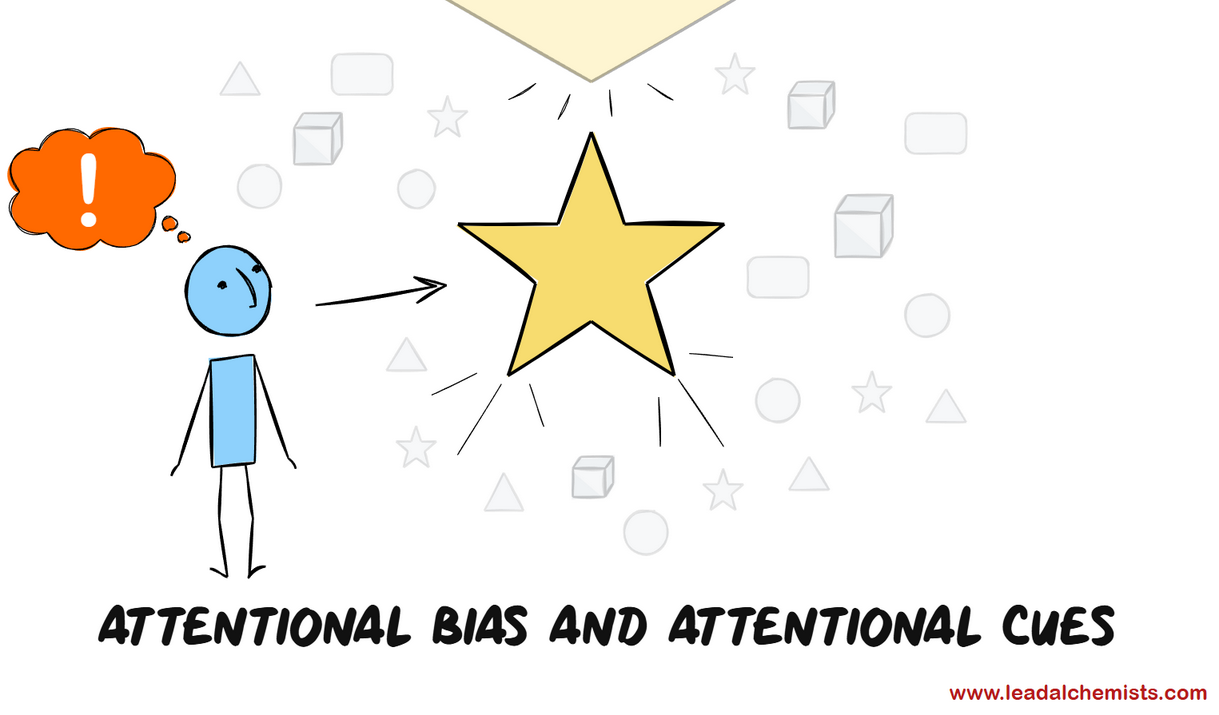
At its psychological core, Attentional Bias works because humans process roughly 11 million bits of information per second but can only consciously handle about 40 bits – meaning our brains instinctively allocate limited mental resources based on what seems most salient, relevant, or emotionally significant. When marketing messages incorporate the right attentional cues, they break through the automatic filtering process that eliminates 99.9% of available information, making it far more likely that customers will notice and engage with your content rather than scrolling past it unaware.
For marketers and advertisers, understanding this bias gives a real competitive edge. By purposefully and strategically incorporating attention-directing elements like scarcity signals, social proof indicators, and authority markers while delivering genuine value that justifies the attention captured, you can break through information overload and drive engagement in ways that other persuasion techniques simply cannot match.
How The Attentional Bias & Attentional Cues (Cialdini) Works (The Psychology Behind It)
The psychological mechanisms behind attentional bias operate through two primary pathways in our brains:
Bottom-up processing occurs when stimuli automatically capture attention due to their inherent properties. Bright colours, sudden movements, loud sounds, or contrasting elements trigger this automatic response. This explains why a bright orange “Get Free Quote” button against a blue background immediately draws your eye.
Top-down processing happens when our goals, expectations, and prior knowledge guide attention toward relevant information. If you’re actively searching for a plumbing service, you’ll naturally notice ads about “emergency plumbing” more readily than advertisements for restaurants.
Research by Bar-Haim and colleagues (2007) conducted a comprehensive meta-analysis showing that individuals consistently exhibit attentional bias toward emotionally significant stimuli. Their findings revealed that anxious individuals, for example, automatically focus on threatening information, whilst people with specific goals direct attention toward goal-relevant cues.
Emotional significance plays a crucial role in this process. The brain’s amygdala, which processes emotions, can hijack attention and direct it toward emotionally charged information. This explains why fear-based headlines (“Don’t Let Burglars Target Your Home”) or excitement-generating offers (“Limited Time: 50% Off!”) prove so effective at capturing attention.
However, some researchers argue that attentional bias isn’t a stable trait but rather a state-dependent phenomenon influenced by contextual factors. This means the same person might show different attentional patterns depending on their current situation, mood, or immediate goals.
Real-World Examples of The Attentional Bias & Attentional Cues (Cialdini)
Beyond Marketing Applications
Attentional bias affects decision-making across numerous contexts. In clinical psychology, individuals with anxiety disorders consistently focus on threatening stimuli, perpetuating their anxiety cycles. Students with attentional biases toward social media notifications struggle to maintain focus on academic tasks, directly impacting their learning outcomes.
In economics, investors’ attentional biases lead them to overreact to salient news events, creating market volatility. Political campaigns leverage these mechanisms by emphasising emotionally charged issues that capture voter attention and influence electoral outcomes.
Marketing Applications in Action
Visual Saliency in Digital Advertising: E-commerce companies strategically place high-margin products in areas where eye-tracking studies show users naturally focus – typically the top-left corner of product grids. This placement increases visibility and sales without requiring additional advertising spend.
Benefit-Driven Headlines: Instead of generic headlines like “Contact Us,” successful service businesses use attention-grabbing alternatives such as “Get a Free Consultation and Discover How We Can Solve Your Problem in 24 Hours.” This approach immediately highlights value whilst addressing the visitor’s immediate concerns.
The Decoy Effect in Pricing: Dan Ariely’s research demonstrates how businesses use asymmetrically dominated options to direct attention toward preferred choices. A magazine offering online subscription (£59), print subscription (£125), and combined print/online subscription (£125) makes the combined option appear significantly more valuable.
Strategic Product Placement: Eye-tracking research from the Baymard Institute shows that strategic placement of elements based on natural attention patterns can increase engagement without additional costs. Companies place critical information and calls-to-action in high-attention zones identified through user behaviour analysis.
How The Attentional Bias & Attentional Cues (Cialdini) Affects Consumer Behaviour
When attentional bias activates in marketing contexts, several neurological processes occur simultaneously. The brain’s prefrontal cortex, responsible for decision-making, receives filtered information based on what the attention system deems important. This filtering process directly influences purchasing psychology.
Cognitive load reduction represents a key mechanism. When marketers use clear attentional cues, they reduce the mental effort required for consumers to process information. A bright, contrasting call-to-action button eliminates the need for users to search for next steps, making conversion more likely.
Emotional priming occurs when attentional cues trigger emotional responses that influence subsequent decisions. Scarcity cues (“Only 3 left in stock”) create urgency and focus attention on immediate action rather than extended deliberation.
Pattern recognition plays a crucial role in how consumers respond to familiar attentional cues. Users have learned to associate certain visual patterns (bright buttons, countdown timers, testimonial layouts) with specific actions, creating automatic behavioural responses.
The brain’s reward system also activates when attentional cues suggest potential benefits. Headlines promising specific outcomes (“Reduce Your Energy Bills by 40%”) trigger anticipation of reward, increasing engagement and conversion likelihood.
Case Studies: How Marketers Use The Attentional Bias & Attentional Cues (Cialdini) in Advertising
Case Study 1: Visual Saliency in Google Ads
The Challenge: An ergonomic office chair retailer needed to increase click-through rates in a competitive Google Ads environment.
The Strategy: They implemented visual saliency principles by testing attention-grabbing elements:
- Headlines using power words (“Discover the Chair That Reduces Back Pain!”)
- Strategic emoji placement to direct attention to key benefits
- Contrasting colours in sitelink extensions
The Approach: A/B testing compared standard text ads against visually salient versions, tracking CTR, conversion rates, and cost-per-acquisition.
Expected Results: Based on established advertising principles and eye-tracking research, the enhanced ads should demonstrate higher CTR due to increased attentional capture.
Key Insight: This approach leverages bottom-up attentional processing by making ads stand out in crowded search results.
Case Study 2: Benefit-Driven Landing Page Headlines
The Challenge: A project management software company struggled with high bounce rates on their landing pages.
The Strategy: They replaced generic headlines with benefit-focused alternatives:
- Original: “Project Management Software – Sign Up Today!”
- Revised: “Get Projects Done 50% Faster – Try Our Project Management Software Free”
The Psychology: The revised headline immediately captures attention by addressing the visitor’s primary concern (efficiency) whilst including a clear, low-risk call-to-action.
Industry Validation: This approach aligns with widely accepted landing page optimization strategies advocated by conversion experts at Unbounce and HubSpot.
Key Insight: Headlines that immediately communicate value capture attention more effectively than generic promotional messages.
Case Study 3: Strategic Eye-Tracking Implementation
The Research Foundation: The Baymard Institute’s e-commerce usability research consistently demonstrates the importance of visual hierarchy based on natural attention patterns.
The Application: E-commerce sites strategically place high-margin items and promotional offers in areas where users’ eyes naturally gravitate, particularly the top-left regions of product grids.
The Results: This placement increases product visibility and sales without requiring additional advertising investment.
Key Insight: Understanding natural attention patterns allows marketers to optimise placement without changing content, maximising existing traffic value.
Practical Applications for Google Ads & Lead Generation
Google Ads Copywriting & Ad Design
Problem-Focused Keywords Strategy: Target keywords that directly address searchers’ immediate problems rather than generic service terms. A plumbing service targeting “leaky faucet repair” with ad copy “Stop the Drip Now! Fast Leaky Faucet Repair” captures attention by aligning with the user’s current focus.
Message Match Implementation: Ensure landing page headlines mirror ad copy exactly. If your ad promises “24/7 Emergency Plumbing,” your landing page headline should prominently display the same message. This reinforces initial attention and reduces bounce rates.
Visual Attention Direction: Use contrasting colours and directional cues to guide attention toward call-to-action buttons. A bright orange “Get Free Quote” button against a predominantly blue background leverages visual saliency principles.
A/B Testing Framework: Create ad groups comparing problem-focused keywords and copy against general service terms. Track conversion rates (lead form submissions) to measure the effectiveness of attention-directed messaging.
Landing Page Structuring for Lead Generation
Benefit-Driven Headlines: Replace generic contact prompts with value-focused alternatives. Instead of “Contact Us,” use “Get a Free Consultation and Discover How We Can Solve Your Problem.”
Form Optimization: Reduce form fields to essential information only, making phone numbers optional rather than required. Research consistently shows shorter forms achieve higher conversion rates by reducing cognitive load.
Lead Magnet Prominence: Position valuable offers (free guides, checklists, consultations) above the fold using contrasting colours and clear value propositions. A brightly coloured banner offering “5 Ways to Save Money on [Service]” captures immediate attention.
Social Proof Placement: Feature client success stories and testimonials in high-attention areas. A local law firm displaying multiple client success stories on their contact page leverages both social proof and strategic placement.
Website UX and Form Optimization
Attention-Directing Visual Cues: Implement arrows, contrasting colours, and strategic whitespace to guide users toward desired actions. These elements reduce cognitive effort required for navigation decisions.
Progressive Information Disclosure: Present information in digestible chunks that align with natural attention patterns. Users can process focused information more effectively than overwhelming comprehensive displays.
Urgency and Scarcity Implementation: Use time-sensitive offers and limited availability messages to focus attention on immediate action rather than extended deliberation.
Mobile-First Attention Design: Optimize for smaller screens where attention competition intensifies. Clear, prominent calls-to-action become even more critical in mobile environments.
Why Marketers Should Care About The Attentional Bias & Attentional Cues (Cialdini)
Understanding attentional bias provides marketers with a powerful competitive advantage in an increasingly crowded digital landscape. With consumers exposed to thousands of marketing messages daily, the ability to capture and direct attention determines marketing success or failure.
Conversion Rate Impact: Properly implemented attentional cues can significantly improve conversion rates without increasing traffic costs. By directing existing visitors’ attention more effectively, businesses achieve better results from current marketing investments.
Cost Efficiency: Attention-optimized campaigns often achieve lower cost-per-acquisition by improving relevance and engagement metrics. Google Ads, for example, rewards ads that generate higher engagement with better positioning and lower costs.
Competitive Differentiation: Most businesses compete on features and pricing. Companies that master attention capture create sustainable competitive advantages that are difficult to replicate.
However, ethical considerations remain paramount. Attentional cues should enhance user experience by highlighting genuine value, not manipulate consumers into unwanted purchases. Transparency and honesty build long-term customer relationships whilst deceptive practices damage brand reputation.
Responsible Implementation Guidelines:
- Avoid manipulative tactics that exploit psychological vulnerabilities
- Ensure all claims are accurate and verifiable
- Use attention-directing techniques to highlight genuine benefits
- Respect user privacy and data protection requirements
How to Implement The Attentional Bias & Attentional Cues (Cialdini) in Your Marketing Strategy
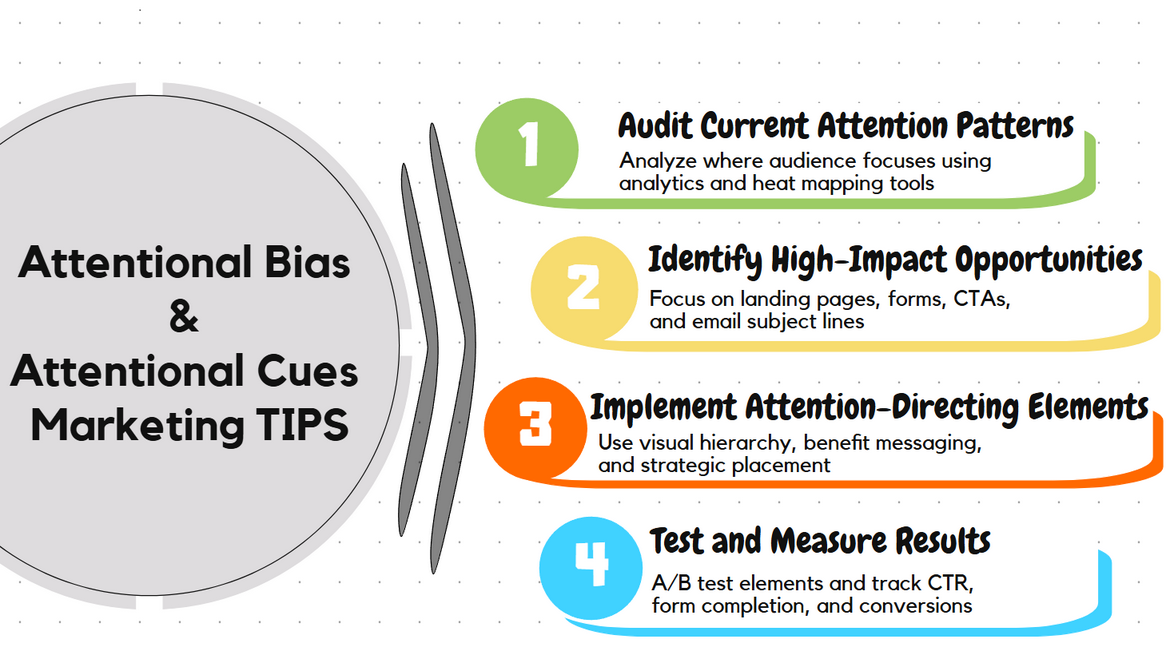
Step 1: Audit Current Attention Patterns
Begin by analysing where your audience currently focuses attention. Use tools like Google Analytics to identify high-bounce pages and low-engagement content. Heat mapping tools reveal actual user attention patterns on your website.
Key Questions to Address:
- Where do users spend most time on your pages?
- Which elements receive the most clicks?
- Where do users typically abandon your conversion process?
Step 2: Identify High-Impact Opportunities
Focus on pages and campaigns with the highest potential impact. Priority areas typically include:
- Primary landing pages from paid advertising
- Homepage and key service pages
- Lead generation forms and contact pages
- Email subject lines and call-to-action buttons
Step 3: Implement Attention-Directing Elements
Visual Hierarchy Optimization: Use size, colour, and positioning to create clear attention flow. Most important elements should be largest and most visually prominent.
Benefit-Focused Messaging: Rewrite headlines and copy to immediately communicate value. Lead with outcomes rather than features or company information.
Strategic Placement: Position critical elements (calls-to-action, contact information, key benefits) in natural attention zones identified through user research.
Step 4: Test and Measure Results
A/B Testing Framework: Test one element at a time to isolate the impact of attention-directing changes. Compare metrics like:
- Click-through rates on calls-to-action
- Form completion rates
- Time spent on key pages
- Overall conversion rates
Measurement Timeline: Allow sufficient time for statistical significance, typically 2-4 weeks depending on traffic volume.
Best Practices and Common Pitfalls
Best Practices:
- Start with high-traffic, high-impact pages
- Test one change at a time for clear results
- Focus on user benefit rather than company promotion
- Maintain consistency across all touchpoints
Common Pitfalls to Avoid:
- Overusing attention-grabbing elements (creates visual chaos)
- Focusing on features instead of benefits
- Ignoring mobile user experience
- Making changes without proper testing
A/B Testing Ideas for Immediate Implementation:
- Test benefit-driven headlines against feature-focused alternatives
- Compare contrasting call-to-action button colours
- Evaluate form length impact on completion rates
- Test urgency messaging against standard promotional copy
Related Psychological Biases & Effects
Understanding attentional bias connects to several related psychological phenomena that marketers should consider:
Anchoring Bias involves focusing heavily on the first piece of information received. Whilst anchoring affects judgment after attention capture, attentional bias determines what information receives initial focus.
Confirmation Bias leads people to seek information confirming existing beliefs, influencing where they direct attention. Marketers can leverage this by aligning messaging with audience preconceptions.
Social Proof captures attention through others’ behaviour and opinions. Testimonials and user counts function as attentional cues that direct focus toward credibility indicators.
Understanding these interconnected biases allows marketers to create comprehensive strategies that work with natural psychological tendencies rather than against them.
Understanding The Attentional Bias & Attentional Cues (Cialdini) can significantly improve your marketing effectiveness by helping you capture and direct your audience’s limited attention more strategically. When implemented ethically and tested systematically, these principles can dramatically improve your conversion rates and marketing ROI.
FAQs About Attentional Bias & Attentional Cues (Cialdini)
What is Attentional Bias & Attentional Cues (Cialdini) and how does it work?
Attentional bias is the tendency to preferentially notice or focus on certain types of stimuli whilst ignoring others, particularly those that are emotionally salient or relevant to personal goals. Attentional cues are environmental signals that direct attention toward specific stimuli.
Whilst Robert Cialdini’s persuasion principles (scarcity, social proof, authority, etc.) aren’t formally labelled as “attentional cues” in academic psychology, they function as such by capturing and redirecting consumer attention. For example:
• Scarcity cues (“Only 3 left in stock”) create urgency and narrow cognitive focus • Social proof indicators (“Most popular choice”) draw attention through perceived popularity • Visual prominence (contrasting colours, bold text) automatically captures attention through bottom-up processing
The mechanism works through our brain’s limited cognitive resources being allocated selectively based on salience, relevance, or emotional significance of stimuli.
How does Attentional Bias & Attentional Cues (Cialdini) influence our daily decision-making?
This psychological phenomenon shapes our daily choices by directing what we notice and subsequently consider when making decisions.
Common daily examples include: • Shopping: Noticing sale tags or “bestseller” labels before other product information • News consumption: Focusing on headlines that confirm existing beliefs or trigger emotional responses • Social media: Paying more attention to posts with high engagement numbers or from familiar sources • Restaurant menus: Being drawn to items marked as “chef’s special” or “most popular”
The effect occurs because our brains use these attention-directing cues as mental shortcuts (heuristics) to process information more efficiently. When we repeatedly focus on certain types of information, we develop stronger attentional biases toward similar stimuli in future situations.
What’s the difference between Attentional Bias & Attentional Cues (Cialdini) and confirmation bias?
Attentional bias is about what captures our initial attention, whilst confirmation bias is about how we interpret and seek information that supports existing beliefs.
Key distinctions: • Timing: Attentional bias occurs at the initial perception stage; confirmation bias happens during information processing • Scope: Attentional bias affects what we notice; confirmation bias affects what we believe or remember • Mechanism: Attentional bias involves selective attention to salient stimuli; confirmation bias involves selective interpretation of information
Example in marketing: An attentional cue might draw your eye to a product review section (attentional bias), but confirmation bias would make you focus more on reviews that align with your pre-existing opinion about the brand.
Both can work together – attentional cues can direct focus toward information that then triggers confirmation bias in processing that information.
Who first discovered Attentional Bias & Attentional Cues (Cialdini) and what research supports it?
Attentional bias as a concept emerged from early selective attention research by Donald Broadbent (1958), though it wasn’t initially termed “attentional bias.” The field developed through decades of cognitive psychology research.
Key supporting research includes: • Bar-Haim et al. (2007): Meta-analysis showing anxious individuals exhibit attentional bias toward threatening stimuli • Field & Cox (2008): Research on attentional bias in addiction, demonstrating bias toward substance-related cues • Pool et al. (2016): Meta-analysis confirming attentional bias toward threat in PTSD
Important clarification: Robert Cialdini’s work focuses on persuasion principles rather than attentional bias per se. His principles (from “Influence” and “Pre-Suasion”) demonstrate how cues like scarcity and social proof capture attention, but they’re not formally studied as “attentional biases” in academic literature.
The research is robust for attentional bias in clinical psychology, but direct academic studies linking Cialdini’s principles to attentional bias effects are limited.
What are the most famous real-world examples of Attentional Bias & Attentional Cues (Cialdini)?
Classic examples from psychology and marketing include:
The Decoy Effect (Pricing): • Magazine subscriptions: Online (£59), Print (£125), Print + Online (£125) • The print-only option acts as a decoy, making the combined option appear more attractive
Visual Saliency in Advertising: • Bright “SALE” tags that immediately capture attention in retail environments • Contrasting colours for call-to-action buttons (orange button on blue background)
Social Proof Indicators: • “Most popular choice” labels on pricing pages • Customer review counts and star ratings prominently displayed • “X people bought this in the last 24 hours” notifications
Scarcity Cues: • “Limited time offer” banners • Stock countdown timers (“Only 3 left”) • Exclusive membership language (“VIP access”)
Note: Whilst these examples are widely cited in marketing literature, specific case studies with quantified results from major brands are often proprietary and not publicly available.
How do marketers use Attentional Bias & Attentional Cues (Cialdini) to influence consumer behaviour?
Marketers leverage attention-directing mechanisms to guide consumer focus toward desired actions or information, though this differs from clinical attentional bias research.
Common marketing applications:
Visual Design: • Contrasting colours for important elements (CTAs, offers) • Strategic placement of key information above the fold • Visual hierarchy using size, colour, and positioning
Copy and Messaging: • Benefit-driven headlines that immediately highlight value propositions • Problem-focused keywords in ads that align with searcher intent • Urgency language that creates time-sensitive focus
Social Elements: • Testimonial clustering to create social proof through volume • Authority indicators (expert endorsements, certifications) • Popularity signals (bestseller badges, trending indicators)
Digital Implementation: • Message matching between ads and landing pages to maintain attention • Progressive disclosure to guide attention through conversion funnels • A/B testing different attention-capturing elements
The key is using these ethically – to highlight genuine value rather than manipulate through deception.
Can Attentional Bias & Attentional Cues (Cialdini) be overcome or reduced through training?
Yes, awareness and training can help reduce susceptibility to unwanted attentional biases, though complete elimination is neither possible nor desirable since attention-directing mechanisms serve important cognitive functions.
Effective strategies include:
Mindfulness Training: • Developing awareness of what captures your attention • Practising deliberate attention control • Recognising emotional triggers that bias attention
Critical Thinking Skills: • Learning to identify persuasion techniques • Questioning why certain information stands out • Seeking diverse information sources
Environmental Design: • Removing distracting visual cues from decision-making environments • Using structured decision-making processes • Creating “cooling-off” periods for important choices
Professional Applications: • Attentional Bias Modification (ABM) therapy for anxiety and addiction • Media literacy education to recognise manipulative techniques • Consumer education about marketing psychology
Important note: Some attentional biases are adaptive and help us navigate complex environments efficiently. The goal isn’t elimination but rather conscious awareness and control when needed.
What’s the neurological basis behind Attentional Bias & Attentional Cues (Cialdini)?
Attentional bias operates through well-documented brain networks involving both automatic and controlled attention systems.
Key neurological mechanisms:
Bottom-up Processing: • Visual cortex automatically responds to salient stimuli (bright colours, movement) • Amygdala prioritises emotionally significant information • Superior colliculus directs eye movements toward attention-capturing stimuli
Top-down Processing: • Prefrontal cortex guides attention based on goals and expectations • Anterior cingulate cortex monitors conflicts between competing stimuli • Parietal cortex controls spatial attention and visual search
Neurotransmitter Systems: • Dopamine pathways influence reward-related attention • Norepinephrine affects arousal and attention intensity • Acetylcholine modulates attention and learning
Clinical Evidence: Research using fMRI and EEG shows that individuals with anxiety disorders exhibit heightened amygdala responses to threat-related stimuli, whilst those with addiction show increased activation in reward circuits when exposed to substance-related cues.
Marketing Relevance: Understanding these mechanisms helps explain why certain design elements (high contrast, faces, movement) reliably capture attention across different populations and contexts.
How does Attentional Bias & Attentional Cues (Cialdini) compare to the halo effect?
These are distinct psychological phenomena that operate at different stages of information processing, though they can interact in decision-making contexts.
Key differences:
Attentional Bias: • Function: Determines what we notice initially • Timing: Occurs at perception stage • Mechanism: Selective attention to salient stimuli • Example: Noticing “5-star rating” before other product details
Halo Effect: • Function: Influences how we interpret information • Timing: Occurs during evaluation stage • Mechanism: Generalising positive impressions across attributes • Example: Assuming a well-designed website indicates quality products
How they interact:
- Attentional cues direct focus to specific information (e.g., premium branding)
- Halo effect then influences interpretation of other attributes based on that initial impression
- The combination can create powerful persuasion effects
Marketing implications: Effective campaigns often use attentional cues to direct focus toward elements that will trigger positive halo effects, such as highlighting awards, testimonials, or quality indicators that influence perception of the entire offering.
What are the ethical concerns surrounding Attentional Bias & Attentional Cues (Cialdini) in advertising?
The primary ethical concern is the potential for manipulation when attention-directing techniques are used deceptively or exploit psychological vulnerabilities.
Key ethical issues:
Deceptive Practices: • False scarcity (fake countdown timers, artificial stock limitations) • Misleading social proof (fabricated reviews, inflated popularity metrics) • Bait-and-switch tactics using attention-grabbing offers
Vulnerable Populations: • Children who lack developed critical thinking skills • Elderly consumers who may be more susceptible to certain techniques • Individuals with addiction or mental health conditions
Privacy Concerns: • Using personal data to create targeted attentional cues • Exploiting emotional states or life circumstances • Manipulating attention during vulnerable moments
Best practices for ethical use:
Transparency: • Clear disclosure of promotional techniques • Honest representation of scarcity and popularity • Accurate information about products and services
Value-focused approach: • Using attention-directing techniques to highlight genuine benefits • Helping consumers make informed decisions • Respecting consumer autonomy and choice
Industry guidelines from organisations like the American Marketing Association emphasise honesty, fairness, and transparency in advertising practices.
How does Attentional Bias & Attentional Cues (Cialdini) affect workplace productivity and focus?
Attentional bias significantly impacts workplace performance by influencing what employees notice, prioritise, and focus on throughout their workday.
Common workplace manifestations:
Digital Distractions: • Email notifications creating bias toward reactive rather than proactive work • Social media alerts capturing attention away from important tasks • Instant messaging interrupting deep work sessions
Priority Management: • Urgent vs. important bias – focusing on immediate demands over strategic work • Recency bias – giving disproportionate attention to latest requests • Visibility bias – prioritising work that’s more visible to managers
Meeting Dynamics: • Authority bias – paying more attention to senior voices • Confirmation bias – focusing on information that supports existing decisions • Social proof – following group attention patterns
Strategies for improvement:
Environmental Design: • Removing visual distractions from workspaces • Using focused work environments for important tasks • Implementing notification management systems
Attention Training: • Mindfulness practices to improve focus control • Time-blocking techniques for sustained attention • Regular breaks to reset attention capacity
Organisational Policies: • Meeting-free time blocks for deep work • Clear communication protocols to reduce interruptions • Training on cognitive biases and attention management
What role does Attentional Bias & Attentional Cues (Cialdini) play in social media engagement?
Social media platforms are specifically designed to capture and maintain attention through sophisticated understanding of attentional mechanisms and psychological triggers.
Key attention-capturing mechanisms:
Visual Design: • Infinite scroll that maintains continuous engagement • Bright colours and high contrast for important actions (likes, shares) • Notification badges that create visual urgency
Content Algorithms: • Personalisation based on past attention patterns • Recency bias showing latest content first • Social proof signals (likes, comments, shares) that indicate popular content
Psychological Triggers: • Variable reward schedules that create anticipation • Social validation through likes and comments • FOMO (Fear of Missing Out) through stories and time-limited content
Impact on behaviour:
Positive aspects: • Connecting with relevant communities and interests • Discovering valuable content and opportunities • Maintaining social relationships
Potential concerns: • Attention fragmentation affecting deep work and relationships • Comparison bias focusing on others’ highlight reels • Addiction-like patterns of compulsive checking
Strategies for healthy engagement: • Setting specific times for social media use • Curating feeds to focus on valuable content • Using platform tools to limit notifications and time spent
Are there any studies that challenge the validity of Attentional Bias & Attentional Cues (Cialdini)?
Yes, there are methodological critiques and debates within the research community, though the basic phenomenon of attentional bias is well-established.
Key criticisms and limitations:
Methodological Issues: • Reliability concerns with indirect measurement tools (e.g., dot-probe tasks) • State vs. trait debate – whether attentional bias is stable or context-dependent • Replication challenges in some experimental paradigms
Research by Mogg & Bradley (2018) questions what exactly is being measured in attentional bias studies and whether modifications are truly effective long-term.
Field & Christiansen (2012) highlight measurement validity issues, noting that different tasks sometimes produce conflicting results.
Contextual Factors: • Cultural differences in attention patterns and susceptibility to certain cues • Individual variation in cognitive processing styles • Situational factors that can override typical attentional patterns
Regarding Cialdini’s principles: While his persuasion principles are empirically supported, direct academic studies linking them specifically to attentional bias mechanisms are limited. Most evidence is indirect, showing that these principles increase attention and influence, rather than proving they operate through attentional bias per se.
Current consensus: The field acknowledges these limitations whilst continuing to refine measurement methods and theoretical understanding. The practical applications remain valuable, but researchers emphasise the need for more rigorous methodology and consideration of individual differences.