Guide to The Banner Blindness in Marketing: Description, Psychology, and Examples
What Is The Banner Blindness?
Banner Blindness is the tendency for people to consciously or unconsciously ignore banner-like information on websites, including advertisements and interface elements that resemble ads, as their brains automatically filter out these stimuli before they reach conscious awareness. This powerful cognitive phenomenon explains why perfectly crafted banner ads seem invisible to target audiences, why traditional banner advertisements achieve disappointingly low click-through rates, and why many businesses struggle to capture user attention despite prominent ad placements.

Banner blindness is the phenomenon where users consciously or unconsciously ignore banner-like information on websites, including advertisements and interface elements that resemble ads. This effect represents a form of selective attention, where users automatically filter out stimuli they perceive as irrelevant to their goals.
The term was first coined by researchers Jan Panero Benway and David M. Lane in 1998, who discovered that users frequently overlooked information presented in banner-like formats, even when that information was directly relevant to their task. This wasn’t simply users choosing to ignore ads – their brains were literally filtering out banner-like content before it reached conscious awareness.
Why does this matter for marketers? Banner blindness directly impacts the effectiveness of digital advertising, website design, and user experience. It explains why traditional banner ads often achieve disappointingly low click-through rates and why many businesses struggle to capture user attention online.
The psychological basis lies in our brain’s remarkable ability to adapt and filter information. When users repeatedly encounter similar visual patterns – like banner advertisements in predictable locations – their cognitive systems learn to ignore these elements to focus on more relevant content.
How The Banner Blindness Works (The Psychology Behind It)
The cognitive mechanisms behind banner blindness involve several interconnected psychological processes that work together to filter out perceived irrelevant information.
Selective Attention forms the foundation of banner blindness. Our brains constantly process enormous amounts of visual information, but we can only consciously attend to a fraction of it. Users naturally focus on goal-relevant information whilst ignoring distractors, particularly in visually cluttered environments like websites.
Habituation plays a crucial role in developing banner blindness. Through repeated exposure to similar ad formats and placements, users become desensitised to these elements. Their brains learn to automatically overlook banners, creating an unconscious filtering system that operates without conscious effort.
Attention Inertia describes how users maintain focus on their primary task, further reducing the likelihood of noticing peripheral or banner-like content. When someone visits a website with a specific goal – reading an article, finding contact information, or completing a purchase – their attention remains locked on task-relevant elements.
Top-Down Processing influences banner blindness through prior experience and expectations. Users develop mental models of typical website layouts and learn to ignore areas traditionally associated with advertisements. This learned behaviour becomes so automatic that users can navigate websites whilst completely bypassing banner areas.
Recent research published in Frontiers in Psychology revealed a surprising finding: contrary to traditional advertising wisdom, neutral-valence banners were recognised significantly better than emotionally charged (positive or negative) banners. This suggests that emotional manipulation doesn’t overcome banner blindness – relevance and context do.
The study, involving 80-120 participants across two experiments, found that high arousal content did not improve banner recognition. Instead, the mechanism behind banner blindness appears to be habituation and attention inertia rather than emotional processing.
Real-World Examples of The Banner Blindness
Banner blindness extends far beyond marketing, affecting various aspects of digital interaction and decision-making across multiple contexts.
In Education, students frequently ignore important notifications or resources on learning platforms when these elements are presented in banner-like formats. University websites often struggle with this issue; critical announcements about deadlines, course changes, or campus safety alerts get overlooked when styled like traditional web banners.
Healthcare Applications reveal serious implications of banner blindness. Patients can overlook critical health messages or warnings on medical websites if these are styled like advertisements or banners. This has led to missed medication reminders, ignored appointment notifications, and overlooked health alerts.
Financial and E-commerce Contexts demonstrate how banner blindness affects economic decision-making. Users on financial platforms may miss important alerts about account changes, security warnings, or time-sensitive offers when these notifications resemble banner advertisements.
Amazon’s Strategic Response provides an excellent example of working with banner blindness rather than against it. Instead of relying on traditional banner advertisements, Amazon integrates product recommendations within the natural content flow using “frequently bought together” and “customers who bought this item also bought” sections. These recommendations appear as helpful suggestions rather than intrusive advertisements, effectively bypassing banner blindness mechanisms.
Government and Public Service Websites often struggle with banner blindness when displaying important civic information. Public health announcements, voting information, and emergency alerts can be ignored when presented in banner-like formats, reducing their effectiveness during critical periods.
The Nielsen Norman Group’s research confirms that users have learned to ignore content that “resembles ads, is close to ads, or appears in locations traditionally dedicated to ads.” This learned behaviour has become so ingrained that it affects how users process all types of information online.
How The Banner Blindness Affects Consumer Behaviour
Banner blindness triggers specific neurological and psychological responses that directly impact purchasing decisions and consumer engagement patterns.
Cognitive Load Reduction occurs when users encounter banner-like content. The brain automatically filters out these elements to reduce information processing demands, allowing users to focus on their primary objectives. This filtering happens at a subconscious level, meaning users often aren’t aware they’re ignoring potentially relevant information.
Task-Focused Attention intensifies banner blindness effects. When consumers visit websites with specific goals – researching products, comparing prices, or seeking customer support – their attention becomes increasingly selective. Marketing messages that appear banner-like become virtually invisible during these focused browsing sessions.
Trust and Credibility Perception can be influenced by banner blindness. Content that appears too promotional or advertisement-like may be unconsciously dismissed as less credible, even when it contains valuable information. This affects how consumers evaluate product information, testimonials, and company messaging.
Decision-Making Speed increases when banner blindness filters out distracting elements. However, this can work against marketers when important calls-to-action or value propositions are ignored due to their banner-like appearance.
Habituation Effects strengthen over time as users develop more sophisticated filtering mechanisms. Experienced internet users often display stronger banner blindness effects, making it increasingly challenging to capture their attention through traditional advertising approaches.
The psychological triggers that amplify banner blindness include visual clutter, predictable placement patterns, and promotional language. Conversely, contextual relevance, neutral presentation, and integration with primary content can help overcome these filtering mechanisms.
Case Studies: How Marketers Use The Banner Blindness in Advertising
Understanding banner blindness has led to innovative marketing strategies that work with, rather than against, this psychological phenomenon.
Case Study 1: Content Integration Strategy
Rather than fighting banner blindness, successful marketers have learned to integrate promotional content within the natural flow of user experience. HubSpot’s Content Upgrade Strategy demonstrates this approach effectively. Instead of using traditional banner advertisements, HubSpot embeds relevant downloadable resources directly within blog posts.
For example, within an article about email marketing, HubSpot might offer a downloadable email template that directly relates to the content. This approach bypasses banner blindness because the offer appears as a natural extension of the valuable content rather than an intrusive advertisement.
Small Business Application: A local financial advisor could implement this strategy by offering a “Retirement Planning Checklist” within a blog post about retirement strategies. The download form appears contextually relevant rather than promotional, increasing engagement rates.
Case Study 2: Visual Hierarchy Optimisation
E-commerce Visual Salience Strategy focuses on making important elements stand out through strategic design rather than traditional banner placement. Companies use high-contrast colours, strategic white space, and subtle visual cues to draw attention to calls-to-action without triggering banner blindness.
The key lies in making CTAs visually distinct whilst avoiding typical banner characteristics. Instead of large, flashy “BUY NOW” buttons, effective designs use subtle contrast and clear, benefit-focused language.
Proposed A/B Test: Test two versions of a service landing page. Version A uses a traditional banner-style CTA at the top of the page. Version B integrates the same CTA within the content using subtle visual emphasis. Measure conversion rates to determine which approach better overcomes banner blindness.
Case Study 3: Native Advertising Approach
Search Result Integration represents another effective strategy for overcoming banner blindness. Google Ads that closely resemble organic search results often achieve higher click-through rates because they don’t trigger the automatic filtering associated with traditional advertisements.
Implementation Strategy: Create ad copy that addresses user questions directly rather than using promotional language. Instead of “Best Plumber in Town – Call Now!”, use “Leaky Faucet Problems? Here’s What You Need to Know.” This approach feels more like helpful information than advertising.
The effectiveness of these strategies lies in their ability to provide value whilst avoiding the visual and contextual cues that trigger banner blindness. Success comes from understanding user intent and presenting information in formats that feel natural and relevant.
Practical Applications for Google Ads & Lead Generation
Banner blindness significantly impacts digital advertising effectiveness, but understanding this phenomenon enables marketers to develop more successful campaigns.
Google Ads Optimisation Strategies
Ad Copy Relevance becomes crucial when accounting for banner blindness. Traditional promotional language often triggers filtering mechanisms, whilst problem-focused copy maintains user attention. Instead of generic calls-to-action, address specific user pain points directly in ad headlines.
Landing Page Alignment ensures continuity between ad copy and destination content. When users click through to landing pages that feel disconnected from the ad, banner blindness can extend to the entire page experience. Maintain consistent messaging and visual hierarchy to keep users engaged.
Visual Integration involves making ads appear less advertisement-like through subtle design choices. Avoid overly promotional imagery, excessive capitalisation, and typical advertising colours that trigger banner blindness responses.
Lead Generation Website Optimisation
Strategic Form Placement moves beyond traditional sidebar and header locations that users automatically ignore. Embed lead capture forms within content where they feel contextually relevant rather than intrusive.
Content-Integrated CTAs perform better than banner-like buttons because they appear as natural next steps rather than promotional interruptions. Use descriptive language that explains the value proposition rather than generic action words.
Value-First Approach positions lead magnets as helpful resources rather than marketing materials. Offer genuinely useful content – checklists, templates, guides – that users want to access rather than promotional materials they’ll ignore.
A/B Testing Framework
Hypothesis Development should focus on banner blindness principles. Test whether neutral, contextually relevant presentations outperform traditional promotional approaches. Measure not just click-through rates but also engagement quality and conversion completion rates.
Implementation Guidelines include testing different visual hierarchies, copy approaches, and placement strategies. Compare banner-like presentations against integrated, contextual alternatives to quantify banner blindness effects on your specific audience.
Measurement Metrics should include attention tracking (through heatmaps), engagement depth, and conversion quality rather than just surface-level metrics like impressions or clicks.
Why Marketers Should Care About The Banner Blindness
Banner blindness represents both a significant challenge and a strategic opportunity for modern marketers who understand its implications.
Competitive Advantage emerges when marketers design campaigns that account for banner blindness whilst competitors continue using traditional approaches. Understanding this psychological phenomenon enables more effective resource allocation and campaign design.
Budget Efficiency improves dramatically when marketing efforts avoid banner blindness triggers. Rather than increasing ad spend to overcome filtering mechanisms, strategic design and placement can achieve better results with existing budgets.
User Experience Enhancement occurs when marketing messages feel helpful rather than intrusive. This approach builds trust and credibility whilst achieving marketing objectives, a win-win scenario for both businesses and consumers.
Long-term Brand Building benefits from approaches that respect user attention and provide genuine value. Brands that consistently deliver relevant, contextually appropriate messaging develop stronger relationships with their audiences.
Ethical Considerations and Responsible Use
Transparency Requirements become essential when working around banner blindness. Native advertising and integrated promotional content must be clearly labelled to maintain user trust and comply with advertising standards.
Value Exchange Principles should guide all marketing efforts. Users should receive genuine value in exchange for their attention, whether through helpful information, useful tools, or relevant solutions to their problems.
Respect for User Intent means aligning marketing messages with user goals rather than interrupting their experience. This approach proves more effective whilst maintaining ethical standards.
Risks of Overuse or Manipulation
User Trust Erosion can occur when marketers abuse techniques designed to overcome banner blindness. Deceptive practices that hide promotional content or mislead users about content nature damage long-term brand relationships.
Regulatory Scrutiny increases as advertising standards organisations develop guidelines for native advertising and integrated promotional content. Marketers must balance effectiveness with compliance requirements.
Audience Sophistication continues growing as users become more aware of marketing techniques. Strategies that work today may become less effective as audiences develop stronger filtering mechanisms.
How to Implement The Banner Blindness in Your Marketing Strategy
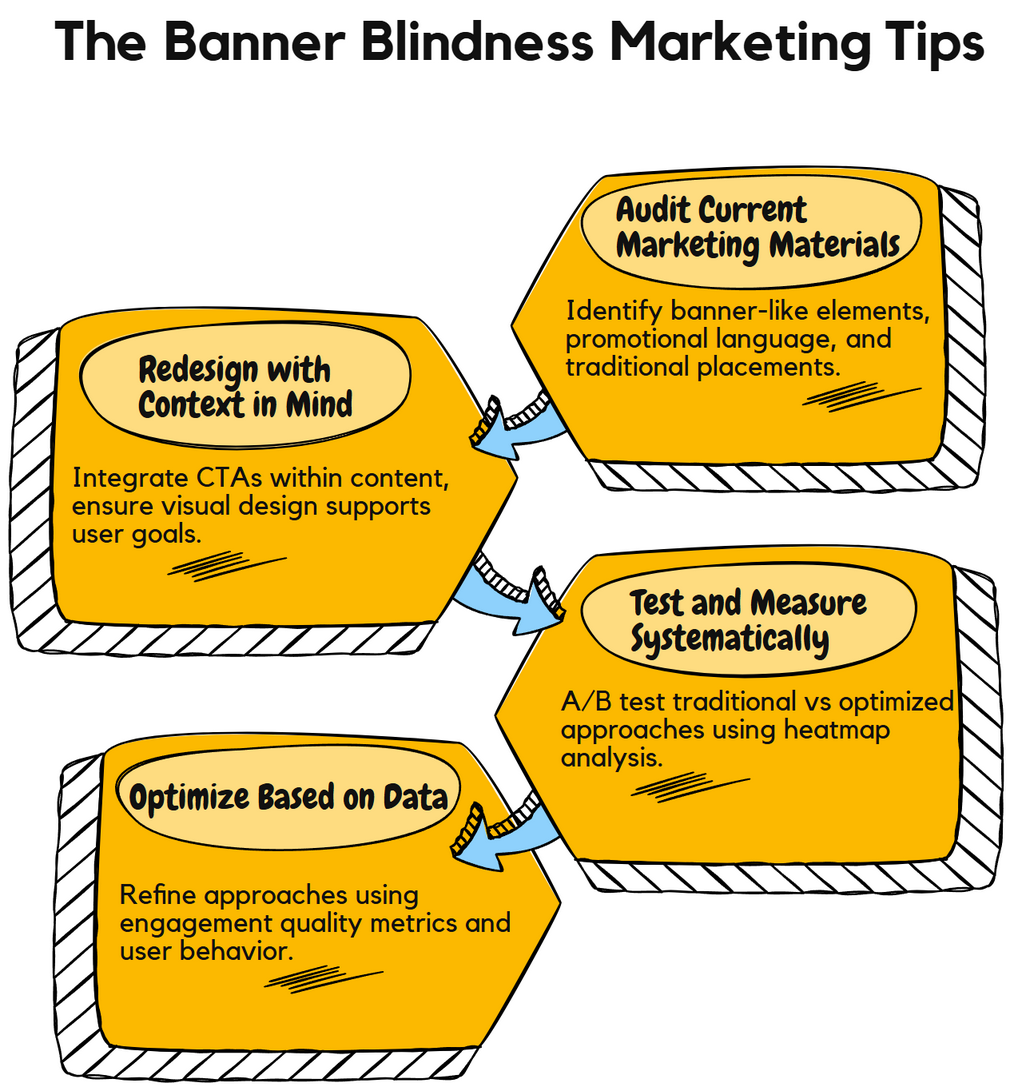
Successfully implementing banner blindness principles requires systematic approach and continuous optimisation based on user behaviour data.
Step-by-Step Implementation Guide
1. Audit Current Marketing Materials Identify elements in your current campaigns that may trigger banner blindness. Look for traditional banner placements, promotional language, and visual cues that users automatically filter out.
2. Redesign with Context in Mind Restructure marketing messages to appear contextually relevant rather than promotional. Integrate calls-to-action within valuable content and ensure visual design supports rather than interrupts user goals.
3. Test and Measure Systematically Implement A/B testing frameworks that compare traditional approaches against banner blindness-optimised alternatives. Use heatmap analysis to understand user attention patterns and identify ignored areas.
4. Optimise Based on Data Continuously refine approaches based on user behaviour data. Pay attention to engagement quality metrics rather than just surface-level performance indicators.
Best Practices and Common Pitfalls
Content Integration works better than content interruption. Embed marketing messages within valuable information rather than placing them in separate, banner-like sections.
Visual Subtlety proves more effective than attention-grabbing design. Use contrast and hierarchy to guide attention without triggering banner blindness responses.
Language Authenticity involves using helpful, informative copy rather than promotional language. Address user needs directly rather than focusing on product features.
Common Pitfalls include over-optimising for banner blindness at the expense of clear communication, failing to maintain proper disclosure for promotional content, and ignoring mobile user experience considerations.
A/B Testing Ideas for Effectiveness Measurement
Placement Testing: Compare traditional banner locations against contextually integrated placements. Measure both attention (through heatmaps) and conversion effectiveness.
Copy Approach Testing: Test promotional language against problem-solving, informational copy. Evaluate user engagement depth and conversion quality.
Visual Design Testing: Compare traditional advertising aesthetics against subtle, content-integrated designs. Monitor user behaviour patterns and completion rates.
Value Proposition Testing: Test different approaches to presenting offers – promotional versus educational framing. Measure both immediate response and long-term engagement.
Related Psychological Biases & Effects
Banner blindness connects to several other cognitive biases that influence user behaviour and marketing effectiveness.
Inattentional Blindness shares similarities with banner blindness but refers to failing to notice unexpected objects when attention is focused elsewhere. Both phenomena demonstrate the selective nature of human attention.
Selective Attention forms the foundation for banner blindness, explaining how users filter information based on relevance to their current goals. Understanding selective attention helps marketers align messages with user intent.
Habituation Effects explain how repeated exposure to similar stimuli leads to decreased response over time. This principle underlies banner blindness development and suggests why advertising effectiveness often decreases with repetition.
Cognitive Load Theory relates to banner blindness through information processing limitations. Users automatically filter out perceived irrelevant information to manage cognitive demands.
Change Blindness demonstrates how users can miss significant changes in their visual environment when attention is directed elsewhere. This connects to banner blindness in showing how selective attention operates.
Understanding these related biases provides a more comprehensive framework for developing effective marketing strategies that work with, rather than against, natural cognitive processes.
Understanding The Banner Blindness can significantly improve your marketing effectiveness by helping you create campaigns that capture attention rather than being automatically filtered out.
FAQs About Banner Blindness
What is Banner Blindness and how does it affect website users?
Banner blindness is a phenomenon where users consciously or unconsciously ignore banner-like information on websites, including advertisements and interface elements that resemble ads. This selective attention mechanism causes users to filter out stimuli they perceive as irrelevant to their goals, even when the information might actually be useful to them.
The effect significantly impacts how users interact with websites by causing them to:
- Skip over important notifications placed in banner-like locations
- Miss relevant calls-to-action that appear too promotional
- Overlook valuable content positioned in traditional advertising spaces
- Focus primarily on task-relevant information whilst filtering out peripheral elements
Why do people develop Banner Blindness when browsing online?
People develop banner blindness through habituation and selective attention mechanisms. The brain learns to filter out repetitive stimuli to focus on more relevant information, essentially creating an automatic filtering system.
Key psychological drivers include:
- Habituation: Repeated exposure to similar ad formats leads to desensitisation
- Attention inertia: Users maintain focus on their primary task, reducing likelihood of noticing peripheral content
- Top-down processing: Prior experience guides users to ignore areas typically associated with advertisements
- Cognitive efficiency: The brain conserves mental resources by filtering out perceived irrelevant information
How does Banner Blindness impact digital advertising effectiveness?
Banner blindness significantly challenges digital advertising by leading to low click-through rates and wasted ad spend. Research shows that users have learned to ignore content that resembles ads, is close to ads, or appears in locations traditionally dedicated to advertisements.
The impact manifests through:
- Reduced engagement with traditional display advertising formats
- Lower conversion rates for banner-style promotional content
- Decreased effectiveness of ads placed in predictable locations
- Need for alternative strategies like native advertising and content integration
However, banner blindness doesn’t mean all online advertising is ineffective – rather, effectiveness depends on format, placement, and user context.
What causes Banner Blindness in web design and user experience?
Banner blindness is primarily caused by learned behaviour patterns where users develop expectations about website layouts and automatically filter out elements that appear advertisement-like.
Design factors that contribute include:
- Traditional banner locations (top of page, sidebars, headers)
- Visual characteristics that resemble typical advertising formats
- Promotional language and obvious sales messaging
- Disconnection from user intent and task-focused browsing
- Visual clutter that makes important elements blend into the background
The key mechanism is that users quickly learn to identify and ignore areas where ads typically appear, creating predictable blind spots in their attention patterns.
Who first discovered Banner Blindness and when was it studied?
Banner blindness was first formally studied by Jan Panero Benway and David M. Lane in 1998. Their groundbreaking research demonstrated that users often miss information presented in banner-like formats, even when that information is directly relevant to their current task.
Their study, published in the International Journal of Human-Computer Studies, established the foundational understanding that users frequently overlook banner-like elements through both conscious and unconscious filtering mechanisms. This research laid the groundwork for decades of subsequent studies on web usability and attention patterns.
What research studies have been conducted on Banner Blindness?
Several key peer-reviewed studies have validated and expanded understanding of banner blindness:
Foundational Research:
- Benway & Lane (1998): First documented users ignoring banner-like elements, even task-relevant information
- Rayner et al. (2001): Eye-tracking studies confirmed users visually skip over banner areas
Recent Findings (2022):
- A study published in Frontiers in Psychology found that neutral-valence banners were recognised better than emotional ones, contrary to expectations
- Research showed that emotional content does not automatically overcome banner blindness
- Task focus and user intent strongly increase the likelihood of ignoring banners
These studies consistently demonstrate that banner blindness persists across desktop and mobile platforms despite changes in ad formats and web design.
How do eye-tracking studies reveal Banner Blindness patterns?
Eye-tracking studies provide concrete visual evidence of banner blindness by showing where users actually look versus where designers expect them to look. These studies reveal that users visually skip over banner areas, supporting the perceptual basis of the effect rather than just cognitive filtering.
Key findings from eye-tracking research:
- Predictable avoidance patterns around traditional ad locations
- Reduced fixation time on banner-like elements
- Heat maps showing “cold spots” in typical advertising areas
- Attention clustering around task-relevant content areas
This research methodology has been crucial in validating banner blindness as a measurable phenomenon rather than just anecdotal observation.
What neurological mechanisms contribute to Banner Blindness?
Banner blindness operates through several neurological and cognitive mechanisms working together:
Primary Mechanisms:
- Selective attention: The brain focuses on goal-relevant information whilst filtering out distractors
- Habituation: Neural responses decrease with repeated exposure to similar stimuli
- Attention inertia: Once focused on a task, users maintain that focus and resist distraction
- Suppression processes: Users actively adjust attentional filters based on information abundance
Recent research indicates that banner blindness is a suppression process rather than perceptual load, meaning users actively filter out banner-like content rather than simply being overwhelmed by visual information.
Are there any studies that challenge the Banner Blindness theory?
Whilst the core principle of banner blindness is well-established, some researchers have noted evolving patterns in user behaviour. A few studies suggest that banner blindness may be decreasing due to:
- Increasing sophistication of online advertising formats
- Users’ growing familiarity with diverse web layouts
- Improved targeting and relevance of digital advertisements
However, these challenges don’t invalidate the fundamental mechanism. Instead, they highlight that the manifestation of banner blindness evolves with web design trends and user habits, whilst the underlying selective attention principles remain relevant.
The consensus remains that users continue to filter out content perceived as advertising, though the specific patterns may adapt over time.
What are the most famous examples of Banner Blindness in action?
Whilst specific branded case studies are limited due to the nature of banner blindness (it’s about what users don’t see), several documented patterns illustrate the effect:
Educational Contexts:
- Students ignoring important notifications on learning platforms when styled like advertisements
- Course announcements being overlooked when placed in banner-like locations
Healthcare Applications:
- Patients missing critical health warnings on medical websites when they resemble ads
- Important safety information being ignored due to promotional styling
E-commerce Observations:
- Users overlooking relevant product recommendations when they appear too advertisement-like
- Important site notifications being missed when placed in traditional banner locations
These examples demonstrate how banner blindness affects information consumption beyond just advertising effectiveness.
How did Banner Blindness affect early internet advertising campaigns?
Early internet advertising was significantly impacted by banner blindness as users quickly learned to ignore traditional banner ad formats. The phenomenon contributed to:
Declining Effectiveness:
- Rapidly decreasing click-through rates as users became accustomed to banner formats
- Reduced ROI for display advertising campaigns
- Need for innovation in advertising approaches
Industry Response:
- Development of native advertising formats that blend with content
- Increased focus on content marketing and integrated promotional strategies
- Evolution towards more sophisticated targeting and personalisation
The early recognition of banner blindness fundamentally shaped how digital advertising developed, pushing the industry towards less intrusive and more contextually relevant approaches.
Which major websites have struggled with Banner Blindness issues?
Rather than specific websites “struggling” with banner blindness, the phenomenon affects all websites that use traditional advertising placements. However, successful sites have adapted by:
Strategic Adaptations:
- Amazon: Integrates product recommendations within natural browsing flow rather than obvious banner placements
- Content sites: Use native advertising and sponsored content that matches editorial style
- E-commerce platforms: Employ contextual product suggestions rather than traditional banner ads
The key insight is that successful websites work with banner blindness rather than against it, designing experiences that align with users’ natural attention patterns rather than fighting them.
What real-world case studies demonstrate Banner Blindness impact?
Due to the nature of banner blindness research, direct case studies with quantifiable results are limited. However, industry adaptations demonstrate the impact:
Documented Patterns:
- Native advertising campaigns often achieve higher engagement rates compared to traditional banner ads
- Content-integrated promotions show better performance than standalone banner placements
- Contextual recommendations (like Amazon’s “frequently bought together”) perform better than obvious advertising
Research-Based Insights:
- Studies show that neutral, task-relevant messaging in non-traditional locations is more effective
- Visual contrast and clarity improve CTA performance when avoiding banner-like styling
- Content relevance matters more than emotional triggers for overcoming banner blindness
How is Banner Blindness different from ad blocking behavior?
Banner blindness and ad blocking are fundamentally different phenomena:
Banner Blindness:
- Cognitive phenomenon where users mentally filter out banner-like information
- Occurs even when ads are not blocked by software
- Unconscious selective attention mechanism
- Affects all banner-like content, not just advertisements
Ad Blocking:
- Technical solution that prevents ads from loading
- Conscious decision to install and use blocking software
- Completely removes advertising content from view
- User-initiated action rather than automatic cognitive process
Understanding this distinction is crucial because banner blindness affects how users perceive information even when no ad blocking technology is involved.
What’s the difference between Banner Blindness and change blindness?
These are distinct psychological phenomena with different mechanisms:
Banner Blindness:
- Selective attention filtering out banner-like content
- Learned behaviour based on expectations about ad locations
- Persistent effect that continues over time
- Content-specific to advertising-like elements
Change Blindness:
- Failure to notice changes in visual scenes
- Occurs when attention is diverted during the change
- Temporary phenomenon related to specific moments
- General visual processing limitation, not content-specific
Both involve attention mechanisms, but banner blindness is about learned filtering of specific content types, whilst change blindness is about missing visual changes during attention shifts.
How does Banner Blindness compare to inattentional blindness?
Banner blindness and inattentional blindness share attention-based mechanisms but differ in scope and application:
Similarities:
- Both involve selective attention processes
- Filtering out information that seems irrelevant
- Unconscious cognitive mechanisms
Key Differences:
- Banner blindness: Specifically targets advertising-like content based on learned patterns
- Inattentional blindness: General failure to notice unexpected objects when attention is focused elsewhere
- Banner blindness: Persistent and predictable based on content type and placement
- Inattentional blindness: Situational and temporary based on attention focus
Banner blindness is essentially a specialised form of selective attention that has developed specifically in response to web advertising patterns.
Is Banner Blindness related to selective attention disorders?
Banner blindness is not related to attention disorders – it’s a normal cognitive function that demonstrates healthy selective attention mechanisms. In fact, banner blindness shows that attention systems are working effectively by filtering out perceived irrelevant information.
Normal vs. Disordered Attention:
- Banner blindness: Adaptive filtering that helps users focus on task-relevant content
- Attention disorders: Impaired ability to control attention appropriately
- Banner blindness: Universal phenomenon experienced by most web users
- Attention disorders: Clinical conditions that interfere with daily functioning
The ability to develop banner blindness actually indicates efficient cognitive processing and successful adaptation to information-rich digital environments.
What’s the opposite of Banner Blindness in web design?
The opposite of banner blindness would be banner prominence or advertising salience – where users actively notice and engage with promotional content. However, this isn’t typically a natural state but rather achieved through specific design strategies:
Strategies for Banner Prominence:
- Native advertising that blends with content whilst remaining relevant
- Contextual integration of promotional elements within natural user flow
- Task-relevant messaging that directly addresses user needs
- Visual contrast without appearing obviously promotional
Important Note: The goal isn’t to “trick” users into seeing ads, but rather to create genuinely relevant and helpful promotional content that serves user needs whilst achieving business objectives.
How do marketers overcome Banner Blindness in their campaigns?
Marketers overcome banner blindness by working with natural attention patterns rather than against them:
Effective Strategies:
- Native advertising that matches surrounding content style
- Content integration rather than separate banner placements
- Contextual relevance that aligns with user intent
- Non-traditional placement avoiding typical advertising locations
- Clear, neutral messaging rather than obvious promotional language
Research-Based Approaches:
- Use neutral-valence content (research shows it’s recognised better than emotional content)
- Focus on task relevance rather than attention-grabbing techniques
- Employ visual contrast and clarity without banner-like styling
- Integrate promotions into natural content flow
What advertising strategies work best against Banner Blindness?
The most effective strategies align with user behaviour rather than fighting banner blindness:
Proven Approaches:
- Native advertising that blends with editorial content
- Content marketing that provides genuine value
- Contextual placement within relevant user journeys
- Sponsored content that matches platform style
- In-feed advertising on social media platforms
Design Principles:
- Avoid traditional banner locations (headers, sidebars)
- Match content style and tone
- Provide genuine value rather than just promotional messaging
- Use clear, direct language without obvious sales copy
- Integrate with user tasks rather than interrupting them
How does Banner Blindness affect conversion rates and ROI?
Banner blindness significantly impacts digital marketing performance by reducing engagement with traditional advertising formats:
Conversion Impact:
- Lower click-through rates for banner-style advertisements
- Reduced form submissions when CTAs appear too promotional
- Decreased engagement with obvious advertising content
- Wasted ad spend on ignored banner placements
ROI Considerations:
- Higher costs per acquisition for traditional banner advertising
- Better performance from native and integrated advertising approaches
- Improved results when focusing on content relevance over visual prominence
- Long-term benefits from building trust through valuable content
The key is measuring success differently, focusing on engagement quality and relevance rather than just visibility metrics.
What role does Banner Blindness play in programmatic advertising?
Banner blindness presents both challenges and opportunities for programmatic advertising:
Challenges:
- Reduced effectiveness of traditional display ad formats
- Lower engagement rates for obvious advertising placements
- Increased competition for user attention
- Need for more sophisticated targeting and creative approaches
Opportunities:
- Native advertising formats that can be programmatically delivered
- Contextual targeting that aligns with user intent
- Dynamic creative optimisation based on user behaviour patterns
- Performance data that helps identify effective vs. ignored placements
Successful programmatic strategies increasingly focus on relevance and context rather than just reach and frequency.
How can businesses measure Banner Blindness on their websites?
Businesses can measure banner blindness through several data-driven approaches:
Analytics Methods:
- Heat map analysis using tools like Hotjar or Crazy Egg to identify ignored areas
- Click-through rate analysis comparing different placement locations
- A/B testing of banner vs. integrated content approaches
- User session recordings to observe actual browsing behaviour
- Eye-tracking studies for detailed attention pattern analysis
Key Metrics:
- Engagement rates by content placement
- Conversion rates for different CTA styles and locations
- Time spent on different page areas
- Scroll depth and interaction patterns
- Form completion rates by placement strategy
Is it ethical to exploit Banner Blindness in marketing strategies?
Using banner blindness insights ethically means improving user experience rather than deceiving users:
Ethical Applications:
- Providing genuine value through relevant content
- Improving information architecture to help users find what they need
- Creating better user experiences by reducing irrelevant distractions
- Transparent labelling of sponsored or promotional content
Unethical Practices:
- Deliberately hiding important information in banner-like areas
- Deceptive native advertising without proper disclosure
- Manipulating users through misleading content placement
- Violating advertising standards through unclear labelling
The goal should be mutual benefit – helping users whilst achieving business objectives through genuinely valuable and relevant content.
Curious about other psychological biases that influence customer behavior? Explore our comprehensive guide to cognitive biases in marketing here.