Guide to The Liking Principle (Cialdini) in Marketing: Description, Psychology, and Examples
What Is The Liking Principle (Cialdini)?
The Liking Principle is the tendency for people to be more easily persuaded by individuals or brands they know and like, making them more receptive to recommendations, offers, and requests from sources they find attractive, similar, or familiar. This powerful psychological principle explains why customers buy from salespeople who share their interests, why friendly local businesses outperform distant competitors, and why brand personality and relatability drive purchasing decisions more than expertise or price alone.
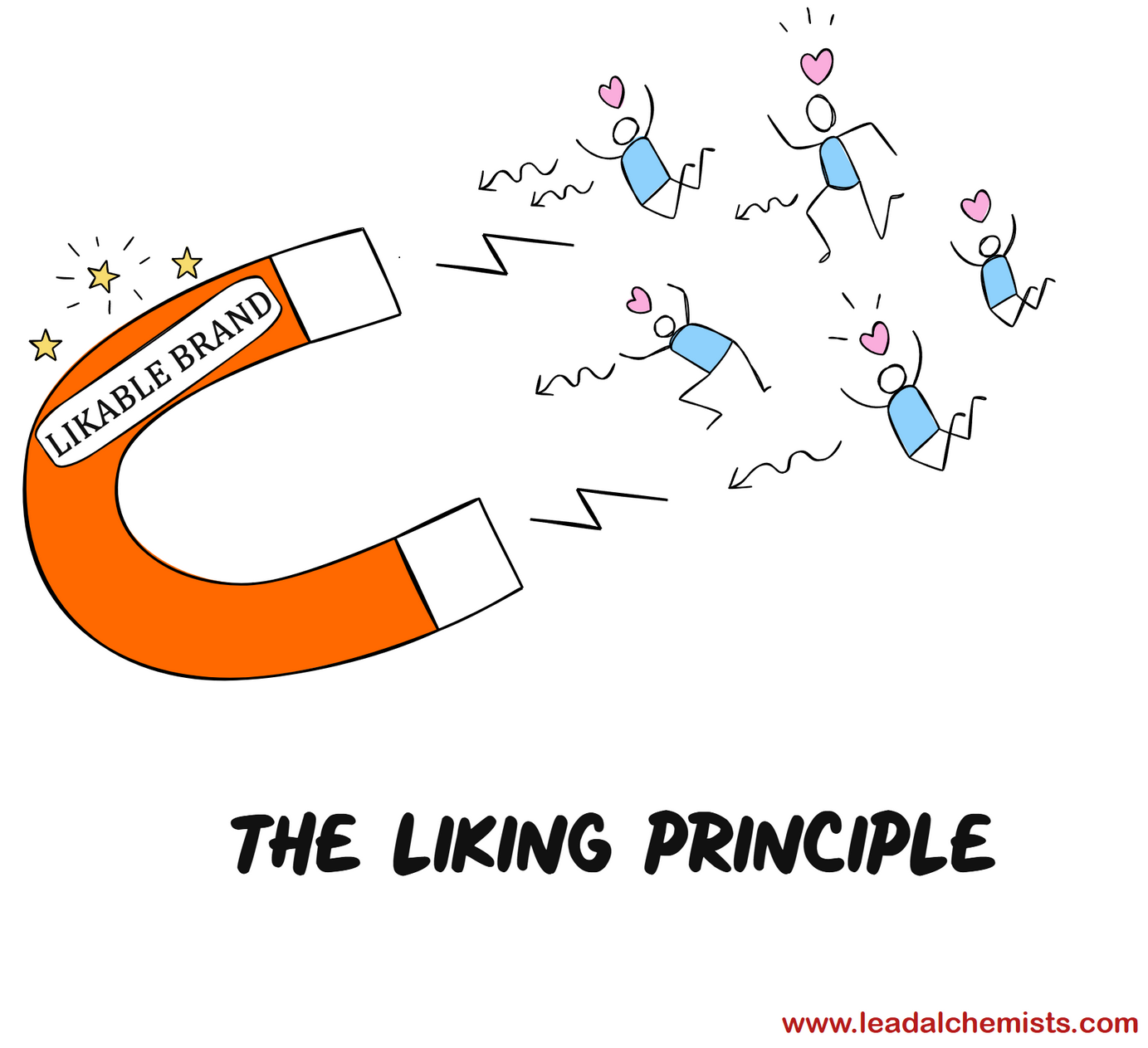
More customers will engage with and buy from your brand if they genuinely like you and feel a connection. Used thoughtfully, the liking principle can be a great way to build trust and increase conversions. It’s used a lot by personal brands and service-based businesses.
At its psychological core, the Liking Principle works because humans are social creatures who instinctively lower their psychological defenses around people and brands they like. When we perceive similarity, familiarity, or positive associations with a brand, our brains automatically increase trust and receptiveness to their messages, making it far more likely that we’ll accept recommendations and make purchases rather than maintaining the skeptical distance we hold toward brands we find unfamiliar or unlikable.
For marketers and advertisers, understanding this bias gives a real competitive edge. By purposefully and strategically building brand likability through authentic similarity, consistent positive exposure, genuine engagement, and shared values while delivering real solutions to customer needs, you can create lasting connections and drive conversions in ways that other persuasion techniques simply cannot match.
How The Liking Principle (Cialdini) Works (The Psychology Behind It)
The psychology behind the Liking Principle is rooted in evolutionary survival mechanisms and social bonding. Our brains are wired to favour those we perceive as part of our “tribe” – people who share our values, experiences, or goals.
The Neurological Foundation
When we encounter someone we like, our brains release oxytocin and dopamine – chemicals associated with trust, bonding, and reward. This neurochemical response reduces our critical evaluation of persuasive messages and increases our willingness to comply with requests.
Key Psychological Mechanisms:
- Social Identity Theory: We categorise people into “in-groups” (like us) and “out-groups” (different from us). We naturally favour and trust members of our in-group.
- Classical Conditioning: Positive associations with likable people or brands transfer to their products or services. This is why celebrity endorsements work – we associate the positive feelings we have for the celebrity with the brand.
- Mere Exposure Effect: The more we’re exposed to someone in a positive context, the more we like them. This explains why consistent, valuable content marketing builds trust over time.
Supporting Research
Burger et al. (2001) demonstrated that even subtle forms of similarity increase compliance and likability. In their study, participants were more likely to comply with requests from people who shared seemingly insignificant similarities, such as having the same birthday or first name.
The famous Tupperware party study by Frenzen & Davis (1990) found that guests’ fondness for the hostess was twice as important as their regard for the actual product when deciding to purchase. This research provides direct evidence that liking drives purchasing decisions more than product features.
Real-World Examples of The Liking Principle (Cialdini)
Beyond Marketing: Where Liking Rules
The Liking Principle operates across numerous contexts:
Education: Teachers who are liked by students create more engaged, motivated classrooms. Students are more likely to participate, complete assignments, and retain information when they have a positive relationship with their instructor.
Healthcare: Patients show significantly higher adherence to medical advice from doctors they like and trust. This relationship often matters more than the doctor’s credentials or the treatment’s complexity.
Negotiation: Business negotiators who establish rapport and demonstrate shared interests achieve better outcomes. The “getting to know you” phase isn’t just pleasantries – it’s strategic relationship building.
Politics: Successful politicians understand that likability often trumps policy positions. Voters frequently choose candidates they’d “like to have a beer with” over those with superior qualifications.
Marketing Applications That Work
Celebrity and Influencer Marketing: Brands leverage the Liking Principle by associating products with likable celebrities or influencers. The key isn’t just fame – it’s the authentic connection between the endorser and their audience.
Brand Personality Development: Companies like Innocent Smoothies and Ben & Jerry’s have built entire brands around likable personalities. Their social media voices, packaging design, and company values all contribute to a sense of shared identity with customers.
Customer Reviews and Testimonials: Amazon’s review system works because potential buyers trust reviews from people like themselves more than marketing copy. The reviews create a sense of social proof combined with likability – “people like me had a good experience.”
How The Liking Principle (Cialdini) Affects Consumer Behaviour
When the Liking Principle is triggered, several psychological changes occur that directly impact purchasing behaviour:
Reduced Critical Evaluation: Prospects spend less time scrutinising claims from brands they like. This doesn’t mean they become gullible – rather, they give the benefit of the doubt more readily.
Increased Trust Transfer: Positive feelings about a salesperson, brand spokesperson, or company culture transfer to the product or service being offered. This is why “people buy from people” remains a fundamental sales truth.
Enhanced Memory and Recall: Information from liked sources is processed more deeply and remembered more clearly. This gives likable brands a significant advantage in crowded markets.
Higher Price Tolerance: Customers are willing to pay premium prices for brands they like. Apple’s pricing strategy succeeds partly because customers have strong emotional connections to the brand.
Increased Word-of-Mouth: People actively promote brands they like, becoming unpaid advocates. This organic marketing is more trusted and effective than traditional advertising.
Case Studies: How Marketers Use The Liking Principle (Cialdini) in Advertising
Tupperware Parties: The Gold Standard
The Tupperware party model remains the textbook example of the Liking Principle in action. Rather than selling through retail stores, Tupperware built their business model around social connections.
The Strategy: Hostesses invite friends and family to their homes for product demonstrations. Attendees are more likely to purchase from someone they like (the hostess) in a comfortable, social environment.
The Results: Frenzen & Davis’s research showed that guests’ fondness for the hostess was twice as important as their regard for the product when making purchase decisions. This model has sustained Tupperware’s global success for decades.
The Lesson: Social connections and personal relationships can be more powerful than product features or competitive pricing.
PetRelocation’s “About Us” Transformation
CXL.com documented how PetRelocation improved their conversion rates by humanising their staff bios and emphasising shared interests with pet owners.
The Strategy: Instead of generic corporate bios, they featured personal stories about staff members’ own pets, their passion for animal welfare, and their understanding of the emotional challenges of pet relocation.
The Results: The company saw measurable increases in conversion rates, attributed to increased visitor trust and relatability.
The Lesson: Showing the human side of your business creates emotional connections that drive conversions.
Local Service Business A/B Test
A realistic scenario many service businesses could implement:
The Test: A local plumbing company runs two Google Ads campaigns:
- Control: “Emergency Plumbing Services – Fast Response – Call Now!”
- Test: “Your Local Plumber – Friendly & Reliable – We’re Here to Help!” (with a photo of the plumber)
Expected Results: The test version should achieve higher click-through rates and conversion rates by emphasising local connection and personal approachability.
The Application: This demonstrates how small changes in messaging can leverage the Liking Principle to improve lead generation results.
Practical Applications for Google Ads & Lead Generation
Google Ads Strategies
Ad Copy That Builds Connection:
- Highlight shared values: “Supporting Manchester businesses for 10+ years”
- Use friendly, conversational language: “We’re here to help” vs. “Contact us today”
- Include community involvement: “Proud sponsors of [Local Charity]”
- Feature awards and recognition: “Rated 5-stars by local customers”
Visual Elements:
- Use photos of real team members, not stock images
- Show happy customers and positive interactions
- Include local landmarks or community elements
- Display genuine testimonials with customer photos
A/B Testing Ideas:
- Formal vs. Friendly Tone: Test corporate language against conversational, approachable copy
- Generic vs. Personal: Compare stock photos with real team member images
- Features vs. Values: Test service features against shared community values
Lead Generation Website Optimization
Landing Page Elements:
- Team Photos: Include professional but approachable photos of staff members
- Personal Stories: Share brief, authentic stories about why team members chose their profession
- Client Testimonials: Feature detailed success stories from relatable customers
- Community Involvement: Highlight local partnerships, charity work, or community events
Form Optimization:
- Add personalised messages: “We’re excited to learn about your project!”
- Include the name of who will respond: “Sarah will be in touch within 24 hours”
- Use conversational language throughout the form process
- Provide immediate value through helpful resources or guides
Trust-Building Elements:
- Display genuine customer reviews prominently
- Include case studies with real client names and photos (with permission)
- Show certifications, awards, and professional memberships
- Feature video testimonials for maximum authenticity
Small Business Implementation
Low-Cost Strategies:
- Authentic Photography: Use smartphone cameras to capture genuine moments with customers and team members
- Customer Story Collection: Regularly gather and share detailed success stories
- Community Engagement: Participate in local events and highlight involvement on your website
- Social Media Personality: Develop a consistent, likable brand voice across all platforms
Big Brand vs. Small Business Examples:
- Big Brand: Salesforce uses grouped customer testimonials and success stories on their signup pages
- Small Business Equivalent: A local law firm features multiple client success stories and staff bios on their contact page to boost consultation bookings
Why Marketers Should Care About The Liking Principle (Cialdini)
The Liking Principle offers several compelling advantages for modern marketers:
Competitive Differentiation: In crowded markets where products and services are increasingly similar, likability becomes a key differentiator. Customers choose brands they connect with emotionally.
Cost-Effective Marketing: Building likability through authentic content and genuine relationships often costs less than traditional advertising while delivering better results.
Long-Term Customer Value: Customers who like your brand stay longer, buy more, and refer others. The lifetime value of a “liked” customer significantly exceeds that of a purely transactional relationship.
Crisis Resilience: Brands with strong likability weather negative publicity and competitive attacks better. Customers give liked brands the benefit of the doubt during difficult times.
Ethical Considerations and Responsible Use
The Right Way: Use the Liking Principle to build genuine connections based on shared values, authentic communication, and real value delivery. Focus on being genuinely helpful and trustworthy.
The Wrong Way: Manipulating emotions through false claims, fake testimonials, or manufactured similarity. These tactics may work short-term, but damage long-term brand reputation.
Best Practices:
- Always be authentic in your communications
- Ensure testimonials and reviews are genuine
- Focus on providing real value to customers
- Build relationships based on mutual benefit
- Respect customer privacy and preferences
Warning Signs of Overuse:
- Customers become sceptical of overly friendly approaches
- Competitors successfully position your brand as “fake” or manipulative
- Team members struggle to maintain authentic personalities
- Customer acquisition costs increase despite likability efforts
How to Implement The Liking Principle (Cialdini) in Your Marketing Strategy
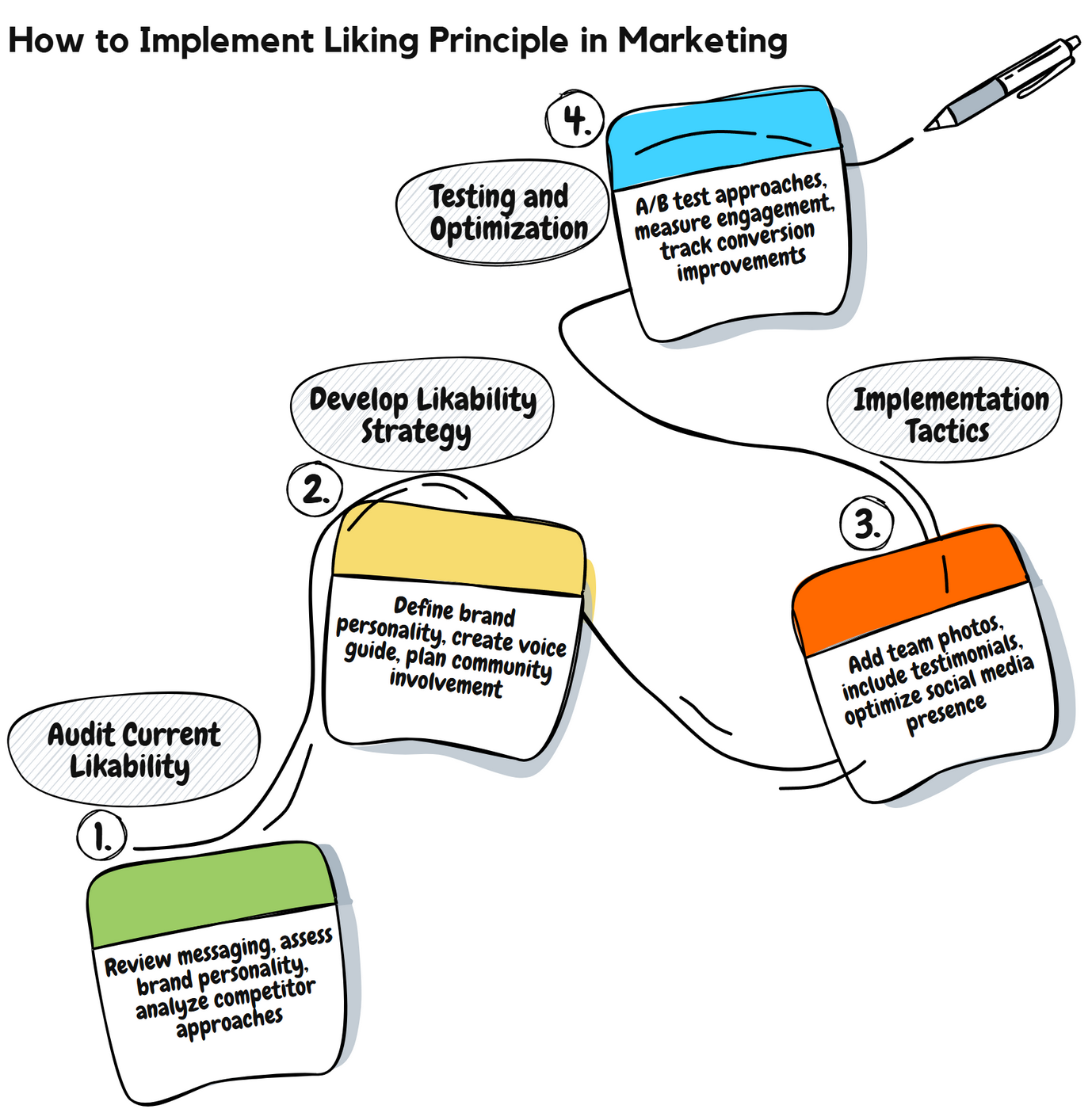
Step 1: Audit Your Current Likability
Brand Personality Assessment:
- Review your current messaging across all channels
- Identify opportunities to show personality and humanity
- Analyse competitor approaches to likability
- Survey existing customers about their perceptions
Content Analysis:
- Evaluate website copy for warmth and approachability
- Review social media voice and engagement levels
- Assess visual elements for authenticity
- Check testimonials and reviews for relatability
Step 2: Develop Your Likability Strategy
Define Your Brand Personality:
- Identify core values that resonate with your target audience
- Develop a consistent voice and tone guide
- Create guidelines for visual representation
- Establish community involvement priorities
Content Planning:
- Plan regular behind-the-scenes content
- Schedule customer success story features
- Develop team member spotlight content
- Create value-driven educational materials
Step 3: Implementation Tactics
Website Optimization:
- Add team photos and personal bios to key pages
- Include customer testimonials with photos and details
- Create an engaging “About Us” page that tells your story
- Implement personalised messaging throughout the user journey
Social Media Strategy:
- Share team moments and company culture
- Respond personally to comments and messages
- Highlight customer successes and community involvement
- Use consistent, friendly language across platforms
Email Marketing:
- Write emails from real team members, not generic addresses
- Include personal signatures with photos
- Share behind-the-scenes stories and updates
- Celebrate customer achievements and milestones
Step 4: Testing and Optimization
A/B Testing Ideas:
- Email Subject Lines: Test personal vs. corporate approaches
- Landing Page Headlines: Compare feature-focused vs. relationship-focused messaging
- Social Media Posts: Test behind-the-scenes vs. promotional content
- Ad Copy: Compare formal vs. conversational language
Measurement Metrics:
- Engagement rates across all channels
- Conversion rates from different message types
- Customer satisfaction and Net Promoter Scores
- Brand sentiment analysis from social listening
Common Pitfalls to Avoid:
- Forcing personality that doesn’t match your brand
- Overdoing friendliness to the point of appearing unprofessional
- Neglecting to maintain consistency across channels
- Focusing on likability at the expense of competence
Related Psychological Biases & Effects
Understanding how the Liking Principle interacts with other psychological biases can amplify your marketing effectiveness:
Social Proof: When people we like recommend something, the social proof effect is magnified. Testimonials from likable customers carry more weight than anonymous reviews.
Authority: Likable experts are more persuasive than unlikable ones. This is why thought leaders focus on building personal brands alongside demonstrating expertise.
Reciprocity: When we like someone, we’re more motivated to reciprocate their kindness or generosity. This makes content marketing and free resources more effective.
Commitment and Consistency: People are more likely to follow through on commitments made to people they like. This improves customer retention and referral rates.
Scarcity: Limited offers from liked brands feel more valuable and urgent. The fear of missing out is stronger when it involves brands we have emotional connections with.
The Liking Principle isn’t just another marketing tactic – it’s a fundamental aspect of human psychology that, when applied ethically and authentically, can transform your business relationships and results. Whether you’re running Google Ads, optimising landing pages, or building long-term customer relationships, understanding and applying this principle can give you a significant competitive advantage.
The key is authenticity. In an age of increasing scepticism about marketing messages, genuine likability based on shared values, helpful service, and authentic communication stands out more than ever. Start small, test consistently, and focus on building real relationships with your prospects and customers.
FAQs About Liking Principle (Cialdini)
What is the Liking Principle (Cialdini) and how does it work?
The Liking Principle states that people are more likely to be persuaded by individuals or brands they know and like. This psychological principle, developed by Robert Cialdini, operates through six key mechanisms: similarity (we like people who are similar to us), familiarity (repeated exposure increases liking), praise (compliments enhance likability), cooperation (working toward common goals builds rapport), association (positive connections transfer to the brand), and physical attractiveness (the “what is beautiful is good” effect).
In marketing, this translates to building genuine connections with your audience through shared values, authentic testimonials, and relatable brand personalities that foster trust and engagement.
How does Liking Principle (Cialdini) influence our decision-making process?
Liking influences decision-making by reducing our critical evaluation of persuasive messages when they come from sources we find appealing. When we like someone or something, we’re more inclined to trust their recommendations, overlook potential flaws, and make faster purchasing decisions.
This happens because positive affect creates a mental shortcut – instead of thoroughly analysing every detail, our brains use our feelings about the source as a proxy for quality. For example, customers are more likely to book a consultation with a local accountant whose website features genuine client testimonials and community involvement, even if their prices are slightly higher than competitors.
What are the key characteristics that define Liking Principle (Cialdini)?
The Liking principle is defined by six core characteristics:
• Similarity: Shared backgrounds, interests, or values create instant connection • Familiarity: Regular exposure builds comfort and trust over time
• Praise: Genuine compliments increase positive feelings toward the source • Cooperation: Working together toward mutual goals strengthens bonds • Association: Positive connections with liked entities transfer to your brand • Physical attractiveness: Appealing visuals and presentation enhance perceived credibility
These characteristics work together to create an overall sense of affinity that makes persuasion more effective. The key is authenticity – forced or manufactured likability often backfires when audiences detect insincerity.
How is Liking Principle (Cialdini) different from other persuasion techniques?
Liking differs from other persuasion principles by focusing on interpersonal connection rather than logical arguments or social pressure. Unlike social proof (following what others do) or authority (deferring to expertise), Liking creates persuasion through emotional bonds and personal affinity.
Key distinctions: • Reciprocity involves obligation; Liking involves genuine affection • Scarcity creates urgency; Liking builds lasting relationships
• Authority relies on credentials; Liking depends on personal connection • Social proof shows what’s popular; Liking shows what’s personally appealing
This makes Liking particularly powerful for service-based businesses and long-term customer relationships, where trust and personal connection drive decision-making more than features or social validation.
Who is Robert Cialdini and why is Liking Principle (Cialdini) named after him?
Robert Cialdini is a renowned social psychologist who systematically studied and popularised the Liking principle in his 1984 book “Influence: The Psychology of Persuasion”. While the psychological mechanisms behind liking were known before, Cialdini was the first to codify it as a distinct principle of persuasion and demonstrate its practical applications.
His research synthesised decades of psychological studies into six core principles of influence, with Liking being one of the most powerful for building genuine business relationships. Cialdini’s work transformed how marketers understand consumer psychology, moving beyond manipulation toward authentic connection-building strategies that benefit both businesses and customers.
What scientific research supports the effectiveness of Liking Principle (Cialdini)?
Several peer-reviewed studies validate the Liking principle’s effectiveness:
Key research findings: • Frenzen & Davis (1990) found that guests’ fondness for Tupperware party hostesses was twice as important as product regard in purchase decisions • Burger et al. (2001) demonstrated that even subtle similarity increases compliance rates • Zajonc’s mere exposure studies confirm that repeated exposure increases liking and trust • Dion, Berscheid & Walster (1972) established the “what is beautiful is good” effect, showing attractiveness increases perceived likability
Recent research focuses on digital applications, particularly in influencer marketing and social media engagement, confirming the principle’s continued relevance in modern marketing contexts.
What neurological mechanisms drive the Liking Principle (Cialdini)?
The Liking principle activates reward pathways in the brain, particularly areas associated with positive emotions and trust. When we encounter someone we like, our brains release dopamine and oxytocin, creating feelings of pleasure and bonding that reduce critical thinking about their messages.
However, direct neurological evidence specific to Cialdini’s principle is limited in recent peer-reviewed literature. Most neuroscience research focuses on broader reward and affect pathways rather than the specific mechanisms of interpersonal liking in persuasion contexts.
Key neural processes: • Positive associations activate reward centres • Familiar faces trigger comfort responses • Similar individuals reduce cognitive load in processing decisions
Are there any studies that challenge the validity of Liking Principle (Cialdini)?
While the core principle is well-supported, some researchers argue that liking alone doesn’t guarantee persuasion if other factors are lacking. Key limitations include:
Moderating factors: • Source credibility can override liking when expertise is crucial • Message strength matters more in high-involvement decisions • Context dependency means liking works better in some situations than others • Cultural variations affect how liking influences different populations
The principle is most effective when combined with other persuasion techniques and when the likability is perceived as genuine rather than manufactured. Overly obvious attempts to create liking can backfire and reduce trust.
What are some famous real-world examples of Liking Principle (Cialdini) in action?
Verified examples include:
• Tupperware parties: Academic research shows hostess likability was twice as important as product quality in purchase decisions • PetRelocation’s “About Us” page: Humanising staff bios with shared pet interests increased conversion rates • Local service businesses: Plumbers and accountants using friendly, community-focused messaging in Google Ads see higher click-through rates • Dove’s “Real Beauty” campaign: Featuring relatable, diverse women built brand connection and increased sales
The most effective applications focus on authentic similarity and genuine community involvement rather than superficial attempts at likability.
How do celebrities use Liking Principle (Cialdini) in their endorsements?
Celebrity endorsements leverage the Liking principle by transferring positive feelings from the celebrity to the product. This works through association – when we like a celebrity, those positive emotions extend to brands they represent.
Effective celebrity endorsement strategies: • Authentic alignment: Matching celebrity values with brand identity • Genuine usage: Celebrities actually using the products they endorse • Shared demographics: Targeting audiences who identify with the celebrity • Long-term partnerships: Building sustained association rather than one-off campaigns
However, this can backfire if the celebrity’s image becomes tarnished or if the partnership appears purely transactional rather than genuine.
Can you find examples of Liking Principle (Cialdini) in popular movies or TV shows?
While specific academic studies on Liking in entertainment are limited, the principle appears frequently in character development and plot progression:
Common applications: • Likeable protagonists make audiences more accepting of their questionable decisions • Similarity building between characters and target demographics increases viewer engagement • Attractive presenters in advertisements and product placements leverage physical appeal • Familiar faces in recurring roles build audience loyalty over time
The entertainment industry intuitively applies these principles, though the effects are often intertwined with storytelling techniques and production values, making direct causation difficult to isolate.
What historical events demonstrate the power of Liking Principle (Cialdini)?
While comprehensive historical analysis of the Liking principle is limited in academic literature, several documented examples show its influence:
Political applications: • Charismatic leaders often build support through personal appeal rather than policy details • Campaign strategies focus on making candidates appear relatable and likeable • Community organising succeeds when leaders share backgrounds with their constituents
However, historical events typically involve multiple persuasion principles working together, making it difficult to attribute outcomes solely to liking. The principle is most powerful when combined with credibility, social proof, and other influence techniques.
How does Liking Principle (Cialdini) compare to the Halo Effect?
While related, these are distinct psychological phenomena:
Liking (Cialdini): • Focuses on interpersonal attraction and connection • Builds through similarity, familiarity, and positive association • Primarily affects persuasion and compliance
Halo Effect: • One positive trait influences perception of all other traits • Can occur without personal connection or liking • Affects overall judgement and evaluation
Key difference: Liking can contribute to the halo effect, but the halo effect is broader and doesn’t require interpersonal connection. A company might benefit from the halo effect due to one excellent product, even if customers don’t particularly “like” the brand personality.
What’s the difference between Liking Principle (Cialdini) and Social Proof?
These principles operate through different psychological mechanisms:
Liking (Cialdini): • Based on personal connection and affinity • “I trust this because I like the source” • Works through emotional bonds and similarity
Social Proof: • Based on what others are doing • “I’ll do this because others are doing it” • Works through conformity and validation
Interaction: Liking amplifies social proof – testimonials from people we find relatable are more persuasive than anonymous reviews. For example, a local gym’s success stories from similar-aged community members combine both principles effectively.
How is Liking Principle (Cialdini) similar to or different from reciprocity?
Both principles influence behaviour, but through different psychological pathways:
Similarities: • Both build positive relationships • Both can increase compliance and persuasion • Both work better when perceived as genuine
Key differences: • Reciprocity creates obligation (“I owe them something”) • Liking creates affection (“I want to help them”) • Reciprocity can work with strangers; Liking requires some connection • Reciprocity is transactional; Liking is emotional
In practice: A financial advisor might use reciprocity by offering a free consultation, then leverage liking by sharing personal stories and community involvement to build ongoing relationships.
Is there an opposite effect to Liking Principle (Cialdini)?
Yes, disliking creates the opposite effect – people actively resist persuasion from sources they find unappealing. This can manifest as:
Negative effects: • Reactance: Deliberately opposing recommendations from disliked sources • Selective attention: Ignoring or dismissing messages from unappealing brands • Negative association: Transferring dislike to products or ideas • Increased scrutiny: Applying higher standards to evaluate claims
Marketing implications: Brands must be careful not to alienate audiences through controversial positions, inauthentic messaging, or association with disliked figures. Recovery from negative associations is typically much harder than building positive ones.
How do marketers use Liking Principle (Cialdini) to increase sales?
Marketers apply the Liking principle through several verified strategies:
Proven techniques: • Authentic testimonials from relatable customers • Team photos and bios that humanise the business • Community involvement showcasing shared values • Personalised messaging that addresses customers directly • Similarity marketing targeting specific demographic groups
Lead generation applications: • Local service businesses highlighting community connections in Google Ads • Professional services featuring client success stories on landing pages • SaaS companies using grouped testimonials to build trust on signup pages
The key is authenticity – manufactured likability often backfires when audiences detect insincerity.
What role does Liking Principle (Cialdini) play in brand loyalty?
Liking creates emotional connections that transcend purely transactional relationships, leading to stronger brand loyalty through:
Loyalty mechanisms: • Emotional attachment makes customers less price-sensitive • Trust building reduces the need to constantly evaluate alternatives • Identity alignment makes the brand part of customers’ self-concept • Forgiveness factor helps brands recover from occasional mistakes
Long-term benefits: • Higher customer lifetime value • Increased word-of-mouth referrals • Reduced marketing costs for retention • Premium pricing opportunities
However, loyalty based solely on liking can be fragile if not supported by consistent quality and value delivery.
How can businesses implement Liking Principle (Cialdini) in their advertising strategies?
Verified implementation strategies:
Google Ads & PPC: • Use friendly, community-focused language in ad copy • Include team photos and local connections in visual ads • Highlight shared values and community involvement • Test relatable messaging against feature-focused copy
Landing pages: • Feature authentic customer testimonials prominently • Include “About Us” sections with team photos and personal stories • Add personalised form messages with staff names • Showcase community involvement and shared values
Content marketing: • Share behind-the-scenes content that humanises your brand • Create content that reflects your audience’s interests and values • Engage authentically on social media platforms • Partner with local organisations and causes
Does Liking Principle (Cialdini) work in B2B sales and marketing?
Yes, Liking is particularly effective in B2B contexts where relationship-building and trust are crucial for long-term partnerships:
B2B applications: • Sales representatives building rapport through shared interests and backgrounds • Account management maintaining relationships through personal connection • Content marketing showcasing company culture and values • Networking events leveraging similarity and cooperation
Effectiveness factors: • B2B decisions often involve multiple stakeholders who must all be influenced • Longer sales cycles provide more opportunities to build liking • Higher stakes make trust and personal connection more important • Professional relationships often extend beyond single transactions
The principle works best when combined with demonstrated expertise and credible results.
What are the ethical concerns surrounding Liking Principle (Cialdini) in marketing?
Primary ethical concerns:
Manipulation vs. Authenticity: • Using fake testimonials or manufactured endorsements • Creating false similarity or shared interests • Exploiting personal information to appear more likeable
Transparency issues: • Not disclosing paid partnerships or sponsored content • Misrepresenting company values or community involvement • Using personal data inappropriately to build artificial connections
Best practices for ethical application: • Ensure all testimonials and endorsements are genuine • Be transparent about business relationships and sponsorships • Focus on authentic shared values rather than manufactured similarity • Respect customer privacy and data protection regulations
Can Liking Principle (Cialdini) be considered manipulative or deceptive?
Liking becomes manipulative when it relies on deception or manufactured connections rather than authentic relationship-building:
Manipulative applications: • Fake testimonials or reviews • False claims about company values or community involvement • Exploiting personal information to create artificial similarity • Using attractive models to sell unrelated products without disclosure
Ethical applications: • Genuine testimonials from real customers • Authentic company culture and values • Transparent business practices and relationships • Honest representation of products and services
The key distinction: Ethical use of Liking builds genuine value for both parties, while manipulation prioritises short-term gains over long-term trust.
What are the risks of overusing Liking Principle (Cialdini) in business?
Primary risks include:
Authenticity backlash: • Customers detecting forced or manufactured likability • Appearing desperate or trying too hard to be liked • Inconsistency between marketing messages and actual experience
Dependency risks: • Over-relying on personal relationships rather than product quality • Vulnerability when key likeable staff members leave • Difficulty scaling personal connection strategies
Brand positioning issues: • Appearing unprofessional in formal business contexts • Alienating audiences who prefer straightforward, fact-based communication • Diluting brand message with too much personality focus
Mitigation strategies: Balance likability with competence, maintain authenticity, and ensure product quality supports relationship-building efforts.
How can consumers protect themselves from Liking Principle (Cialdini) manipulation?
Awareness strategies:
Recognise the techniques: • Notice when marketers emphasise similarity or shared values • Be aware of attractive spokespeople or testimonials • Question whether praise or compliments serve a sales purpose • Identify attempts to create artificial familiarity
Decision-making safeguards: • Separate your feelings about the messenger from the message quality • Research products independently of marketing materials • Compare options based on objective criteria, not just appeal • Take time to make decisions rather than responding immediately to likeable presentations
Critical evaluation: • Ask whether testimonials and endorsements are genuine • Verify claims about company values and community involvement • Consider whether your positive feelings are based on substance or presentation