Guide to The Endowment Effect in Marketing: Description, Psychology, and Examples
What Is The Endowment Effect?
The Endowment Effect is the tendency for people to value items they own more highly than identical items they don’t own, demanding more money to give up something they possess than they would pay to acquire it. This powerful cognitive bias explains why customers become emotionally attached to products once they feel ownership, making the prospect of losing them feel more painful than the pleasure of gaining something new.
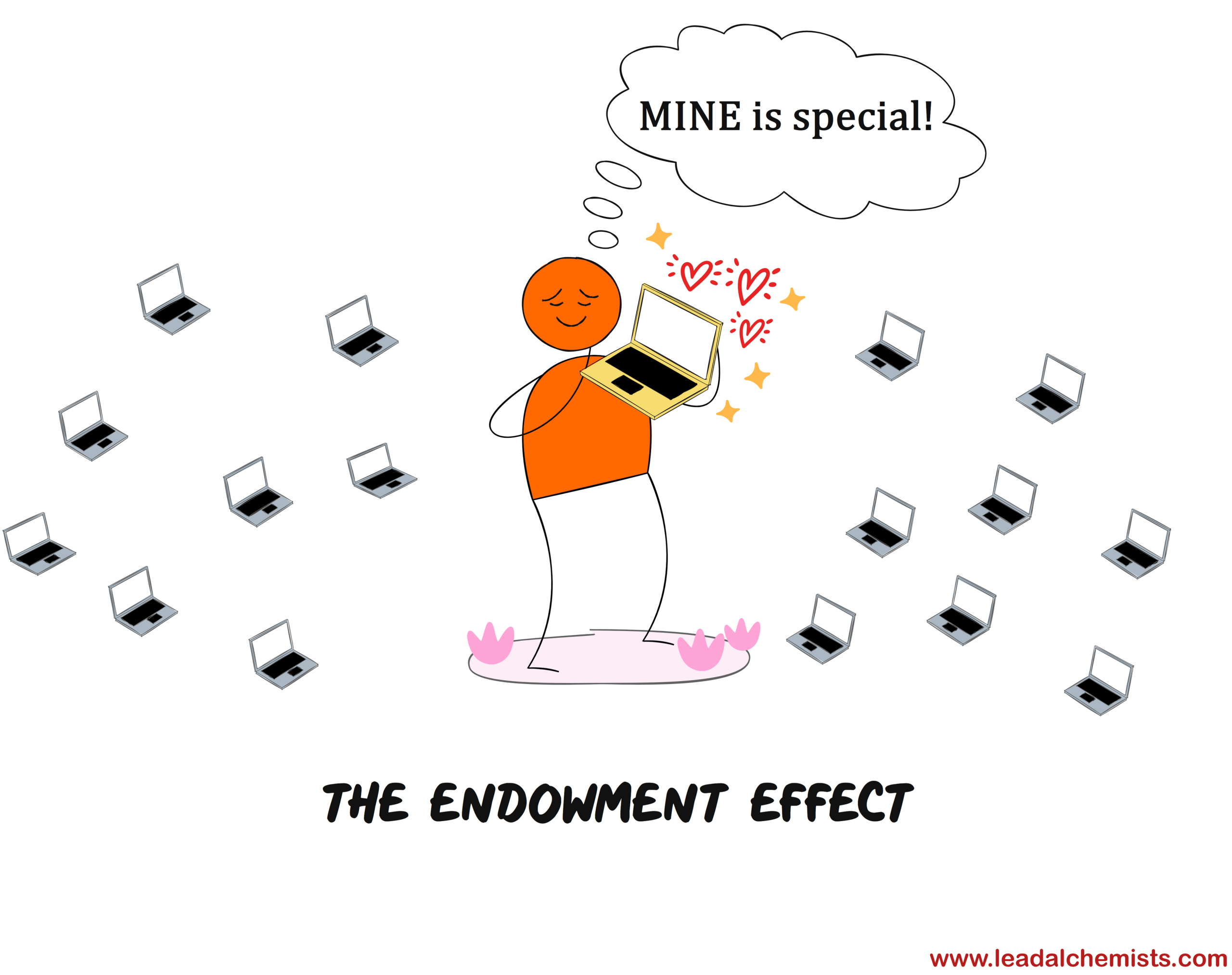
At its psychological core, the Endowment Effect works because humans are loss-averse – we instinctively feel the pain of losing something more intensely than the pleasure of gaining something of equal value. When we take psychological ownership of an item, our brains automatically increase its perceived value to justify keeping it, making it far more likely that we’ll complete a purchase or retain a product rather than giving up something that feels like “ours.”
For marketers and advertisers, understanding this bias gives a real competitive edge. By purposefully and strategically creating ownership experiences through free trials, demos, and personalization while delivering genuine value to customers, you can increase purchase completion and reduce returns in ways that other persuasion techniques simply cannot match.
How The Endowment Effect Works (The Psychology Behind It)
The Cognitive Mechanisms
The endowment effect operates through several psychological mechanisms:
Loss Aversion: People experience the pain of losing something more intensely than the pleasure of gaining something of equal value. This asymmetry in emotional response makes individuals reluctant to part with items they own.
Psychological Ownership: A feeling of ownership can develop even before legal ownership is established. Simply touching a product, customising it, or imagining owning it can trigger this sense of possession.
Self-Referential Memory: People remember and recall attributes of owned items more easily, which may bias their evaluation towards positive aspects.
Reference Dependence: Individuals evaluate outcomes relative to a reference point (often their current state), making them more sensitive to losses than gains.
Key Research Supporting the Effect
The classic demonstration of the endowment effect comes from Kahneman, Knetsch, and Thaler’s 1991 “mug experiment.” Participants randomly given a mug demanded roughly twice as much to sell it as other participants were willing to pay to acquire the same mug.
Morewedge and colleagues (2009) later demonstrated that merely touching an object can induce the endowment effect, highlighting how easily this bias can be triggered in retail environments.
Conflicting Viewpoints and Limitations
Not all researchers agree on the universality of the endowment effect. John List (2003) found that market experience can reduce or eliminate the effect, suggesting it may be less pronounced amongst experienced traders or in certain contexts.
Some studies argue that methodological issues in experiments may inflate the observed effect. Plott and Zeiler (2005) demonstrated that with proper controls, the endowment effect could be significantly reduced, suggesting some earlier findings may have been overstated.
More recent research by Smitizsky, Liu, and Gneezy (2021) proposes that the effect may be driven more by strategic pricing (buy-sell discrepancy) than by loss aversion in certain experimental designs, offering an alternative explanation for the observed behaviour.
Real-World Examples of The Endowment Effect
Non-Marketing Examples
The endowment effect influences decision-making across numerous domains:
Housing Market: Homeowners typically set asking prices higher than objective market values due to emotional attachment, often leading to slower sales and market inefficiencies.
Investment Decisions: Investors frequently hold onto losing stocks longer than they should – a phenomenon known as the “disposition effect” – because they overvalue assets they already own.
Negotiations: Parties often overvalue what they bring to the table, creating impasses that prevent mutually beneficial agreements.
Legal Disputes: Individuals typically demand higher compensation for property damage than market value would suggest, due to the emotional attachment formed through ownership.
Marketing Applications
Several major brands have successfully leveraged the endowment effect in their marketing strategies:
Starbucks: Personalisation Creates Ownership
Starbucks enhances psychological ownership by writing customer names on cups. This simple act of personalisation creates a sense of ownership even before consumption, increasing repeat purchase intent and brand attachment. Whilst specific conversion data isn’t publicly available, academic analysis confirms this strategy effectively leverages the endowment effect.
Tesla: Test Drives Build Attachment
Tesla’s marketing strategy deliberately encourages potential customers to test drive vehicles and interact with products in-store. Staff are trained to maximise dwell time, allowing customers to develop a sense of ownership before purchase. This experiential approach helps overcome the high price barrier by creating psychological ownership first.
Apple: In-Store Product Interaction
Apple retail stores are designed to encourage customers to handle and interact with products. Their touchable displays and trained staff create an environment where customers can experience ownership before purchase. Academic case studies confirm this approach has contributed to Apple’s retail success, though the specific impact of the endowment effect cannot be isolated from other factors.
How The Endowment Effect Affects Consumer Behaviour
Psychological Triggers
Several factors can amplify the endowment effect in consumers:
Physical Touch: When consumers can physically interact with products, the endowment effect strengthens. This explains why retail environments that encourage product handling often see higher conversion rates.
Customisation: Allowing customers to personalise products increases their sense of ownership and perceived value. This is why configurators and customisation tools are effective sales drivers.
Imagination: Simply prompting consumers to imagine owning a product can trigger ownership feelings. Effective marketing copy often uses phrases like “imagine yourself using…” to activate this response.
Time: The longer someone possesses an item, the stronger the endowment effect becomes. This explains why free trial periods often convert well – users develop ownership feelings during the trial.
Neurological Basis
Neuroimaging studies have shown that the endowment effect correlates with increased activity in brain regions associated with value and ownership, particularly the medial prefrontal cortex. When people consider selling something they own, areas associated with pain and loss aversion also activate, highlighting the emotional component of this bias.
Case Studies: How Marketers Use The Endowment Effect in Advertising
Free Trials and Samples
Free trials represent one of the most widespread applications of the endowment effect in marketing. By allowing customers to experience temporary ownership, businesses create psychological attachment that makes cancellation feel like a loss.
Whilst no major SaaS company has published controlled studies isolating the endowment effect from other trial-related factors, the strategy’s effectiveness is supported by behavioural science principles. Companies like Netflix, Adobe, and countless software providers leverage this approach to drive conversions.
The key insight for marketers is that once users integrate a product into their workflow or lifestyle during a trial period, giving it up feels like a loss rather than simply returning to their previous state.
Virtual Try-On and Visualisation Tools
Retailers increasingly use augmented reality and visualisation tools to create a sense of ownership before purchase. Whilst specific conversion data attributable solely to the endowment effect isn’t publicly available, these tools align with the psychological principles of imagined ownership.
For example, furniture retailers like IKEA use AR apps that let customers visualise products in their homes, creating a sense of ownership that increases purchase likelihood. Similarly, eyewear companies like Warby Parker allow virtual try-ons that help customers imagine owning the product.
A/B Test Example for Lead Generation
For service-based businesses focused on lead generation, here’s a realistic A/B test to measure the endowment effect:
Scenario: A financial advisory firm wants to increase consultation bookings.
Version A (Control): Landing page headline: “Schedule a Free Financial Consultation” Call-to-action: “Book Your Consultation”
Version B (Endowment Effect): Landing page headline: “Your Personalised Financial Roadmap Awaits” Call-to-action: “Claim Your Free Financial Roadmap”
Metrics to Track:
- Form submission rate
- Time on page
- Follow-up engagement after form submission
This test leverages the endowment effect by framing the consultation as something the prospect already possesses (“your roadmap”) that simply needs to be claimed, rather than a service they need to request.
Practical Applications for Google Ads & Lead Generation
Google Ads Copywriting & Design
To leverage the endowment effect in Google Ads campaigns:
Use Possessive Language: Incorporate words like “your,” “my,” and “yours” in ad headlines and descriptions.
Instead of: “Download Free Guide” Try: “Download Your Free Guide”
Create Ownership Before Click: Frame ads to suggest the user already has a stake in what you’re offering.
Instead of: “Get a Marketing Consultation” Try: “Claim Your Marketing Strategy Session”
Highlight What They’ll Lose: Emphasise the potential loss if they don’t take action.
Instead of: “Learn SEO Techniques” Try: “Don’t Miss Your Chance to Master SEO”
A/B Test Ownership-Focused Headlines: Compare standard headlines against those using possessive pronouns and ownership framing.
Landing Page Structuring for Lead Generation
Optimise landing pages to create psychological ownership:
Personalised Welcomes: Use dynamic content to personalise the experience based on ad clicks or user data.
Interactive Elements: Include calculators, assessments, or configurators that create investment through interaction.
Progress Indicators: Show users they’ve already started a process, making them less likely to abandon it.
Preview Deliverables: Show exactly what they’ll receive, helping them visualise ownership.
Ownership-Focused CTAs: Use action verbs that imply claiming something that’s already theirs:
- “Secure Your Spot”
- “Unlock Your Report”
- “Claim Your Analysis”
Website UX and Form Optimisation
Multi-Step Forms: Break forms into steps with progress indicators to create investment in the process.
Personalised Results Preview: Show a preview of what they’ll receive after form submission.
Branded Deliverables: Ensure any lead magnets or free resources are personalised with the prospect’s information when delivered.
Follow-Up Messaging: Reference their “ownership” in follow-up emails:
“Your analysis results are waiting”
“Your free guide is ready”
“Access your custom report”
Why Marketers Should Care About The Endowment Effect
Strategic Advantages
The endowment effect offers several strategic advantages for marketers:
Higher Perceived Value: Creating a sense of ownership before purchase can increase the perceived value of your products or services.
Reduced Price Sensitivity: Customers who feel psychological ownership are often willing to pay more for products or services.
Increased Conversion Rates: Properly applied, the endowment effect can boost form submissions, trial conversions, and purchases.
Enhanced Customer Loyalty: Psychological ownership creates stronger emotional bonds with your brand.
Ethical Considerations
Whilst powerful, the endowment effect must be used ethically:
Transparency: Be clear about what customers are getting and any obligations. Hidden terms or misleading trial conditions damage trust.
Genuine Value: The endowment effect works best when customers genuinely benefit from your product or service. Manipulating people into buying things they don’t need will backfire.
Vulnerable Populations: Be especially careful when marketing to vulnerable groups who may be more susceptible to cognitive biases.
Pressure Tactics: Avoid creating artificial urgency or using high-pressure tactics that exploit the endowment effect unethically.
How to Implement The Endowment Effect in Your Marketing Strategy
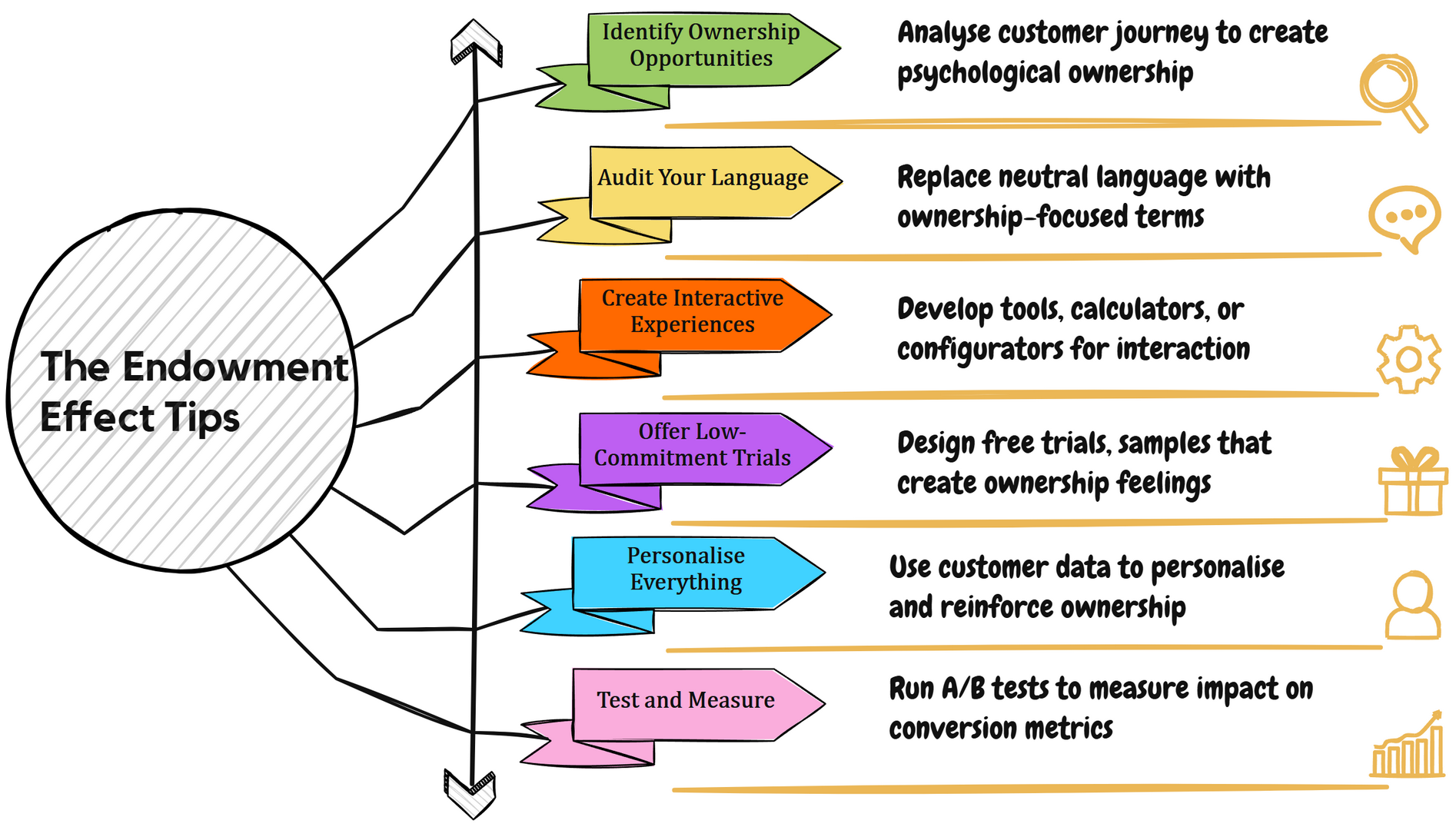
Step-by-Step Implementation
Identify Ownership Opportunities: Analyse your customer journey to find points where you can create psychological ownership.
Audit Your Language: Review your marketing copy, replacing neutral language with ownership-focused terms.
Create Interactive Experiences: Develop tools, calculators, or configurators that let prospects interact with your offering.
Offer Low-Commitment Trials: Design free trials, samples, or consultations that create ownership feelings.
Personalise Everything: Use customer data to personalise experiences, reinforcing the sense that something was made specifically for them.
Test and Measure: Run A/B tests to measure the impact of endowment-focused changes on your conversion metrics.
Best Practices
Start Small: Begin with simple language changes before investing in complex interactive tools.
Be Authentic: The endowment effect works best when aligned with your brand’s genuine value proposition.
Focus on Benefits: Emphasise what the customer gains through ownership, not just features.
Create Consistency: Ensure the ownership message is consistent across all touchpoints.
Common Pitfalls
Overpromising: Creating unrealistic expectations will lead to disappointment and erode trust.
Neglecting Value: The endowment effect enhances perceived value but doesn’t replace the need for actual value.
Inconsistent Messaging: Mixing ownership language with distancing language creates cognitive dissonance.
Ignoring Analytics: Failing to measure the impact of your endowment effect strategies prevents optimisation.
Related Psychological Biases & Effects
The endowment effect operates alongside several related psychological biases:
Loss Aversion: The tendency to prefer avoiding losses over acquiring equivalent gains. The endowment effect is a specific manifestation of loss aversion related to ownership.
Status Quo Bias: The preference for the current state of affairs. Whilst related to the endowment effect, status quo bias is broader and applies to situations beyond ownership.
IKEA Effect: People value products more if they’ve invested effort in creating them. This complements the endowment effect in contexts involving customer co-creation.
Mere Exposure Effect: People develop preferences for things simply because they’re familiar with them. This can enhance the endowment effect through repeated exposure.
Sunk Cost Fallacy: The tendency to continue an endeavour once an investment has been made. This often works alongside the endowment effect to increase customer retention.
Understanding how these biases interact can help marketers create more effective, psychologically informed strategies that respect consumer autonomy whilst achieving business objectives.
By implementing the endowment effect thoughtfully in your marketing, you can create stronger connections with prospects, increase perceived value, and ultimately drive more conversions – all by tapping into the fundamental human tendency to value what we feel we already own.
FAQs About Endowment Effect
What is the Endowment Effect and how does it work?
The Endowment Effect is a cognitive bias where people assign greater value to objects simply because they own them. This psychological phenomenon creates a gap between what people are willing to pay to acquire something (WTP) and what they demand to give it up (WTA). The effect works by creating a sense of psychological ownership that increases an item’s subjective value, making us reluctant to part with our possessions.
Research by Kahneman, Knetsch, and Thaler (1991) demonstrated this effect in their famous “mug experiment,” where participants given a mug demanded significantly more to sell it than others were willing to pay to buy the identical item.
How does the Endowment Effect influence our decision-making process?
The Endowment Effect significantly impacts our decision-making by creating an emotional attachment to what we already possess. This attachment leads to several key influences:
Overvaluation of possessions: We tend to place higher value on items we own compared to identical items we don’t own
Status quo preference: We resist change and favour keeping what we have
Loss aversion activation: The pain of losing something feels stronger than the pleasure of gaining something equivalent
Difficulty in objective evaluation: We struggle to assess our possessions’ true market value
This bias affects everyday decisions from negotiating prices when selling personal items to resisting beneficial changes in professional tools or methods we’ve grown accustomed to using.
What causes the Endowment Effect in human psychology?
The Endowment Effect stems from multiple psychological mechanisms working together:
Loss aversion: The primary traditional explanation – we feel losses more intensely than equivalent gains (Kahneman & Tversky, 1979)
Psychological ownership: Objects become incorporated into our self-concept, making them feel like extensions of ourselves
Status quo bias: We have a general preference for maintaining our current state and possessions
Emotional attachment: We develop feelings towards things we own, especially items with personal significance
Recent research suggests strategic buy-sell discrepancies may also contribute, as sellers and buyers approach transactions with different mindsets and priorities. Some studies challenge the centrality of loss aversion, suggesting multiple factors create this powerful bias.
Who discovered the Endowment Effect and when was it first studied?
The Endowment Effect was first described by economist Richard Thaler in 1980 in his paper “Toward a Positive Theory of Consumer Choice.” Thaler observed that people often demanded much more to sell an object than they would be willing to pay to buy the same item.
The effect was experimentally validated and thoroughly documented a decade later by Daniel Kahneman, Jack Knetsch, and Richard Thaler in their landmark 1990 paper “Experimental Tests of the Endowment Effect and the Coase Theorem.” Their research used simple objects like coffee mugs to demonstrate how ownership significantly increased perceived value.
This work formed part of the broader development of behavioural economics, which challenged traditional economic assumptions about rational decision-making. Kahneman later received the Nobel Prize in Economics in 2002 for his work on prospect theory, which includes loss aversion – a key mechanism behind the endowment effect.
What are the most famous experiments that demonstrate the Endowment Effect?
The most famous experiments demonstrating the Endowment Effect include:
The Mug Experiment (Kahneman, Knetsch & Thaler, 1990): Participants randomly given coffee mugs demanded approximately twice as much to sell their mugs ($7) as others were willing to pay to acquire identical ones ($3.50). This demonstrated a clear WTA/WTP disparity.
The Pen and Chocolate Bar Study (Knetsch, 1989): Participants were given either a pen or a chocolate bar, then offered the opportunity to trade. Most kept their original item, regardless of which one they received, showing reluctance to trade away owned items.
The Basketball Ticket Study (Carmon & Ariely, 2000): Duke University students who won basketball tickets in a lottery valued them much higher than students who didn’t win tickets but wanted to purchase them.
The IKEA Effect Experiment (Norton, Mochon & Ariely, 2012): Participants valued items they assembled themselves higher than pre-assembled identical items, showing how effort enhances the endowment effect.
These experiments consistently demonstrate how mere ownership significantly increases perceived value across various contexts.
How do neuroscientists explain the Endowment Effect in the brain?
Neuroscientists have identified specific brain activity patterns that help explain the Endowment Effect. fMRI studies show that viewing owned items activates self-referential brain regions, particularly in the prefrontal cortex, which processes personal relevance and value.
Key neurological findings include:
Increased activation in the insula when contemplating losses, which correlates with negative emotions and pain processing
Heightened activity in the nucleus accumbens when viewing owned versus unowned items, suggesting ownership triggers reward circuitry
Medial prefrontal cortex engagement when processing self-related information, including possessions that have become part of our identity
Amygdala activation during potential loss scenarios, indicating emotional responses to giving up possessions
These neural patterns support the psychological mechanisms behind the endowment effect, showing how ownership literally changes our brain’s response to objects. The effect appears to involve both emotional and cognitive processing systems, explaining its powerful influence on decision-making.
Are there any studies that challenge or contradict the Endowment Effect?
Yes, several studies challenge aspects of the Endowment Effect or suggest it’s not as universal as once thought:
Market Experience Studies (List, 2003): Experienced traders show reduced or eliminated endowment effects, suggesting the bias diminishes with market experience.
Experimental Design Critiques (Plott & Zeiler, 2005): Researchers found that with proper experimental controls (anonymity, incentive compatibility, practice rounds), the effect can be significantly reduced or eliminated.
Alternative Explanations (Smitizsky, Liu & Gneezy, 2021): This recent study found no evidence for loss aversion in certain settings, instead supporting a strategic buy-sell mechanism rather than psychological attachment.
Cultural Variations: Some cross-cultural studies show the effect varies significantly across societies, suggesting it’s not a universal human trait.
Ownership Duration Effects: The strength of the endowment effect can depend on how long someone has owned an item, with some studies showing minimal effect for very recently acquired items.
These challenges don’t invalidate the endowment effect but suggest it’s more context-dependent and potentially more complex than initially theorised.
What role did Daniel Kahneman play in Endowment Effect research?
Daniel Kahneman played a pivotal role in Endowment Effect research as one of its primary investigators and theoretical architects. His contributions include:
Foundational experiments: Along with Jack Knetsch and Richard Thaler, Kahneman conducted the seminal “mug experiments” in 1990 that provided empirical evidence for the effect.
Theoretical framework: Kahneman and Amos Tversky’s Prospect Theory (1979) established loss aversion as a fundamental psychological principle, which became the primary explanation for the endowment effect.
Academic legitimacy: As a psychologist who won the Nobel Prize in Economics (2002), Kahneman helped bridge psychology and economics, giving behavioural biases like the endowment effect mainstream acceptance.
Popularisation: Through his bestselling book “Thinking, Fast and Slow” (2011), Kahneman brought the endowment effect and related biases to public awareness.
Kahneman’s work fundamentally changed how economists and psychologists understand human decision-making, establishing that systematic biases like the endowment effect are predictable aspects of human cognition rather than random errors.
What are some real-world examples of the Endowment Effect in action?
The Endowment Effect manifests in numerous real-world scenarios:
Housing market: Homeowners typically overvalue their properties compared to market assessments, often setting asking prices above objective market value due to emotional attachment and perceived improvements.
Investment decisions: Investors hold onto losing stocks longer than is rational because they’ve developed psychological ownership of these investments (Odean, 1998).
Workplace resistance: Employees resist new software or processes because they’ve developed attachment to familiar tools and methods.
Warby Parker’s Home Try-On programme: This eyewear company leverages the endowment effect by allowing customers to try frames at home, creating temporary ownership that increases purchase likelihood.
HubSpot’s freemium model: Users invest time setting up the free CRM, developing ownership that makes them more likely to upgrade to paid features.
Car test drives: Dealerships encourage extended test drives because temporarily “owning” a vehicle creates attachment that increases purchase probability.
Organ donation rates: Countries with opt-out systems have higher donation rates than opt-in systems because the default feels like an existing entitlement.
These examples demonstrate how the effect influences decisions across personal finance, consumer behaviour, and policy domains.
How does the Endowment Effect appear in popular movies or TV shows?
The Endowment Effect appears in various movies and TV shows, though it’s rarely named explicitly:
“Toy Story”: Woody’s jealousy when Andy gets Buzz Lightyear demonstrates attachment to his position as the favourite toy – he values his “ownership” of Andy’s affection more than its objective worth.
“The Big Bang Theory”: Sheldon Cooper’s extreme attachment to “his spot” on the couch, which he defends vigorously despite it being objectively similar to other seating positions.
“Hoarders”: The entire premise revolves around people unable to part with possessions due to extreme psychological attachment, showing an amplified version of the endowment effect.
“Breaking Bad”: Walter White’s attachment to his meth empire goes beyond rational financial interest – he’s emotionally invested in what he’s built.
“The Office”: Michael Scott’s excessive attachment to mundane office items and routines when he leaves Dunder Mifflin illustrates how we overvalue things simply because they’re “ours.”
These portrayals, whilst often exaggerated for entertainment, reflect the genuine psychological difficulty people experience when giving up possessions or positions they’ve come to see as extensions of themselves.
Can you see the Endowment Effect in historical events or famous cases?
The Endowment Effect has influenced several historical events and famous cases:
Treaty negotiations: Historical territorial disputes often stall because each side overvalues land they consider “theirs,” regardless of strategic or economic value. The Israeli-Palestinian conflict demonstrates how psychological ownership creates negotiation impasses.
Corporate mergers: The AOL-Time Warner merger faced integration challenges partly because executives overvalued their existing systems and processes, resisting necessary changes.
Brexit referendum: The campaign slogan “Take Back Control” leveraged the endowment effect by suggesting something owned (sovereignty) had been lost and needed reclaiming, regardless of economic consequences.
Native American land disputes: Both sides valued the same territories differently based on perceived ownership rights, creating conflicts that persist today.
Patent wars: Companies like Apple and Samsung engaged in prolonged legal battles over intellectual property, with each side overvaluing their innovations and undervaluing competitors’ claims.
These examples show how the endowment effect scales from individual psychology to group dynamics and national policy, often creating resistance to objectively beneficial compromises or changes.
What’s the difference between the Endowment Effect and loss aversion?
The Endowment Effect and loss aversion are closely related but distinct psychological concepts:
Loss Aversion:
- A broader psychological principle where people feel losses more intensely than equivalent gains
- Applies to all potential losses, not just possessions
- Described in Prospect Theory (Kahneman & Tversky, 1979)
- The emotional response that makes losses feel approximately twice as impactful as gains
Endowment Effect:
- A specific manifestation of loss aversion applied to ownership
- Occurs specifically when people overvalue things because they own them
- Results in the gap between selling prices (WTA) and buying prices (WTP)
- Requires actual or psychological ownership to occur
The relationship: Loss aversion is generally considered the underlying mechanism that drives the endowment effect. When we own something, the prospect of giving it up triggers loss aversion, making us demand more to sell it than we’d pay to buy it.
Recent research suggests additional factors beyond loss aversion may contribute to the endowment effect, including psychological ownership, identity attachment, and strategic seller-buyer differences.
How is the Endowment Effect different from the sunk cost fallacy?
The Endowment Effect and sunk cost fallacy are distinct cognitive biases that affect decision-making in different ways:
Endowment Effect:
- Causes overvaluation of items simply because we own them
- Occurs immediately upon ownership (even without financial investment)
- Focuses on the perceived value of possessions
- Results in reluctance to trade or sell owned items
- Example: Demanding £100 for a concert ticket you own, whilst only willing to pay £50 for the same ticket if you didn’t own it
Sunk Cost Fallacy:
- Causes continued investment in something because of resources already invested
- Develops over time as investments accumulate
- Focuses on justifying past expenditures
- Results in throwing “good money after bad”
- Example: Continuing to repair an old car because you’ve already spent so much on it, even when replacing it would be more economical
Whilst both biases can operate simultaneously (we often invest more in things we own), they represent different psychological mechanisms. The endowment effect is about ownership-based valuation, whilst the sunk cost fallacy is about justifying previous investments regardless of future prospects.
Is the Endowment Effect the same as anchoring bias?
No, the Endowment Effect and anchoring bias are distinct cognitive phenomena, though they can sometimes work together:
Endowment Effect:
- Causes people to value items they own more highly than identical items they don’t own
- Requires actual or psychological ownership to occur
- Creates a gap between selling prices (WTA) and buying prices (WTP)
- Driven primarily by loss aversion and psychological ownership
- Example: Valuing your own car above market price because it’s “yours”
Anchoring Bias:
- Causes people to rely too heavily on the first piece of information encountered (the “anchor”)
- Doesn’t require ownership – applies to any judgement or decision
- Affects how we evaluate all subsequent information
- Driven by cognitive shortcuts in information processing
- Example: Setting a higher selling price because you first saw a similar item with a high price tag
Whilst distinct, these biases can interact. For instance, the initial purchase price of an item can serve as an anchor that influences the endowment effect, making owners even more reluctant to sell below what they paid, regardless of current market value.
What’s the opposite of the Endowment Effect called?
There isn’t a universally recognised term for the “opposite” of the Endowment Effect, but several related concepts describe contrary valuation patterns:
Reverse endowment effect: In rare cases, people value items they don’t own more highly than identical items they do own. This has been observed in specific cultural contexts or when people are trying to acquire something perceived as scarce or exclusive.
Divestiture aversion: Whilst not exactly opposite, this refers to reluctance to acquire new things rather than reluctance to give up owned items.
Grass-is-greener syndrome: The tendency to believe that what others have is better than what you possess – essentially overvaluing what you don’t own.
Novelty bias: The preference for new experiences or items over familiar ones, which can sometimes counteract the endowment effect.
Adaptation or hedonic adaptation: The psychological process where we quickly adapt to new possessions, reducing their perceived value over time.
None of these perfectly mirrors the endowment effect in reverse, as the tendency to overvalue what we own appears to be a more fundamental and consistent bias in human psychology than any tendency to undervalue our possessions.
How do the Endowment Effect and status quo bias relate to each other?
The Endowment Effect and status quo bias are closely related cognitive biases that reinforce each other:
Relationship:
- Both biases favour existing conditions over potential changes
- They share loss aversion as a common psychological mechanism
- Together they create powerful resistance to change
- Both can operate unconsciously in decision-making
Key Differences:
- Endowment Effect specifically concerns overvaluing things we own
- Status quo bias is broader, involving preference for current states in any domain (not just possessions)
How They Work Together:
- Status quo bias makes us prefer our current possessions (the status quo)
- The endowment effect makes us overvalue those possessions
- This combination creates strong resistance to trades or changes
For example, an employee might resist a new software system both because it changes established workflows (status quo bias) and because they’ve developed attachment to the current system they’ve mastered (endowment effect).
According to Kahneman, Knetsch, and Thaler (1991), these biases are so intertwined that they described the endowment effect as a manifestation of status quo bias in ownership contexts.
How do marketers use the Endowment Effect to increase sales?
Marketers leverage the Endowment Effect through several proven strategies:
Free trials and samples: Allowing customers to use products temporarily creates psychological ownership that makes giving them up feel like a loss, increasing conversion rates when the trial ends.
“Try before you buy” programmes: Companies like Warby Parker and clothing retailers send multiple product options to customers’ homes, creating temporary ownership that significantly increases purchase likelihood compared to in-store shopping alone.
Personalisation and customisation: Allowing customers to configure products (like Nike’s shoe customiser or car configurators) creates investment and ownership feelings even before purchase, making customers more committed to completing the transaction.
Virtual try-on tools: AR and visualisation technologies help customers imagine ownership, triggering the endowment effect without requiring physical possession. IKEA’s furniture visualisation app and virtual makeup try-ons demonstrate this approach.
Possessive language in marketing copy: Using words like “your,” “my,” and “yours” in headlines, ad copy, and CTAs creates psychological ownership. Instead of “Get a free report,” marketers write “Claim your free report.”
Extended test drives and demos: Car dealerships and software companies encourage longer trial periods to strengthen ownership feelings. The longer someone uses a product, the harder it becomes to give it up.
Progress indicators and multi-step processes: Showing customers they’ve started a process (like filling out a form or configuring a product) makes abandonment feel like losing progress they’ve already made.
Freemium models: Free versions create habits, workflows, and data that feel painful to abandon when considering upgrades to paid tiers. This strategy is particularly effective for software products.
Personalised experiences: Creating customised landing pages, product recommendations, or content based on user behaviour reinforces the feeling that something was created specifically for them, increasing perceived ownership.
Money-back guarantees and risk-reversal: Whilst this seems counterintuitive, allowing customers to “own” a product with the option to return it often results in lower return rates than expected because once customers possess the item, the endowment effect makes returning it feel like a loss.
The key principle underlying all these strategies is creating a sense of ownership before actual purchase occurs, making the decision to buy feel like keeping something rather than acquiring something new. This reframes the purchase decision in terms of loss aversion rather than gain seeking, which generally motivates behaviour more powerfully.
What are some common mistakes marketers make when applying the Endowment Effect?
Marketers often make several mistakes when attempting to leverage the endowment effect:
Creating false ownership without value: Simply using possessive language like “your product” without creating genuine interaction or personalisation can feel manipulative and inauthentic to customers.
Overly complicated trial processes: Making free trials difficult to set up or use prevents customers from developing the genuine ownership feelings that drive conversions.
Ignoring post-trial communication: Failing to remind trial users of what they’ll lose if they don’t convert misses a critical opportunity to activate loss aversion.
Using dark patterns: Employing deceptive tactics like making cancellation difficult or auto-enrolling users in paid plans without clear consent may boost short-term conversions but damages long-term trust and reputation.
Assuming universality: The endowment effect varies across individuals, cultures, and contexts. What works for consumer products may not work for B2B services, and vice versa.
Neglecting actual product value: No amount of psychological ownership will overcome a product that doesn’t deliver genuine value. The endowment effect enhances perceived value but cannot create it from nothing.
Excessive pressure tactics: Creating artificial urgency or high-pressure situations can backfire, making customers feel manipulated rather than genuinely attached to your offering.
Inconsistent messaging: Mixing ownership-focused language with distancing or impersonal communication creates cognitive dissonance that undermines the effect.
What industries benefit most from applying the Endowment Effect?
Whilst the endowment effect can be applied across virtually any industry, certain sectors see particularly strong benefits:
Software and SaaS: Free trials and freemium models allow users to integrate products into their workflows, creating strong psychological ownership that drives conversions to paid plans.
E-commerce and retail: Virtual try-on tools, generous return policies, and home try-on programmes create temporary ownership that increases purchase rates.
Subscription services: Once customers integrate services like streaming platforms or meal kits into their routines, cancellation feels like losing something they already have.
Automotive: Extended test drives and home demonstrations allow potential buyers to imagine ownership, significantly influencing purchase decisions for high-value items.
Real estate: Virtual tours, staging, and allowing potential buyers to envision themselves in a space create psychological ownership before purchase.
Financial services: Interactive calculators and personalised financial projections help prospects visualise their financial future, creating ownership of the outcome.
Education and courses: Free modules or trial lessons allow students to begin their learning journey, making continued enrolment feel like maintaining progress rather than starting something new.
Fitness and wellness: Free trial periods at gyms or with fitness apps allow users to establish routines and see initial results, making cancellation feel like abandoning their progress.
Industries involving high-value purchases, recurring revenue models, or products that integrate into daily life tend to see the strongest benefits from endowment effect strategies.
How can you measure the impact of the Endowment Effect in your marketing?
Measuring the endowment effect’s impact requires careful experiment design and tracking:
A/B testing: Create controlled experiments comparing ownership-focused approaches against neutral alternatives:
- Test possessive language (“your guide”) versus neutral language (“download guide”)
- Compare ownership-focused CTAs (“claim your spot”) against standard CTAs (“register now”)
- Measure interactive versus static product presentations
Key metrics to track:
- Conversion rates (form submissions, trial sign-ups, purchases)
- Trial-to-paid conversion rates
- Time spent engaging with interactive elements
- Cart abandonment rates
- Return rates for products with try-before-buy programmes
- Customer lifetime value for different acquisition approaches
Segmentation analysis: Compare results across different customer segments, as the endowment effect may vary by:
- Demographics (age, income, education)
- Purchase history (new versus returning customers)
- Product category or price point
- Geographic region or culture
Qualitative research: Conduct customer interviews or surveys asking:
- What made them decide to convert from trial to paid?
- How did they feel about giving up the product if they cancelled?
- What aspects of the product became most important to them during the trial?
Cohort analysis: Track different cohorts exposed to varying levels of endowment effect strategies and compare long-term retention and satisfaction.
Attribution modelling: Identify which touchpoints incorporating endowment effect principles contribute most to conversions.
The challenge in measuring the endowment effect specifically is isolating it from other psychological factors. The most rigorous approach involves controlled experiments where the only variable is the presence or absence of ownership-creating elements, whilst keeping all other factors constant.
Conclusion: Making The Endowment Effect Work Ethically and Effectively
The endowment effect represents a powerful tool in the modern marketer’s arsenal, but like any psychological principle, it demands responsible application. The most successful implementations don’t trick customers into overvaluing products – they help prospects genuinely experience the value your offering provides before making a purchase decision.
Think about what makes the endowment effect so powerful: it’s not about manipulation, it’s about allowing people to experience ownership in a way that aligns with how humans naturally evaluate value. When you offer a free trial, you’re not exploiting a cognitive bias – you’re giving someone a genuine opportunity to see how your product fits into their life. When you use possessive language like “your customised report,” you’re not being deceptive if that report truly is personalised for them.
The ethical line is clear: use the endowment effect to highlight genuine value, not to obscure poor products or misleading offers. If your free trial creates such strong attachment that cancellation feels painful, that’s only positive if the product genuinely improves customers’ lives enough to justify the cost. If it doesn’t, you’re just using psychology to trap people in purchases they’ll regret.
Start implementing the endowment effect in your marketing with these priorities:
First, focus on creating genuine ownership experiences. Whether through free trials, interactive tools, or personalisation, give prospects real opportunities to experience your value proposition.
Second, test rigorously. Don’t assume that what works for one company will work for yours. Run A/B tests comparing ownership-focused approaches against your current methods, and let the data guide your decisions.
Third, measure beyond immediate conversions. Track customer satisfaction, retention, and lifetime value to ensure your endowment effect strategies create long-term value for both your business and your customers.
Finally, stay transparent. Be clear about trial terms, pricing, and cancellation policies. The strongest applications of the endowment effect don’t rely on confusion or deception – they rely on creating such genuine value that customers naturally want to keep what they’ve experienced.
When implemented thoughtfully and ethically, the endowment effect doesn’t just boost conversion rates – it helps create better matches between customers and products, leading to higher satisfaction, lower churn, and stronger long-term relationships. That’s the kind of marketing that builds sustainable businesses whilst actually serving customer needs.